



Filter
Our members also liked:
4.7/5(23 reviews)
70 %
22 %
4 %
Write a user review
Users reviews
 RAFIQPublished on 11/05/09 at 14:57 (This content has been automatically translated from French)YAMAHA AW 16 G OF 800 EURO TRE GOOD SON OF QUALITER00
 bolinox
I don't get it
Published on 03/28/13 at 02:12A fat digital unit
The technical features have already been mentioned by other people in the reviews.
UTILIZATION
Headache guaranteed
SOUNDS
When it works, it's nice
The effects are OK, but sometimes (rather frequently) I get lost in the complexity.
OVERALL OPINION
It's certainly a good machine, but, coming from a 4-track tascam cassette recorder, I am totally lost. I don't understand anything. And yamaha interfaces are very particular; you really need some time with them.
The 280-page manual isn't very instructive, in my opinion.
I know my review isn't very comprehensive, but beginners should get a simpler home studio.
I can't see anything to connect it to t…Read moreA fat digital unit
The technical features have already been mentioned by other people in the reviews.
UTILIZATION
Headache guaranteed
SOUNDS
When it works, it's nice
The effects are OK, but sometimes (rather frequently) I get lost in the complexity.
OVERALL OPINION
It's certainly a good machine, but, coming from a 4-track tascam cassette recorder, I am totally lost. I don't understand anything. And yamaha interfaces are very particular; you really need some time with them.
The 280-page manual isn't very instructive, in my opinion.
I know my review isn't very comprehensive, but beginners should get a simpler home studio.
I can't see anything to connect it to the computer, only a cd-rom was supplied and I can't read it. I didn't see anything about it in the manual (did I miss anything?).See less00 Fred'Alco
A safe bet!
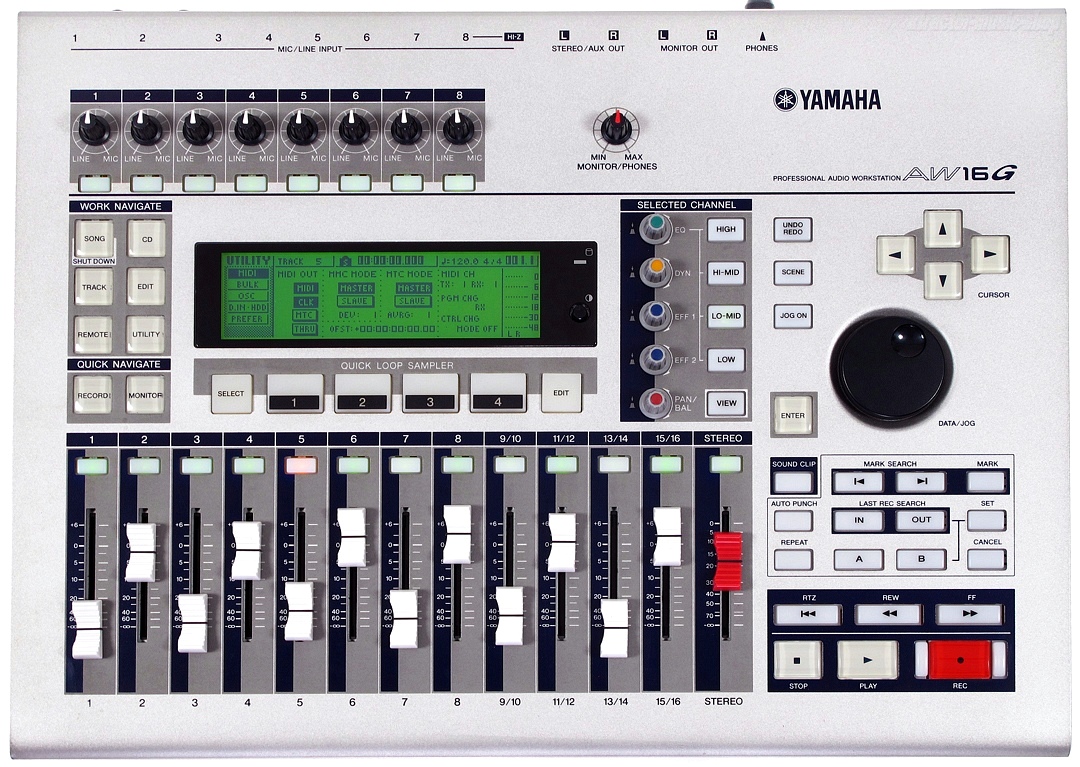
Published on 10/24/11 at 10:5616-track digital mini studio that works at 16 bits/44kHz. It records simultaneously 8 tracks and also has a stereo track to record a master. It uses an internal hard drive to store what your record. The CD player/burner allows you to import (as long as you respect the ISO formatting mentioned in the documentation), export and save an entire project, or parts of it, in wav format. No USB, no SCSI...not very practical, but you get used to it, given the quality of the unit. You have 12 mono and 2 stereo tracks for mixing, as well as 8 levels of independent virtual tracks. No track automation (although it's possible via midi and an external sequencer) but there is a Scene Memory that can be use…Read more16-track digital mini studio that works at 16 bits/44kHz. It records simultaneously 8 tracks and also has a stereo track to record a master. It uses an internal hard drive to store what your record. The CD player/burner allows you to import (as long as you respect the ISO formatting mentioned in the documentation), export and save an entire project, or parts of it, in wav format. No USB, no SCSI...not very practical, but you get used to it, given the quality of the unit. You have 12 mono and 2 stereo tracks for mixing, as well as 8 levels of independent virtual tracks. No track automation (although it's possible via midi and an external sequencer) but there is a Scene Memory that can be useful.
In terms of precessing, you have a parametric equalizer (4 freq) and a compressor (expander, limiter, etc...) per channel (inputs+tracks!) whose settings are very comprehensive. 2 very comprehensive multi-effects, too. A (very limited) 4-channel sample player.
For more info see the (lengthy) documentation.
UTILIZATION
The studio is rather well thought-out, although it is not the same in terms of usability as a PC software (but that applies only to the usability!). The track editing functions are laborious, but the results have an impeccable quality. Audio routing is the same as on a standard analog mixer, so it shouldn't pose a problem for people familiar with them. And for those who don't, this mini studio will be useful for the future.
SOUNDS
In my opinion, this is the main strength of this unit, which is why I don't want to let go of it. The converters (16bits/44kHz) are of a very high quality. No converter is transparent, but how can I put it...I prefer them over several 24bit/96kHz ones. The headphone and main outputs are very good, which is ideal for mixing. The EQs, dynamic processors and effects are simple and effective (it's yamaha, remember?...).
OVERALL OPINION
It breathes quality. It's solid. A safe bet, despite the absence of something that seems crucial today in terms of communication with the external world (usb, firewire) but...it's a (nice) unit from another era.See less00- EfpPublished on 03/22/03 at 10:20 (This content has been automatically translated from French)2 XLR inputs with 48V phantom + 6 between 6.35 (including a spcial guitar)
excellent sound (44.1 KHz / 16 bit uncompressed)
support hard drive
8-track simultaneous recording 16 tracks read
For each track was recorded 8 tracks virutelles (soon to clear a track to remake a decision if it is not sr: you can choose APRS all taken).
UTILIZATION
If you have not used the numrique, the beginners are difficult, but worth it.
Gnralement functions are easily accessible: some lments seemed illogical (but I'm not a regular numrique). Obviously, we would like all the LCD screen is bigger ...
The manual is trs * * wrong.
I have not used the sampler, which does not seem simple matr…Read more2 XLR inputs with 48V phantom + 6 between 6.35 (including a spcial guitar)
excellent sound (44.1 KHz / 16 bit uncompressed)
support hard drive
8-track simultaneous recording 16 tracks read
For each track was recorded 8 tracks virutelles (soon to clear a track to remake a decision if it is not sr: you can choose APRS all taken).
UTILIZATION
If you have not used the numrique, the beginners are difficult, but worth it.
Gnralement functions are easily accessible: some lments seemed illogical (but I'm not a regular numrique). Obviously, we would like all the LCD screen is bigger ...
The manual is trs * * wrong.
I have not used the sampler, which does not seem simple matriser trs. We'll see ...
SOUNDS
Being given that I pass the 4-track cassette machine numrique this, I must say that the diffrence is fMeasure. I also had a studio in between multi-computer, but After a few years, we get tired of doing everything the mouse, and machines like the AW16G, no doubt about the results give more spontaneous if one learns to use it (such as computers ...).
There is a 4-band compressor paramtrique trs effective and equalizer on each track + 2 internal effects: It is viewable on the screen.
The effects seem good.
OVERALL OPINION
I chose the AW16G APRS bcp tudi have all models in this price range. It parat that the low end, but frankly, the price is an extraordinary machine. I would do without this choice hsitation.
I've had a few weeks: it is a machine that requires well take time to learn to use it. 15 30 minutes a day only for beginners not to be too when you take the lead in numrique beginners. A minimum of 6 months to start be comfortable I think, and probably a good year for the matriser. The manual is trs bad but there are excellent sites and forums in English
http://www.aw16g.com and http://forum.aw16g.com
These sites are essential for the deficiencies of the manual level.
I use it only in leisure, I'm 40, I make the zic during my rare off-peak hours, when my children and my job gives me time ..
J'apprcie particulirement the hill more spontaneous with a computer (over hacking Standing between the hardware and software). But for addicts of the computer's internal CD recorder allows you to export all the wav sound files on a CD, and treat it all on a computer.
In addition, the table serves AW16G pilot to control the software like Cubase, Cakewal, Sonar, etc..See less00 - BazoomPublished on 03/27/03 at 03:38 (This content has been automatically translated from French)I will not here again numrer what trs well done VET, I share the opinion that 100%
UTILIZATION
I find this camera a little complicated for the typical person (I am), having no notion in the record Dtd.
The machine is powerful but none, I believe, intuitive.
The manual does not help unfortunately this regard because of its complexity dconcertante same.
SOUNDS
I am not a specialist in the digital and Save, as VET, this is my first DTD (APRS be used long ago, a Tascam 4-track K7).
The sound unit dlivre be neutral and I think that's what I wanted.
The quality is perfect for me to use my Home Studio.
OVERALL OPINION
I possde for a little over one month bu…Read moreI will not here again numrer what trs well done VET, I share the opinion that 100%
UTILIZATION
I find this camera a little complicated for the typical person (I am), having no notion in the record Dtd.
The machine is powerful but none, I believe, intuitive.
The manual does not help unfortunately this regard because of its complexity dconcertante same.
SOUNDS
I am not a specialist in the digital and Save, as VET, this is my first DTD (APRS be used long ago, a Tascam 4-track K7).
The sound unit dlivre be neutral and I think that's what I wanted.
The quality is perfect for me to use my Home Studio.
OVERALL OPINION
I possde for a little over one month but I confess to not m'tre immersed srieusement on bte once or twice due to time constraints.
This is my first multitrack digital and I thought I could quickly finalize a CD and this, Manir innit! Nni ... that we must delve into the Mandres the manual for this.
It is impossible to work instinct with this mini-studio, but the habit of recording should find their account nanmoins (operation PRO!).
Before, I barnacles audio into the microphone and I climbed through the reader of the latter.
Obviously, the mix (if not usurped talking about mixing) and ZrO c'tait linear but have tweaked via the APRS squenceur, finalizing the Cd silent relatively simple.
However, the quality did not suit me and the many crashes microphone inhrents Exceeds the result of alterations of memory (although 768 MB of RAM) DCID me move on indpendant mini-studio.
I also tudi other stuff and, frankly, there's no price report better quality especially as the construction of the device (not plastoc) is reassuring.
But it may be that if the D1600 CDR had t the price of the AW16 G. ...See less00  Chourmo 957Published on 06/17/03 at 00:18 (This content has been automatically translated from French).
UTILIZATION
.
SOUNDS
.
OVERALL OPINION
That's it, I finally my AW16G I paid Euro 1190 with 2 year warranty in Lyon.
I find it honest even if it still hurts when to exit.
First impressions are pretty good, all is sturdy and inspires confidence. Apart from the recorder appears fragile (laptop type).
I read the user manual almost entirely before buying the machine to be sure not to deceive me when to use a bit special I want to do.
I was greatly facilitated the handling and all seems to me not very complicated.
I plan to use the machine for models of course but also to live. I have a group of reggae / ragga and I want to turn the instrument on while…Read more.
UTILIZATION
.
SOUNDS
.
OVERALL OPINION
That's it, I finally my AW16G I paid Euro 1190 with 2 year warranty in Lyon.
I find it honest even if it still hurts when to exit.
First impressions are pretty good, all is sturdy and inspires confidence. Apart from the recorder appears fragile (laptop type).
I read the user manual almost entirely before buying the machine to be sure not to deceive me when to use a bit special I want to do.
I was greatly facilitated the handling and all seems to me not very complicated.
I plan to use the machine for models of course but also to live. I have a group of reggae / ragga and I want to turn the instrument on while using the multi-function mixer with 8 inputs compression, EQ, and effects, for four singers (mouth disease), the DJ and a guitarist.
All this is possible which is pretty phenomenal.
For editing waves, you are entitled to minimum union with qd even a pitch and time stretch. But better to have a PC in addition to that.
I will oppose and, moreover, not PC DtDs but I will say that they are complementary. The PC for its ease of use (monitor, mouse, versatility ,...) and the recorder for reliability, mobility, ability to live ...
Regarding the quality of the converters is the 24-bit but I have not yet really tested so ... no opinion yet on this issue.
Note that the small loop sampler built is really nice to live.
The big lack in my opinion just the lack of connection to the computer world precisely the style USB, SCSI or FireWire.
This is a small balance first after 3 days of use (a 10aine hours).See less00- rogdalPublished on 06/22/03 at 10:47 (This content has been automatically translated from French)Connectivity numrique
UTILIZATION
I think it makes it faster than we can esprait to departure.
It is a matter of adaptation.
The usual functions seem fairly accessible
The manual a bit short and certainly not fun, but with a little concentration is found.
Luckily the site:
http://forum.aw16g.com/. Nice
SOUNDS
I'm not a pro.
But the first rsultats obtained are encouraging for me trs.
I do not spend too much time unfortunately.
The effects and filters are effective. I could not even use the effects for guitar.
if anyone can tell me a word ... thank you
The dynamics are respected. I have some problems at the moment of final mix at the
volumes.
The …Read moreConnectivity numrique
UTILIZATION
I think it makes it faster than we can esprait to departure.
It is a matter of adaptation.
The usual functions seem fairly accessible
The manual a bit short and certainly not fun, but with a little concentration is found.
Luckily the site:
http://forum.aw16g.com/. Nice
SOUNDS
I'm not a pro.
But the first rsultats obtained are encouraging for me trs.
I do not spend too much time unfortunately.
The effects and filters are effective. I could not even use the effects for guitar.
if anyone can tell me a word ... thank you
The dynamics are respected. I have some problems at the moment of final mix at the
volumes.
The short sound is simply fantastic and, for me, the main strength of this unit.
OVERALL OPINION
How long have you use it? About 1 month (episode)
- What is the particular feature you like best and least? + the sound on - the CD
cost me the head with ATAPI ERROR, I had to move up a gear X4
- Have you tried many other models before acqurir? No I inquired.
All pros have told me it's no contest pbe appropriate.
- How do you report qualitprix? Excellent
- With the exprience, you do again this choice? ... Yes!See less00 - juicePublished on 12/02/03 at 05:03 (This content has been automatically translated from French)Specifies See manufacturer
UTILIZATION
Use gnrale is quite simple, it's my first studio and did not pos of Pb
As against it on points that has dtails thickens a bit, especially since the user manual in zap a lot!
SOUNDS
The equalizer and the compressor are applicable and fucking all the tracks, which is not true of all the competitors.
It works by "CD quality" (16-bit, 44.1 KHz) for recording, providing a pretty good sound DEFINITIONS.
The effects are but too varis EXAGRES in rglage factory, we can of course just paramtrer A Z.
OVERALL OPINION
I use it for ending for 6 months now and am generally satisfied. C'tait, when I bought what was best in the Co…Read moreSpecifies See manufacturer
UTILIZATION
Use gnrale is quite simple, it's my first studio and did not pos of Pb
As against it on points that has dtails thickens a bit, especially since the user manual in zap a lot!
SOUNDS
The equalizer and the compressor are applicable and fucking all the tracks, which is not true of all the competitors.
It works by "CD quality" (16-bit, 44.1 KHz) for recording, providing a pretty good sound DEFINITIONS.
The effects are but too varis EXAGRES in rglage factory, we can of course just paramtrer A Z.
OVERALL OPINION
I use it for ending for 6 months now and am generally satisfied. C'tait, when I bought what was best in the Contents (qualitprix report).
I bought this one to have APRS Pluch normment Fran and international test which confirmed that the best choice to c'tait (1200 with burner in store near my home sells e) it's down now (six months in this area, C standard)
By default against standard: He plants like a common PC!, And it's not casual, because C almost every time. Problem, the VAS, mini takes three months to see what it is!
Moreover, I wonder if this happens to others.See less00  cyber_techPublished on 12/29/03 at 05:55 (This content has been automatically translated from French)Technically say anything except that there is no real possibility to interconnect with the world of Micro Computer (except South), which is a shame especially now.
UTILIZATION
It is true that there are tons of parameter.
I think the key is relatively quick handle.
Once one has really come into the heart of the matter (with mixing scene, EQ, FX etc ...) has thickens.
Regarding the manual, I think we pretty much agree on the fact that it really is not to become a prvu bte on the product. But I think it applies to all technologically complex. But I think it's a bible pages of miles it would have had that Yamaha edited if they had wanted to know everything about the "thing". Be…Read moreTechnically say anything except that there is no real possibility to interconnect with the world of Micro Computer (except South), which is a shame especially now.
UTILIZATION
It is true that there are tons of parameter.
I think the key is relatively quick handle.
Once one has really come into the heart of the matter (with mixing scene, EQ, FX etc ...) has thickens.
Regarding the manual, I think we pretty much agree on the fact that it really is not to become a prvu bte on the product. But I think it applies to all technologically complex. But I think it's a bible pages of miles it would have had that Yamaha edited if they had wanted to know everything about the "thing". Be expected can be a special editor as Edyrol focuses on the subject for a doc really concrete.
If not a little thing, I find some docs all in English and I made a synthse Franaise with doc and I did answer some of my questions.
And yes, it's strange, but by language, some are more pertinant documentation.
SOUNDS
His level, I really t surprised.
At the moment I am not used to the studio just to prepare my lives.
I record my sound coming from my PC to the AW16 and frankly I really nail the sound.
Whether it's pure sound or dynamics say anything.
Ok, so I do not make chamber music, I am more oriented Electro Body Music and Industrial so I sound pretty grimey. As against this kind of music you need a good momentum and was fine with me.
OVERALL OPINION
I have this studio for 2 months. I will gradually tame bte, which allows me to learn every day.
I still learn a lot, but what I did and use qualitprix report is excellent and if I had the choice again, well I will not hesitate.
Audiofanzine thank you, thanks for this site is that I base my purchases and I have yet t deu.See less10- weishardPublished on 02/11/04 at 05:19 (This content has been automatically translated from French)Recorded, mixed, mastering and CD burning while digital of course.
20G hard disk, CD archiving option to relieve SD.
8-track recording and 16 in reading.
For each track: parametric EQ, Compression,
2 effects simultaneous users only, it is a fair bit, but in fact if they are not selected for a particular channel, they can be assigned to all tracks.
UTILIZATION
The record "forgets" to tell in great detail ... which does not facilitate the task.
But if the use is actually pretty simple when we understand the spirit of the beast.
Some functions such as copying a song for example, can be time consuming or even a few hours ... not a crash, just wait.
SOUNDS
The …Read moreRecorded, mixed, mastering and CD burning while digital of course.
20G hard disk, CD archiving option to relieve SD.
8-track recording and 16 in reading.
For each track: parametric EQ, Compression,
2 effects simultaneous users only, it is a fair bit, but in fact if they are not selected for a particular channel, they can be assigned to all tracks.
UTILIZATION
The record "forgets" to tell in great detail ... which does not facilitate the task.
But if the use is actually pretty simple when we understand the spirit of the beast.
Some functions such as copying a song for example, can be time consuming or even a few hours ... not a crash, just wait.
SOUNDS
The sonoritées are excellent both in dynamic for clarity, without any hardness.
The sound is transparent and reflects the microphones, etc. ...
All effects are good but the saturation of electric guitars.
OVERALL OPINION
I use it for about a year, I am very satisfied.
If the sound is not good, or the confused mix, it's my fault not that of the beast.
Lorqui we control the aircraft, it even manages to make it sound not so good decision.
I started on a Yamaha 4-track cassette, then after a Boss BR532 Digital, in other words with the AW16G we go hack to the real possibility of a model that sounds fucking death.
My work station n 'NEVER planted, and provides excellent support for trips taken live.See less00 - manutakeoffPublished on 03/01/04 at 02:54 (This content has been automatically translated from French)Connectors Analog: 2XLR (phantom power supply), 6 line jack (one HZ)
Sampling: 44100 khz CD quality
CD R and RW
Functions mastering: EQ, dynamic por each track.
Recording 8 tracks live.
Ability to mix up to 16 tracks in the studio overdubbing.
No connection via a PC ... damage.
UTILIZATION
It takes a few hours to understand the key operating procedures. To discover the hidden face of the beast, it takes a lot to document.
The common functions are easily accessible. I had some anxiety at first, but everything goes very fast once you understand the spirit of the machine.
The manual is far from enough. It will take an external doc: internet, friends, literature mast…Read moreConnectors Analog: 2XLR (phantom power supply), 6 line jack (one HZ)
Sampling: 44100 khz CD quality
CD R and RW
Functions mastering: EQ, dynamic por each track.
Recording 8 tracks live.
Ability to mix up to 16 tracks in the studio overdubbing.
No connection via a PC ... damage.
UTILIZATION
It takes a few hours to understand the key operating procedures. To discover the hidden face of the beast, it takes a lot to document.
The common functions are easily accessible. I had some anxiety at first, but everything goes very fast once you understand the spirit of the machine.
The manual is far from enough. It will take an external doc: internet, friends, literature mastering ... Indeed, each sound recording is different. It saves not metal like blues, or pop. And unfortunately no tip on the sound of an instrument is given. The manual explains the role of dynamic, equalizers etc ... but not how to truly apply it to each instrument. However the models (or libraries) are pre recorded and applied to each instu.
Go see these sites for more doc: http://www.aw16g.com and http://forum.aw16g.com
SOUNDS
The sound is very good. To produce a model that is just right. To distribute to Potex, bars or a prod '. If the sound is bad ca just not the sound of the machine. Review its microphones and musicians.
OVERALL OPINION
I use it for a week, and yes it is new. But it's my favorite toy. The ability to independently mastered each track (eq + dyn) is a big Attout of the machine and provides a more than acceptable for a model. And a 16-track is already formidable. VALUE FOR MONEY COPY.
You can go to the website of my group where a small demo recorded entirely using the AW16G http://www.takeoff.ht.st is available. Matos used: micro Battery Park HQ, guitar amp line input Line 6, Kustom bass amp line input, microphone Sennheiser E825 vocal, no mic pre amp or capacitor.
For more information on registration contact me ostracise@aol.com. Do not be too demanding when the quality of the mix, it does not a week that I have the beast. But it is well representative of its possibilities.See less00 - Vlad-DracPublished on 10/12/04 at 11:33 (This content has been automatically translated from French)See manufacturer's website
trs robust.
UTILIZATION
Overall I would say that how to use gnral is quite special. It is not forcment intuitive. One must read the manual before starting. We realize that the use trs well thought out.
Just a small note on the manual. It fairly complete, but could be the advantage in some respects quite dlicats.
SOUNDS
Cot's nothing wrong. converters have good air quality. effects are effective (except the amp simulations ...) and the global dynamics is very well respected.
we might be able to record s'inquiter cot, knowing that this machine registers at 16 bits, however, we realize that the quality is and that is definitely not a hand…Read moreSee manufacturer's website
trs robust.
UTILIZATION
Overall I would say that how to use gnral is quite special. It is not forcment intuitive. One must read the manual before starting. We realize that the use trs well thought out.
Just a small note on the manual. It fairly complete, but could be the advantage in some respects quite dlicats.
SOUNDS
Cot's nothing wrong. converters have good air quality. effects are effective (except the amp simulations ...) and the global dynamics is very well respected.
we might be able to record s'inquiter cot, knowing that this machine registers at 16 bits, however, we realize that the quality is and that is definitely not a handicap.
(It is better in very good 16-bit, 24 bit ... a mdiocre)
OVERALL OPINION
The big advantage of this machine is its implmentation complte twelve o'clock, which can be used as a control surface for any other VST squenceur.
We are therefore in a multitrack prsence numrique a trs good quality controller in addition to a system that computer. Therefore it is intended both for people wanting a multitrack recording as the main Systm (without PC), as personnnes wanting a control surface and a compact to save lives.
trs a good choice for a small price!See less00 - ivoryPublished on 01/06/05 at 09:00 (This content has been automatically translated from French)All told adj g t believe ...
But just in case obr /> 16pistes-Recorder (8 maximum simultaneous recording)
- "Mini" sampler Intgr VERY practice
-2 XLR (microphone statik) powered fantme
-1 Between specially high impdance (guitar lectrik)
Writer-CDR / RW (MANDATORY) to burn your musik, make backups, import & export WAV
-EQ totally paramtrique (HIGH, HIGH MID, LOW MID, LOW) for Chak track
Dynamik-processing (compressor, etc.). Chake to track
Multi-purpose Intgr
UTILIZATION
It has been said and t rptla grip is not empty at all (PROFESSIONAL audio workstation ...) for the same ki has a habit of multitrack hardware!
4 beginners in my tracks K7 (TASCAM porta02), then u…Read moreAll told adj g t believe ...
But just in case obr /> 16pistes-Recorder (8 maximum simultaneous recording)
- "Mini" sampler Intgr VERY practice
-2 XLR (microphone statik) powered fantme
-1 Between specially high impdance (guitar lectrik)
Writer-CDR / RW (MANDATORY) to burn your musik, make backups, import & export WAV
-EQ totally paramtrique (HIGH, HIGH MID, LOW MID, LOW) for Chak track
Dynamik-processing (compressor, etc.). Chake to track
Multi-purpose Intgr
UTILIZATION
It has been said and t rptla grip is not empty at all (PROFESSIONAL audio workstation ...) for the same ki has a habit of multitrack hardware!
4 beginners in my tracks K7 (TASCAM porta02), then used the TASCAM 464 g to finally go to the BOSS BR8 numrik (as the name indika, 8pistes ...) but g Mylen all had a little trouble before tame bte ...
APRS lot of sleepless nights, have finally begun g RFLEX AW16G!
Ke so far, g navigate the menus, submenus, the speed of ... Lumire (well Preska ...)!!
Frankly, this machine is very intuitive!
C a real rgal manipulate the buttons, keys and other potentiomtres ki rpondent in kart ride!
The faders are enjoyable to touch and prcis trs.
The sampler is both very easy to use and full trs (edition graphik waveform, loop points prcis, etc.)..
Ldition track has all the manipulations ncessaires: copy, paste, dplacer, delete, name ...
SOUNDS
The converters are trs good, if it does not sound good, c is certainly not the fault of the AW16G!
The effects can be used if one knows how to use!
The DynaMike is beautiful and well l! (surprising as it can boost a bass drum for example, correcting a little excessive variations taken voice ...)
The legalization paramtrike allows insrer Chake instrument in the mix and it just k'on know, your exact is bluffing!
OVERALL OPINION
What more if ke YAMAHA couraging with this machine rve the many home-studio owners looking for an all-in-one Reduces budget and without compromise?
None of the lment AW16G (recorder, multi purpose, sampler, mixer, recorder) does act as a "gadget" and couraging with precision and efficiency of its responsibility che ki!
With the AW16G, talent, expertise and knowledge INGENEERING LOT, you can get about the results amazing!
G is used for a year now and Chaka ke g once a song starts, I g rjouis advance the human adventure, musical ke g AW16G will live thanks to (do not worry, do not work g YAMAHA not c ... is not the pub!)
Trs G'm really glad I made the right choice (g rflchi long, between hsit DIFFERENT MODELS Audiofanzine and thanks, a lot of documentation and the "green light" of professionals in the field, g I finally east to the AW16G ...).
With exprience, ke g g sincrement think would do this choice because in Contents Musik, face so many products, g koi asked myself I needed in the light of my (small) budget and AW16G is what I needed ...See less00 - gueno13Published on 01/20/06 at 11:28 (This content has been automatically translated from French)I did not add much over what adj t said, except that this multi-laqualit prsence is an effect of dynamic track (or compressor Hesse etc ...) which is really convenient and efficient trs. BMOL one, there is no USB connection. Too bad. I put 8 for a. ..
UTILIZATION
It is true that beginners not empty. But as with any machine is a little complex with lots of features, it takes time to adjust. That said I had a Roland VS 880 EX and Yamaha seems to me really easier to use.
SOUNDS
So the nothing wrong. I use it to couraging models "live" track by track or with groups rather orientsmtal and rendering Exceeds expectancy at my craziest. If the sound is not good is not the fault…Read moreI did not add much over what adj t said, except that this multi-laqualit prsence is an effect of dynamic track (or compressor Hesse etc ...) which is really convenient and efficient trs. BMOL one, there is no USB connection. Too bad. I put 8 for a. ..
UTILIZATION
It is true that beginners not empty. But as with any machine is a little complex with lots of features, it takes time to adjust. That said I had a Roland VS 880 EX and Yamaha seems to me really easier to use.
SOUNDS
So the nothing wrong. I use it to couraging models "live" track by track or with groups rather orientsmtal and rendering Exceeds expectancy at my craziest. If the sound is not good is not the fault of the machine. Either the sound is lousy or the musciciens particulirement are bad. As for effects, like the majority of multi you should use a good multi effect for instruments. For or against the AW 16G dmarque it is by mastering effects and dynamics that are truly effective and make a workstation Entire hand. I put 10 just for a.
OVERALL OPINION
I use it since 2001. In all I had until 3 Submitted numriques multitrack, korg a D 8, a Roland VS 880 EX and the jewelry (the AW 16G). There is no hsitations suprieur other shows (which I sold for), more versatile (and taken live home studio), mastering the ability to work. Considering the price the opportunity now (I bought mine used in 1100 2001/2002) must be crazy to go without.See less00 - edjouPublished on 02/10/07 at 04:24 (This content has been automatically translated from French)8 tracks simultaneously, interesting to record a separate battery and other instruments later.
UTILIZATION
Manuel complicated.
A gas plant in such a small volume, it is not normal that simple.
It's like everything, you have to practice, take notes, to the post.
SOUNDS
Equalizer very effectively, good reverb for snare drum, guitars prefer their personal effects.
OVERALL OPINION
I bought 2 years ago to achieve the group's demos of my son.
I drooled before the master for the first time I used this device and I was recording a full band with drums. The result was above my expectations.
I just regret and that is why the note, the abscence of USB as how to…Read more8 tracks simultaneously, interesting to record a separate battery and other instruments later.
UTILIZATION
Manuel complicated.
A gas plant in such a small volume, it is not normal that simple.
It's like everything, you have to practice, take notes, to the post.
SOUNDS
Equalizer very effectively, good reverb for snare drum, guitars prefer their personal effects.
OVERALL OPINION
I bought 2 years ago to achieve the group's demos of my son.
I drooled before the master for the first time I used this device and I was recording a full band with drums. The result was above my expectations.
I just regret and that is why the note, the abscence of USB as how to transfer data on my computer now that I collect or use CUBASE PROTOOLS. The manual does not say. If anyone knows?
You can report the sound of the demo sites:
http://www.myspace.com/faloide" rel="ugc noopener" target="_blank">http://www.faloide.new.fr
[/ Url] http://www.myspace.com/faloideSee less10
- 1
- 2