



View other reviews for this product:


 johannis
Published on 11/22/08 at 09:03
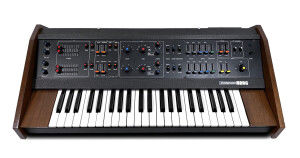
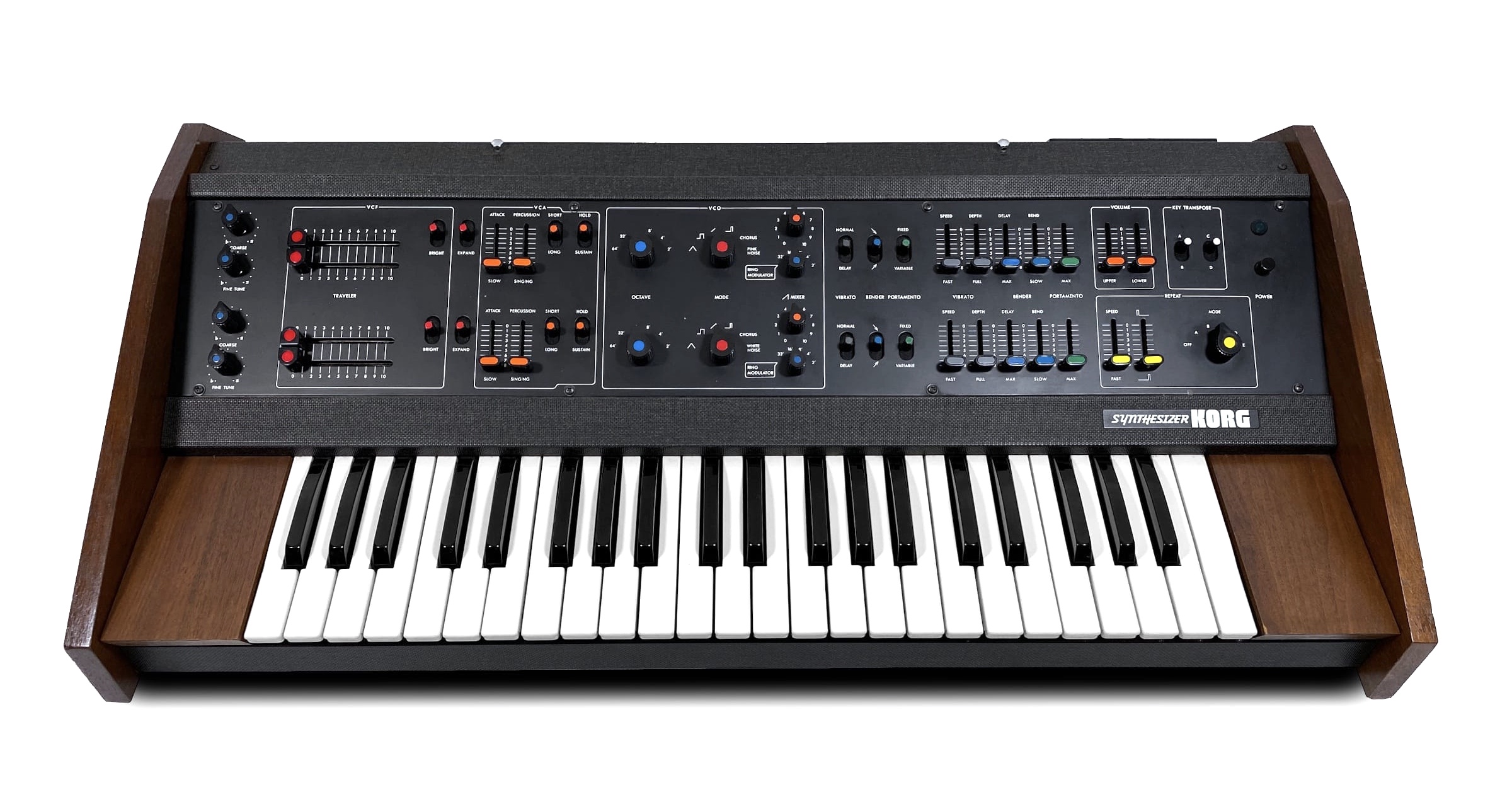
Duophonic split: each tilt is indeed accompanied by a signal splitter with saw-tooth (but which also serves as mixer or the signal to enter the second tilt, or work with the ring modulator), if we added white noise generator and pink (you can have both, one on each channel ...) plus the portamento (variable for each channel), the fine tuning (a total of four pots of understanding) and the famous double filter "traveler", we get (once grasped the finger ...) to have an almost duophonic quadra ... (Or a 4-way multitimbral sound a note)
UTILIZATION
Use child was (very didactic in fact), ultimately much more intuitive (in my opinion) than the Minimoog (but not as clear and "square" than the Arp Odyssey (I compare synths equivalent sold roughly the same price at the same time: between 900 and 1100 F in 1973) ...
However, for a user to synths which grew with the sacred trilogy vco / vcf / vca
all controlled by LFO and ADSR / CA or ADS + modulation wheel (pitch + mod), access is confusing ...
the low-pass filter s'adorne a high-pass filter, and the whole is called "traveler"
ADSR is reduced to the attack / sustain (in fact decay), the sustain / release is a 3-position switch, the emphasis / resonance (not self oscillation of the filter) is another inter three positions, etc..
If we add the arpeggiator that can work: module top (A) or the lower module (B), or both simultaneously (C) or both alternated (D), or up and down without repetition (E) and we complete with the two scales for assigning keys (modes A, B, C, D) for playing the keyboard at the top, bottom of the keyboard, the two simultaneously, two separate (left hand (well, left finger) and right hand (well, right finger), with change in priority (high note, bass note) and retrigger the envelope or not, it includes:
1. the fingering is rather special ... or problem (there may well not get out any sound or have not provided a glissando in the program ...)
2. once the above fingering well-integrated play opportunities are incredible, and in particular allow accompaniment, bass lines and effects of percussion and rhythm absolutely huge ... (Not to mention the sound effects).
SOUNDS
The ability to finely tune oscilloscope can be very rich and expressive sounds (you can do with four multitimbral channels simultaneously - note that the basic setting of the oscilloscope is 64 to 2 feet, and you can add a chorus of white and pink noise, a ring modulator ... while offering waveforms triangle, sawtooth, square, pulse and chorus (actually pulse modulation) ...
Remember that all these functions are multiplied by two (two independent synths but can interact via the ring modulator, mixer and crossover modes arpeggio driven by the LFO).
Last addition, the filter traveler (that make the sound of the Korg and, to some extent replace the Pitch / modulation - which gives the well characteristic of these machines (low 700/700s/800DV/synthé 770) and were able to exploit so well and Vangelis Kitaro), these filters can be controlled by one or two pedals VCF, which frees the hands to play the other buttons (and there are a gaggle!)
Overall, a good big bass sounds very fat (in my opinion, this chapter, it is unsurpassed - it's not for nothing that Francis Rimbert, back when he was in Gaffarel Korg demonstrator was using controlled by a pedals to play his bass lines in its CONCERE demo.
But it also beautiful tablecloths (by trial and error, we come to almost sounds ...), Mellotron sound effects very credible and sound gong, percussion, ethnic instruments (the koto at the didjeridu) with generators DOUBLE noise and ring modulator.
Finally, for very fat leads to attack with portamento or bender (handy for making sounds Walter Carlos (given the time it was not Wendy) and Tomita, both the two oscilloscope + suboscillos coupled slightly detuning and adjustment of keyboard playing in unison ... it's all good.
OVERALL OPINION
This was my first synth (offered by Ms. for Father's Day 1976 ...) Paid 800 F (after haggling tight) with Paul Beuscher. At the time (as mentioned above), I hesitated between the Minimoog (at the time, I played with that of Sergio Macedo), the Arp Odyssey, and the Welson Syntex Korg 700s ...) Finally, was the DV 800 and I do not regret a single moment purchase. With its superb flight case leather brown granite-lined blue velvet (with box reserved for the VCF pedal that I bought very quickly thereafter), it was class ... (Flight case on wheels anyway indispensable given the weight of the beast ...
I recorded three albums with, a lot of soundtrack, made moult concerts and it still works perfectly. A time (early 80's, I almost sell it. Fortunately for me - a posteriori! - The potential buyer was forfeit: he thought I was selling a 800 Poly ... The guy was disappointed but ultimately all is for the best: I kept my 800DV (I still have the invoice and the original notice), and later I bought a Poly 800 for next to nothing on ebay ...
And to think that at the time (1976-1982), what I got room per musico my friends who swore by the Minimoog or Arp Odyssey ...
UTILIZATION
Use child was (very didactic in fact), ultimately much more intuitive (in my opinion) than the Minimoog (but not as clear and "square" than the Arp Odyssey (I compare synths equivalent sold roughly the same price at the same time: between 900 and 1100 F in 1973) ...
However, for a user to synths which grew with the sacred trilogy vco / vcf / vca
all controlled by LFO and ADSR / CA or ADS + modulation wheel (pitch + mod), access is confusing ...
the low-pass filter s'adorne a high-pass filter, and the whole is called "traveler"
ADSR is reduced to the attack / sustain (in fact decay), the sustain / release is a 3-position switch, the emphasis / resonance (not self oscillation of the filter) is another inter three positions, etc..
If we add the arpeggiator that can work: module top (A) or the lower module (B), or both simultaneously (C) or both alternated (D), or up and down without repetition (E) and we complete with the two scales for assigning keys (modes A, B, C, D) for playing the keyboard at the top, bottom of the keyboard, the two simultaneously, two separate (left hand (well, left finger) and right hand (well, right finger), with change in priority (high note, bass note) and retrigger the envelope or not, it includes:
1. the fingering is rather special ... or problem (there may well not get out any sound or have not provided a glissando in the program ...)
2. once the above fingering well-integrated play opportunities are incredible, and in particular allow accompaniment, bass lines and effects of percussion and rhythm absolutely huge ... (Not to mention the sound effects).
SOUNDS
The ability to finely tune oscilloscope can be very rich and expressive sounds (you can do with four multitimbral channels simultaneously - note that the basic setting of the oscilloscope is 64 to 2 feet, and you can add a chorus of white and pink noise, a ring modulator ... while offering waveforms triangle, sawtooth, square, pulse and chorus (actually pulse modulation) ...
Remember that all these functions are multiplied by two (two independent synths but can interact via the ring modulator, mixer and crossover modes arpeggio driven by the LFO).
Last addition, the filter traveler (that make the sound of the Korg and, to some extent replace the Pitch / modulation - which gives the well characteristic of these machines (low 700/700s/800DV/synthé 770) and were able to exploit so well and Vangelis Kitaro), these filters can be controlled by one or two pedals VCF, which frees the hands to play the other buttons (and there are a gaggle!)
Overall, a good big bass sounds very fat (in my opinion, this chapter, it is unsurpassed - it's not for nothing that Francis Rimbert, back when he was in Gaffarel Korg demonstrator was using controlled by a pedals to play his bass lines in its CONCERE demo.
But it also beautiful tablecloths (by trial and error, we come to almost sounds ...), Mellotron sound effects very credible and sound gong, percussion, ethnic instruments (the koto at the didjeridu) with generators DOUBLE noise and ring modulator.
Finally, for very fat leads to attack with portamento or bender (handy for making sounds Walter Carlos (given the time it was not Wendy) and Tomita, both the two oscilloscope + suboscillos coupled slightly detuning and adjustment of keyboard playing in unison ... it's all good.
OVERALL OPINION
This was my first synth (offered by Ms. for Father's Day 1976 ...) Paid 800 F (after haggling tight) with Paul Beuscher. At the time (as mentioned above), I hesitated between the Minimoog (at the time, I played with that of Sergio Macedo), the Arp Odyssey, and the Welson Syntex Korg 700s ...) Finally, was the DV 800 and I do not regret a single moment purchase. With its superb flight case leather brown granite-lined blue velvet (with box reserved for the VCF pedal that I bought very quickly thereafter), it was class ... (Flight case on wheels anyway indispensable given the weight of the beast ...
I recorded three albums with, a lot of soundtrack, made moult concerts and it still works perfectly. A time (early 80's, I almost sell it. Fortunately for me - a posteriori! - The potential buyer was forfeit: he thought I was selling a 800 Poly ... The guy was disappointed but ultimately all is for the best: I kept my 800DV (I still have the invoice and the original notice), and later I bought a Poly 800 for next to nothing on ebay ...
And to think that at the time (1976-1982), what I got room per musico my friends who swore by the Minimoog or Arp Odyssey ...