Log in
EN
FR

J. Rockett Audio Designs

Series

54 products found

Categories
Series
Filter
Sort by
Evaluation
  • Reviewed or not
  • Editor’s award
  • Reviewed by Audiofanzine
Availability
  • Available or not
  • Sold new or used
  • Sold new
  • Sold used
Must-have products
  • All products
  • Flagship products
  • Best rated products
  • Hot products
  • Popular products
Price
  • Freeware
€
Clear
Sort by
  • Popularity
  • User ratings
  • Price - low to high
  • Price - high to low
  • Used price, increasing
  • Used price, decreasing
  • Name (from A to Z)
  • Name (from Z to A)
  • Added on
Choose a category
Choose a series
Sort results
  • Popularity
  • User ratings
  • Price - low to high
  • Price - high to low
  • Used price, increasing
  • Used price, decreasing
  • Name (from A to Z)
  • Name (from Z to A)
  • Added on
Filter results 54 results found
Evaluation
Availability
Must-have products
Price
  • Freeware
Show results

The best J. Rockett Audio Designs reviews

The reviews Audiofanzine members found the most helpful.
  • « Greater Signal Clarity and Plenty of Boost to Drive Your Amp and Pedals »

    SOUND: If you’re looking to clean up your signal and return those sparkling highs, Steampunk makes for an excellent Buffer choice. Moreover, this pedal also is designed to drive your pedals and amp harder with up to 20 dB of clean boost, as demonstrated in the YouTube video below. There’s a little switch under Steampunk’s chassis that allows you to disengage the Buffer component of this Boost/Buffer pedal. I was curious to know how well it ‘buffered,’ and so I did some comparisons with both clean and distorted signals in the above video, and the result was surprising. The signal sounded fine without the Buffer, but when engaged the tone suddenly cleared up and became defined (particularly the high-ends), as though an EQ was added in the mix. I had a total of six pedals in the demo – the four JET series pedals (including Steampunk), the Le Lead Preamp and the Rock Bug amp/cab simulator. Not exactly a large signal chain, but apparently enough to muddy the waters. Significant, but not exaggerated, the Boost does a fine job (some boost pedals are so extreme I can’t imagine anyone using the full amount as it would cause clipping). There is some added noise when using the boost, but considering you would use such an effect when pushing heavy rhythms or going into a lead solo, you would not hear the noise (only if you stopped playing with complete silence). This is not an entirely clean boost, but it’s not too dirty either. I found it added some ‘oomph’ to the original tone and in a good way, as though the crunch became crunchier and the leads had some added sustain and body. OVERALL IMPRESSION: Developed by J. Rockett Pedals, the Steampunk Boost/Buffer is one of a limited edition four pedals in the JET collection. Also available is the Squeegee Compressor, the Touch Overdrive and the Immortal Echo. Half the size of a regular pedal, Steampunk comes in at only $99 USD (as do the others in the collection). The Buffer aspect works exceptionally well by clearing up the tone by regaining any high-end loss that may occur with long cables or a lot of pedals within the chain (and it can be used without engaging the Boost). The Boost provides upward of 20 dB to push your solos or to add some drive to your amp for some noticeable crunch-factor. It is a fairly clean boost, but it’s obvious that the tone takes on some added aggression when already distorted or driven; as for clean signals, they become more pronounced with some additional rowdy push (as opposed to any distortion). Overall, an extremely useful pedal as you get two common features in one and the price is excellent. It’s available at: https://rockettpedals.com/product/steampunk-boostbuffer/ EASE OF USE: Super simple to use, the Buffer switches on and off via an internal switch, and so you need to decide whether you need it or not (necessitating the removal of four screws to gain access), whereas the Boost is controlled by a single knob. Steampunk’s Boost is marked by a small line (about quarter way) to show parity, which does not boost the signal, but does add some energy and sustain when turned on and kept low. Of course, there’s a lot more sustain and grain to be added as you crank the Boost upward of 20 dB extra. RELIABILITY & DURABILITY: The Steampunk Boost/Buffer is a hefty little guy with its all-steel chassis, while barely taking up any pedal board space and measuring in at 1.75 x 3.5 inches (4.44 x 8.89 cm). There’s only one knob/pot, which feels very solid and smooth when turned. Due to Steampunk’s small size, a big foot may touch down on the plastic knob occasionally, but the knob feels of heavy enough construction that there shouldn’t be an issue in cracking or breakage. The Buffer aspect is turned on and off via an internal switch, which may be an annoyance if you’re constantly turning it on and off, but since the Buffer makes such a significant different in sound quality I doubt you would want it off. And if you do want it off, then there’s no issue in wanting to turn it on. The input/output for cables are located in the back, whereas the power supply (standard 9v 2.1 mm) insert is on the side. Even with the power insert located on the side, you still can fit pedals rather tightly around Steampunk, which helps to keep the power input snug and in place (another pedal sets up against the power input cable), and out of harm’s way.

  • « Clean, Clear and Easy-to-Use Delay at a great Price »

    SOUND: The Immortal Echo is best described as clean and clear. This pedal is at a very good price, which means it is more of a barebones pedal than some other delays that may offer several types of echo with modulations, etc. However, if you’re the type of player that likes it simple with some modest customization, the Immortal Echo does a fine job. The YouTube demo video accompanying this pedal provides a look at the range of the Mix, Time, Repeats and Tone. What is most noticeable with the Immortal Echo include two factors. First is the Mix: Even when turned up 100% it is not 100% wet. Even when turned up full you still can hear the dry signal or original tone. And so, if you’re looking for some extra-ethereal sounds this is not the delay for you. The second noticeable aspect is the Tone knob. I’ve used other delays that have tone controls, but I found the Immortal Echo to be one of the most obvious, going from a nice warm sound to a very crisp and thinner sound (in the echo, of course). It does a most excellent job at cleaning up muddy pickups or thickening up bright ones, simply by altering how much bass or treble is in the echo itself. OVERALL IMPRESSION: Developed by J. Rockett Pedals, the Immortal Echo is one of a limited edition four pedals, part of the JET collection. Also available is the Squeegee Compressor, the Steampunk Boost/Buffer and the Touch Overdrive. Half the size of a regular pedal, the Immortal Echo comes in at only $99 USD (as do the other three in the collection), and when combined with the other three you can have a very basic, yet highly functional mini-pedal board. Miniaturized pedals, like the Immortal Echo, are becoming more common and more popular, allowing a musician to squeeze in just one more thing on a pedal board. The Immortal Echo fits that bill, but it also is of excellent quality as it produces a crystal clear echo tone that can be adjusted for general use, from country to rock to ambient. Consequently, you can darken or brighten the overall sound by adjusting the pedal’s Tone knob, which then alters the outcome of dark or bright pickups. The one drawback is that there is no tap tempo function, which is difficult to achieve in a pedal of this cost and size. As well, if the power input were located in the back the Immortal Echo would be just about perfect at its price point, as it would allow an even tighter pedal fit and board layout. Available from: https://www.rogueguitarshop.com/products/rockett-pedals-immortal-echo EASE OF USE: All the JET series pedals are easy to use, including the Immortal Echo. It has a Mix, Time, Repeat and Tone knob. The Mix indicates how much of the echo you hear, regardless of how high or low the Time and Repeats are. Even at 100% you still hear some of the original tone (it is not 100% wet). Time extends to about 1000ms, or so it seems (I did not time it, nor is it indicated on Rockett Pedals’ site). You can achieve some good slap-back echo (around 9-o’clock), and definitely decent ambient echo once turned up to about 2-o’clock and higher. The Repeat function has a nice fading effect, meaning that if you place the control around 12-noon for 4-5 repeats, each one fades off slightly for a more natural echo effect, rather than one pulse or repeat remaining as strong as the last. Consequently, whether going for only a few repeats or up full for a good 10-seconds worth of repeats, there is a very organic trailing off that occurs. The Tone control needs some tweaking for best effect, as you want to match it with your pickups. Typically (although you may want different), if your pickups are dark, then increase the Tone more toward treble to create a differentiation between tone and echo – at least if you want the echo effect to be more dramatic and the sound thicker. Conversely, thinner or brighter pickups (e.g., Strat and Tele) would benefit with more bass in the echo to, likewise, produce a thicker tone and more differentiation. RELIABILITY & DURABILITY: The Immortal Echo’s all-steel chassis feels rather hefty in the hand, and measuring in at only 1.75 x 3.5 inches (4.44 x 8.89 cm). Due to its small size, a big foot may touch down on the plastic knobs occasionally, although the knobs are of good quality. In that regard, the feel of the pots when turning the knobs are very solid and smooth. The cable input/output both are located in the back, whereas the power supply (standard 9v 2.1 mm) insert is on the side. Even with the power insert located along the side, you still can fit the pedals rather tightly together (particularly with EBS flat head patches), which helps to keep the power input snug and in place, and out of harm’s way. The Immortal Echo cannot run on a battery.

  • « Bare Bones & Effective »

    SOUND: The Touch Overdrive delivers the goods, from Blues to Classic Rock, in a super small footprint and a highly affordable price, as demonstrated in the YouTube video below: You will notice that two things are obvious in the sound while tweaking the knobs. First, the Grain (drive) is so subtle when on low that you can hear it being used to add a hint of dirt to a clean signal, to be used for some Blues or Funk and without being too ostentatious. As you approach 11-o’clock the Touch begins to take on a different character and you can hear a more modern tone emerge. Once you get to 12-noon it is obvious that you are in hard rock territory. And when turned up full the notes remain clearly defined and without being too saturated or muddy. The Tone knob adds just enough highs or lows that you can find use for the entire band width. When using bright or very clear pickups you can turn it all the way toward the low end and it still sounds clear and pretty good. It may sound a touch jangly all the way on the highs, but that’s where those dark pickups would perform well. The Touch Overdrive sounds good on its own and has very nice warmth and clarity when cranked, but it picks up on attitude when combined with the Squeegee Compressor and/or the Steampunk Boost. Those added tones are demonstrated in the demo video as well. OVERALL IMPRESSION: The Touch Overdrive, developed by J. Rockett Pedals, is one of a limited edition four pedals, part of the JET collection. Also available is the Squeegee Compressor, the Steampunk Boost/Buffer and the Immortal Echo. Half the size of a regular pedal, the Touch Overdrive comes in at only $99 USD (as do the other three in the collection), and when combined with the other three in the collection you have a pretty nice mini-pedal board at a super price. I really appreciate the size of the Touch Overdrive, allowing you to squeeze in just one more thing on a pedal board; but it’s the quality of the sound that is very spot-on… it has a warm grainy tone ideal for leads or when grinding out a cool riff – and the harmonics and note definition really pop as you turn up the Grain. If the power input were located in the back the Touch Overdrive would be just about perfect, as it would allow an even tighter pedal board layout. EASE OF USE: The Touch Overdrive, as well as all the JET series pedals, is easy to use. It has a Volume, Grain (drive) and Tone knob. The Volume is easy enough to set, and I found starting at 12-noon gives you a good starting point… from there you can adjust relative to your other gear and any clipping that may occur. The Tone knob pretty much works throughout the entire range, insofar as any position sounds good. Too much ‘highs’ may be a bit too much for the bridge pickup (although I tested this on a guitar with very clear and somewhat bright pickups), and although there’s a sweet spot for any guitar and amp, I found between 9-o’clock and 2-o’clock sounded pretty decent and I found it difficult to decide which tone I preferred more. The Grain is perfect if you want to add some dirt to a clean signal, but it also helps to push a high-gain or distorted signal even better (similar to how a tube screamer on low gives that added boost to an already dirty signal). When playing some crunch rhythm the sweet spot is around 11- and 1-o’clock, whereas rock leads shine nicely around 12-noon or higher (depending on how much sustain and saturation you want). RELIABILITY & DURABILITY: The all-steel chassis of the Touch Overdrive feels rather hefty in the hand, and measuring in at only 1.75 x 3.5 inches (4.44 x 8.89 cm). Due to its small size, a big foot may touch down on the plastic knobs occasionally, although the knobs are of good quality. Likewise, the feel of the pots when turning the knobs are very solid and smooth. The input/output for cables are located in the back, whereas the power supply (standard 9v 2.1 mm) insert is on the side. Even with the power insert located on the side, you still can fit the pedals rather tightly together (particularly with EBS flat head patches), which helps to keep the power input snug and in place, and out of harm’s way.

  • « Diverse Waves Make this Tremolo & Reverb a Complete Package »

    SOUND: Mr. Moto is one sweet ride if you want an easy-to-use tremolo and reverb combination, as demonstrated in the YouTube video below: There are a number of impressive aspects to Rockett Pedal’s Mr. Moto, but what cannot be ignored is how natural the tremolo sounds, as though it’s a part of the original signal as opposed to it altering the signal. A bonus is that you’re able to adjust the Wave from a Sine to a Square and any combination between. This means you can achieve anything from a soft dreamy wave to a choppy and more aggressive pulse. And if that’s not enough, Rockett Pedals didn’t forget to include an excellent sounding Reverb, which goes so well with tremolo (particularly if you’re trying to re-create that famous 1960s surf sound). The Reverb is not extensive, such as a spacey or canyon type quality, but offers enough depth to satisfy any sense of The Ventures’ nostalgia. And you can use the tremolo or reverb independently. OVERALL IMPRESSION: For $199 USD you get a solid buy with Rockett Pedal’s Mr. Moto. First, the construction is super solid and hefty, and the ‘Speedswitch’ inside allows you to plug in a new switch if the old one malfunctions (no soldering required). Second, you get two pedals in one – a tremolo and a reverb – either of which can work independently or together. Third, both the tremolo and reverb are very natural and clear sounding – the electronics are superb. Fourth, you can select how smooth or choppy you want the wave, from pure Sine to pure Square or anything between (Mr. Moto morphes extremely well from one end of the spectrum to the other). The diversity of Mr. Moto is exceptional because of all these factors, making it ideal for 1960s Surf music, but also ambient Pink Floyd type compositions. If you enjoy playing slow to moderate melodic guitar, then you must have a good tremolo pedal in the mix, and Mr. Moto is a perfect solution. EASE OF USE: Tremolos are fairly easy to operate, although there typically is a wide range of potential results. Depth controls how much of the effect is in the mix, whereas Speed controls how rapid the guitar signal switches from ‘on’ to ‘off’ (which is how a tremolo works). You could have a rapid Speed, yet have the Depth rather low and barely notice the effect, like a slight tremor in the sound. Conversely, a slow Speed and high Depth can produce some very dramatic wave-like results. To add to the complexity and results you’re after, the Wave knob on Mr. Moto indicates how aggressive you want the pulse, from a very subtle and smooth Sine Wave to a very choppy Square Wave and anything between (although not cut in stone, some very atmospheric or ambient music usual applies gentle Sine-type Waves, whereas more upbeat ‘Surf’ music likely would embrace a Wave that is more Square or somewhere in the middle). Once you have this figured out, you then determine how much Reverb (if any) you want. The Verb on Mr. Moto is audible about quarter-way up and obvious half-way. As you turn the dial all the way you get some great reverb depth (e.g., Hall reverb) with a lot of clarity (definitely not a muddy-sounding reverb). A nice feature is that you can use the Reverb without the Tremolo and vice versa, making this a two-function pedal. RELIABILITY & DURABILITY: Things were made better in years ago – thicker metal, heavier construction and designed to last. Cars definitely come to mind with their chrome bumpers and solid steel bodies, and Mr. Moto is no different. Unusually heavy for a pedal, there’s no lack of steel in this effect. There are four plastic knobs (Depth, Speed, Wave and Verb) with a cream retro vibe that feel very smooth and of high-quality when turning. The footswitch has a very solid ‘click,’ also signifying solid construction and high-quality. The footswitch in this pedal (as with many other Rockett Pedals) has a ‘Speedswitch’ installed, which means when you remove the cover you can pop out one switch mechanism and plug in a new one… no re-wiring required… definitely a bonus for touring musicians since there is no soldering required if you need to make a last minute repair. All cable inputs (power, TS in/out) are located in the back, which saves on pedal board space and potential strain from a stomping foot. It operates on a standard 9V DC 2.1mm tip jack power supply (neither the manual nor the company’s website indicates the mA power draw, but I presume it’s not that much).

  • « Rockaway Archer Improves Your Amp »

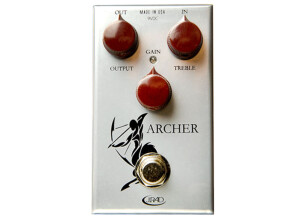
    SOUND: The YouTube video below demonstrates the capabilities of the Rockaway Archer, by Rockett Pedals, a transparent boost with an organic-sounding gain/drive and an EQ to help sculpt an ideal tone: The Rockaway Archer was designed to drive your amp harder (meant to be last in your pedal chain and after all your drive/fuzz pedals), so that you can develop your tone further (via the EQ and Gain), to increase gain going into your amp and to boost the signal if warranted (and the pedal is very quiet considering how much boosting you can do). Even with the EQ flat and the Gain all the way down you can hear added harmonics and tonal definition previously not coming from your amp or pre-amp. The Gain can be very subtle, and you barely hear any added drive when turned up quarter way. Once the Gain is up half-way there is a distinct dirty addition in the mix, and as you turn up the Gain toward full capacity you notice how warm and it sounds with some delicious nastiness – absolutely no brittle harshness. You use the Volume knob as a Boost (upward of 18 dB cut or boost at six different EQ frequencies), although you can keep the Volume at parity with your amp and other equipment. What is most obvious is how clear the Boost is, whereas any tonal changes take place with the Gain and the six-band EQ, which provides a nice range of options without sounding exaggerated and harsh to the ears, e.g., pushing the bass or mids do not sound muddy and pushing the treble does not sound abrasive or sharp. OVERALL IMPRESSION: There are so many pedal manufacturers and pedals on the market that it’s always pleasant to be impressed, and Rockett Pedal’s true bypass Rockaway Archer definitely adheres to that sentiment. When you have a tone you like and then have the harmonics and note definition improve (with the tone standing out further in the mix), then it’s all good. This is true of clean, crunch or high-gain, as the Rockaway Archer does such a great job working in any environment. A signature pedal of Steve Stevens, a well-respected guitarist, his collaboration with Rockett Pedals makes the $249 price tag very reasonable once you integrate the Rockaway Archer on your pedal board. Amazingly what sounded good suddenly sounds a bit flat or ordinary when you remove the pedal, making the Rockaway Archer a definite keeper. The Gain is amazingly usable, whether left low or cranked high, and the EQ is one of the best I’ve used as the ranges for each frequency seem appropriate, whether turned high or low. In other words, you do not get an excessively low, mid or high response as you experiment with each frequency slider – but a potentially usable tone throughout the EQ’s entire spectrum. Other EQs I’ve tested worked well, as intended, but they also seemed to exaggerate too much lows (a strong ‘boom’ result) or produced shrill highs – in other words, the Rockaway Archer’s EQ fits exceptionally well within a guitar’s ideal frequency range. EASE OF USE: The easiest part on this pedal to use is the Volume, although adjustments will be required depending on where you set the Gain and the EQ (and whether each frequency is flat, a cut or a boost). The Volume can be used at parity, so that any tonal changes you create with the Gain and EQ are at the same level as your output without the Rockaway Archer, or you can set it so that you can boost your signal during lead solos or ‘heavier’ rhythm parts. You will add some volume and high end to the signal with the Gain, and so you may need to adjust the Volume and EQ depending on what tone you’re chasing. The Gain increases in output and dirt relatively slowly and is not exaggerated, since it is used to add to or enhance what already is going on with your pedal board and amp – simply a very warm and organic sounding distortion. Even when playing ‘clean,’ you can up the Gain quarter way and it does not distort the signal, but seems to add to the fullness of the tone. As you approach half-way on the Gain you definitely hear added distortion, although not excessive. When working with high-gain amps, the Gain on the Rockaway Archer may be off completely, up slightly and likely not more than half-way. Cleaner amps will benefit from full Gain on the Rockaway Archer, particularly if you want to push a crunch tone or to shift from clean to crunch. As you move the frequency sliders you will notice that the EQ is exceptional and everything seems to respond rather well, although in different ways. As stated previously, the EQ is highly usable as no matter where you place the lows, mids or highs it all seems to work well within a guitar’s overall frequency. The six-band EQ comprises the following, starting from lows (far left on the pedal) and moving to the highs (far right): Band 1 – 100 Hz Far Left Band 2 – 200 Hz Band 3 – 400 Hz Band 4 – 800 Hz Band 5 – 1.6K Band 6 – 3.2K Far Right What you get is upward of 18 dB of cut and boost per frequency, which is why you may need to adjust both Volume and Gain depending on your EQ setup. Consequently, this is not an easy pedal to use, nor is it difficult. It will take 10-minutes to get the hang of it and dial in an awesome tone. RELIABILITY & DURABILITY: It is obvious that Rockett Pedals did not skimp on the construction of the Rockaway Archer. Its steel frame is incredibly hefty in weight and feel. The two knobs for Volume and Gain are steel as well, and feel very smooth and high-quality when turning. The EQ sliders have LEDs, which does increase any potential for damage, and so don’t stomp down like the giant chasing after Jack down the bean stock. The footswitch has a very solid ‘click,’ and you can tell its construction is of a high-quality. Further to the footswitch, this pedal has a ‘Speedswitch’ installed, which means when you remove the cover you can pop out one switch mechanism and plug in a new one… no re-wiring required… which is a nice touch that indicates one less thing (soldering of the switch) to go wrong. All cable inputs (power, TS in/out) are located in the back, which saves on pedal board space and potential strain from a stomping foot. It operates on a standard 9V DC 2.1mm tip jack power supply, drawing only 30mA

  • « Fantastic and innovative tremolo pedal. »

    Dual Channel Tremolo with individual rate and depth controls Rate: Controls speed of tremolo Depth: Controls level of tremolo effect Volume/Boost: Controls signal output 9vdc, battery or adapter powered 1/4" in and out I rate it a 9 as it would be nice to have a stereo option, which it does not have. UTILIZATION This pedal is extremely easy to use. There are two channels, and each can be set up for different settings. I love this, as I like a slower, throbbier tremolo on clean passages, and a quicker, yet narrower trem on lead work. The volume feature is genius, as this pedal can boost the output of the guitar signal. Typically tremolos suffer from a perceivable volume loss when engaged, but this pedal does not have that problem. SOUND QUALITY The sounds are extremely rich and luscious, like an old 50 or 60s Fender tube amp optical tremolo. Not too choppy - this is a vintage-sounding unit. The trem will get very deep, and very fast or slow - there is a lot of room to find just the right settings here. The pedal is pretty transparent - your guitar will still sound like itself. One neat trick to try is to run this before a distorted amp, and have the tremolo engaged to have a medium-fast speed but shallow depth - the solos tend to jump out, and the tremolo sound gets very subtle at that point. Joe Bonamassa does something similar with his rig, to great effect. OVERALL OPINION This is a great pedal all the way around! Josh Smith is a fantastically tasty guitarist, and to have his name on this pedal is a testament to how lush the tones are. Having two settings in one pedal is a boon, and the volume boost is fantastic. I'd absolutely buy another one of these pedals. This is the best tremolo I've ever used.