Log in
EN
FR

ARP

29 products found

Categories
Filter
Sort by
Evaluation
  • Reviewed or not
  • Editor’s award
  • Reviewed by Audiofanzine
Availability
  • Available or not
  • Sold new or used
  • Sold new
  • Sold used
Must-have products
  • All products
  • Flagship products
  • Best rated products
  • Hot products
  • Popular products
Price
  • Freeware
€
Clear
Sort by
  • Popularity
  • User ratings
  • Price - low to high
  • Price - high to low
  • Used price, increasing
  • Used price, decreasing
  • Name (from A to Z)
  • Name (from Z to A)
  • Added on
Sort results
  • Popularity
  • User ratings
  • Price - low to high
  • Price - high to low
  • Used price, increasing
  • Used price, decreasing
  • Name (from A to Z)
  • Name (from Z to A)
  • Added on
Filter results 29 results found
Evaluation
Availability
Must-have products
Price
  • Freeware
Show results

The best ARP reviews

The reviews Audiofanzine members found the most helpful.
  • Audiofanzine FR's review

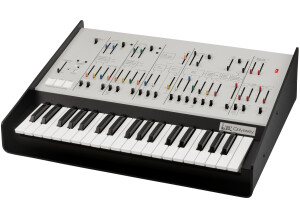
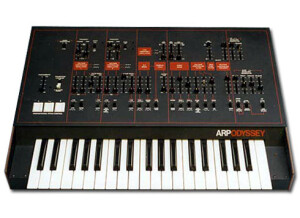
    (Originally written by cagouille/translated from Audiofanzine FR) Beside the Minimoog, it's "the other" big mono synth of the 70's. Huge possibilities (far more than a Minimoog). Not limited to bass sounds because the leads and effects are simply awesome! Although it has one oscillator less, the Odyssey isn't left far away from the 2600 in regard to philosophy and sound. That's why its code name is "Arp 2800". Unlike the MK1s, all MK2s have CV/gate inputs and can be modified. UTILIZATION The drawbars are way more practical than buttons and allow you to read the parameters instantly. Unfortunately their durability is not so good (test them before you buy it). Once the unit is OK, creating a sound with an ARP is a real pleasure, given that the user panel is very clear. SOUNDS The ARP sound is not the Moog sound. It's less round and brassy but still very warm. The legendary analog character is very present. It can also sound very metallic depending on the programmer's skills. Contrary to the Mini, the ARP does deliver in ALL analog styles: Bass sound (from Ashra to Alphaville's "Sound like a melody"), sequenced sounds (Vangelis' Spiral), lead sound (Schulze in the Timewind period), FX sounds (Autobahn)... In short, the Odyssey makes a good job on all fronts but the Mini still outdoes it! Many users will say both synths complement each another wonderfully. One thing is for sure: it has the fastest envelopes I've ever heard, faster than a Moog or a Pro-one (which is actually famous for this), and very sharp high frequencies (look out for your tweeters). OVERALL OPINION The Odyssey is a safe bet in analog synths and it costs half the price of a Mini. And is is still as exciting as the Mini (maybe even more...). Moog and ARP are the yin and yang of analog synthesis: with one each you'd have THE setup to recreate the authentic 70's sound (without considering modular synths!). Add a string machine (ARP Solina), analog phasing delay effects and take off... Nowadays it's hip to worship the Minimoog and to disregard the Odyssey. That's so not fair (except for the round lows and the brassy character of the filter). As a summary, the Odyssey surpasses its rival in terms of efficiency and possibilities. The Mini should stop being considered the analog king!

  • « Great job! What a sound: pleasant, lively, fat or not, nice sound grain –but a small keyboard though »

    I’ve used it to play some stuff close to electronica, dunno :8O: Well, in any case for that kind of music: https://soundcloud.com/studioliv/sets/my-own-tracks :-D So, it’s used in a home studio alongside a Minilogue and a Slim Patty among other analog devices. I put a Strymon Bluesky right after. It’s a well-finished product, faders are firm to taste, imo they are to be handled not too fast to keep this resistance on their course. I’ll see how it ages. Couldn’t be better ergonomically, but that seems quite normal on such a synth that seems to come from another time period. Each fader has its own purpose. The keyboard seems sturdy, though quite kitschy. I think it’s normal to have that sort of feeling with a small keyboard – I have the exact same feeling with the Minilogue. By the way, their touches are quite comparable. If I can, I prefer to play the Odyssey with a separate master keyboard through MIDI. I was after a sound close to this. I long hesitated before finally getting it. It has no memory bank, can be used as mono or duophonic – I’d even say triphonic depending on the sound – and, most important, its general tuning is not easy to get used to when you mostly work on digital keyboards (just like me until then...). I first tried the Slim Phatty... A big, nice sound, but not enough vintage-sounding for me – not enough “instability” if I may say. I was after lead sounds comparing to the CS80’s or the Yamaha C1 or C2’s. I tried the Minilogue... Not bad, some sounds react differently when playing legato. I’ve also tried – and sent back – the Deepmind 12, instead of which I took an Arp Odyssey. Now, the sound is getting close to what I wanted: a lively sound, full of motion that provides grinding bass sounds, no chorus needed and the detune effects really do the job. You really get yesterday’s sound with a certain kind of instability in the sound – which gives it all its charm. Sometimes, when you play, you feel like the “articulations” (a digital age comparison ;) ) start to work between two notes. So you got it, I really had a crush on that one. This video convinced me to get the Arp: A very simple, “normal” version of this synth – that’s the philosophy behind this model. Making sounds… you just need to get used to the way the knobs and faders react. But it goes quickly, as you have everything under your eyes. As usual with analog synths, it takes at least an additional reverb or delay, except for basses and some specific sounds. A real change compared with the digital models, really...:-D Now let’s start with the cons... I don’t really know, except for the keyboard’s size. Now, there’s a “Full Size FS” version which is twice as expensive than this 2/3 version and delivers the exact same sound. There’s so little in this synth I can find fault with, that I might end up telling you about the problems I found with its bigger brother. I’ve been surprised by the absence of a MIDI Output. To me, it’s strange to have a synth without it... but in the end, I perfectly understand its lack of necessity on such a model - and, you can still get a MIDI Out when plugging in USB. Now, its pros: Everything – it finally matches the vintage sound that i was after. Now, i’m starting to consider turning against my Minilogue, which I may swap for a Pioneer Toraiz AS-1 one of these days... On the vintage side, this one looks nice, too. But that’s a different story… I’d sure make the same choice again, and i’m sure to keep it for a good while.

  • Audiofanzine FR's review

    (Originally written by matomatik/translated from Audiofanzine FR) Monophonic analog synth with presets (30), 3 octaves, 37 aftertouch-sensitive notes. You can assign several effects to the aftertouch (pitch, wow, growl, volume, vibrato) On/off effect switches Aftertouch sensitivity slider Brilliance slider for sound filtering (cut off) Time slider for portamento Vibrato speed knob Outputs: jack and XLR Footswitch input for the portamento function UTILIZATION No need for the user's manual, it's very intuitive and easy to use (presets) SOUNDS Full-fledged instrument with a pure analog sound and a high-sensitivity keyboard. The presets offer a comprehensive range of lead sounds which can be generated with an oscillator. Limited editing capability since all sounds come from a ROM memory and nothing is editable except for the (cut off) brilliance filter. Nevertheless, the sounds and ease of use meet almost completely our expectations (up to 90%) of a monophonic analog lead synth (70's!) OVERALL OPINION The idea is to reproduce the ARP SOUND spending 4 or 5 times less money than on an Arp Odyssey or another fancy, costly and bulky analog synth... (even if the sound isn't exactly the same, it's more than enough) The Pro-DGX is virtually identical to its big brother Pro-Soloist (the ROM is not the same but it's only a detail, except maybe for a purist). Preset synths aren't hip... so GO GET ONE because they are great, easy going, intuitive and affordable. Every brand has built a preset synth (check out how those beasts sound on Audiofanzine and youtube!) If I'd have known earlier... you're lucky... Good luck on your search.

  • lgoodwine's review

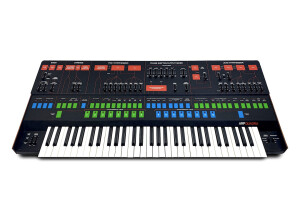
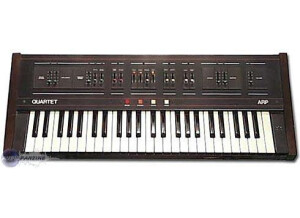
    This was the first Polyphonic synth I ever bought. It was big, meaty, and the sound was exactly tthat as well. I still have and use it in my studio. The "Quad"ra has four distinct sections, controlled from it's front panel with a membrane switch area and sliders within the specific "modules" of the face panel. The bass synth section features a monophonic synth over the lower 2 octaves of the 5 octave, keyboard action keys. The keys are extended over the edge of the chassis making stacking the synth over another a Rhodes or B3 a comfortable option. The 2nd synth was a dedicated ARP Omni type String synth, with a switchable "Hollow" waveform "reed-like" timbre. (nice) Smack dab in the middle of the panel is a mixer with sliders for the 4 dedicated sections and a switchable Phase shifter. Next section was an 8 voice polyphonic synthesizer followed by 2 voice lead synth. The keys have pressure sensitivity helpful for adding vibrato or pitch-bend, (no joystick here). The back panel was interesting back in the day. Besides the standard voltage control pedals and sustain pedal jacks, Control Voltage and trigger voltage jacks for connecting to other synths with this option was an amazing idea, (pre-midi days we're talking about), and With 6 cables you could be connected. The multiple outputs and digital memory (which only remembers which sliders were active) made for an at the time versatile synthesizer, and with analogs making a comeback, (and argueably never leaving) will be around for awhile if you can find them. UTILIZATION The panel is well laid out, with signal flow graphics, sliders, LEDs, and membrane touch switches allowing for programming for the 4 main sections and master section. Sure beats a crowded LCD and layers of menus and a few buttons. Though this synth takes up alot of space. I had it on my Rhodes with a modified flat top by itself. The Bass synth, (far left on the panel) has 2 Octave settings as well as a String synth waveform that can be substituted in for the standard analog bass synth waveform. Next was the String synth which utilized 4 octaves of the keyboard with unless you switch in the bass synth waveform , using the entire keyboard. The mixer/Phase shifter is in the middle of the panel followed by a basic Polyphonic synth. The final section on the right was the 2 voice lead synth, fairly versatile, and key-pressure sensitive for pitch bend, multiple and single triggering, and arppegiator. With a basic knowledge of modular synth programming, you could get around on the panel of the Quadra very quickly. SOUNDS The sound are a bit limited, (and dated as any classic synth would be) although I found them to be warm, layered, and adequate for the songs I was composing or imitating in my coverbands, and rock bands. It was and is a great synth that can lend it self to fatting up a keyboardist's sound, stuck in sampled, pre-programmed, un-tweakable, need it fast times. OVERALL OPINION Owning a Quadra since the late 70's early 80's and going back to it time after time, I'm glad to have it as part of my keyboard sound. I'd buy it again if I had the chance, and in hindsight the dollar value versus usage is high. Please keep in mind, this review is fairly slanted, and I hope you can make an informed listening decision for yourself.