Log in
EN
FR

SeriesBehringer Ultragain

9 products found

Filter
Sort by
Evaluation
  • Reviewed or not
  • Editor’s award
  • Reviewed by Audiofanzine
Availability
  • Available or not
  • Sold new or used
  • Sold new
  • Sold used
Must-have products
  • All products
  • Flagship products
  • Best rated products
  • Hot products
  • Popular products
Price
  • Freeware
€
Clear
Sort by
  • Popularity
  • User ratings
  • Price - low to high
  • Price - high to low
  • Used price, increasing
  • Used price, decreasing
  • Name (from A to Z)
  • Name (from Z to A)
  • Added on
Sort results
  • Popularity
  • User ratings
  • Price - low to high
  • Price - high to low
  • Used price, increasing
  • Used price, decreasing
  • Name (from A to Z)
  • Name (from Z to A)
  • Added on
Filter results 9 results found
Evaluation
Availability
Must-have products
Price
  • Freeware
Show results

The best Behringer Ultragain reviews

The reviews Audiofanzine members found the most helpful.
  • Audiofanzine FR's review

    (Originally written by efabric/translated from Audiofanzine FR) Tube/modeling hybrid technology. No effects. You can boost the signal until it starts to distort, and change the EQ. Compact and transportable unit (not for rack). I use it with a Bass V-amp, a powerblock and a Vox 2 x 12" speaker cabinet. UTILIZATION Very easy setup. Easy editing and short user's manual. I would have liked more precise descriptions of the limiter section, the low-pass frequencies, the modeling, and the amplifier stages. In which stage the tube actually works, etc. SOUND QUALITY The sound of the instrument is faithfully reproduced but the modeling is not versatile enough. Sometimes the selector generates some noise when manipulated. Sound coloration is very evident! It's not comparable with a solid-state amplification system! In the beginning it's quite subtle, but as soon as you play a solid-state preamp you feel the difference. You can boost the effect until you get distortion. The sound is good with moderate settings otherwise I don't like the effect. I'll make some new tests when the unit is hot and do some comparisons with modelings. The unit doesn't clip except when you boost the instrument's signal or when you pick up the sound of a speaker with a mic for example. I haven't tried out every combination but it's true that the limiter reduces the dynamic range greatly. Review update: With a bit more experience now I find the saturation sounds good, and when you increase both gain and volume settings you can enhance the signal of a guitar. The limiter effect is strange: I connect my bass and get a strong sustain. When I attack a string hard the limiter rapidly decreases the volume. Normal! On the contrary, when I let the string ring, the volume increases again after 1 or 2 sec. before the note fully fades out! It's a strange effect like an ADSR filter... However you can use the limiter (with low settings) for phrases with short notes. OVERALL OPINION I've been using it for 2 days. It's has no power on/off switch. So use a multiple socket outlet with a switch. Pro: the tube warmth! Con: the modelings, especially with the limiter. It's my first tube gear. Very good value for money. It colors and enhances every sound source very subtly. I recommend it even though my experience with it is rather short. Review update: With more experience I find this unit is essential. It's great with a multi-FX processor! It's ideal for guitar or bass recordings if you don't have a DI box but only a mixer!

  • moosers's review

    I use this with the ADAT ins and out for my Digidesign 002R. It has 8 basic preamps, with an XLR/line in and an out for each of them. The main function of this is to hook it up with the ADAT jacks I believe, using them as external preamps, good for someone with an interface that only has a few inputs and wants extra preamps at a ridiculously cheap price. OVERALL OPINION I've had this for about 3 years now and I have used it both with my Digidesign 002R and I used to have a MOTU 896HD and it worked great with both of them, espically with my 002R since it only has 4 preamps on it and to record drums its great to have the option of having 12 preamps instead of just 4. But the thing I like most about this unit is the price. Considering how cheap this is there is no excuse to be without one if you are looking for more preamps on a budget. Obviously these are not the best preamps in the world, but if you are simply looking to have more inputs it won't color the sound too much, and with some good mics it doesn't sound bad at all. Until I upgrade with a few more high end preamps, I'll be holding onto mine for awhile.

  • FP User's review

    The features on this unit are great Price paid: 100.00 USD UTILIZATION The Tube Gain 1953 is a very user friendly device. SOUND QUALITY This low cost "Mic Pre" really sounds good. I add warmth to your vocals without over coloring of the sound. OVERALL OPINION The fit and finish of this unit is up there with higher priced mic pre's. I'm not sure about the durability of this unit, as it went staright from the box to my rack. I am really impressed with this entry level mic pre. Do I love it? Nah however I am in extreme like with this joint. It gets the job done what more can you ask for. Originally posted on FutureProducers.com Posted by: dutty ( 4-, 2006)

  • « A must for exploring new tones and rediscovering your instruments »

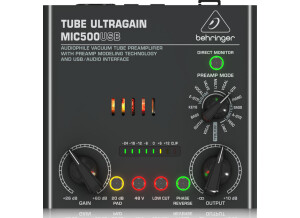
    The Behringer MIC500USB is a compact tube preamp that also doubles as a USB interface. It delivers warm, analog character at a very reasonable price. I love it, even if it can occasionally produce a bit of noise. That said, swapping out the stock Ruby tube for a Brimar 12AT7 changed everything: the noise disappeared, and the sound quality is unbeatable at this price point. It replaced my old ART Tube MP Studio. Both offer similar sound quality, but the MIC500USB is clearly better built internally. On the ART, changing the tube was risky—you could easily damage the board. That’s not the case here. It’s solid, reliable, and honestly, I hope to keep this little gem forever. What I like: • Super easy to use—just plug and play • Very versatile, both in terms of sound and connectivity • Low noise floor, easily cleaned up with basic tools like Audacity • Better internal build than the ART Tube MP Studio What I would have loved: • A stereo version would be more than welcome!

  • « Good, practical unit for the money »

    I bought this unit to supplement my Positive Grid Bias Mini Guitar Amp. The Bias Mini is an amp modeler. It sounds great but the 'valve sizzle' was missing in the signal chain. The MIC2200 adds sufficient warmth and sizzle that an amp modeler cannot give you. The MIC2200 also has a precise EQ that I use to filter out annoying mid frequencies in the guitar signal. I have tested the MIC2200 with a condenser microphone going into my DAW. Although I will use this pre-amp for other instruments when recording, I will not use it on vocals. This is not because it doesn't sound good but because most tube pre-amps color a signal and I happen not to like the colorization of tube pre-amps on vocals. I've read a lot of criticism of the LED light in the background and hissing noise. These statements are nonsense. Who cares whether Behringer decided to dramatize the tube-look by installing lights behind it? Hissing is a natural by-product of tubes when pushing them. During normal input/gain levels, I found no discernible hissing. Any minor hiss generated, if at all, will be lost in the mix. If you are recording pristine, clear audio, I wouldn't use a tube pre-amp anyway. However, I have heard of professional studios using Behringer gear and this particular tube pre-amp. I worked in the music industry for three decades. I've used and owned brand products such as Digitech, Alesis, dbx, Mackie etc. All good stuff. But when Behringer hit the market, they were ridiculed by established studio gear manufacturers because they feared the competition. I now own a range of Behringer products after upgrading my gear because the price, quality and features are generally better than that of overpriced competitors, who by the way nowadays also manufacture in Asia. To date, only one Behringer product has had an issue. The unit was replaced immediately. Behringer's reputation, as far as I am concerned, is excellent. This unit comes in a 19" rack size. Build quality is excellent and the EQ, phantom power and balanced/unbalanced in and outputs are great at this price point. Sound is a personal matter, and as stated above, I wouldn't use any tube pre-amp on vocals (unless doing some old Frank Sinatra stuff and I want that creamy, smooth, tube sizzle). I use it for instruments for which it is serving its purpose really well. Obviously, if you don't like the sound of the MIC2200, then don't buy it and don't give it a bad rating because of that. If you want to spend $5K or $10K on a tube pre-amp, and you actually believe that you get a substantially better sound, then go for it. Overall, you get a lot for AU $189.

  • « Behringer Tube Ultragain Mic100 Preamp and DI with Limiter »

    This is a the table top model, not a pedal or is it a rack unit. It's about the size of a standard DI box or external hard drive. These run about $50. I picked it up to find out if it really does all it says it does for $50. You can get them just about anywhere that sells Behringer products. I like the the unit is cheap. It's lightweight. If it broke in 6 months I would not be heart broken nor angry. You get what you pay for. It will 'warm up' your signal with a little bit of tube warmth. Sure it isn't going to sound AMAZING, but if you're on a budget it's a great unit. I like that it has an XLR input as well as an instrument input. I can use this for vocals or a guitar. The -20 DB is very helpful. Power is great. You can power it through Phanton Power, a power supply or by a 9 volt battery. The Limiter is very limiting. You can't adjust it other than your gain and output volume knobs. Since the unit is cheaper the construction is not on par with what I think it should be for a pro situation, but hey pros don't need to worry about budgets right? I mentioned before I do not think the construction is up to snuff. You will most likely set this on top of your amp and sooner or later an instrument cable with get tugged or stepped on and this unit is going to come crashing to the ground. I don't think it would absorb a fall, but I have not dropped mine either. I was very careful to gingerly use this. Bottom line is if you need a guitar, bass, vocal or keyboard DI are are on a budget it, this is great. It will get the job done for you without too much noise to boot. It will warm up a brittle sound to an extent but the Behringer is not a miracle worker. This review was originally published on http://www.musicgearreview.com