Log in
EN
FR

Black Arts Toneworks

18 products found

Categories
Filter
Sort by
Evaluation
  • Reviewed or not
  • Editor’s award
  • Reviewed by Audiofanzine
Availability
  • Available or not
  • Sold new or used
  • Sold new
  • Sold used
Must-have products
  • All products
  • Flagship products
  • Best rated products
  • Hot products
  • Popular products
Price
  • Freeware
€
Clear
Sort by
  • Popularity
  • User ratings
  • Price - low to high
  • Price - high to low
  • Used price, increasing
  • Used price, decreasing
  • Name (from A to Z)
  • Name (from Z to A)
  • Added on
Choose a category
Sort results
  • Popularity
  • User ratings
  • Price - low to high
  • Price - high to low
  • Used price, increasing
  • Used price, decreasing
  • Name (from A to Z)
  • Name (from Z to A)
  • Added on
Filter results 18 results found
Evaluation
Availability
Must-have products
Price
  • Freeware
Show results

The best Black Arts Toneworks reviews

The reviews Audiofanzine members found the most helpful.
  • « Increase Note Definition and Harmonics with Any Amp or Pedal »

    SOUND: The YouTube video below demonstrates the SKYBOOST, a boost/overdrive/fuzz combination pedal with true bypass switching: Offering different capabilities with any modern genre of music, SKYBOOST is a very simple and highly usable pedal. It isn’t classified as high-gain, but it can be used to increase gain in a high-gain amp or pedal. The GAIN knob allows you to increase the harmonic quality of your tone when turned low, but increases saturation and fuzziness as you crank it up. I find that SKYBOOST actually adds an element of ‘life’ to a tone, whether using an amp with or without drive/fuzz/distortion pedals. The CONTOUR switch allows you to shift from a more bass-heavy tone to a more treble-enriched tone. The RANGE switch allows you to shift from a lower-gain (sweeter), which is cool if you want a good dose of fuzz that isn’t over the top, to a higher-gain (edgier) setting. OVERALL IMPRESSION: Known best for its super heavy and saturated sounding fuzzes and distortions, Black Arts Toneworks has a solid reputation in the industry. SKYBOOST actually is a calmer pedal within the family, although it offers some very unique qualities for those thriving on a cleaner tone (who want a bit extra boost or dirt when necessary) to those driving high-gain amps and tones looking for some boost or to add front-end definition and pizzazz. Definitely good value at $159 USD. In effect, you can get some very gentle full-range boost with nary a hint of distortion or fuzz, and all the way up to a very aggressive and clearly-defined fuzz. With its two EQ contours (a full-range and a treble emphasized boost) and two boost ranges (low gain and higher gain) there is a lot to work with regardless of the gear you’re using. The SKYBOOST definitely adds to the sound without distracting from the original tone, even when pushing the boost and fuzz (which remains very clear and defined, even when pushing the limits). EASE OF USE: Initially you should match the volume of your amp with the SKYBOOST engaged (via the VOLUME knob), and from there you add extra boost, fuzz, etc., as needed. The rest is hardly rocket science, although the range of what you can produce is significant enough and depending on your choices. The GAIN knob is very subtle from zero to even half-way, which range adds some dirt, but nothing over the top (good for a gritty clean or adding some definition to a higher-gain tone). Once you get to 3-o’clock the fuzz really kicks in, and once turned up full at 5-o’clock there is an even more significant difference in the fuzz, as though skipping a few steps into warp-drive. The CONTOUR switch shifts from more bass-heavy (flipped to the left) to more treble-emphasized (flipped to the right). There’s enough bass or treble at either end that you will need to adjust your amp’s bass and treble setting accordingly (unless you want a noticeable increase in bass or treble). The RANGE switch has low gain (flipped left) and higher-gain (flipped right). It’s not a high-gain drive as you would find on high-gain amps and some other pedals, but when placed in front of a high-gain amp you better turn down the amp’s gain, since it tends to drive such amps very hard and very well. RELIABILITY & DURABILITY: Black Arts Toneworks’ SKYBOOST is an average sized pedal, made of steel, and includes a standard lifetime warranty. The paint is smooth and slightly matt in appearance and feel (not glossy). The paint quality feels good and it would take quite a bit of abuse to scratch it off. The footswitch has a solid click and feels of good quality, as well. The two knobs (VOLUME and GAIN) are of plastic and sit far back enough from the footswitch. Then there is the LED and two switches (CONTOUR and RANGE) that also sit far back enough (the switches sit lower than the knobs and are protected in that regard, and the LED is relatively small and sandwiched safely between the two knobs). All lines (input/output/POWER) are located in the back, to save on pedal board space and to keep unwanted force or pressure away from a stomping foot. You cannot use a battery with SKYBOOST, but a 9v DC power supply (approximately 24mA).

  • « From Grainy OD to Massively Thick & Heavy Fuzz »

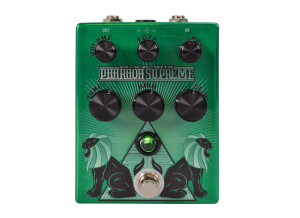
    SOUND: This is one nasty fuzz and Black Arts Toneworks has received a lot of worthy praise as a result! Although I created a demo of how some settings sound on a Clean channel, I couldn’t resist throwing in the effects on a High-Gain channel (reminiscent of a chainsaw cutting through hardwood!). What makes this fuzz so appealing is that it’s as much distortion and drive as it is fuzz… giving that intense graininess to the tone, which becomes massive in sound when playing in the lower registry. Besides the VOLUME and FUZZ knobs, which are fairly straight forward (and a little goes a long way with the Fuzz), there is a TONE knob and a HIGH knob. These work well together in that you can roll off the highs with the Tone knob, and then reintroduce them with the High knob. You may think “why not just increase the Tone knob for more highs?” Well, you may want to introduce more lows and need to sneak in more highs at the same time. A very nice knob combination and plenty of tone to go around! There is a LO/HI switch, similar to what you would find on an amp – offering a deeper and darker sound (more headroom and less clipping) vs. one with more treble definition (less headroom and more clipping). I like the ‘on the cutting edge’ of the HI setting, and so the demo is based on that. The other switch is a diode selector, which allows for different modes of clipping; you can select Silicon Diodes (for an edgy distortion) or Asymmetrical Germanium clipping diodes (for a warm, tube-like sound). However, when set in the middle you get the cleanest, loudest signal and no clipping, which is where I left it for the demo (which was running over 9-minutes without experimenting with the other settings… did I mention plenty of tone to go around?). When you factor in all the possible settings it won’t take long to discover that you can get some very warm overdrive and boosting from the Son of Pharaoh, or perhaps some meaty distortion. And you certainly can get a full assault of one of the hairiest fuzzes you’ve ever heard. All of which cleans up nicely with the volume control. OVERALL IMPRESSION: Encased in steel, the Son of Pharaoh has a metal foot switch and plastic knobs. The Diode and Lo/Hi toggle switches are metal, located between knobs for better protection. The foot switch is far enough removed from the knobs that there shouldn’t be an issue of damage caused by stomping. The standard 9v power input is located at the back, as well as the input-output – far from harm’s way. For those not into fuzz pedals, the Son of Pharaoh may change your mind. It can be so subtle and warm, grainy and distorted or simply massive that it rumbles the floor and walls around your speaker. On that note, this pedal also works very well for Bass guitar, offering thick fat fuzz tones without low-end loss or sounding squishy or flabby. As well, it should be noted that this is the SAME pedal as Black Arts Toneworks’ PHARAOH… merely in a smaller footprint to save you room on your pedal board. EASE OF USE: The pedal is not difficult to use… pure analog and no digital screens, etc. However, there is some playing around required among Tone, High and Fuzz knobs… and how they sound with the Lo/Hi setting and what diode you use (which can affect where you want to set the knobs, but also your Volume). There are absolutely no downfalls, except it will not operate on a battery and you need a separate power supply (basic 9V).

  • « Mild overdrive... Crunch... Classic Distortion... Metal and Super Heavy Fuzz are all here! »

    SOUND: Black Arts Toneworks has been developing some of the heaviest sounding pedals imaginable, and Tres Diablos Ruidosos (Three Rowdy Devils) is no exception. Below is a YouTube video with various sound samples. This pedal is not a one-trick pony. There are three volume/gain knobs that can provide a modest boost, a sizzling gain, a thick crunch, classic distortion and over-the-top fuzz with a bass rumble that screams Doom Metal. The three gainstage knobs each has its own drive/frequency, providing higher end and lower end output you are able to mix and match for dozens of tonal possibilities. OVERALL IMPRESSION: Encased in steel, the Tres Diablos Ruidosos has a metal foot switch for ‘on’ and ‘off.’ The volume/drive knobs are plastic and far enough removed from the foot switch that there shouldn’t be an issue of damage caused by stomping. The input and output are located in the back, as is the standard 9v power input… far from harm’s way. You can achieve mild boosting to more classic crunch and distortion, all the way to the thickest and fattest fuzz I ever heard (apart from other Black Arts Toneworks pedals, I should add). Guaranteed you will spend hours tweaking and experimenting, and even be inspired to compose music that reflects Tres Diablos Ruidosos’ unique characteristics… it’s difficult not to crank out some heavy riffing with this pedal. EASE OF USE: This pedal is straight-forward, but the tonal variations are varied enough that it will take some getting used to, to find the tone you want, and certainly to discover tones you never thought possible with an array of drive, crunch, fuzz, etc. As well, each knob not only increases its own gain, but will increase volume. Consequently, backing off on the guitar’s volume may be required at times (since increasing one pedal knob will give a boost to the signal), but that’s part of the fun, since volume knob experimentation will help you discover even more tonal variations beyond what is possible just in the pedal. Uncomplicated in the general sense (three knobs), anyone into distortion and fuzz pedals with love the Tres Diablos Ruidosos, even if you’re using it primarily for some thick crunch. The only drawback is that it does not run off a battery… you need a power supply.