Log in
EN
FR

Cusack Music

20 products found

Categories
Filter
Sort by
Evaluation
  • Reviewed or not
  • Editor’s award
  • Reviewed by Audiofanzine
Availability
  • Available or not
  • Sold new or used
  • Sold new
  • Sold used
Must-have products
  • All products
  • Flagship products
  • Best rated products
  • Hot products
  • Popular products
Price
  • Freeware
€
Clear
Sort by
  • Popularity
  • User ratings
  • Price - low to high
  • Price - high to low
  • Used price, increasing
  • Used price, decreasing
  • Name (from A to Z)
  • Name (from Z to A)
  • Added on
Choose a category
Sort results
  • Popularity
  • User ratings
  • Price - low to high
  • Price - high to low
  • Used price, increasing
  • Used price, decreasing
  • Name (from A to Z)
  • Name (from Z to A)
  • Added on
Filter results 20 results found
Evaluation
Availability
Must-have products
Price
  • Freeware
Show results

The best Cusack Music reviews

The reviews Audiofanzine members found the most helpful.
  • « More than a Fuzz, but an Awesome Overdrive that Offers Plenty of Tones »

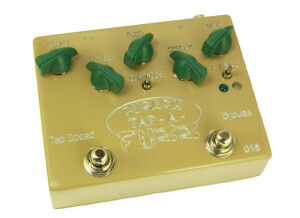
    SOUND: Although called a Screamer Fuzz Germanium it’s not strictly a fuzz-sounding device and offers a lot of different tones. Certainly there are some nice thick and grainy fuzz tones, but with the combination of an Overdrive you can create a wide mix of sounds that range from strictly mild overdrive, to heavy distortion and fuzz. The easiest way to describe the sounds over the three settings (whether using just the drive, the fuzz or both) is that the Germanium setting has a thicker and darker tone, the silicon setting has a smoother and more biting quality, and the LED setting has a louder and more aggressive (punchy) character that blends some characteristics of the other two. The Tone knob has a very wide range, from heavy and dark to somewhat piercing, and so whether your amp, pickups and other gear is on the dark side or bright side it’s easy to dial into a pretty awesome sound. The range of drive is significant, in that turned low (9-o’clock) you can hear some added energy in your tone and when pushed (3-o’clock) you can achieve some very nice ‘breaking-up’ qualities, but without masking the original sound of your amp and gear. However, add in even a modest amount of fuzz (8-9 o’clock) and you not only get into some fantastic distortions, but the volume increases quite a bit, making for an awesome boost. Overall, as you fiddle with the Drive, the Fuzz and the output Level there is plenty of headroom on tap. As an added bonus, the Screamer Fuzz Germanium cleans up exceptionally well – crank up the Drive and Fuzz to about 12-noon each and the sound is fairly massive, but dial back on the guitar’s volume knob (to about half-way or less) and you get a good dirty crunch tone. Of course, all of this pertains to a clean amp channel. When working with a high-gain or dirty channel, the levels on this pedal will be affected by how dirty the amp signal is, but also how high the gain is on that channel. Typically just a touch of fuzz and drive on the Screamer Fuzz Germanium will go a long way to hot-rod your dirty channel and without robbing it of the original characteristics and sound. It’s like modding a 5150 amp head… it still sounds like a 5150, but with an extra set of balls. OVERALL IMPRESSION: Fuzz is not for everyone, including pedals that sound like a hive of bees (a very particular taste); and I get that sentiment. However, Cusack Music’s Screamer Fuzz Germanium is one of those fuzz pedals for people who don’t like fuzz pedals (and also for those who do). This is a new take on the original Screamer Fuzz but with a Germanium setting as opposed to a Shottke clipping diode. You can use the Drive exclusively (the germanium diodes go into the Drive section, which then affects the Fuzz thereafter), which is a great sounding overdrive that is quite versatile considering the three clipping options (germanium, silicon and LED); and when you add a touch of Fuzz the sound is far more comparable to a dirty, gritty overdrive or distortion. It’s only when you start cranking the fuzz to about 10-o’clock or beyond that you get that mistakenly obvious fuzz tone… although I find on any of the clipping settings the quality of fuzz is more robust and organic rather than fizzy and overly-saturated. Factor in a highly usable Tone control and one of the most dynamic ranges of settings possible among all the options to craft your own sound (or series of sounds) and the Screamer Fuzz Germanium is a solid buy at $205 USD. Regardless, this is a limited production model with about 35 units remaining. If sold out, do check all the other Screamer Fuzz pedals over at Cusack Music since this company is the real deal when it comes to high-end boutique-like pedals at very reasonable pricing. GENERAL USE: The clipping setting determines if you’re looking for a fatter and darker tone (Germanium), a tone that cuts through the mix a bit better (Silicon) or a tone that has an aggressive boosting quality (LED). The Tone knob works as it should, and with a wide range of dark-to-bright it’s easy to dial into something that works with any gear – fatten up that thin sounding Strat or brighten up those muddy humbuckers. The next consideration is what type of tone you are after, since you can use a lot of Drive, a lot of Fuzz or a combination of the two in various amounts. When focusing on Fuzz the Drive adds some saturation to smooth the signal, but at the same time makes the Fuzz sound a bit angry (a fuzz-distortion type of mix). When focusing on the Drive you can achieve a very classic amp-pushing quality with a lot of Drive and only a hint of Fuzz (you would not think this a fuzz pedal with such a mix, but a fantastic sounding drive/distortion). Add in even more Fuzz and you begin getting a fatter distortion and eventually an unmistakable fuzz tone. The results are even more widespread depending if you are adding the Screamer Fuzz Germanium to a clean or dirty channel. Depending on how ‘clean’ the channel, you can really crank up the pedal with awesome results. With dirty channels that verge on high-gain it is best to add low amounts of Fuzz (8-o’clock) and Drive (9-10 o’clock) for that extra dimension so that you get a super high-gain result. OTHER DETAILS: A standard sized pedal made of heavy duty, lightweight aluminum with an attractive and textured Terridium finish, the Screamer Fuzz Germanium’s graphics on the pedal reminds me of the Periodic Table of Elements, giving it a unique look and style. Measuring 112 mm (L) x 60mm (W) x 50mm (H) (4.4 x 2.36 x 1.97 inches), the footswitch is a soft-switch, which means it does not ‘click’ when engaged or disengaged. The three-position clipping toggle switch is solid when moved and is sandwiched among the four proprietary milled aluminum knobs. The four knobs controlling Level, Tone, Drive and Fuzz all have good quality pots (smooth and solid when turned). The cable input and output are located in the back of the unit, whereas the power input is located on the side and about mid-way long the pedal (far from any foot-stomping that may take place). The LED to indicate on (red) and off (green) has a nickel plated brass bevel around it, and is located at the top of the pedal. You can disengage the green LED (when the pedal is not in use) by holding down the footswitch for a second. However, I like this feature, particularly for dark stages, since you know where this pedal is even when not in use (via the green light). The Screamer Fuzz Germanium can work on a standard 9V battery or via a standard 9VDC (center -) power supply, while consuming only 7mA of power.

  • « Great combination of 2 old favorites »

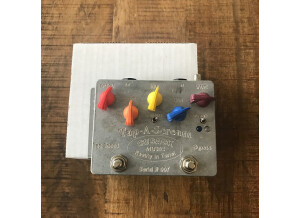
    The Cusack ScreamerFuzz, as the name sort of suggest, is a combination of a TubeScreamer circuit with a FuzzFace circuit. You don’t get a tone control but you get a level, screamer and fuzz control. The pedal is analog and has true-bypass. It works with a standard 9v battery or a power supply. I owned the 1st version. You get 2 pedals in one and then some!! UTILIZATION Getting a good sound from this pedal is pretty easy, because there are a LOT of great sounds in this pedal. First of all, you can use it as a TS, keep the Fuzz control at 0 and you have a really nice Tubescreamer pedal. Keep the screamer level at 0 and you have a cool fuzzface. The beauty is with the combination. You can really get great tones from the combination. The ScreamerFuzz can get you anything from a low gain overdrive up to MASSIVE amounts of gain and sustain if you run Screamer and Fuzz levels high. There’s always a great amount of output as well so it can also work as a boost. SOUND QUALITY Combining a TubeScreamer and Fuzzface in 1 pedal is a great idea. It makes for a VERY versatile pedal. Most of the time, I run it into an overdriven amp, keep the Screamer level pretty low and the fuzz about halfway. Use the level control to get a bit of boost. Now you can get all sorts of tones with picking dynamics and use of your guitar’s volume control. It’s like an infinite channel-switcher. The Fuzz-side helps to clean up the signal when you dial back the volume and with the volume flat out, you get big FAT fuzzy OD tones. It works well with humbuckers and single coils, when running my LP into this pedal, I can get pretty damn close to the big fat fuzzy tones from Joe Bonamassa and Eric Johnson! OVERALL OPINION Tubescreamer and Fuzz are a winning combination and I’m surprised that this pedal doesn’t get more praise. I love it!

  • « Individual Crunch & Lead Channels with a lot of Tone Flexibility »

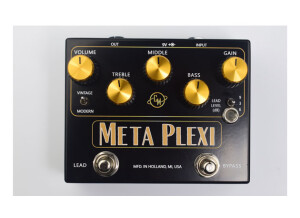
    SOUND: I’ve worked with a number of Plexi-based pedals and find the Meta Plexi to have the best sound and the greatest diversity when working with various amps (including pushing the Gain on the pedal with a clean amp or adding a bit of Gain to an already dirty amp). I used the Meta Plexi with two clean channels, which I’ll address first: the Amp1 Iridium (by BluGuitar) and The Countess V4 (by Victory Amps). The Iridium had more of a bite (since it’s a solid state with nanotube technology), whereas The Countess was warmer (since it’s a 4-tube preamp). In both instances the Plexi flavor was strong and sounded great. As well, even with the Gain all the way down there is a nice grainy crunch effect, ideal for soft to moderate Rock. For rhythm, I find the Gain can range from all the way down to about 12-noon (now entering Hard Rock and Hi-Gain territory). Once past 12-noon the ‘heaviness’ and saturation picks up so that it seems more appropriate for lead, unless you like that thick wooly sound. When working with gain channels, a very little goes a long way (Meta Plexi’s Gain either all the way down or up quarter-way at most). I applied this to the various gain channels on the Iridium (a Metal amp), as well as three Victory preamps: The Sheriff (a Plexi-based sound), The Countess (warm, thick hi-gain) and The Kraken (edgy hi-gain). The Meta Plexi, in all instances, added that overdriven bite exceptionally well, able to work with multiple platforms. The Meta Plexi also has two modes: Vintage and Modern. The Vintage has more ‘headroom,’ dynamics and note nuances, whereas the Modern sounds creamier and smooth (with a touch of mid scoop in comparison). The EQ is quite varied, in that a touch of Treble, Bass or Midrange makes a difference and certainly proves useful in crafting a host of various tones. When engaging the Lead switch you have the option of Boosting the signal by 3dB, 6dB and 9dB – obviously 3dB is subtle, yet audible, whereas 9dB is far more obvious in the mix. GENERAL USE: The Meta Plexi engages and disengages via the Bypass Switch. When Lead is not selected the LED is off when the pedal is bypassed, but Red when engaged. When Lead is selected and the pedal is on the LED is yellow, but is green when bypassed (to also indicate that when you turn it on it will be in boost mode, rather than finding out unexpectedly when you hit the bypass switch to turn it on). Consequently, there is a modest learning curve to know when the pedal is on or off based on whether the Lead function is engaged or not. The Volume and Gain controls work together, in that more Gain may require a reduction in Volume and vice versa. On a clean channel the Gain will range from grainy and crunchy when turned all the way down to thick and saturated when turned up and beyond 12-noon. The EQ works as usual, with Bass, Midrange and Treble controls, all of which are touch sensitive enough so that a tweak from any of them can make a difference in sound (the Meta Plexi works exceptionally well for those who like to scoop the Mids or produce any other type of tone nuance). When engaging the Lead function, there also is a Boost control that enables you to bump up the volume by 3dB, 6dB and 9dB. I find a modest 3dB enough, but that would depend on other guitarists in a group and how much push the Lead requires. It’s nice to have options, which the Meta Plexi delivers. Finally, there is a Vintage and Modern setting. Vintage has more dynamics and note definition in the mix (more headroom as well), whereas the Modern setting has a more even saturated tone, along with a touch of Mid scoop. I like the Vintage setting when combined with a clean amp, whereas the Modern setting definitely is required when adding the Meta Plexi (as an OD) to an already driven amp. OTHER DETAILS: The Meta Plexi measures 90mm(D) × 115mm (W) × 50mm (H) or 3.54 (D) x 4.53 (W) x 1.97 (H) inches. A solid built pedal, it has a black aluminum chassis and gold/white screen graphics. There are two ‘soft’ footswitches (Lead and Bypass), neither of which produces any audible sound when engaged or disengaged. The two toggle switches (for mode and dB level) are solid and easy enough to flip into place. The five plastic knobs, reminiscent of a Marshall amp, are of good quality and the pots feel smooth and solid when turned. The modulation type pushbutton switch also feels solid and engages the intended effect (chorus or vibrato) without any issues. The footswitches are far enough removed from the LED, toggle switches and knobs that damage from use should be avoided. The input, output and power insert all are located in the back, thereby saving some pedalboard space while keeping cables further from a stomping foot. The Meta Plexi requires a 9VDC standard power supply (negative tip) while drawing less than 20mA of current. OVERALL IMPRESSION: This pedal sounds and looks great. Not many could argue gold hardware and writing on black and the sound is authentic to the Plexi heritage. Not only do you get that unmistaken Plexi grain and bite, but you can have it with a Vintage (dynamic) or Modern flare (tight) and with a Lead function that boosts the signal just enough and to your liking. The Meta Plexi sounds awesome with a clean channel, turning any clean amp into a Marshall beast, but works exceptionally well as an overdrive with already driven amps (from low-gain to hi-gain and everything between). I’ve worked with various Plexi-based pedals and had my favorites, but the Meta Plexi has taken the number one spot and for several reasons – it reproduces the Plexi qualities faithfully, it offers a wide array of tone possibilities and it works with anything from ultra-clean to hi-gain nasty. There are no apparent limitations, unless you are looking for a low-gain OD type pedal. Even with the Meta Plexi’s Gain all the way down, there is enough drive for moderate Rock music. If that is too harsh, you would need to adjust your guitar’s volume, as well as your clean amp’s gain.