Log in
EN
FR

Driftwood Amplifiers

8 products found

Categories
Filter
Sort by
Evaluation
  • Reviewed or not
  • Editor’s award
  • Reviewed by Audiofanzine
Availability
  • Available or not
  • Sold new or used
  • Sold new
  • Sold used
Must-have products
  • All products
  • Flagship products
  • Best rated products
  • Hot products
  • Popular products
Price
  • Freeware
€
Clear
Sort by
  • Popularity
  • User ratings
  • Price - low to high
  • Price - high to low
  • Used price, increasing
  • Used price, decreasing
  • Name (from A to Z)
  • Name (from Z to A)
  • Added on
Choose a category
Sort results
  • Popularity
  • User ratings
  • Price - low to high
  • Price - high to low
  • Used price, increasing
  • Used price, decreasing
  • Name (from A to Z)
  • Name (from Z to A)
  • Added on
Filter results 8 results found
Evaluation
Availability
Must-have products
Price
  • Freeware
Show results

The best Driftwood Amplifiers reviews

The reviews Audiofanzine members found the most helpful.
  • « Thick, full and amp-like, with a lot of features! »

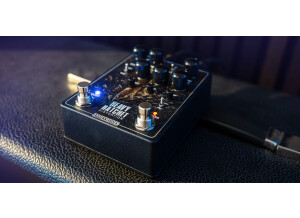
    From classic rock to modern metal, Driftwood Amp’s Heavy Hatchet delivers a wide range of tonal qualities, and with a host of options. There are two ways of running Heavy Hatchet (and with 200 mA standard power supply), either in front of an amp or through an amp’s Send/Return (set via a toggle switch). You then have four Mode combinations – select between Vintage or Modern, and then select whether you want a high-gain or lo-gain response. https://www.youtube.com/watch?v=Dv8A0cJE6Xk From there you begin sculpting your tone with several on-board tools. The Gain is pretty thick and meaty, even when dialed back and on Vintage/Lo-Gain setting. The three-band EQ is the typical Bass, Midrange and Treble, and they do produce a very large and usable range. Full bass and midrange are a bit much, insofar as I don’t think many people will go to those extremes, but those ranges are there if you need them. Regardless, pushing any of the EQs do not produce flubby bass or harsh treble. There are three small knobs below the EQ knobs. Rumble adds depth, and its perfect for keeping bass tight and within reason in the mix, yet remain punchy with obvious bottom end. The Sharp knob is like a presence control, and provides that clarity and brightness. The internal Gate is wired in a 4-cable manner and it works exceptionally well – there does not seem to be any tone drain, or at least nothing noticeable to my ears, and even with very high gain on the Modern setting this is a darn quiet pedal without the gate on at all. With the gate up full, you can achieve some intense chugging attacks. Finally, Heavy Hatchet comes with a boost, based on a Tube Screamer design (although without a middle hump honk). It engages separately (foot switch), with the blend controlled via the Boost knob. There are two things I like about the Boost’s knob control: First, as you crank it up, the signal becomes more aggressive, but not muddy and washed out; and second, there is only a modest volume increase, so that switching the Boost on/off does not produce a blatantly noticeable volume drop or increase if it happens to be up full. I find the Boost makes the signal hotter with more snarl, as opposed to making it significantly louder, which is how I prefer it. Also note that how the boost interacts with the settings vary, in that you do get a more vintage sounding boost on the Vintage setting, and a more modern boost on the Modern setting. Very cool, and I can hear this, as the Vintage remains a bit more open and flowering, whereas the Modern has a tighter, more aggressive, and saturated quality. At 279€, Heavy Hatchet is very much on par with today’s boutique pedals, and it delivers for every penny. ‘Amp-like’ is a bit of an overused term, like ‘organic,’ but if the terms fit, they fit. With all controls flat, this pedal was impressive to the ears upon first plug-in. Thick, rich, sounding like a hi-gain distortion amp, and with clear detail and definition in the grain. I find it as impressive as the Purple Nightmare tube preamp, which I’ll be doing a sound comparison in an upcoming video. On that note Heavy Hatchet is not an exact replication of the Purple Nightmare preamp; they have similar qualities (maybe in the gain-stage structure, but I’m guessing), but are different flavors of that Driftwood sound. I find the Purple Nightmare preamp sounds warmer and more ‘gooey,’ and likely due to its tube and perhaps some differences in electronics, but you can be the judge. Overall, two confident thumbs up for Driftwood Amp’s Heavy Hatchet. Some Extras: Comparing the Heavy Hatchet distortion to the Purple Nightmare Preamp (pretty darn close), and hearing how the Heavy Hatchet cleans up, and if there's a sound difference whether in front of the amp (distortion mode) or in an amp's FX Loop (Preamp mode). https://www.youtube.com/watch?v=NS9-XbDNIiE

  • « 2W Amp + Preamp with Killer Tones from Rock to Metal »

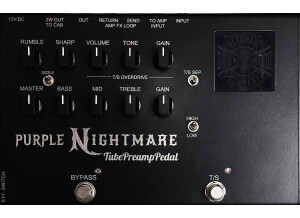
    Now and again, gear comes along that blows me away, and I am sure others have had that experience. The Purple Nightmare Preamp (based on Driftwood Amp’s flagship Purple Nightmare head) follows suit with incredible sound and indispensable features. Do understand that although marketed as a ‘preamp,’ which it is, it also is a 2W (Mosfet power) amp with two 12AX7 tubes that can drive cabs from 4-16 Ohm. This amp/preamp has an internal charge pump that converts a 12V 1.5A input to 250v DC plate voltage to replicate a full amp head response and sound. Is it loud enough (though a 4x12) not to be drowned out by a heavy hitting drummer? Well, this is an amp made for hard rock to high-gain (although light rock is possible) and it may not cut mustard beyond a practice and recording amp, but there are easy solutions, which Driftwood Amps addresses. You can go direct to another amp’s power section (FX Return), and use the Purple Nightmare as a preamp, integrate the PN with another amp via the 4-cable method, thus providing another amp solution, go direct to the front end of a clean amp, or go to a separate power amp and then to a cab. The demo video goes through the different features, along with sound samples, but I will address those here and in brief. There is the amp section, but also a built-in Tube Screamer style overdrive section. Both can work independently (so that when the amp section is off, the TS OD still is available in the chain to boost another amp), or they can work together (when you bypass the amp, the TS OD turns off as well). The tone and aggression can be set to low-gain or high-gain, although note that ‘low’ gain is on the moderate to hard rock side of things, unless you keep the Gain down and your guitar’s volume knob backed off. (In that regard, my Ibanez Quantum has very clean pickups and I can get dirty clean sounds from this amp; and so, it depends how hot your pickups are.) The amp section’s main controls are basic, including Volume, Gain, Bass, Mid & Treble, and every bit of the EQ section is usable and provides a good range of tones – no flabby bass or shrill treble. And to further carve your tone, there is Rumble (tight low end mids) and Sharp (which brings out the highs and acts like a Presence knob). Driftwood also added its famous ‘Sizzle’ switch (off/lo/hi), which does just that. This is not a high-end treble response, but ‘bacon frying on a grill’ quality, which has a slight fuzz characteristic, but not exactly. It does not sound like a fuzz, and so… sizzle likely is the best term, or perhaps a smooth grainy growl. The TS section does as much for the tone, and aggression, as does all the other controls. There is no mid-hump with this TS, however, and it coordinates and sounds so great with the amp section – a perfect pairing. Overall, there is so much gain and bite that an external OD is unwarranted. The TS has Volume, Tone, and Gain controls. With its Gain up high (and the amp’s low), it sounds very different than with the TS Gain low and the amp’s Gain high, thus producing different tonal qualities in that respect, besides altering compression. And so, we have an amp that also doubles as a preamp, which has a built-in ‘Burn’ channel via the TS OD. There are two clipping stages, the first of which has more of a hard rock sound, whereas the second stage enters metal territory. Possible tones range considerably, although there may be a ‘Purple Nightmare’ sound quality; but I find this amp far more flexible and ranging than something like a Diezel amp, which I do like. But the PN can thrive in different realms, from the dark, thick, and woolly to a great mid-scoop 80s, to modern punchy metal as you mix in more mids. The quality of the gain is growly, but the ‘grain’ is not overly robust and rumbly, not to be confused with the Rumble knob, which produces tighter low-mids. What further impresses me about the Purple Nightmare is that it has its own unique characteristics… it does not sound like you are playing a Diezel, a 5150, an ENGL, etc., thus providing a distinct alternative to those wanting a sound that is less mainstream, yet very pleasing to the ears. Of course, your cab choice and quality is as important, but I did use a V30 4x12 cab IR in my demo and it does come across slightly different, almost like combining a V30 with a Rectifier cab. The Purple Nightmare Preamp has so many useful features, yet it is not confusing to use. Quickly, you get a sense of what switch to flip or knob to turn as you dial into killer tones, whether straight-on rock up through to industrial metal mayhem. The Driftwood window is a nice feature, glowing purple and making for a visible target on a dark stage. All the pots feel good to the touch, and it has good quality construction with an aluminum chassis, measuring 23cm x 15cm x 4.5 cm (approx. 9 x 6 x 2 inches) and weighing only 974g or 2.1 pounds. If you are into hard rock or metal, the Purple Nightmare Preamp needs to be a serious consideration. I have other high-gain preamps and amps (e.g., Kraken, Diezel Herbert, etc.), which are slightly less expensive, but definitely not as impressive as the Purple Nightmare.