Log in
EN
FR

Realistic

36 products found

Categories
Filter
Sort by
Evaluation
  • Reviewed or not
  • Editor’s award
  • Reviewed by Audiofanzine
Availability
  • Available or not
  • Sold new or used
  • Sold new
  • Sold used
Must-have products
  • All products
  • Flagship products
  • Best rated products
  • Hot products
  • Popular products
Price
  • Freeware
€
Clear
Sort by
  • Popularity
  • User ratings
  • Price - low to high
  • Price - high to low
  • Used price, increasing
  • Used price, decreasing
  • Name (from A to Z)
  • Name (from Z to A)
  • Added on
Sort results
  • Popularity
  • User ratings
  • Price - low to high
  • Price - high to low
  • Used price, increasing
  • Used price, decreasing
  • Name (from A to Z)
  • Name (from Z to A)
  • Added on
Filter results 36 results found
Evaluation
Availability
Must-have products
Price
  • Freeware
Show results

The best Realistic reviews

The reviews Audiofanzine members found the most helpful.
  • moosers's review

    The Realistic PZM (pressure zone microphone) is a microphone that I have used in the recording studio. Like most microphone of this nature, it can cross over to the live show world, but I've only used it in the studio, so my review will be about the use of the mic in this type of setting. Realistic is a brand put out by Radio Shack, but is no longer a company as far as I know. However, they did make some interesting gear that is useful, and included in this category are the Realistic PZMs. OVERALL OPINION The only application that I've used the Realistic PZMs for is an acoustic grand piano. Putting this under the hood of the piano not only gives your sound isolation, but also gives it an up close and personal feel. Of course depending on where you place the mics, you can get a wide array of sounds, but I generally keep the Realistic PZMs by the strings rather than the hammers, as this is what I would do with and PZM microphones inside of an acoustic piano. While the Realistic PZMs might not be the cleanest or more in depth sounding microphones out there, the fact that you can slide them just about anywhere more than makes up for this. I really wasn't expecting too much from these microphones since Realistic isn't exactly known for making high quality microphones, but I was definitely pleasantly surprised. It seems like there are a few gems made by Realistic that have fallen through the cracks over the years, and while I wouldn't call these microphones 'gems,' they are good sounding mics. I don't know how easily accessible these are, but I would imagine that they wouldn't be the easiest microphones to find since they haven't made them for years and are somewhat of an off brand. However, if you see them in a studio you're at like I did, definitely give them a whirl if you need a PZM!

  • moosers's review

    The Moog Music / Realistic ConcertMate MG-1 is an analog synthesizer made in the early 1980s. It is about two and a half octaves and has 32 keys. Unfortunately, it does not have a pitch or modulation wheel, which is one of this guys only flaws. It has an instrument cable jack in the front and has pitch and trigger outputs and a set of RCA outputs and aux outputs. I have only used the instrument cable in the front when recording direct or sending it to an amplifier. UTILIZATION The setup of the synth is pretty easy to follow, but takes a bit of time to really get to know what everything can do. I've gotten a wide array of sounds from this and I am never surprised when it makes a sound I haven't heard it make before. If you know a lot about synthesizers I'm sure you can figure out easily what everything does, this is my first synth so I'm probably not as experienced with synths as some of you out there. The manual is very helpful and includes a bunch of presets that really demonstrate the variety of sounds you can get with this guy. SOUNDS The sounds this Moog makes suits my style in situations that I feel it is necessary to use it in. Whenever I use it it always sounds good, but I don't always use it. You can get a classic moog lead synth or bass sound with this as well as a plethora of other sounds, most of which are hard to describe. Most of the sounds you can get with this are very realistic sounding and usable and it is a great tool for getting some great synth sounds OVERALL OPINION I've had my MG-1 for about four years now. Even since then the price seems to have raised for these guys if you can get one on ebay. It is a true Moog and while it is not as diverse as a Voyager, it sounds great for what it does. While it is small, it is enough keys for me to play the parts I want to play. The only real problems I have with this are because it needs to be serviced and cleaned as it is almost 30 years old. Most of the time it works fine. The biggest downfall in the make up of the MG-1 is its lack of a pitch and modulation wheel, as I feel the pitch bender is almost necessary to have while playing a Moog synth. The price is just about as cheap as you can pay for a Moog synth, as this is the lowest end model of the true Moog synths. Of course I would love to have a Prodigy or a Rouge, or even a Voyager, but the difference it price made the MG-1 my only option. I'm glad I have it and I hope to hold on to it for a long time!

  • moosers's review

    The Realistic Concertmate-500 is a sampling keyboard that is the same keyboard as the Casio SK-1, but is under a different name as this was sold at Radio Shack (Realistic was a Radio Shack brand). The Concertmate-500 is pretty hard to find, at least more hard to find than the SK-1 is. Although I haven't used the two of them side by side, as far as I know they're the same exact keyboards with the same controls and all. It's got a built in mic for sampling purposes and the sampling is just 8 bit, so it's pretty down and dirty. I don't know the connections that it has off the top of my head, but all you really need to know is that you can take a signal out of it when necessary. UTILIZATION The Realistic Concertmate-500 has a number of features beyond the sampling, but I've really only used it for the sampler. It does have a number of built in sounds and drum loops, all of which are incredibly cheesy. However, navigating around it's setting controls isn't difficult at all as it's all in layman's terms and after playing around with it for a little while users should be able to become accustomed to it. I don't think the manual is necessary, but one should be readily available if needed. OVERALL OPINION Again, beyond the sampler itself, the sounds on the Realistic Concertmate-500 are deifnitely pretty cheesy, but I can see them being useful in situations where you might be looking for some cheesy synth sounds. Of course almost everyone is going to be using the Concertmate-500 for it's sampler, and that's definitely where this is going to be most useful. Even though the sampler only takes in what you give it at an 8 bit and 9 kHz rate, it's kind of part of it's charm...

  • « It's alright... »

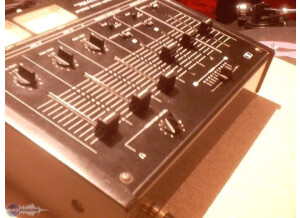
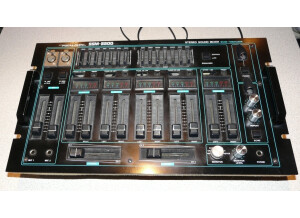
    The Realistic 32-1200B has a couple characteristics for its use. It's a rackable mixer with connections of RCA and Jack connections. It doesn't have XLR microphone connection, just a jack connection for microphones which isn't very convinient. It is an analog DJ Mixer for turntables that isn't so great. It has an amount of 3 mic channels, 2 channes for the turntablesa crossfader and a master volume. In the back it has 1 AUX input and one Tape Input as well as a Main Output, a Tape Output and Phono 1 and 2 Inputs. It has no effects section on it, not EQ or mixing... just faders. UTILIZATION It's easy to use. All you need to do is connect the turntables to the Phono Inputs and wire the ground and your set. Then all you have is faders and volume channels and microphone channels. It was easy to put together and the manual was easy to understand. SOUNDS The sound quality isn't good... It makes a big hiss and has a lot of mass sound to it. When you play a turntable with it, the quality of the sound isn't good as it's hard to hear because of all the hissing and mass. It has no EQ, so there is no way to control it. OVERALL OPINION I like that it was easy to use and it was good to start off my DJing, but if you're more professional, there are way better options to choose from. I didn't like the characteristics and tools of this mixer nor the sound quality which was poor. I also desliked the smoothness of the faders. It was stiff and hard to move. The price was decent, pretty cheap, wasn't a big of a deal. The sound quality as I said, was poor and it created a lot of mass and hiss which was hard to egt rid of. I hadn't tried any models before this one, since i started off with this mixer. This mixer isn't very good and you are better off looking for other DJ mixers.