Log in
EN
FR

Hagerman Amplification

17 products found

Categories
Filter
Sort by
Evaluation
  • Reviewed or not
  • Editor’s award
  • Reviewed by Audiofanzine
Availability
  • Available or not
  • Sold new or used
  • Sold new
  • Sold used
Must-have products
  • All products
  • Flagship products
  • Best rated products
  • Hot products
  • Popular products
Price
  • Freeware
€
Clear
Sort by
  • Popularity
  • User ratings
  • Price - low to high
  • Price - high to low
  • Used price, increasing
  • Used price, decreasing
  • Name (from A to Z)
  • Name (from Z to A)
  • Added on
Choose a category
Sort results
  • Popularity
  • User ratings
  • Price - low to high
  • Price - high to low
  • Used price, increasing
  • Used price, decreasing
  • Name (from A to Z)
  • Name (from Z to A)
  • Added on
Filter results 17 results found
Evaluation
Availability
Must-have products
Price
  • Freeware
Show results

The best Hagerman Amplification reviews

The reviews Audiofanzine members found the most helpful.
  • « Pro Sound in a Small Package (for practice or studio recording) »

    Hagerman designed a low watt amplifier for the primary purpose of a practice amp, in order to avoid using and burning up a larger stage amp at home. I can expand on that premise to suggest that many times bands leave gear in a particular location, to prevent having to haul amps, cabs, etc., back and forth. It would make sense that you have some type of practice amp at home, which brings us to inexpensive modelers, which often are good enough for practice. It may be asked why invest in a low-watt tube amp, the ONE WATTER, as an alternative? I see this from two angles. First, there is a tone difference with real tube amps versus modeling gear; the latter may have come a long way, but there’s a certain element of warmth and sponginess that comes with real tubes for those tube snobs uninterested in modeling. Nothing wrong with using or refusing modelers. Second, the ONE WATTER also was designed for direct recording. This amp will drive any 8-to-16 ohm speaker cabinet, but if using a TRS cable (amp out), you can bypass the cab and go direct to a mixer, interface, etc., and use whatever cab sims preferred. https://www.youtube.com/watch?v=v0wV__um2f4 The ONE WATTER has a clean channel and a boosted channel. The clean channel sounds very clean with single-coils, and fairly clean with humbuckers (a bit of hair, but if you dial back on the guitar’s volume, it becomes very clean). To avoid any modest grit with humbuckers, using the guitar’s volume is key, as the amp’s volume will not change that characteristic. The clean channel uses a 12BH7 tube, which also is driven by a 12AY7 tube (paralleled sections) running single-ended into an oversized output transformer. The boost channel offers up to +28dB gain boost (150 to 3kHz). It utilizes an EF86 tube that adds 2nd harmonic warmth to the tone, but also overdrives the first 12AY7 stage, thus giving it a slight treble boost (to reduce mud), and also a breakup sound that ranges from a hint of grit (turned all the way down) to classic rock dirt and crunch when pushed past 12-noon. With the boost on and gain all the way up, there is enough drive to produce decent lead tones (I like crunch with the Gain set around 11 to 1-o’clock). But it takes only a basic drive pedal to make it sing with sustain. And certainly, you can add drives and distortions on the already boosted channel, but the clean channel sounds excellent on its own as a pedal platform, whether using a basic blues driver, fuzz, or delving into modern metal pedals. Now, in the first demo I indicated that this amp reminded me a lot of Fender amps, insofar as its tone. However, Jim Hagerman offered these tips, which I demo in the second video: “Tone controls are pretty flat at noon, so a bit like a tweed. Set both BASS & TREBLE to maximum and you get a Fender blackface sort of midrange dip. In between is Marshally (both at 3-o’clock?).” https://www.youtube.com/watch?v=gzW4-ISNkzg There is a volume increase when engaging the boost, increasing drive, and increasing either EQ control (60Hz to 6kHz bandwidth), and so, some tweaking is required to obtain proper sound levels (same as with any amp). On that note, this is a ONE WATTER when using the clean channel, but it does increase to 3-watts (at 8 ohms) with the boost engaged. That may not sound like much, but it’s irrelevant for direct recording and still pretty darn loud going through a cab for in-home practice (loud enough to annoy others in your house or with apartment-dwelling neighbors). The Hagerman quality definitely is in this 5Ω output impedance amp, and there’s no denying the company’s standards. Very nice tones! I also like its size, at only 9x5x4.5 inches, making it ideal for pedalboard or desktop. It comes with its own 15Vdc power supply (@17W) and a very well-built and attractive chassis. The price is reasonable ($439 USD), considering it’s a tube amp, sounds fantastic, is ideal for quality recording (besides home practice), and makes for an excellent pedal platform. I don’t consider the exposed tubes to be a factor, since it’s not meant to be carted about (FYI, if you’re experimental, you can try different tubes). The ONE WATTER’s only downfall is that it does not have an FX Loop, which can be a deal breaker for some, depending how you need to hook up your gear for practice or recording.

  • « First rate sound from full-bodied cleans to classic rock drive »

    No affiliation to the company. The last review I did on a Hagerman product was the Power Baby (tube power amp in a pedal), and that has impressed me more than any other Hagerman product… it’s one of those always on pedals that make a significant difference in one’s tone and overall note quality (which is true of any power amp… preamps on their own sound good, but something is missing). The Power Baby quickly replaced my power amp sims. It was shortly after that I was very curious about the Overdrive Clipper, a true bypass, all-analog, dual 12AX7 tube pedal preamp designed to mimic classic Dumbly tones, although Jim Hagerman’s design was customized to surpass the original. Them’s fighting words, and it didn’t disappoint. h This is a dual preamp, in that you have full, clear tones when ‘clean’ and then higher-gain with the Clip toggle flipped, thus engaging an all-tube symmetric clipper circuit for some great Rock edge. In either instance, the Tone and Color knobs is what provides a plethora of sounds and in various combinations. The Color control provides equalization, so that anything below 12-noon is smoother, duplicating Robben Ford settings (particularly when minimized), and settings past 12-noon have more edge and cut. The Tone control sweeps through a range of mids, whether looking for something darker or brighter, thus affecting and developing the Color to one’s preference. Again, without the Clip switch engaged, the cleans are fantastic, and make for an excellent pedal platform for distortion, etc., and particularly if looking for more gain than what the Overdrive Clipper offers. I demonstrate this in the demo. Nonetheless, with Drive up full while playing clean, you still get a nice sparkling bite that is very pick sensitive and dynamic. With Clip engaged, you now are into Rock territory and it sounds great… thick and chewy, yet very defined. The Lift switch acts outside the circuit, providing a 10dB boost in gain, which can push rhythm even harder, but obviously is suited best for lead playing. It really helps to make those notes sing and soar. There is plenty of Volume on tape, and I never pushed it to the limit while clean, and often kept it below 12-noon with Clip engaged (which increases volume). There’s also enough Drive for my liking, which sounds good low or full bore when clean (sparkly and some nice breakup). When clipping, I often keep Drive between 11-o’clock and 2-o’clock for rhythm, but may go full Drive, or at least past 12-noon, with lead. Much of this depends on the composition, of course. The way I used the Overdrive Clipper is within a pedalboard format, and then off for direct recording (or it could go to a mixer/PA for live playing). The pedal also can be integrated as a preamp feeding a power amp directly via an effects loop/return (keep tone controls close to flat on your amp and adjust Tone and Color via the pedal’s controls). I am a huge fan of preamp pedals, and the Overdrive Clipper has established itself as one of my main choices, for cleans, solid rock sounds that pop in the mix, but also as a platform pedal with other gear. I also should note that I have Cornerstone’s Imperium, which is a Dumblesque preamp, and although good, it does not compare to the tubes and guts of the Overdrive Clipper. The Imperium sounds more like a pedal mimicking something, whereas Hagerman created a pedal that responds and reacts like an actual amp. The Overdrive Clipper includes a wall-wart power source (+12V @500mA). Other specs include: 52dB maximum gain (no LIFT); 470k ohm input impedance; 3Vrms maximum output; 140V tube supply; and measures 4.7" x 5.8" x 2.3". Two thumbs up! https://www.hagamps.com/collections/pedals/products/overdrive-clipper-dumbly-tube-pedal

  • « Tube Power Amp in a Pedal that will Enhance any Pedalboard/Amp Sim, etc. »

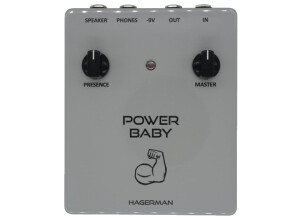
    If you find this review useful, below is a link for a Crowd Funder for Hagerman Amplification’s POWER BABY Power Amp (with a big discount until Oct 11/25). I receive no remuneration or gratuity, and Jim Hagerman is a trusted class act. POWER BABY will be released without fail. https://www.kickstarter.com/projects/1907446723/power-baby-tube-output-stage Hagerman Amplification’s reputation has always been about quality boutique builds at affordable pricing, but also innovation. I’ve tried pedal-based power amps (solid state) and a few digital simulations (Axe-Fx and KMG Machines), and then I heard about the upcoming release of Power Baby, a push-pull guitar power amplifier stage in pedal format that incorporates shock-mounted tubes – 1 x 12AX7 and 2 x 12AU6 with an all-analog circuit. I reached out to Jim Hagerman, as to when it will be available, but I didn’t want to wait an entire month (like most guitarists looking for the latest pedal); and so, Jim shipped off one of his prototypes (nothing more than a circuit board with tubes sticking up, although it offers the same sound as the finished product, which has an enclosed chassis measuring 4.7” x 5.8” x 2.3”). It’s interesting that Power Baby does incorporate a typical tube circuit, yet the pedal does not get hot (only warm) and does not require venting – no worries about dust, liquids or bugs getting inside. What you’re getting is D-style preamp tone from the preamp utilized, together with M-style power amp breakup from the micro-sized Power Baby. https://www.youtube.com/watch?v=kgwWWwbDrSg I’ll get to the sound, response, etc., but here are some things this power amp pedal can do: 1) It can drive an 8 or 16-Ohm speaker at bedroom levels, ideal for practice; 2) It also has a headphone jack, which seems to be a common ‘want’ among pedal users for silent practice; and 3) You can go direct to a mixer/PA or into your DAW interface. And so, there’s some decent flexibility depending on one’s needs. And considering many venues are saying no to big amps, Power Baby is perfect for the gigging musician who goes direct to PA. The demo addresses the above, although all my sampling was done with the Power Baby at the end of my chain (before delay). Sound-wise, I was blown away. I’ve heard many times that what a person often is missing in tone, particularly if working with preamp pedals and a pedal board is that power amp drive, and Power Baby delivers with thick, full pentode tube sag (via internal boost, as if tube rectification was employed), compression, and phase inverter distortion. It does NOT sound like the solid state and pedal simulations I’ve tried, all of which did add to my sound and tone, but no where near the extent of Power Baby. My setup now sounds like a full-blown amp! Also, it comes with a 12VDC 600mA power supply, although many pedal board power supplies have this available. Listen to the demo to know what I’m talking about, as it even works wonders with my acoustic guitar (going through an acoustic preamp pedal) or my digital piano module. Both surprised me, as Power Baby is meant as an additional gain stage to really push an electric guitar playing through some dirt. Power Baby has only two knobs, a Presence and a Master. The Presence is straight-forward, and offers that high-end clarity to off-set the raunch of the tubes, and do they make an impression as you tweak the Master. However, this depends on what you put in front of it. With an acoustic guitar, turning up the Presence and Master up half-way does not make it distorted, but crisp, full of overtones and lively… similar to what it does for the digital piano sample provided (with Presence and Master up full!). You get a tone less processed while sounding more realistic and dynamic. When it comes to placing some type of drive or distortion in front of it, that’s where Power Baby comes to life. The fullness, detail and definition of the notes are amazing, and sometimes you only need a little (the more high-gain the preamp or associated pedals, then less gain from Power Baby required to hit that sweet spot). When listening to the demo I may have went a bit overboard with the Master knob in some instances, but I relished in the heavy growl achieved; dialing in would require hearing it in the mix, which I did in the opening composition when comparing lead riffing with Power Baby on and off. Even with a moderate gain pedal in front of it, you can go from a sizzle, to a slight break up, to a snarl and to a growl. This thing has balls! Also note that the rhythm guitar in the background to the demo’s opening number also utilized Power Baby and produced a great sounding crunch. On a related note, expect to play somewhat differently or to hone your playing skills slightly, because the harmonics and nuances that pop forward are profound enough that you can achieve more tonal qualities from varying your pick attack than what you would notice or achieve otherwise. Power Baby is not coming off my board, unless Hagerman Amplification comes out with something even better. And in that regard, I think this is one of the best creations that Jim has developed. It simply makes a huge difference in what you can achieve with your gear, whether direct recording or playing live. I don’t say that lightly, and it’s a joy to go through all my preamps and distortion/ODs to hear them for the first time again! https://www.hagamps.com/collections/pedals/products/power-baby-tube-output-stage?variant=45504341672130

  • « Incredible Tone Enricher and Fattener »

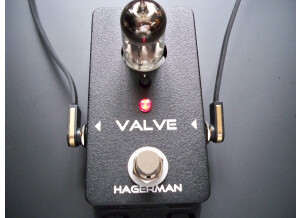
    The VALVE is a ‘keep on’ pedal, and Jim Hagerman classifies it as a boost (upward of 20dB), but it is a tone charmer that has overdrive properties. At $129 USD, the VALVE is one of the best bangs for the buck, as it fattens up a Strat, makes humbuckers growl, and simply adds more life and dimension. Moreover, by placing a boost in front of the VALVE, to push its 12AU7 tube even harder, there is a BK Butler pedal effect, as demoed in the final lead section to the intro composition on the accompanying video. https://www.youtube.com/watch?v=Q2zycMzNb5c Now, keep in mind that this is a tube-driven pedal with no silicon involved, operating in starved-plate and starved-heater mode (viz., the tube receives adequate voltage, but the plate and grid are starved of higher voltages that would bring them within their intended headroom and total harmonic distortion parameters) and all done on a typical 9VDC power supply (also works with 12V). This configuration has not been successful until now, although others have tried. The Matsumi 12V ValveCaster attempts this, but has limited performance due to not addressing grid current at such a low bias. I did indicate what it does to a tone in general terms, but insofar as my own experience, I added the Hagerman Valve to two different tube amps (Orange Tiny Terror and the Peavey Classic 20), as well as the Fractal FM3 modeler. Jim Hagerman claims great things with solid state amps, but I did not have access to that platform. Without fail, the results were superb. This full-bandwidth pedal resulted in tube amps sounding thicker and richer; and the FM3 becomes more energized and realistic. Clean signals sounded glassier and vibrant, merely by placing the VALVE’s ‘level’ at parity (about 9:30 o’clock); and once past that level, there is increasing dirt/breakup, and to the point of a classic rock sound (with level cranked full). And yet, the amp still retains its underlying tonal characteristics. Dirty and hi-gain amps mixed very well with the VALVE, and with greater richness, gain and boost at only 10-o’clock, as though modded and super-charged. Of course, you can get a lot more saturated for those creamy, gooey leads by placing the level all the way up for lead solos. The VALVE is true-bypass and well-built with a heavy aluminum chassis power-coated in black with white lettering/graphics. It comes with a 12AU7 tube, which should be removed during transport, unless you have a protective pedalboard cover/case. Its design permits it to be Velcroed as usual, but also screwed down into a wooden pedalboard or bolted onto a metal unit. As mentioned, it takes both 9VDC and 12VDC power supplies, requiring only 135mA power (150mA if running 12V) via a standard negative-center cable. Other specs include 100k ohm input impedance and 100Hz to 20kHz bandwidth. One caveat is that the VALVE’s level control knob is small, which makes it a bit awkward if changing the level on stage. However, that is where an extra boost comes in handy (such as the Hagerman Boost), i.e., the VALVE can be left on and used to add dimension to rhythms, and then the added Boost engaged for fat leads and that BK Butler effect. NOTE: The company notified me... they added a rubber o-ring where the tube plugs in, making the structure a bit more rugged, and now you can dump a beer on pedal without worry. Tube still sticks out and can be damaged if clumsy, but it's only tube that breaks, not pedal.

  • « Warm and Dynamic only begins to describe the quality of this overdrive »

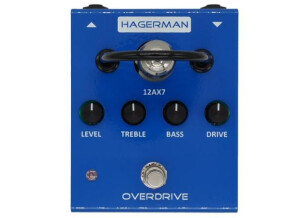
    The term ‘organic’ may be overused in the music industry, and perhaps a bit of a peculiar nomenclature to describe circuits and electronics, but its applicable nonetheless when comparing sounds that tend to be full-bodied and rich, as opposed to those sounding more sterile or flat. It also suggests that the sound has a more ‘natural’ robustness, or what we have come to expect from tube amplifiers and analog equipment – which solid state and digital technologies strive to achieve. The Hagerman Overdrive is such an ‘organic’ piece of gear and it deserves far more recognition than it has received. Interestingly, the designer, Jim Hagerman, is not a guitar player, but has been designing analog circuits for nearly 40 years, based on what he likes and what sounds good in a guitar tone. The end result is the Hagerman Tube Overdrive, which consists of a 12AX7 and guts that cannot be found anywhere else – since Jim designed the overdrive from scratch and not based on other circuits or popular overdrives. When first using this overdrive, it becomes apparent that it is unique in sound and how it ‘stimulates’ an amplifier with an enhanced warm, lush and flourishing tone. I’ve used and reviewed other overdrives that have higher gain and tend to be a cross between drive and distortion, and some do have very natural amp-like qualities, as though the amp itself is hot-rodded. The Hagerman Overdrive adds enough heat and crunch to transform a clean amp into a classic rock machine, but definitely engineered to turn a high-gain amp into a beast that sounds professionally modded. Moreover, and as important, it truly does sound amp-like, thanks to the 12AX7 tube and Jim’s genius – and it is very, very quiet. The Drive control/amount can be so low that it is nothing more than a fantastic clean boost, and once approaching 10-o’clock the tone enters crunch territory. When fully cranked there is a good amount of fat preamp-style overdrive, but nothing that screams, which means this is a low-to-moderate gain pedal. Moreover, up full and the drive remains incredibly clear and defined without muddiness or muffling in tone. There’s also plenty of headroom with that gain, thanks to an advanced boost converter that generates high voltage. (On that note, be aware that the pedal comes with its own 9VDC 450mA power supply that has a POSITIVE center – most pedalboard power supplies have negative center pins). What I also noticed is that the EQ controls’ range are not excessive– both Bass and Treble give a very decent amount of cut or boost that remains highly useful in a guitar’s frequency range, thus making it easy to dial in for just the right sound. I suspect the Hagerman Overdrive is not as popular as it should be due to its overall design, being more affluent in (and created originally for) studios, as opposed to going on tour and fitting (height-wise) in pedalboard cases with low top profiles. However, for those playing small gigs and lugging an open pedalboard, it shouldn’t be an issue. And, with so many guitarists being content with in-home studio playing and recording, the Hagerman Overdrive is the cat’s meow. Each powder-coated Hagerman Overdrive is hand-built in the USA (direct from Hawaii). At $229 the price is rather reasonable considering many other high-end overdrives are comparably valued; and the Hagerman’s sound is unique and of the highest quality components, including metal film resistors, high-temperature electrolytics, polypropylene capacitors and a custom designed folded-aluminum chassis. If that isn’t enough, the Hagerman Overdrive comes with a 10-year warranty, which is unusual in an industry of 1 to 3-year warranties. If you’re looking for that real-tube result that enhances the natural sound of your amplifier, the Hagerman Overdrive needs to be a consideration as it is a serious contender.

  • « A Tone Game Changer (tube drive) »

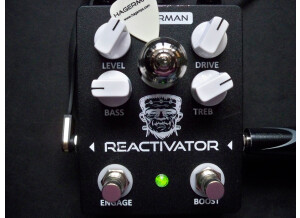
    I now realize why Hagerman Amps calls its latest true bypass pedal Reactivator – “it’s alive… it’s alive!” This is a low to moderate gain pedal, a two-transistor/two-triode overdrive, but its tube driven components maintain that ‘warm’ and realistic amp sound, which the demo video exemplifies. Many overdrives, whether digital or analog, have a slight bite, harshness or sterile quality, and I don’t use those terms lightly or in an insulting manner. Sometimes you need that cutting-edge with dark amps and pickups, and particularly depending on the mix in which the guitar has to sit. However, the Reactivator is so natural sounding that amps literally do not sound any different, insofar as their underlying characteristics, except with greater detail and robustness – to the point of growling. https://www.youtube.com/watch?v=ZoDpstiu3bY&t=5s This reminds me of Hagerman’s VALVE pedal, except the Reactivator has an EQ and Boost (there are other differences, including the bandwidths, but I wanted to make a general comparison as to the tubey goodness). In fact, the Reactivator utilizes the VALVE’s starved tube section with an added clean gain boost (followed by a tonestack with output buffer). As Jim Hagerman stated, which is very apropos: “During the early days of TV, if a picture tube grew dim, servicemen could perform a trick called "reactivation", where heater voltage was overdriven to the point of regenerating a poisoned cathode, thus restoring brightness. That's where the name of this pedal comes from! Increasing power from 9V to 12V adds another 6dB of gain for even higher performance. It may not reanimate dead tissue, but it will breathe new life into your guitar. This pedal is absolute magic.” I’ll describe the sound of the elements, although the demo does a better job. First, do not expect a massive gain, since it sounds more ‘broken up’ and slightly raunchy with a very clean amp. Once you work with crunch tones, you can hear the sparkle and robustness pop through. As you get into higher-gain sounds, you maintain that aggression without the mud or excessive saturation (which means keeping your amp’s gain in check while dialing in nastiness with the Reactivator). This is no different than how any overdrive should work, but this pedal is first-rate in pushing an amp without exaggeration or disappointment, producing an incredibly natural result. The pedal’s volume offers up to 20dB gain, and up to 30dB with the boost. I do find the boost results in more treble in the tone, which is not a bad thing. For lead, the notes cut through better. And if you want that slight treble boost result, then ease off on the pedal’s Drive and turn on the Boost for some slice and dice rhythm. (On that note, I added Hagerman’s BOOST pedal, which offers both full-band and treble boosting; and boy, does the treble boost, even turned very low, really add to the overall package. However, you can get a similar effect by easing off on the REACTIVATOR’s Drive and engaging its Boost.) The Bass and Treble controls are modest, in that fully cranking either all the way up or down lies within a very usable range, with neither muddy boom nor ear-piercing shrill. This is similar to the Hagerman OVERDRIVE (the blue chassis 12AX7 model), which I reviewed several months back. With some darker amp settings, you can dial back the Bass all the way (or nearly so) and it still sounds good. You then can crank the Treble, and still great results. Very nice! Here are a few other details. Both the Engage and Boost controls have their own footswitches while sharing the same LED – red when turned on and green when the Boost activates. The Reactivator has a 110k ohm input impedance and a 90Hz to 7kHz bandwidth. It does require a standard negative-center 9V power supply (which converts to 12V internally) while consuming only 135mA of power. Yes, it does come with a 12AU7 tube, which necessitates some care if you plan on adding this to your pedalboard (it removes and inserts very easily if you’re concerned about breakage when transporting to gigs), but with no real handling issues if used in a studio environment. A protective toe bar (cross bar) is one suggestion, but that increases cost and pedal size. Regardless, at $179 USD, the Reactivator is in the boutique price range, although it very much is a boutique-built pedal and with a concomitant boutique sound. Hagerman Amps have never disappointed!

  • « Broadband & Treble Boost with Overdrive Qualities »

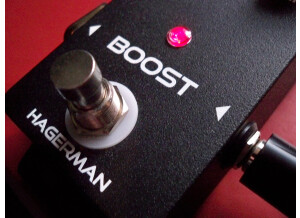
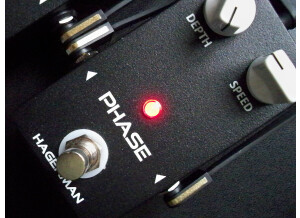
    This is no ordinary boost, and built in the USA by a sound engineer, Jim Hagerman. And as I tweaked the knobs I knew there was something unique about this boost pedal. Depending on where you place the Ungain knob (relative to working with a clean vs. dirty amp, or single coils vs. humbuckers), there is a wide range of sound characteristics that can be achieved. When turned low, just at parity, the tone livens up (clears up), which means an improved tone without any boosting. So far, so good. The clarity achieved with this pedal is due in part of the buffered bypass when not in use, but also that it adds no color when on. As you add boost slightly to the signal and beyond parity (knob rotated counterclockwise with this pedal), the tone seems to expand in scope while adding some dB in the mix. Once past 2-o’clock (for humbuckers) or 12-noon (for single coil), there is an obvious overdrive occurring with the boost. This is exemplified in the accompanying demo, as I work with clean, crunch and hi-gain amps, and with single-coil and humberbucker guitars. As Jim Hagerman explained, “all boosts end up getting dirty at some point, even those running at 18V. This one (the Hagerman Boost) falls apart very nicely. At maximum gain it can only handle 300mV input and remain clean – that would be with single coils. A humbucker would start to clip, but you also would not need as much gain for a given output. It will push 6Vpp (peak-to-peak) output cleanly. That's a lot!” He further adds, “6Vpp is signal amplitude. Single coils put out roughly 0.15 units. Humbuckers 0.6 units. The boost will amplify cleanly to a level of 3.0 units. That's 5 times higher (louder) than a humbucker. The Hagerman Boost can amplify 10x. At maximum gain it turns a single coil signal of 0.15 units into one with 1.5 units.” The Hagerman Boost produces clean, noise-free gain using expensive matched JFET pairs; consequently, the discrete circuitry “delivers pure amplification,” which helps to preserve your guitar’s tone. But what makes this boost even more appealing is that you can have a Broadband Boost or a Treble Boost. The Broadband option (Tone button pushed down) seriously fattens up the tone, making it ideal for single-coil or thin sounding pickups, for fat creamy leads or to add some serious bottom end to heavy riffing. The Treble Boost sounds incredible for crunch and riffing, and will cut through any mix. It offers a high-pass corner at 700Hz and is dialed in just right. I’ve worked with other treble boosts and there’s always as issue of dialing in to that sweet spot, whereas the Hagerman Boost delivers very well in that regard and without any thought. Jim Hagerman claims this is the highest performing silicon boost pedal you can buy, and he may be right on that front. For $129 USD this is one great sounding Boost that behaves a little differently from other boosts I’ve experienced. I also find the overall boost range very usable. Placing the Ungain knob at parity or up full provides a very suitable dB gain without sounding ridiculous (some boosts go to such extremes that you never would use the top half, unless you wanted to dominate your drummer, bassist and keyboardist). Although it pumps out upward of 19dB, the volume does not become over-bearing. I already reviewed the Hagerman Tube Overdrive and the Hagerman Phase (also silicon-based), and both definitely are studio grade and should be investigated, as well. The size of a regular pedal, the Hagerman Boost comes with a 10-year warranty and requires 9V to 12V input (negative center pin) while consuming only 7mA of power.

  • « A tube-driven, warm, thick, crunch drive with amp-like behavior »

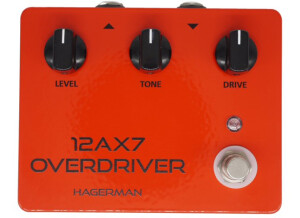
    NOTE: This review and video demo are for both the EF86 BOOSTER and the 12AX7 OVERDRIVER. Hagerman Amplification knocked the ball out of the park on these two pedals, and for several reasons. First, the EF86 BOOSTER and the 12AX7 OVERDRIVER are tube-based (as per the names), which means rich overtones, superb dynamics and response to one’s playing, amp-like tone quality, and low mA requirements (215mA for the boost and 175mA for the overdrive). Below is a demo featuring these two pedals in isolation with clean and driven amps (both solid state and tube), but also with other gear and how they respond when stacked. I have the original beta models, if you will, which indicate EF86 BOOST and OVERDRIVE on their chassis, but are one in the same, but renamed, on the Hagerman site. Boutique all the way, hand-built one at a time, the true bypass EF86 BOOSTER uses a pentode (5 electrodes), which means a warm and super clean gain for driving both amps and other pedals, which became obvious as tones blossom when matched with regular analog gear. And although the power requirements are modest, there still is high voltage (2V input and 140V tube supply) for optimal tube operation with a lot of headroom. With the Drive all the way down (and volume maxed), there is a noticeable boost, but start adding in the drive and it is LOUD, with 21dB maximum gain! The signal remains warm while still delivering ample second order (octave) harmonics. What really impresses me is how good the signal sounds when added to other gear, even if keeping the drive all the way down while pushing the volume… one of those always-on pedals. The 12AX7 OVERDRIVER is a fantastic extension of one’s amp, as its gain can be described as a classic preamp-style overdrive, so that its tone accentuates a natural sounding fat crunch with lush tones. What makes this true bypass drive even more desirable is how it behaves with other gear – it responds incredibly well when stacked with other drive pedals or amps with moderate- to high-gain output (I also paired it with a Rockerverb-style preamp, and it rocks). Some drives tend to thin out a tone, but not this one, as it remains true to that thick, breaking-up quality guitarists want and strive to maintain within a signal chain. It also has huge headroom, with 36dB maximum gain and a 30mV input, onset of clipping. The grain is warm and generous, which becomes more aggressive as you push the drive, as experienced with real tube amps. Now, it's part of a reviewer’s duty to discover elements that may be lacking, but these two pedals are so simple and deliver the goods so well, there’s not much to address. Some may want more of a Tone control range, but to my ears and with the various gear combined with these pedals, I never found that the case. In that regard, turning the Tone all the way left (more bass frequency) or right (more treble frequency) provides modest change to one’s original tone, which means dialing in your amp, then tweaking the boost and overdrive accordingly. For the most part, I never deviate between 10-o’clock and 2-o’clock, and often will keep it at 1-o’clock (flat), unless wanting a touch more bottom or top end (which really shapes those high-gain amps for thump or punch). Both the EF86 BOOSTER and the 12AX7 OVERDRIVER retail for $342 USD, which is very much on par with today’s cost of gear, and is very reasonable when considering these are studio designed with engineered quality by an amplification company. Fantastic add-ons for tube amps, they literally help transform solid state amps and pedals amazingly well. https://www.hagamps.com/

  • « Ultra-clean, warm tube boost with big headroom »

    NOTE: This review and demo video are for both the EF86 BOOSTER and the 12AX7 OVERDRIVER. Hagerman Amplification knocked the ball out of the park on these two pedals, and for several reasons. First, the EF86 BOOSTER and the 12AX7 OVERDRIVER are tube-based (as per the names), which means rich overtones, superb dynamics and response to one’s playing, amp-like tone quality, and low mA requirements (215mA for the boost and 175mA for the overdrive). Below is a demo featuring these two pedals in isolation with clean and driven amps (both solid state and tube), but also with other gear and how they respond when stacked. I have the original beta models, if you will, which indicate EF86 BOOST and OVERDRIVE on their chassis, but are one in the same, but renamed, on the Hagerman site. Boutique all the way, hand-built one at a time, the true bypass EF86 BOOSTER uses a pentode (5 electrodes), which means a warm and super clean gain for driving both amps and other pedals, which became obvious as tones blossom when matched with regular analog gear. And although the power requirements are modest, there still is high voltage (2V input and 140V tube supply) for optimal tube operation with a lot of headroom. With the Drive all the way down (and volume maxed), there is a noticeable boost, but start adding in the drive and it is LOUD, with 21dB maximum gain! The signal remains warm while still delivering ample second order (octave) harmonics. What really impresses me is how good the signal sounds when added to other gear, even if keeping the drive all the way down while pushing the volume… one of those always-on pedals. The 12AX7 OVERDRIVER is a fantastic extension of one’s amp, as its gain can be described as a classic preamp-style overdrive, so that its tone accentuates a natural sounding fat crunch with lush tones. What makes this true bypass drive even more desirable is how it behaves with other gear – it responds incredibly well when stacked with other drive pedals or amps with moderate- to high-gain output (I also paired it with a Rockerverb-style preamp, and it rocks). Some drives tend to thin out a tone, but not this one, as it remains true to that thick, breaking-up quality guitarists want and strive to maintain within a signal chain. It also has huge headroom, with 36dB maximum gain and a 30mV input, onset of clipping. The grain is warm and generous, which becomes more aggressive as you push the drive, as experienced with real tube amps. Now, it's part of a reviewer’s duty to discover elements that may be lacking, but these two pedals are so simple and deliver the goods so well, there’s not much to address. Some may want more of a Tone control range, but to my ears and with the various gear combined with these pedals, I never found that the case. In that regard, turning the Tone all the way left (more bass frequency) or right (more treble frequency) provides modest change to one’s original tone, which means dialing in your amp, then tweaking the boost and overdrive accordingly. For the most part, I never deviate between 10-o’clock and 2-o’clock, and often will keep it at 1-o’clock (flat), unless wanting a touch more bottom or top end (which really shapes those high-gain amps for thump or punch). Both the EF86 BOOSTER and the 12AX7 OVERDRIVER retail for $342 USD, which is very much on par with today’s cost of gear, and is very reasonable when considering these are studio designed with engineered quality by an amplification company. Fantastic add-ons for tube amps, they literally help transform solid state amps and pedals amazingly well. https://www.hagamps.com/

  • « Thick, meaty, and with a growl »

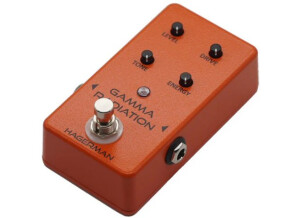
    If you’re looking to go from medium to high-gain, Gamma Radiation is a choice pedal. If you want your distortion to have thick, grainy and robust characteristics, then Gamma Radiation may further serve that purpose. Based on Jim Hagerman’s ‘gamma’ patent from 1995, this is a more powerful version of the Hagerman Distortion. In effect, the circuit runs two clipping stages in series to make a clean amp turn into a rock machine when the Drive is low to moderate, and then some metal mayhem when the Drive is 12-noon or higher. The demo below illustrates various tones and drive qualities, but something I did not present is how it sounds with the Drive all the way down and the guitar’s volume backed off – cleans come alive with exceptional note details and harmonics. With a guitar’s volume up, Drive qualities range from a vigorous breakup when all the way down, to a very thick and nasty crunch just before 12-noon, to a more saturated and slightly hairier distortion beyond 12-noon. The overall tone quality does maintain throughout, although more supercharged as the Drive increases. And that’s what I much appreciated about the Gamma Radiation, in that the distortion always is thick and meaty, and not a thin, almost fizzy sound that some distortions have. The others may be fine for driving an already dirty amp, but they sound lackluster on a clean channel. Gamma Radiation, on the other hand, has very amp-like qualities. The gain (Level) is 43dB, which means a lot of volume on tap to drive your amp, and I never have it past 12-noon (often less, depending on the gear I’m using and their levels). The Tone control is post, and when working with a dark amp and cab (or IR), I suspect you will not have to drop Tone past 11-o’clock, which means plenty of bottom end for those brittle-sounding amps or bright pickups. Energy is another Tone control that sits between the two clipping stages, for additional tone sculpting. Now, your gear may be different, but for a modern metal sound I like the Tone up 90% and the Energy all the way down (or nearly so) for full bass/low mids, and with my amp pushing the mids; a very punchy and bold result. Also, Gamma Radiation can run to the front of an amp, but I find it sounds best in an FX Loop, thus making it more of a preamp than a pedal affecting the amp’s preamp (which gives mixed results, depending on the amp). Keep that in mind if you order one, as I found it sounded good in front of my amps, but more organic and powerful in the loop. Gamma Radiation is a true bypass pedal kit, although build is easily done within 10-15 minutes (no soldering required). Some other details of this pedal include a 6mV input clipping level, 55Hz-7kHz bandwidth, and a 9V (neg center) 4mA power requirement. It retails for $99 USD, direct from www.Hagamps.com, and even includes a 10-year warranty, and so, you’ll know it will last. I’ve reviewed several Hagerman pedals, and this is one of my favorites. I don’t play hard rock or metal exclusively, but I’m a sucker for a pedal that can pull it off, and Gamma Radiation does just that.

  • « Modern Take on the Klon »

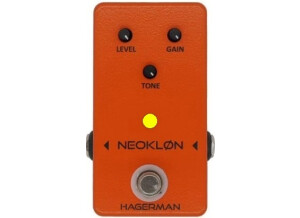
    The myth and scarcity of an original Klon has made it legend in the gear industry. I don’t get it… since it’s a particular flavor of drive, but has sold in recent times for upward of $5,000 USD… but that’s how musicians operate. Some are willing to pay $100k for a ’59 Les Paul that sold for $450 with a case in 1959. I get nostalgia, but would sooner have a drive that has similar tonal characteristics that have been improved upon – and for a fraction of the price. Jim Hagerman admits that he doesn’t play much guitar besides some noodling around, but he knows electronics and sound (with electronics that delve into the high-end audiophonics industry). What he did to the Klon circuit should have people turning their heads away from the original and its clones and toward NEOKLØN. One thing you will notice and hear with NEOKLØN, is the increased headroom. Gone is the compressed signal, which means improved picking and sound dynamics; the notes sound livelier and fuller. Now, I never played through an original Klon, but I did play through a few clones that kept as true as possible to the original circuit. Further, in that regard, I can say that NEOKLØN has an exceptional low noise floor. With both Gain and Level up full, there is a low ‘sshhhh’ sound; barely audible with complete silence and no playing. As for the sound, there is a robustness or thickness, without being too grainy, yet it does not have that thin digital quality some overdrives possess. The best way to describe it, is that it makes the tone beefier, while bringing forward those added harmonics and details. NEOKLØN does make the base tone a touch darker sounding, rectified easily enough with the pedal’s Tone control. But whether playing a touch dirty or making your high-gain amp sound thicker and better, NEOKLØN certainly sounds different than usual overdrives or Klon clones. NEOKLØN has gone to the next level, as Jim Hagerman revamped the circuit to retain the original characteristics, but improved upon the response at low gain. No, this is not an improved and new ‘Coke,’ in that it’s a completely different product. Rather, Jim removed the flat bandwidth response at minimum gain; and in effect, this allows for the full tonal response at low Gain levels. In fact, NEOKLØN reminds me of a Tube Screamer, in that it is highly useful with its Gain all the way down! With NEOKLØN’s Gain completely down, it produces a similar tonal response to the original Klon and with its gain around 9-10 o’clock. Generally, and with a crunch/dirty amp, I don’t have NEOKLØN’s gain past 9-o’clock (and often all the way down), and may have it around 12-noon or slightly higher for lead (although all the way down sounds good still). NEOKLØN currently comes as a kit, which takes five-minutes to assemble. The circuit board is fully assembled and tested, and so it’s not a full build kit that requires soldering. It also requires a measly 20mA power, ideal for any pedalboard. If you’re a Klon fan, then this modern take is a must.

  • « Reactive Load for Amps up to 5W »

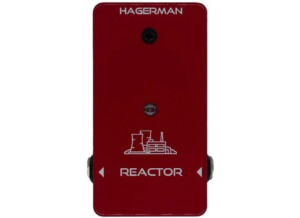
    Leave it to Hagerman Amplification to design a boutique Reactive Load so small it fits on a pedalboard (or next to/on top of whatever small amp you’re using), ingeniously designed to provide a reactive load for small tube amps. In essence, the REACTOR is meant to take the load of amps 5 watts or lower, while offering a number of uses. First, the attenuated output is a direct-in signal for recording consoles/mixers or into other pedals or a computer interface. Second, and in many instances, it can replace a speaker for a reasonably good sound (cleans or a bit dirty are best, whereas hi-gain tones still require a cab IR due to the nature of the gain/distortion and to sound best – at least to my ears). Third, there are some small amps that also are preamps, and the 2-Watt Purple Nightmare Preamp comes to mind, a point I address. With that preamp, I can go direct out to a cab IR, computer interface, etc., and it sounds good, but it sounds even better when I use the ‘speaker out’ and take advantage of the power amp section. But to do that, I require a mic’d cabinet or some type of reactive load/attenuator. There are several reactive load boxes out there, usually designed to handle 100W, with some capable of more, whereas smaller and less expensive reactive load units will handle upward of 50W. Regardless of the size, these can be costly, with $500+ being the norm. And I raise this point for good reason, since there are so many home musicians, who far outnumber anyone who gigs or plays professionally, and who have small amps due to budget and/or practicality (if you want 10 amps in your bedroom studio, it’s not so affordable or easy to stack and house full-blown models). And this is where the REACTOR comes in, handling so many of the small amps out there, including Fender Champ, Magnatone’s Starlite, Bugera 5G Infinium, Marshall DSR5CR, Friedman Runt 20, and the Peavey Invective MH, to name a few. And there are a host of mini one-watt models from Hughes & Kettner, Blackstar, Jet City, Kustom, Laney, Vintage, and Vox, besides Hagerman’s own One Watter (and its Half Watt). The REACTOR is compatible with both 8 and 16 ohm taps, operating at 10 ohms nominal. Although small in size, the REACTOR can handle upward of 5W loads without issue, due to the large 10mH coil running at 2.6 ohms (100 Hz resonance), besides a secondary 1mH coil, which runs in series with the main resistor, at 0.5 ohms, ranging from 10 to 10.5 ohms. This is to handle an internal resistance that exceeds 10 ohm. Those are the use benefits, but there are two other things going for the REACTOR that I really like. First, it costs only $139 USD (minus any holiday discounts or offers provided by Hagerman Amplification), which is amazing for home players not wanting to splurge on a reactive load that easily will cost far more and are designed for larger and more traditional amps. Yes, there are budget reactive loads, but you get what you pay for. And this brings me to point two, and how it sounds. I have limited experience with this area of gear, but I did own a Suhr Reactive Load, and I returned it. The response and tone quality, to my ears, is inferior to the REACTOR. Of course, there’s also the size, as mentioned above, which really is a third point worth reiterating. All of these features make the REACTOR highly desirable for home and small studio musicians.