Log in
EN
FR

Hear Technologies

7 products found

Categories
Filter
Sort by
Evaluation
  • Reviewed or not
  • Editor’s award
  • Reviewed by Audiofanzine
Availability
  • Available or not
  • Sold new or used
  • Sold new
  • Sold used
Must-have products
  • All products
  • Flagship products
  • Best rated products
  • Hot products
  • Popular products
Price
  • Freeware
€
Clear
Sort by
  • Popularity
  • User ratings
  • Price - low to high
  • Price - high to low
  • Used price, increasing
  • Used price, decreasing
  • Name (from A to Z)
  • Name (from Z to A)
  • Added on
Sort results
  • Popularity
  • User ratings
  • Price - low to high
  • Price - high to low
  • Used price, increasing
  • Used price, decreasing
  • Name (from A to Z)
  • Name (from Z to A)
  • Added on
Filter results 7 results found
Evaluation
Availability
Must-have products
Price
  • Freeware
Show results

The best Hear Technologies reviews

The reviews Audiofanzine members found the most helpful.
  • StainlessB's review

    I was hesitant to get this... and the first time I looked at it,as soon as I saw the Cat 5 cables... came an immediate "no way do I want to run cables... what a hassle...etc" I had been using the RME mix matrix and mixer, which works well... however, as a session wore on (in live settings and my own bands rehearsals in the studio) I seemed to spend a lot of time re-adjusting headphone mixes as ear fatigue set in (or someone turned up/down)... In fact...I was sick and tired of the whining and complaining! "I can't hear myself", "All I hear is him", "there's too much ... (take your pick)" I took the plunge. The 4 pack comes with a D-sub x 8 1/4" cable and 4 50' Cat 5 cables. I chose to run my own cables so as not to have any excess ....(only recommended for those with lots of patience) The mixers have a standard microphone mount on the back and I used Altas podium mounts, and a short extension for everybody but the drummer who got the podium mount and a mini-boom. Each mixer handles 8 channels!* was originally using an Aphex 141 D/A converter to sent mixes from the RME into a Presonus HP60. so I redirected the lightpipe and the D-sub to the Hear Back rack unit. The unit supports up to 8 mixers. Each mixer will run 2 headphones (same mix....and I haven't tried it) I ran extra cables in case we get a permanent player... which means I'll need to get another mixer (~$240...) THIS WORKS GREAT!!!!!! plenty of volume, a limiter so they can't blame me for going deaf... no more whining and complaining!!!! I bought mine from Sweetwater and they matched the best e-Bay price (I thought that was pretty cool) so plenty of pros.... and yes, a few cons* I wish channel 1 & 2 could be unlinked... while 3/4, 5/6 am\nd 7/8 can be linked, 1/2 cannot. I wish there was the option on an insert on the rack unit instead of just the mixers... and lastly (though I realize I'm reaching) it'd be superb if you could mix analog and digital inputs.. I read one dissenting opinion on one of the forums that complained about the 1.5 mSec latency....(?) all I can say is "Brother, your ears are a lot more astute than mine) You want the ability to have individual players be in charge of what they hear? This this is the real deal! I will very likely add a couple of more mixers to my studio (conveniently located of course!)

  • moosers's review

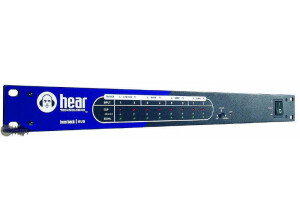
    The Hear Technologies Hear Back Hub is part of the Hear Back headphone monitoring system designed for recording studios. You can’t use the hub on it’s own, as you need the headphone stations to go along with it, but this is the part of the system that connects everything together. The system has four stereo channels, all of which is routed through this hub and sent to the individual headphone boxes. There isn’t too much to know about the characteristics of the Hear Back Hub, as it’s a simple rack mountable piece of gear that will only take up a single space in a traditional rack casing. I don’t really know what the connections are in the back of this, beyond the Ethernet connections that are required to hook up the head phone boxes to this. I didn’t really need to look in the back of it as it was already set up and ready to go with the head phone boxes in a studio that I used to work at. While the Hear Technologies Hear Back Hub is built pretty well, this system as a whole isn’t my favorite out there. While it will get the job done as it did for us on many different sessions, it still wasn’t the most reliable piece of gear as it would sometimes be quirky. You’ll need the purchase the whole Hear Back system in addition to the Hear Back Hub if you’re interested in this system, but I’d probably recommend checking out some of the other headphone systems out there like those made by Furman and Mytek before committing. While the Hear Technologies Hear Back Hub and system in general will cost you a bit less than those that I just mentioned, if you’re running a studio where players are playing together on a regular basis, having a reliable headphone system is essential, so if it was me I’d spend a few extra bucks on the Mytek Private Q system or something in between the quality of this one and that…

  • moosers's review

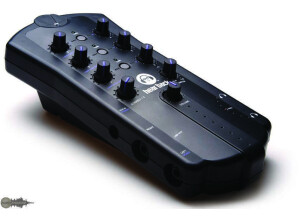
    The Hear Technologies Hear Back Mixer is a personal mixing station that is used for monitoring while you are recording. It allows you to control four stereo pairs of tracks so you can dial in your own comfortable mixes while you are recording. I've been using the Hear Back system for about a year and I've found it to be a useful system for recording. It has nine knobs in total - eight that control four stereo pairs, and one to control the overall volume being sent to your headphones. It also has four link buttons so you can either control each track with the two stereo knobs, or just control one if you have the link button off. It has two inputs for headphones and also has 1/4 inch two line out jacks and a stereo aux input. The Hear Back Mixer is sent via ethernet cable to the Hear Back rackmount that is hooked up to your outputs so you can send your tracks to the system. Overall, I have found the Hear Back mixer to be well designed and haven't had too many problems using it at all. The price of these is pretty reasonable, and if you are going to buy the mixer you also need the rack to send this to. The whole system isn't too expensive, especially compared to a superior system like Mytek's Private Q. While I definitely prefer the Private Q over the Hear Back system, Private Q is much more expensive. The reason I like the Private Q better is because you can control more tracks, rather than just four stereo pairs on the Hear Back. All in all, I definitley recommend the Hear Back mixer and monitoring system to those bigger studios that might need something of this nature to monitor while they are recording.