Log in
EN
FR

LiberaToe

21 products found

Categories
Filter
Sort by
Evaluation
  • Reviewed or not
  • Editor’s award
  • Reviewed by Audiofanzine
Availability
  • Available or not
  • Sold new or used
  • Sold new
  • Sold used
Must-have products
  • All products
  • Flagship products
  • Best rated products
  • Hot products
  • Popular products
Price
  • Freeware
€
Clear
Sort by
  • Popularity
  • User ratings
  • Price - low to high
  • Price - high to low
  • Used price, increasing
  • Used price, decreasing
  • Name (from A to Z)
  • Name (from Z to A)
  • Added on
Sort results
  • Popularity
  • User ratings
  • Price - low to high
  • Price - high to low
  • Used price, increasing
  • Used price, decreasing
  • Name (from A to Z)
  • Name (from Z to A)
  • Added on
Filter results 21 results found
Evaluation
Availability
Must-have products
Price
  • Freeware
Show results

The best LiberaToe reviews

The reviews Audiofanzine members found the most helpful.
  • « Blues Breaker + Hot Cake in One »

    In a collaboration, Vogart Audio and Liberatoe engineered KEEPIT LEMON, a dual overdrive that offers the flavors of a BluesBreaker and Hot Cake drives, which you also can stack for a big gain-stage result. The front end ‘hot’ drive (Red Channel) has a warm midrange and flowing high ends for that crisp breaking up, harmonically-rich grit. It ranges from a clean boost to a gain boost, all the way up to crunch, then distortion, and eventually a thick fuzz. Adjustments then can be made via a guitar’s tone knob, although tones are darker with more gain and humbuckers with some amps, whereas brighter amps and single-coil pickups tend to maintain tone more consistently. https://www.youtube.com/watch?v=PR8I5Q43p5o The ‘breaker’ drive at the rear (Green Channel) is fairly transparent and more of a ripper. As well, it includes a 3-way toggle to emphasize specific mid-range frequencies (middle is flat, whereas 2.4kHz to the left has more bottom end and 7.2kHz to the right has more of a bite). Another feature for this channel is a Presence control, for that added sparkle or sizzle. Under the chassis is an asymmetrical clipping option (adjusted through internal DIP switches), which I did not explore in the video… everything sounded pretty darn good as is. Even with all that, a key feature with this pedal, and other Vogart/Liberatoe collaborations, is the ability to Stack. As a result, the extent of tones possible with various mixes of the two drives (with different EQ, Gain and Volume levels) is wide-ranging. Even how you integrate the two can vary, e.g., regular crunch for rhythm (from one of the select drives), then stacked for lead. The Channel toggle switch allows for the following combinations: • Toggle Up: Green or Red channel selected • Toggle Middle: Green or Stacked • Toggle Down: Red or Stacked Channels then are selected via the footswitch (a quick click turns KEEPIT LEMON on/off, whereas a brief 0.5 sec hold switches channels). KEEPIT LEMON is true bypass, and implements high input impedance and low output impedance to ensure effective use of pedals before or after it, and each overdrive/channel has its own stabilization circuit for quiet operation. The robustness of sound likely is supported by internally boosting the input from 9V to 18V, thereby providing high headroom, while maintaining the original signal. As well, the quality of tone flow, while aiming to eliminate tone color in the components, is the result of an electro-mechanical relay signal path, rather than using typical FET or analogue switch components. I think what makes KEEPIT LEMON so useful and effective, besides it’s great sound production, is its diversity. From clean boost, to cutting edge grind, to thick fuzzy distortion, there are elements and tones suitable across a broad spectrum of music styles. This is not the only Vogart/Liberatoe collaboration pedal I have tried or reviewed, and they are simply impressive, to say the least. KEEPIT LEMON is available as a standalone pedal ($159 USD) or as a module ($89 USD) for a Liberatoe platform system, while drawing 120mA power. https://www.vogartaudio.com/keepit-lemon

  • « Ampless Solution for PA/Mixer/DI & More »

    Tweedle Deux is not just a pedal, but a workstation platform, for studio and live work. In effect, it is a No-Amp tool, with a basic rundown of what it offers: • Clean Preamp: From British to American classic amp tones • Cab Sim: Fender/Jensen and Marshall/Celestion speakers with Presence and Resonance controls • Master Volume/Boost: High headroom master volume that doubles as a clean boost • Reamp: The ability to reamp/record tones within Tweedle Deux directly, or out to a different source, together with impedance adjustment • Reverb: Studio quality reverb with a broad range of qualities, e.g., spring, room, etc. • Input/Output Interface: Various TRS/TS, XLR jacks • Other: Headphone jack and Aux-In jack Watching the accompanying video demonstrates the various uses/sounds, but I will cover some details and opinions on Tweedle Deux. First, basic operation includes a selector switch that allows you to choose Direct Input (1-2 guitars), Reamping, or to use the Master/Boost. And if you choose DI, you can have stereo input via a TRS cable, together with stereo out (you will require XLR to XLR, or XLR to ¼-inch out, as needed). Now, the clean TMB tone stack preamp is super clean, clear and sparkly; there’s a bit of gain when cranked, but only enough to provide a slight breaking up quality. It not only sounds fantastic playing clean, but is an awesome pedal platform for distortions, drives, and modulations. I previously have been using a Quilter Tone Block 202, and I may return to it for a different flavor, but I’ve been using this preamp exclusively for the past few weeks and have been enjoying it immensely. What’s cool is that a toggle switch allows you to run the preamp on its own, together with the Reverb, or bypassed completely (for connection of other preamps… look for my review on the DAWKINS preamp pedal, which also uses the Cab Sim on Tweedle Deux). The Cab Sim is very impressive. I have my favorite IRs, but this takes it to a completely different level, in terms of sounding natural and sounding GOOD… very raw like a typical speaker. The Presence and Resonance settings help to take this over the top, as you can dial in easily and quickly to just the right combination, whether playing clean, a bit dirty, or hi-gain. I tend to prefer the Fender/Jensen speaker for clean to overdriven dirty, whereas the Marshall/Celestion (I presume V30) is my choice for harder rock and metal. I’ve since abandoned my IRs. Also, you can bypass the built-in Cab Sim and use a different source, whether an IR or something like the UA OX Box. The Reverb sounds very clean and natural, although some may prefer coloration or some type of modulation mixed in the reverb. But if you’re looking for something more basic (no ‘space reverbs with long tails), then I suspect this would meet the needs of most people. Adding a bit to my lead adds a nice zing to the tone. With my present setup, I don’t have much use for the Master/Boost. However, this is fantastic for those older amps without a master volume, and the boost is one of the loudest and cleanest I’ve heard. With a 33V high headroom, it can amplify signals upward of 20dB without tonal distortion. This also serves to push a tube amp’s gain. As well, you still have access to the Reverb. I’m not one to Reamp, but I did do a setup to give it a try, and it works flawlessly and very well (see demo). In essence, Tweedle Deux Reamp converts pre-recorded tracks into guitar-like signals and connects them to out to a pedal board/effects, etc., for further processing. Amazingly, Tweedle Deux’s price is about the same or not much more than most Reamp pedals/devices on the market, and if you ever need it, there it is. The price is as impressive as this pedal (if you want to call it a pedal) for all you get, and at only $189 USD (an introductory price, soon to be $219 USD)… the price of most typical pedals on the market. It weighs only 1.3 pounds (610g) and is the size of a dual-sized pedal, making it perfect for a pedalboard, or to toss into a gig bag. It does sound 10% better running through a power amp (or a power amp sim), but still holds up extremely well on its own. Tweedle Deux also requires an 18v input (negative center. If your power supply lacks an 18V output, an inexpensive solution off Amazon is the STRICH SPS-30 power supply, which runs under $35 USD (or $48 CAD). This power supply also boasts several 500mA 9VDC outputs and a 12VDC output (the 18V also can be switched to 12V). I’ve been impressed with Liberatoe products, for sound quality, two-channel diversity, and exceptional pricing, and the Tweedle Deux is no exception. A few things I would like to add is that Tweedle Deux comes with two sets of knobs – color-coordinated and all black. There’s a lot going on with this pedal, so having different colored knobs may be preferred by some users. As well, the package includes a Y mono patch cable, so that you can record and monitor (mixer/DAW) simultaneously. This means a channel of the DAW can record dry signals while the other is for monitoring with effects. Liberatoe covered just about every possible playing/recording requirement. A highly welcomed new addition to my studio! https://www.liberatoe.com/peripherals-parts

  • « Modern Tape Delay with Great Features »

    Alter Ego is LiberaToe’s re-creation of a warm vintage Tape Echo delay, although with more transparency and less coloration. This analog pedal is both a stand-alone that anyone can buy and use, but also, it’s a module for the LiberaToe pedalboard/switcher system or platform. Since it has a dual channel, you can set both short and long delays with different delay times, repeats and mix amounts. I find this useful as I prefer a short delay with rhythm and a longer delay (or something a more intricate delay) with lead soloing. https://www.youtube.com/watch?v=6_o1JbP3_wI The general sound is very warm and with a modest modulated decay, melding into the background without being too obtrusive, and while maintaining it’s organic nature. Consequently, this is not a bright or attacking delay, as one would find with digital counterparts; Alter Ego becomes one with the instrument’s mix, rather than being a separate sound. There is a ‘tap tempo’ insert (requires a footswitch) that controls long delays (when the pedal’s Platform Tap toggle is in the up position), but you also can attach a separate switcher that controls the LiberaToe platform and which has a tap tempo function. As stated, tape delays are more subtle than other types, and they serve to provide additional space and breadth without being ostentatious. To create a bigger sound without necessarily hearing a lot of repeats, I keep the mix at least half-way (up to 2-o’clock), but with repeats around 12-noon. Of course, the tempo (Time) has a bearing on this and how tight you make the space between note and delayed repeat, but with a brief enough time you don’t hear much of the repeats, but you do hear a broader and fatter tone. I used that method for the lead section on the introductory composition of the demo video, whereas I exaggerated the time/repeats for clean and crunch tracks. Besides the dual channel feature, Alter Ego handles delay with some unique toggle features, such as mixing in parallel or serial, with both short and long repeats. A parallel mix provides a greater sense of space, behaving similar to a stereo delay on a single amp, thus making this a great feature for Prog and Ambient music. Here is another toggle example: The top toggle (Platform Tap) has two positions, and when flipped up, it provides short delays on the Green channel (or tails for the Red channel) and long delays if on the Red channel. With that toggle flipped to the bottom position (and on the Green channel), it acts as a bypass, and to hear delay you have to switch to the Red channel. I won’t describe every setting option, as I explore them, and will make more sense, in the video demo accompanying this review. What should be noted is that when on the Green channel and hearing short delays, those tails continue if you switch to the Red channel; conversely, if on the Red channel with longer tails, there is no spillover if switching to the Green channel. Alter Ego has its role, and I find it most suitable for someone looking for a simple delay effect that sounds warm and natural, but also with some features that optimize what a modern tape delay should be and can be. From its dual channel, to mixing of short and long repeats, Alter Ego is a great analog option for six-stringers and bassists; and I’m confident singers, keyboardists and other instrumentalists would find good use with this high-flexible delay pedal. Overall, great sound quality and build.

  • « Dual Channel with Filter or Fuzz, or Filter + Fuzz (bass or lead) »

    A fuzz and an envelope filter in one, and ideal for either lead/rhythm or bass. This may not seem unusual, but add to that a dual channel with various filter options, and you have a killer pedal for $150 USD (half that price if you buy the ProudAnus module for one of the LiberaToe pedal/switcher/router systems). This is a great sounding 60s fuzz, which combines both germanium and silicon. Depending on how you dial into it (with the resonance), it can sound as much overdrive or distortion as it does fuzz. Very versatile – and it cleans up nicely with a guitar’s volume knob. For the video demo, I ran the ProudAnus into two emulators (UA’s Woodrow ’55, which is an emulation of a 1955 Fender Tweed, and the Ruby ‘63, which is an emulation of a 1963 Vox AC30), as well as the Rivera Venus Recording tube amp. In all instances, the ‘fuzz’ sounded robust and growly. Now, I say that with some reservation, since if changing cabinets toward something that is thinner or more cutting in frequency, the fuzz has more of a silicon fuzzzzzz sound, rather than a growl. Overall, you can achieve a heavier, darker and more wooly sounding fuzz, all the way to a biting, screaming tone that bites like an OD/distortion. The Filter (or Wah) aspect of the pedal varies significantly and is very vocal. It can sound throaty, barely audible (great if you want to add a tonal character to rhythm or lead), or even thin enough to mimic a Sitar (not 100%, but it works in a pinch, which I demo on the video). As an added feature, you can toggle select either a hi or lo-frequency filter. You also can adjust the sensitivity toward your picking dynamics, so that a light string strike is more subdued than a hard string strike. Fine-tuning the vocal response also is dependent on the Attack and Decay controls. Now we get into the diversity of this pedal, with these possible combinations (Main Toggle): TOGGLE UP: Green channel = Wah; Red channel = Fuzz TOGGLE CENTER: Green chn = Wah; Red channel = Wah (there is a reason for this, as per the second toggle switch, described next) TOGGLE DOWN: Green chn = Fuzz; Red channel = Fuzz + Wah I provided a quick demo of how channels can be switched and mixed/matched in the video, but let’s consider the second toggle’s role, in selecting a hi or lo filter. TOGGLE UP: Green chn = Hi Wah; Red chn = Lo Wah TOGGLE CENTER: Green & Red chn = Hi Wah TOGGLE DOWN: Green & Red chn = Lo Wah Suppose the main toggle is up for a Wah (green) and Fuzz (red); you can select either a Hi or Lo Wah for green via the second toggle. If the main toggle is center (Wah for both channels), then you can select a Hi Wah for green and a Lo Wah for red via the filter toggle. If the main toggle is down (Fuzz for green and Fuzz + Wah for red), then you again can choose a Hi or Low Wah for the red channel. This may seem a bit confusing without seeing the video, which I encourage you to do. Overall, ProudAnus stands up to any LiberaToe pedal I have tried, and without disappointment. You get some great analog tones, but with serious flexibility. For the fuzz aficionado, ProudAnus is a beauty and I find it very easy to dial into great tones. No complaints and all thumbs up! https://www.liberatoe.com/

  • « Dual-Channel with Three Phaser Types, Vibe & Tremolo... powerful and sounds fantastic! »

    Pascal is a dual-channel (Green & Red) modulation pedal (it also is a module for the LiberaToe pedal/switcher systems). In effect, you have a separate set of controls for each channel. A channel can be turned on or off as usual (fast click via the footswitch), but if you hold the footswitch down for 0.4 seconds, it switches channels (or turns the pedal back on to the next channel). As much as I like the LiberaToe pedals for this reason, Pascal offers a lot of options, as demonstrated in the accompanying video. The Green channel offers a warm, subtle phaser; a classic phaser (typical of 1970s and 1980s) and an asymmetric phaser (more bite with a higher-end resonant response). The Red channel offers tremolo, vibe, and a wide phaser with a broader phase response. These selections are established via a toggle switch with the following combinations: Toggle Down – Green = warm phaser, and Red = tremolo; Toggle Center – Green = classic phaser, and Red = vibe; and Toggle Up – Green = asymmetric phaser, and Red = wide phaser. Now, if you wanted the warm phaser coupled with the wide phaser, or a different combination between the two channels, you will have to flip the toggle. As stated, each channel has its own controls, each having Level, Depth, Rate and Feedback. This means a very subtle phaser in one instance (perhaps to add this quality to rhythm), followed by a more robust phaser, e.g., for lead, via both Level and Depth. Moreover, you can have different rates (speed) and feedback (resonance). All of these features should make it obvious how diverse Pascal is and the potential modifications that are possible with very little knob turning, thus providing a gigging musician faster and better flexibility on the go. This analog true-bypass pedal has exceptional sound quality. The effects are very clear and defined, but also thick and organic. And with the variations of modulations possible, Pascal is an excellent consideration for phaser aficionados. At $147 USD ($85 for the module without the Shell casing), the sound quality and flexibility make this pedal a no-brainer. You do not need to spend a lot of money on ‘boutique’ pedals, when the boutique is available straight from Pascal (and that holds true for any LiberaToe pedal I have reviewed!).

  • « Dual Channel Spring Reverb + Enhancer (great sound and analog) »

    NOTE: I bought a 'module' of the Brever, but it is available in a full-pedal format for about $150. Brever may be as close as it gets to an actual amp spring reverb. Now, I am basing my opinion on other reverbs in my studio, although all are digital and not analog, like Brever. As with other LiberaToe pedals, Brever is dual channel, which can mean a few things. First, be aware that this also is a dual-mode pedal, in that it offers reverb and an enhancer. The enhancer is like adding a broader range to the tone, which further amplifies the reverb; it also provides a clean boost, depending on where you set it. https://www.youtube.com/watch?v=rcDSn1v46Ac Creating channel combinations is controlled by a three-way toggle switch. In the ‘up’ position, Green channel (1) is dedicated to Reverb, whereas Red channel (2) is the Enhancer without reverb. In the ‘middle’ switch position, both Green & Red channels are Reverb (which can be set differently). In the ‘down’ switch position, Green is dedicated to Reverb and Red has both Reverb + Enhancer. The Green channel has a separate set of controls from the Red Channel. The Green has a Level, a Reverb (mix), a Decay and a Tone. The Red channel’s controls are more basic, including Level and Reverb. The two other knobs (colored Red) are the EQs (High & Low) for the Enhancer. You change channels by holding the footswitch for about a half-second, whereas turning the unit off requires a typical quick stomp on the footswitch. When Brever is re-engaged, the last channel on previously will be the channel returned (if it’s Red when you shut off, then Red comes back on). If you want a different channel, hold down the footswitch for a half-second, to both turn Brever on and to switch channels (e.g., to Green). Brever has some obvious uses, including Surf Rock, 50s style Rock and Country. But don’t forget Psychedelic and Stoner Rock, since using a reverb provides an air of spaciness and ambience. A spring reverb is ideal for such an application, as I demoed in the accompanying video. Brever certainly fits the bill, as this wonderful sounding reverb can range from ‘in the room’ to ‘cavernous,’ and it sounds superb.

  • « Dual Channel EQ/Boost Combo »

    Nothing cuts through a mix than proper equalization… separating the frequencies and making certain each instrument sits properly and effectively. This is true of a clean or driven/distorted tone. Bass is no different, and years ago (when I first dabbled in music), I found it difficult to learn bass lines off records as they were buried (muffled and slightly muddy to my ears), and while the vocals and guitar overruled. Today, bassists have far more tools in their arsenal (including bi-amping) and they tend to focus more on a tight punchiness to help bring those low frequencies to the forefront, as opposed to simply working tandem with drums. LiberaToe’s Holy Belly not only is a very effective Parametric EQ, but has four accessible options via a dual channel footswitch. https://www.youtube.com/watch?v=zkZAd5CshZM Holy Belly is a true bypass pedal, and each channel has its own treble, midrange and bass (although the midrange is fixed at 12-noon on the Green channel/toggle down, and for reasons explained below), as well as separate volume controls. There is plenty of headroom via Holy Belly, as I tend to keep both around the 10-11 o’clock range. Holy Belly does have two different circuits - EQ and Boost (and the boost circuit does have its own EQ function). The various EQ/Boost combinations are accessible via the toggle switch, as follows: • Toggle Switch UP: Green channel acts as EQ, with treble/mid/bass, and Red channel is an EQ with Boost (full EQ accessible). • Toggle Switch Down – only the boost circuit is active: Green channel has a flexible treble/bass with a fixed midrange locked at 12-noon, which provides a flat response while tweaking treble/bass for proper tone balance; the Red channel is a full EQ/Boost with treble/midrange/bass. And so, in effect, and with toggle up, you can have a basic EQ (locked midrange) on the Green channel switchable to an EQ/Boost on the Red channel; or flip the toggle down and you can switch between a treble/bass EQ/Boost (locked midrange flat response) or the Red channel with full EQ/Boost (same as when toggle is up). Moreover, the Red channel’s toggle down has a modest mid-push… nothing extreme, but if you want more mids pushed then toggle down will give it to you. Obviously, working with a full EQ allows you to scoop the midrange (or push it even harder), depending on the tone and needs of the bassist. These options are important since you can set your tone (Green channel EQ with toggle up) with an appropriate EQ mix, then you can switch to a different EQ (Red channel) that boosts a particular tone. In total, you have access to four tones at the stomp/flip of a switch. This is a very straightforward pedal, but Holy Belly’s build and sound quality holds true to the other LiberaToe pedals I have reviewed – it is a performer! Also note, this is a standalone pedal, but also a module for the LiberaToe-4 and -6 pedalboard switching/routing systems. Both the pedal and the systems should be considered if you are looking for a smaller pedalboard, and particularly if you need to save space on your current board with a pedal that has better control/flexibility than most bass EQs that cost more.

  • « Dual Channel Clean Boost with 'Muscle' »

    Boostequila is a diverse beast! It is a dual-boost, which means two channels, one you can dedicate to a clean channel and the other a dirty channel, or one for rhythm crunch and the other lead, as two common examples. Switching channels is done direct from the footswitch (hold for 0.4 seconds versus a quick click to turn on/off). Each channel has its own EQ (treble, mid & bass), and those can act as a boost on their own, besides sculpting and fine-tuning the tone. Also, each channel shares a ‘Muscle’ knob, which adds or takes away from the low end. When on Bone, bass is removed, but what you get is utter clarity and sparkle, as though having a presence knob; this can clean up any dark amp. As you turn the knob counter-clockwise, toward the middle, the Muscle adds a great tight low-end. The more you turn the knob, the fatter the tone becomes. In terms of loudness, with the EQ set at 12-noon, I doubt anyone would need to set the level past 1-2 o’clock. In my demo, I only had the Level at 1-o’clock 9 (as well as the treble EQ), since any louder and I would have clipped my signal. In other words, there is plenty of headroom. If the above isn’t enough, Boostequila drives an amp in such a way that the mids burst through, and this produces a very similar response to a low-to-mid gain pedal. But what makes it even more impressive is the nature of Boostequila. This must be one of the cleanest boosts available. Cleans remain clean and dirty simply becomes more aggressive; in either instance, the added detail and robustness is superb and noticeable. The demo included touches on some basic examples, but there could be quite a bit of tweaking, if so desired. Each EQ knob makes a difference, anywhere from a simple treble boost (fantastic without any upper-end harshness) to producing a massive, heavy crunch with a typical dirty amp. The ‘Muscle’ knob then permits you to hone in on the bottom end, to clean up any mud or to add deep punch to thin-sounding pickups. Boostequila is one of those ‘always-on’ pedals. It retails as a stand-alone pedal (complete with dual-switching mode), but also is a module for a LiberaToe pedal switching platform.

  • « Amp-like and with Attitude »

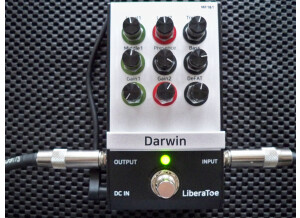
    Darwin is an analog touch-sensitive overdrive that can be purchased as a stand-alone pedal or as a module for the LiberaToe system (pedalboard/switcher). It’s amazing how any pedal or amp can sound different, depending on one’s speakers/cab sim, and so, be aware that the demo uses the Hagerman One Watter amp in the first part, together with a dual cab-sim (Fender Blackface + AC30). Stick a Marshall or MESA cab in there, or a different amp, and you get different tones. And this can be heard in the second part, using the Rivera Venus amp and its built-in cab sim. Regardless, there are a few key descriptors for this pedal: robust with a healthy dose of growl and grain. Darwin is very much amp-like, in that adding this moderate-to-high-gain drive to a clean amp is like adding another channel… and without sounding artificial, over-processed, etc. It has some meat on them bones. The demo accompanying this review should make Darwin’s worth obvious, as the detail and harmonics literally dance about in the mix. And this pedal has a lot of headroom, created by the internal 18V supply, thus making a clean channel sound like a specialized high-gain amp. Besides the sound quality, Darwin has a few features worth noting, including its dual-channel capability. The Green channel has its own volume and gain controls, but also a Middle control that allows you to scoop or add mids, whether going for an 80s Metal tone or something more Classic Rock. The Red channel has its own volume and gain controls, but also more saturation (its middle is fixed at 12-noon internally). Obviously, this pedal was created to merge rhythm and solo, with channel switching accessible within 0.4 seconds of holding the footswitch. Both channels share Presence (high-end control, just like an amp), Treble and Bass. They also share a DeFAT knob that eliminates that bottom end boom, flub and fizz, so that heavy muscular riffing remains tight and clear in the mix. This also means you can add some meat to thin sounding tones. Although Darwin is a moderate to high-gain overdrive, it can merge with high-gain amps. I demoed this toward the end of the video, but two things of note: 1) I reduced the amp’s gain on its dirty channel to about 10-o’clock; and 2) I reduced Darwin’s Gain (on both of its channels) to zero, or all the way down (similar to adding a turned down Tube Screamer to a dirty amp for the purpose of providing some push or drive). That is how much attitude Darwin has, and it works well if you keep those two things in mind and in check. Darwin requires 160mA of power (typically negative center pin) and has a very solid build.

  • « Dual-Channel with Dry/Wet settings... will bite through any mix »

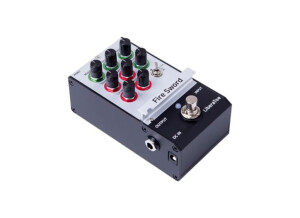
    My first review for a LiberaToe pedal, and I can’t say enough about this company (I’m already into my eighth pedal from this company, with more reviews coming). Fire Sword is one intense distortion and it has a number of things going for it, far superior to other distortions I have tried. One, it is quiet. I have played through other distortions that sounded fantastic, but as you turn up the gain, you get more unwanted noise. Not the case with Fire Sword. Second, it is dual channel, which means setting a crunch tone for rhythm and a heavier tone for lead work or more aggressive rhythm. Third, the EQ is super easy to control; both channels have a Tone knob, but also a Middle knob, which controls how much mids are scooped out or added. Yes, you can add that mid hump for a bigger, darker sound, but it is a gradual mid increase that does not produce any flub. Fourth, there is both a dry and ‘wet’ option; dry is slightly higher pitched and cleaner, whereas ‘wet’ adds a touch of volume (boost) with a tight bottom end. Again, this is perfect for thick, creamy leads, but adds a nice punch to rhythm. Fifth, Fire Sword is a module and part of the LiberaToe platform (pedalboard/switcher), but also is available as a stand-alone pedal. Sixth, this is a dual-channel pedal, which means setting up different settings and switching between those (quickly changed via the footswitch). What don’t I like about Fire Sword? Not much. It growls and bites, but does not too chunky and thick, making it far better for cutting through the mix. However, this pedal must be used sparingly (low gain) when coupled with a high-gain amp; when with such an amp, its gain has to be turned down accordingly. However, the effect you get is much more expressive harmonics and note detail. In fact, Fire Sword’s tone and dynamics are based on the distortion achieved with high-gain tube amps, without the cost of some of those amps. Accordingly, Fire Sword is a blessing with clean amps and when you want that high-gain tone and still have it sound like a quality high-gain amp. Another instance for consideration is when you have a high-gain channel on an amp, but you’re not fully pleased with it. I’m in that camp with my Hughes & Kettner Tubemeister 18… I do not mind the sound of the clean channel, but find the dirty channel very dark, even with the treble turned up and the bass/mid turned down quite a bit. That is not the case when added Fire Sword to the Tubemeister’s clean channel, or if merging it with its dirty channel. Now, I should qualify some of this, and it relates to that dark tone. For the second half of the demo, you will hear a far heavier and thicker sound than in the first half, where I do a composition with a different amp (I used its own cab sim). For the second half, I used cab sims via Spectre Studios (you can download them for free by checking the description link in Spectre’s videos on YouTube). Those cab sims are meant for heavy metal music, and they work well with high-gain amps/sims. Consequently, if you have favorite cab sims, or your actual physical cab has a dark presence to it, you do not have to ditch them. I suspect highly that Fire Sword can tame that dark gear rather well. Also, I have combined this pedal with another LiberaToe creation, the Darwin overdrive, which I reviewed previously. This works best with Fire Sword feeding into Darwin, both with their respective gains down considerably (9-o’clock or so). A very aggressive combination, but one that produces a unique high-gain flavor. Fire Sword Distortion replicates a self-distortion effect which occurs when a large tube power amplifier and speaker box output a high volume. To emulate the amp distortion tone generated by total 7 tubes of the pre-amplifiers and the power amplifiers, devices with the closest characteristics for each tube are selected without the clipping element. Thus, depending on the dial, Fire Sword Distortion shows superior performance compared to an overdrive that has only a few real tubes. The advantage of reproducing the tube's characteristics is that unlike normal distortion, it can extract near-clean textures at low gain, allowing the two channels to act like completely different effects. Equipped with the unprecedented middle knob that simply replaces three TMB knobs to hump or scoop the tone, Fire Sword Distortion can digest a variety of genres, including Blues, Hard Rock and Classic Metal. The combination of the middle knob and toggle switch allows you to produce a wide range of gain and tone, from almost clean to the very saturated. Fire Sword Distortion is recommended for those who like tube-like gain that doesn't get buried in by other instruments, who play hard rock and blues, funky, for those who want to easily pull backing and solo tones through the middle adjustments, and those who want to create diverse tones while maintaining a small pedal board. https://www.liberatoe.com/

  • « Great Flexibility In Sound and Tone Sculpting. »

    LiberaToe’s BearAss is a true-bypass multi-functional pedal chock full of features and uses, for both guitar and bass. It is a Fuzz and Compressor/Sustainer with some very decent flexibility; the Fuzz can range from a touch-sensitive grit to a thick and massive saturation, and the player has access to two modes of Compression (that or a Sustainer). The Compression (green channel) pushes the attack for a tighter and chewier response, whereas the Sustainer (with Boost on the red channel) preserves the natural attack to allow notes to breathe while enhancing sustain and volume. Let’s tackle the Fuzz first, which starts off fairly smooth on low gain output, and cleans up exceptionally well (as stated above, a hint of grit when controlled with a guitar’s volume). As you turn up the Fuzz close to 12-noon and beyond, the quality switches to a more aggressive square wave for thick Doom and Psychedelic Rock. Even cranked full BearAss cleans up very well to medium Fuzz intensity, albeit with that square wave characteristic, which makes it ideal for classic rock-type distortion/drive/fuzz with a guitar’s volume down, then soaring lead with the guitar’s volume full (particularly with the Sustainer engaged). The Fuzz’s tone offers a very usable range, whether all the way down or up, sounding neither too bassy or shrill. The Compressor is obvious when it’s down all the way, and helps to clean up the Fuzz for tighter control. In the demo I used the Compressor during rhythm, set about 9-o’clock. Once Compression is set past 12-noon it works very well to provide those choppy, snappy chords without sounding flat or squishy (you get some of that, but it’s not sterile sounding, as I’ve experienced with some compressors). In essence, you can reduce the attack of notes while flattening out the output for a more consistent volume throughout, but while adding some sustain overall. The Sustainer is excellent, allowing previous notes to decay slowly while latter notes blossom. This can be useful for some fast rhythms (to keep notes and artifacts from bleeding into one another), but adds that clarity and a tighter cascading of notes when playing lead. The Boost function with the Sustainer is HUGE. I typically never had the level past 9-o’clock (likely just past parity), whereas the volume on the Compressor seems to be around parity at 12-noon or a touch higher (closer to 1-o’clock when engaged, as the notes do flatten and you can lose a bit of volume compared to when not using the Compressor). As an added bonus, both the Compressor and Sustainer have a Voice control. When set all the way left (counter-clockwise), the tone is flat and full-range. All the way right and the tone has more mid-focus. At 12-noon, there is reduced low end and tightness. You then can adjust how much full range or mid-focus together with tightness by adjusting accordingly between the values. I like this feature a lot as you can better sculpt your tone using the Comp/Sust and adding that to the Fuzz (or other pedals in the chain). For about $130, this is a great value pedal, as its electronics are of very high quality (manufactured in South Korea and not China) and there is a lot of tweaking available. Even if you don’t use Fuzz much, you have access to a very simple-to-use Compressor and Sustainer to integrate with your typical drive, distortion, or amp gain. It takes seconds to dial into useful settings, and with the diversity of the Fuzz, I suspect non-fuzz lovers will find this analog pedal less typical. Another winner from LiberaToe, BearAss requires only 60mA of power. https://www.liberatoe.com/product-page/bb-series-one-piece-pedal

  • « All analog distortion & filter with a wide range of tone possibilities »

    If you’re looking for a unique Distortion that bites, yet cleans up very well, Proud Addams may be the ticket. And if you wanted to add in a Filter with vocoder characteristics (for that cocked wah sound), you now have two great integrations for under $130 USD. I reviewed LiberaToe’s Proud Addams before, although it was an integrated stacked pedal whereby you would select a red or green channel and whatever combination and settings you would have for the Distortion and/or Filter. This new dual-pedal/dual-channel pedal operates a bit differently and seems to have more appreciation toward the pedal crowd. The Distortion section (known as Thingstortion) is more complex than merely a distortion. Rather it seamlessly blends distortion and fuzz (if you don’t like fuzz, don’t let this dissuade you, as it’s not a traditional fuzz). You can go from a crisp overdrive to a rumbling, sticky fuzz depending on the distortion level, but also your guitar’s volume knob. Generally speaking, the first half (up to 12-noon on the distortion knob) is just that, whereas anything past 12-noon provides more of that fuzz feel, although very much still distortion sounding (great for lead!). The more Distortion you use, the more of a square shaped wave produced. When adjusting a guitar’s volume knob, dialing back to about 25-30% produces an almost clean (slightly gritty) clean, whereas upward of 75% guitar volume and you get some really nice crunchy gain. Up full and you get that distortion/fuzz combination (again, this depends as much on the distortion level on Proud Addams). It cleans up exceptionally well with single-coils, whereas there’s more thump and push with humbuckers, but still sounding relatively clean. The Tone knob for Distortion has a very usable wide range, and in the final composition in the demo, I had ‘picking’ done with the Tone at 3-o’clock (about 30% guitar volume), the chunky rhythm at 12-noon (about 75% guitar volume), and the lead at 9-o’clock (100% guitar volume), which demonstrates Tone, various distortion levels, guitar volume clean-up results, and how well everything blends. The Envelop Filter with semi-vocoder characteristics (the Wahristotle section) has a number of options, including being able to switch from a low to a high filter, designed for both 6-string and bass. The knobs include Sensitivity (how quickly the effect responds), Attack (the speed in which the effect engages with peak frequencies), and Decay (the release time of the effect). Various combinations provide such wide-ranging results that I encourage you to check out the demo to get a full spectrum of what is possible. And what I like about this Filter is how it responds to one’s pick attack, ranging from subtle filter nuances to very vocal (vowel) sounding results. Combine this with a massive range of the control knobs and the potential for a customized effect is achieved with ease. Add in the distortion and lead playing becomes a different animal, particularly since you now can switch from low to high filter in a flash, thus producing a unique wah-like experience (or for bassists to enter a modern Funky Town). Proud Addams’ physical properties include 4.72“ x 3.8” x 2.1“ (12 x 9.7 x 5.3 cm) and 0.82lbs/370g. It requires 9VDC (negative center) power supply, while drawing only 30mA, and with an impedance of Input of MΩ(filter) and 510kΩ (distortion), with an Output of 1kΩ. As a long-time fan of LiberaToe products, for producing quality gear at exceptional pricing, you need to check out this company if you have not already. https://www.liberatoe.com/product-page/bb-series-one-piece-pedal