Log in
EN
FR

SeriesLine 6 Relay

14 products found

Filter
Sort by
Evaluation
  • Reviewed or not
  • Editor’s award
  • Reviewed by Audiofanzine
Availability
  • Available or not
  • Sold new or used
  • Sold new
  • Sold used
Must-have products
  • All products
  • Flagship products
  • Best rated products
  • Hot products
  • Popular products
Price
  • Freeware
€
Clear
Sort by
  • Popularity
  • User ratings
  • Price - low to high
  • Price - high to low
  • Used price, increasing
  • Used price, decreasing
  • Name (from A to Z)
  • Name (from Z to A)
  • Added on
Sort results
  • Popularity
  • User ratings
  • Price - low to high
  • Price - high to low
  • Used price, increasing
  • Used price, decreasing
  • Name (from A to Z)
  • Name (from Z to A)
  • Added on
Filter results 14 results found
Evaluation
Availability
Must-have products
Price
  • Freeware
Show results

The best Line 6 Relay reviews

The reviews Audiofanzine members found the most helpful.
  • « Line6 G50 wireless guitar sytem works great, built ok »

    This came highly recommended from other musicians on forums such as Rig-Talk and other places. Had it special ordered from my Guitar Center as they only carried the G30 which others had said was built a little cheaper. I was very happy when I plugged it in for the first time and it was super easy to use. The basic controls were simple and very intuative. Absolutely love the Cable Tone feature to simulate the impedence of the guitar chord and adjust the tonal characteristics of the input signal. It truly works and does a great job. I have found very little degrading of the tone going wireless as oppossed to plugging in although there is a slight difference but very minimal. I was very happy and still am happy with the overall sound and function. Here is where it gets complicated. Second gig using this, the chord pulled out of the transmitter and now does not snap in, I have had to tape it so it never pulls out. This really bugs me because for the price, it should be able to take a little beating here and there. My assumption is that mainly working musicians need a wireless so it should be tough enough to handle the wear and tear of the road. I also don't like how easy the battery panel opens on the transmitter, way too easy to pop off. This review is a mixed bag not because of the sound but because of the construction. On the surface, the thing appears to be heavy and built well. I found out that it has some weaknesses and unfortunately it would cause me to look elsewhere in the future for someting a bit tougher as far as the transmitter goes. I wish it was better as I like its functionality.

  • « Very good unit for multiple instruments »

    I play guitar in a touring band with 3 guitarists and a bass player. We all prefer wireless when we tour. In the past we had all used our own rigs and our own wireless systems. The only issue with this was interference. Apparently (and not surprisingly) wireless systems of different brands in the same venue don't always play nice. Now 90% of the time we never had trouble, but there would always be one or two nights on tour where something weird would happen possibly because of the venue or the way we were set up onstage. Anyway, we decided to spring for a single unit for all of us, and while we usually have a no-line 6 policy with the band, we did the research and made an exception here for what appeared to be a solid product. Features wise it's pretty abundant. 12 channels and 300 feet of range. We honestly don't use any of the XLR outs or any of that stuff. It's purely an instrument to rig interface thing for us. Line 6 pushes the no signal loss features pretty heavily with this unit which was not a huge selling point for us, since we haven't found a wireless yet that doesn't lose some signal. I have to say that this one is pretty transparent though. It does have the typical signal gain you inevitably get from every wireless but that's a fact of life. The big plus however, is the fact that we never get any interference. None at all. We've had as many as 5 transmitters running at once with no issues that we can hear at least. It's stood up to about 14 months of off and on touring in a rack. It has taken some drops too. Overall very impressive for functionality and reliability. The price is pretty decent too.

  • « Unbelievable clarity that releases your tone »

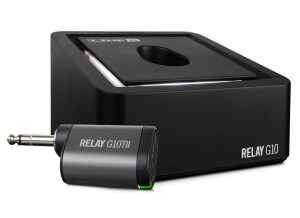
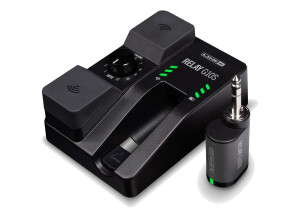
    SOUND: The Relay G10S is a 2.4GHz wireless system for guitar (and other musical instruments) that produces (allows for) incredible tone because of its 24-bit uncompressed digital transmission (best in class ADC and DAC provide very low noise). Amazing clarity is the obvious first impression. The demo video accompanying this review demonstrates how to operate the Relay G10S, but there’s also a sound comparison, which very much surprised me. I strummed some chords on a clean channel then later banged out a few riffs and double stops with some high gain. In both instances I compared two cable brands to the Relay G10S. The least expensive cable (of modest cost $25) was a Monster 12-foot. Next up was a quality 12-foot cable by Spectraflex, a company known in the industry for producing higher-end cables (and endorsed by many professional musicians). When compared to the G10S the Spectraflex cable was slightly darker and not as crisp and clean, whereas the Monster cable had an even more obvious darkness or muddiness to it. Now, what’s interesting about the G10S is that it offers a Cable Emulation function for both a 10-foot and 30-foot cable (I presume a sound difference becomes noticeable once you get upward of 30-feet). What this does is add an analog ‘warmth’ to the signal if you so choose such a setting, which can be beneficial if using bright pickups or amps. This, too, is demonstrated in the video. OVERALL IMPRESSION: The clarity of signal with the Relay G10S is nothing short of impressive. All my guitars, pedals, preamps, etc., actually sound better and slightly different… more crisp with a very apparent ‘cut-through-the-mix’ quality. At $249 USD it may seem steep for a wireless system that does nothing but transmit your guitar’s signal, but that is a typical cost for many pedals (and certainly a fraction of the price of a guitar, amp, etc.). Consequently, imagine having a pedal that enhances the sound of your music gear investment, and that’s exactly how the G10S should be viewed, besides having freedom from a chord wrapping around your feet. The Transmitter has a very fast charge of about 30-minutes, which then gives upward of 8-hours of play (by then your fingers will want a break). And if you leave your guitar for a short while and with the Transmitter plugged in, the Transmitter goes into sleep mode within 4-minutes to preserve battery life. With all all-steel construction, 130-feet of cable-free-freedom, auto channel select and a design made for a pedal board (although you can place it where preferred) there’s everything to like about Line 6’s Relay G10S and not much to gripe about. Wireless systems finally are getting to where high-end pedals have been for the past few years – excellent work by Line 6. GENERAL USE: Using the Relay G10S requires very little initial setup. The Transmitter (the part that plugs into your guitar) inserts into the Receiver for initial charging, which takes about a half-hour (which then gives upward of 8-hours of use). You can leave the Transmitter in storage when not in use, although you need to ‘press the Release Latch on the Receiver and pull the Transmitter out one stop so that the battery does not drain’ (fully inserted and the Transmitter communicates with the Receiver). If you leave the Transmitter in your guitar it will enter ‘sleep mode’ when there is no play for 4-minutes (the battery continues to drain, albeit more slowly). The Receiver has up to 11 possible channels from which to choose. Typically you would leave it on Auto so that the Receiver can search for the clearest channel with the least interference. However, if other band mates are using a wireless system you will need to select a Channel to prevent honing in on their territory and to keep their signals from interfering with your signal. Both the Transmitter battery life and the Receiver (RF) signal strength can be viewed clearly on the Receiver (3 LEDs each, with ‘RF’ on the left and ‘battery life’ on the right). When you see 3 RF Green LEDs light up you have a strong signal, whereas 2 or 1 Green LEDs mean there is some strength, but not as good (and you cannot wander as far away before losing your signal). Red LEDs indicate anything from a usable or short range to too much interference. Having good reception (3 Green LEDs) means upward of 130-feet of freedom, just in case you want to stroll through an audience while playing. In regard to battery life, you get upward of 8-hours of play time on one charge, indicated by 3 Green LEDs. As you get down to only 1 Green LED you have about 1.5 hours, or a bit more, of charge. Red LEDs provide warning with 30-minutes or less of charge. As indicated previously, there is a Cable Emulation option, to add analog warmth to the signal (since the G10S is so amazingly clear); a function that can be useful for bright amps and pickups – or perhaps you simply like a warmer tone relative to your gear. This function can be used only if you use the quarter-inch jack instrument out. The other ‘out’ option is the XLR DI Output that goes to a mixing desk, audio interface, etc. As well, there is a micro USB input for firmware updates and optional power. OTHER DETAILS: The Line 6 series of wireless systems have improved over the years. The Relay G10S has all metal construction, for both the Receiver and Transmitter. Past Receivers had a plastic housing and touring musicians had concerns about the long-term durability of the unit (I also have read this concern on various guitar forums). The antennae in the Receiver are protected by rubber pads as well, just in case your stomping foot goes awry. The unit is of standard pedal size, made for pedal board use, measuring approximately 5 (L) x 3.5 (w) x 2 (h) inches or 12.7 x 8.9 x 5 cm. The Transmitter tucks in nicely and well protected under the 2-inch height of the Receiver unit. All cable inputs and outputs are located in the back, which keeps a pedal board clean looking and cables out of the way. The Relay G10S (Receiver + Transmitter) comes with its own 500mA power supply, and you also get a USB cable if you prefer powering up in that manner, and certainly needed for firmware updates. As a side note, the Transmitter is a G10, which has existed prior to the G10S release. Consequently, if you have any G10 Transmitters you can use them in the updated Relay G10S system.

  • « The digital wireless revolution is here!!! »

    This is NOT Spinal Tap You've either seen it, heard it, or lived it. The freedom of wireless roaming on stage crippled by the interference of local radio stations, other broadcasts, or the wireless from the opening band's guitar player that didn't get turned off after THEIR set (I've actually seen the last one happen). All of these scenarios have led to a small backlash against traditional analog/RF wireless units and have players going back to their tried-and-true cable. What's in a cable? If you have the inclination, you can find information on the Internet that bashes guitar cables as "tone suckers" and nothing better than antennas that bleed your guitar tone and introduce interference. While this may be true, many opt for the stability of a cable over the gamble of interference on a wireless. Leave it to Line6 to solve this issue in an incredibly creative way using proven technology. When it comes to wireless, Line6 now has every other company smacking themselves on the forehead and asking, "Now why didn't WE think of that?" The Relay G30 Digital Wireless Guitar System Enter the Line6 Relay G30 Digital Wireless Guitar System. Comprised of a small transmitter and receiver, this system that Line6 represents as their entry-level package outperforms most other expensive wireless systems. The design of the G30 is both elegant and practical. The receiver is smaller than most stomp boxes and will fit easily on a pedal board, on top of, and possibly inside the back of most open-backed amps. The internal antennas on the G30 receiver makes it easily mistaken for a stomp box on a pedal board. The transmitter is just big enough for the device itself and the two 'AA' batteries that power the transmitter. Now let's talk about intelligence for a second. When you're playing, you can't see the transmitter that is on your guitar strap, belt, etc. That's why Line6 put the meter that shows the relative strength of the signal (including transmitter battery strength) on the receiver, where you CAN see it at a glance via a row of color-changing LED lights. There is, of course, a battery indicator on the transmitter, but I found myself relying more on what the receiver was telling me than constantly looking over my shoulder. I had the Relay G30 up and running in about 30 seconds. Put in the batteries, pick one of the six available common "channels" on the receiver and the transmitter, plug in, and play. No messing with antenna positions, no dealing with interference, just pure, true guitar signal getting to your amp. Line6 has accomplished this by using tried-and-true digital wireless technology. This is the same technology you've had in your house for some time now, wirelessly connecting your computers to the internet. The Relay G30 operates over the 2.4 GHz frequency band, the same as most of the older cordless telephone and computer wireless access points. Given the history of wireless systems and interference, plus the fact that I'm an admitted geek as well as musician, I decided to see if I could make the G30 fail or introduce any interference into the signal. Nope. I even put a famous-maker wireless access point made for computers directly between, beside, over, and under the G30 receiver and never encountered any interference. This is due to a pair of technologies on-board in the G30. First is Digital Channel Locking (DCL) technology that "locks" the transmitter and receiver onto the same signal frequency. The second employs some advanced technology, again borrowed from the computer world, to block out any signal that might try to interfere with YOUR frequency. But how does it sound? Once I plugged in the G30 I was amazed at the clarity, quality, and overall fullness of the sound when compared to my cable. In fact, it was a little TOO good. Higher frequencies were popping out all over the place and I thought, "I haven't changed my EQ settings, where did all this treble come from?" Well, it turns out the G30 will transmit all those higher frequencies that your guitar cable doesn't. The specifications on the G30 state its frequency response between 10 Hz and 20 kHz. My first thought was that I would have to adjust my EQ settings to accommodate the new wireless. But wouldn't you know it, Line6 thought of that as well. The G30 has a feature called "Cable Tone Simulation." Basically, this is a three position switch on the receiver that allows you to select how you want the G30 to sound. Your choices are Full Digital, 5 Meter Cable Simulation, or 9 Meter Cable Simulation. Clicking onto the 5 Meter position rolled off a good bit of the high frequencies and my guitar started to sound more like its old self. Clicking onto the 9 Meter position rolled off even MORE of the high frequencies and my thoughts of having to adjust my EQ melted away. As an interesting note, the lowest and highest frequencies listed on my 31-band famous-name EQ are 20 Hz and 20 kHz, so the G30 has got you more than covered. The high-fidelity quality of sound that the G30 produces will have you looking at your guitar and gear in a whole new light. I was afraid that while I could hear the differences live, I wouldn't be able to capture the differences when recording sound clips. That wasn't the case at all. I plugged in a variety of guitars and amps using the G30 system including Gibson and Epiphone Les Paul models, Ibanez RG and JEM models, a Fender Lite Ash Telecaster, a PRS SE Semi-hollow, a Mosier MMi-T, and various Squier models. I was treated to the same crystal-clear beautiful tone every time. Overall, I think the Relay G30 Digital Wireless Guitar System far exceeds any "entry-level" expectations and have a difficult time thinking of it as entry-level on any scale. The signal delivered is pure and true and the Cable Tone Simulation feature means you can gradually adjust your EQ settings until you reach that "full digital" state if desired, or leave it on to shape your tone exactly how you want it. Be forewarned that due to the power needed to maintain good signal strength the transmitter will deplete a standard set of 'AA' batteries after a few hours of playing so either make sure you put in fresh batteries before a gig, or use high-grade Lithium batteries that are specially designed for high-power devices. Either way, if you're standing right in front of the receiver and the signal strength light is showing one red bar instead of 2-3 green bars, change your transmitter batteries. The receiver is powered by the included AC adapter, so you're covered there. Say good-bye to your cable, bad wireless interference, and anything else that has previously kept you from exploring the rest of the stage, the crowd, the drum riser, or anywhere else within 30 Meters of the receiver.