Log in
EN
FR

Orban

28 products found

Categories
Filter
Sort by
Evaluation
  • Reviewed or not
  • Editor’s award
  • Reviewed by Audiofanzine
Availability
  • Available or not
  • Sold new or used
  • Sold new
  • Sold used
Must-have products
  • All products
  • Flagship products
  • Best rated products
  • Hot products
  • Popular products
Price
  • Freeware
€
Clear
Sort by
  • Popularity
  • User ratings
  • Price - low to high
  • Price - high to low
  • Used price, increasing
  • Used price, decreasing
  • Name (from A to Z)
  • Name (from Z to A)
  • Added on
Sort results
  • Popularity
  • User ratings
  • Price - low to high
  • Price - high to low
  • Used price, increasing
  • Used price, decreasing
  • Name (from A to Z)
  • Name (from Z to A)
  • Added on
Filter results 28 results found
Evaluation
Availability
Must-have products
Price
  • Freeware
Show results

The best Orban reviews

The reviews Audiofanzine members found the most helpful.
  • moosers's review

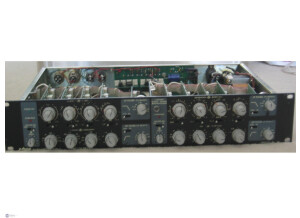
    The Orban 642B is a dual channel parametric equalizer and notch filter. It is an analog piece of gear if I'm not mistaken, but I can't say what sorts of connections it has since my use with it has been somewhat limited and in a professional studio environment where it was already racked up and in place. It is a rack mountable piece of gear in the traditional sense, and will take up two rack spaces. UTILIZATION Since the Orban 642B offers up a lot of flexibility and control over your sound, it can take a little bit of time to get used to. There is often a trade off between ease of use and versatility, which is the case here with the 642B. I don't find it too hard to use myself, but it definitely isn't the simplest parametric EQ that I've used. Each of the two channel has four bands, each of which consists of parameters for bandwidth, frequency, boost/cut level, and vernier, which is for fine tuning. Each channel also has both a low and high pass filter as well as bypassing switches for each of the bands and for each channel as a whole. I think the 642B is easy enough to figure out without the assistance of a manual, but for beginners it is always a good idea to have it around anyway. SOUND QUALITY With so much control over your sound comes the ability to really zero in on notching and filtering with the Orban 642B. It isn't really your typical parametric equalizer, as it is designed for cutting or boosting really specific frequencies in addition to all the accommodations of your typical parameter equalizer. You can definitely used the 642B for any application where you would want to filter in anyway, as it has a clean sound quality that will extend pretty universally. OVERALL OPINION I think that you'd have a pretty hard time finding an Orban 642B, as this isn't the most readily available parametric Eq/notch filter available. Orban isn't a well known company, but I've generally liked the gear that I've used made by them. Because of this, I do think that you you came across a 642B that you'd be able to get a pretty good deal for a piece of gear like this, so I'd recommend checking it out if you need a hardware EQ and notch filter in one.

  • moosers's review

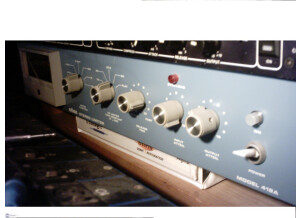
    The Orban 418 Stereo Limiter comes in two models - the 418A and the 418B. This review is for the 418A, as is pictured above. I don't know all that much about what's inside the 418A or what type of connections it has, as I don't own one and have only used one on a few occasions. We didn't have to make any connections to it as it was already hooked up to the patch bay for easy patching. It will fit in a traditional rack casing, and it takes up two spaces. UTILIZATION The configuration of the Orban 418 Stereo Limiter isn't out of the ordinary and is easy to understand. The parameters that you've got to work with include those for input attenuation, output attenuation, release time, and one for high frequency limiter time constant. It then has a knob to set what your VU shows - it can be set to show left and right input, left and right output, and gain reduction. I haven't seen a manual for this, and I think it would be kind of hard to find one since it is a somewhat rare piece of gear. SOUND QUALITY The sound quality of the Orban 418 Stereo Limiter is really quite good. The obvious application for this unit would be for mastering purposes, and situations like it where you would want a stereo set of signals being sent to a limiter. I've actually only used each of the channels separately on the 418. At the studio where I used it there were plenty of other compressors and limiter that I used on the session before I got to this one, so I was really just using this when I didn't have any other limiters to work with. This isn't to say that I don't like the sound of the 418, because I do very much. It does the job well with a realistic sound that works well for just touching signals or hitting them hard... OVERALL OPINION Although my experience isn't as deep as it is with some other similar pieces of gear, I definitely enjoyed using it when I got to. I'm not sure why, but it seems like it's hard to find most pieces of gear out there that are made by Orban, and this is definitely the case with the 418 Stereo Limiter. The only one that I've seen was the one the I used. I guess either Orban didn't make too much of these, or maybe they died out over the years. Either way, if you come in contact with one of these guys, I'd recommend it as a second tier compressor/limiter option...

  • moosers's review

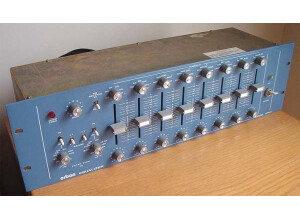
    The Orban 516 EC is a hardware de-esser, consisting of three channels and a very simple make up. It is an analog piece of gear, and I'm not sure what types of connections it has since the one that I used was already racked up and ready to go in the studio where I used it. To make the connections, it was already hooked up to the patch bay for easy access. It is rack mountable and will only take up a single space in traditional casing. UTILIZATION Using the Orban 516 EC is incredibly simple to do. There is only one parameter to control the level of de-essing on each of the three channels, as well as one to engage each of the channels. As anyone can easily tell just from looking at it, there isn't much to know about the 516 EC. This is definitely something that I like about this unit, as it makes it quick and easy to de-ess. The manual is useful for checking out the schematics, but isn't necessary for any other sort of use. SOUND QUALITY The sound quality of the Orban 516 EC definitely makes it more than useful. It does a very good job of de-essing, but doesn't offer up too many parameters so it isn't all that versatile. Of course this is only going to be used for vocals, but it would be nice if there were some other parameters on this to make it easier to adapt it to different types of vocalists. Either way, the 516 sounds clean and does the job well and very quickly. OVERALL OPINION While I generally use plug-ins to de-ess nowadays, when I do have access to the Orban 516 EC, it is definitely something that I will use as it has a more realistic sound than most of the de-esser plug-ins out there. I can't say that I'd recommend going out and seeking one of these out since they would be hard to find, but if you do come across one and are in the place where you'd like a hardware de-esser, the price should make it cheap enough where you can try it out to see if it will be helpful for you.

  • « gotta love analog gear »

    The Orban 672A is a parametric EQ in the form of a piece of outboard gear that is not rackable in your traditional sense. They will fit within the API lunch box but aren't the standard rack size. The 954 is an all analog piece of gear and it is unique because it has the capabilities to be automated, although I've never ventured into this portion of the unit. UTILIZATION The configuration is very easy to understand and figure out as it is your basic EQ, with three bands in total - high, middle, and low. You can set your frequency for each with the bottom knob, and set the gain or cut with the top. I don't have a manual for the API Audio 954, but if you have any experience with EQs at all you shouldn't need it as the unit is easy enough to figure out how to use without it. SOUND QUALITY The sound quality of the Orban 672A is extremely crisp and clear, and won't color your sound beyond what you set it to do. It is suitable for all types of instruments, and I typically use it for electric and acoustic guitars, bass guitar, keyboards of all kinds, and both lead and back up vocals. However, it is rare that I will track with this, as I like to go back and add EQ later during the mixing stage. The Orban 672A does its job effectively and does it with a top notch sound quality. OVERALL OPINION I've been using the Orban 672A for about three or four years and it has become one of my favorite pieces of outboard gear in terms of equalization. It has both the ease of use and top notch sound quality that you have come to expect from API gear. These are very rare and will cost a decent amount of money if you can find one, but if you have access to them at a studio, they are absolutely worth using. This being said, I wouldn't suggest picking these up if you are a home studio owner looking for a single EQ to track or mix with, as it is just too expensive. All in all, another stellar piece of gear from Orban.

  • moosers's review

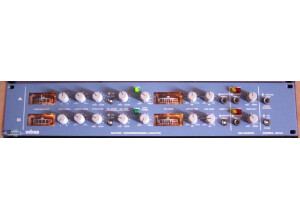
    The Orban Dual Reverberation 111B is a stereo spring based reverb system. The unit is an analog one consisting of XLR connections. Each of the two channels has the same configuration. The 111B is rack mountable and will take up two rack spaces. UTILIZATION I don't find the using of the Orban Dual Reverberation 111B is hard to do at all. Both channels have parameters for attenuation in and out, bass EQ, and mid range EQ. Upon playing around with the parameters for a few minutes I found that I was able to get a pretty good grasp on how to use the reverb. While it doesn't have the most straight ahead parameters in terms of how it names them, I think you'll see quickly that everything is pretty easy to understand once you sit down with it. I don't believe a manual is necessary for this unit although I haven't seen one so I can't say anything about its make up. SOUND QUALITY Since the Orban Dual Reverberation 111B is made up of a real spring reverb, it has a pretty sweet sound. I can't say that it is my favorite analog spring reverb out there, but having two channels in a compact unit like this is pretty cool. I've used the reverb for drums and vocals with some good results, but unless you're going for a specific type of spring reverb tone that this has to offer, I wouldn't say that it can be used all of the time. I think that it's a cool sound, I'm just saying that it wouldn't be my all purpose, go to reverb and I can't imagine that it would be that way for most people. For me, it is a great reverb to have around to use every so often as you never know when it could end up working perfectly. OVERALL OPINION Surprisingly, I've used more than one Orban Dual Reverberation 111B in my day. These are pretty rare as far as I know, and although I do like i'ts sound, it wouldn't be the type of unit that I would go searching after if I didn't have it already available. The price isn't expensive at all however if you wanted to buy a used one. If you're looking for a cool compact spring reverb, the Orban 111B should be on the list of inexpensive models that are worth looking into.