Log in
EN
FR

Farfisa

56 products found

Categories
Filter
Sort by
Evaluation
  • Reviewed or not
  • Editor’s award
  • Reviewed by Audiofanzine
Availability
  • Available or not
  • Sold new or used
  • Sold new
  • Sold used
Must-have products
  • All products
  • Flagship products
  • Best rated products
  • Hot products
  • Popular products
Price
  • Freeware
€
Clear
Sort by
  • Popularity
  • User ratings
  • Price - low to high
  • Price - high to low
  • Used price, increasing
  • Used price, decreasing
  • Name (from A to Z)
  • Name (from Z to A)
  • Added on
Sort results
  • Popularity
  • User ratings
  • Price - low to high
  • Price - high to low
  • Used price, increasing
  • Used price, decreasing
  • Name (from A to Z)
  • Name (from Z to A)
  • Added on
Filter results 56 results found
Evaluation
Availability
Must-have products
Price
  • Freeware
Show results

The best Farfisa reviews

The reviews Audiofanzine members found the most helpful.
  • « Music Circus! A large and good analog combo »

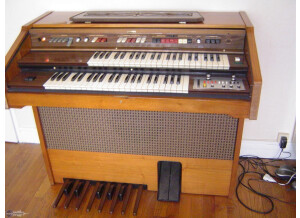
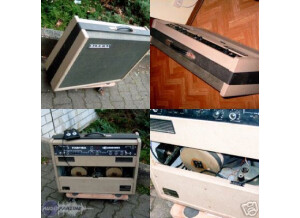
    A real mammoth that I found out of order at a pawnshop and managed to refurbish: partytime! It’s an organ/ string machine/ piano/ harpsichord/ synth/ drum machine all-analog combo with a vertical acoustic Leslie-style processor and a spring reverb! Even as a furniture it looks great and classy. - A rather “lightweight” organ sound, featuring harmonics (“flutes”) with on/off for sole settings and only little character: 6 on the upper keyboard, including 3 dedicated to percussions with long and short options and repeat feature (held and chopped but with a set speed). The release function can be parametered. The lower keyboard features 5 harmonics without a percussion (but you can cumulate piano, harpsichord and strings). Other sounds (ALL of which can be cumulated, including the organ) for the upper keyboard include: - A round and warm piano sound, but not realistic of course, - A very analog-sounding 70s-pop like harpsichord, - String ensemble: 2 identical presets with a 1 octave difference that can be used together, but the best surprise is that – it’s Solina! Independent settings include colume, lowpass filter (for brilliance) and release (for sustain). A real pleasure. - mono synth (=a single note at once): 8 presets with rather soft attacks (rendering wind instruments and violins). Settings through 6 faders: volume, lowpass filter, resonance (on/off plus attack length – why?), sustained sound or decay length + release (why, again?), portamento length, vibrato (off or on + speed), and finally a portamento on/off switch. You can “cheat” and add sounds over others, providing small color variations. A gadget: a pitch bend down function allowing for a half-tone down on all the sounds of the upper keyboard with a foot pedal, on the right of the volume pedal. - the analog drum machine (including presets) is a good surprise (it’s a Partner M). On the circuit card (see picture), I found the adjustable resistors for colume, color, tune or decay for most sounds! (the heavy kick and so on…). You can also cheat and add rhythms above each others, with results sometimes more interesting than the original ones. As a gadget, there’s a break per button on the front or foot-controllable on the side of the volume pedal (the left controller). - The acoustic “Leslie” is rather legit, especially used with the organ preset and the additional “click”. I intend to try and tweak it so as to be able to use it also with external sounds. The Leslie block is internally connected using real Leslie-style connections, so you should be able to plug the Farfisa into a real Leslie, or use and control the internal “Leslie” with an external device as was often the case in the past. - The reverb provides no surprise, but it would be nice to be able to push its volume further up. - Connectors include line out (except for the “Leslie”), external audio in (which can get through the reverb) and headphone out. I will finish to repair it cosmetically then try to post a more complete video than those that are already online. I’m not getting into all the details regarding the presets, bass pedalboard and many accompaniment, arpeggio and combination options, but it’s obviously a really high-end Farfisa model.

  • moosers's review

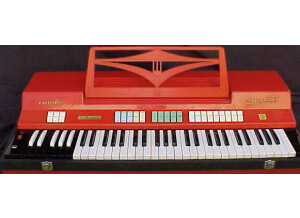
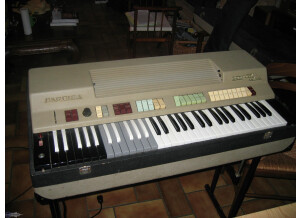
    The Farfisa Combo Compact is an electric organ with a unique sound. The Farfisa sound in it's own is it's own type of organ sound, as it's pretty cheesy and thrives on this notion. This isn't too much unlike many of the other Farfisas out there, but it's hard to find one that's better than this as to me this one does it all. The studio I work at has one of these and it will see some use from time to time. It's definitely fun to play with to say the least. It's got an attached 1/4" cable as well as a built in power cord. The keyboard has full polyphony... UTILIZATION Operating the Farfisa Combo Compact isn't difficult. The keyboard itself spans about four octaves, and it has a pretty good feel although the keys are pretty light and flimsy. I think you're going to find this to be the case with any Farfisa, however. It's got a variety of controls to work with, including switches to control the bass volume, reverb, tone boosting, and the different voices. Included in the voice to choose from are strings, flute, oboe, bass, trumpet, and piccolo, with a few of them have multiple buttons for different sized sounds. It's a simple push and play systems, so no manual should be necessary here. SOUNDS The sound of the Farfisa Combo Compact is everything you would hope it would be for those familiar with the Farfisa sound. If you don't directly know what this will sound like, you've certainly heard it on records. I like it as it's a great change of pace for to your more traditional sounding organ. It's definitely a cheesy sound, but that's the novelty to it in my opinion. There's also a good amount of differing sounds possible between all the voices on here since you can mix and match them. OVERALL OPINION The Farfisa Combo Compact is an awesome electric organ to have in any studio. I don't know if it's worth it to have one of these otherwise as it's somewhat bulky to bring around and is a sound that can be emulated digitally easier than most other instruments. I'm really glad that we have one at the studio where I work, as although it doesn't get used as much as the Hammond B3, it's definitely a nice color and option to have around. I don't know what one of these would cost, but it's certainly worth looking out for for any fan of Farfisas.

  • moosers's review

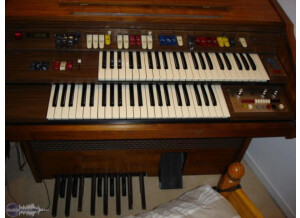
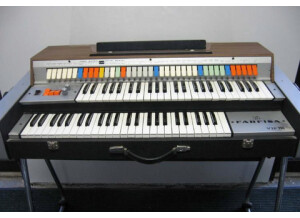
    The Farfisa Capitol is a dual keyboard organ, each of which has about two and a half octaves worth of keys. It doesn't have any pitch or modulation wheels, but has sustain and vibrato as well as a number of other effects and parameters. In addition to the two keyboards, it has bass foot pedals as well. The keyboard is fully polyphonic, and while it has a built in speaker, it can also be sent out to someplace else if you desire as well. UTILIZATION The configuration of the Farfisa Capitol is pretty easy to follow and there is a good amount of control over your tones to go along with it. Having the two keyboards plus the foot pedals allows you to have three different tones going at once if you wanted to. It is easy to understand everything on this keyboard and it is easy to figure out where everything is. I don't have a manual for the Farfisa Capitol, but it is easy enough to use that you shouldn't need one if you don't have it. SOUNDS The sound quality of the Farfisa Capitol is pretty good. Nothing about the sound of this keyboard blows me away, but it still has some usable organ sounds, including the cheesy organ sound that has made Farfisa famous. There are a good amount of effects and parameters to manipulate your tone which makes this is a pretty versatile organ. Overall, a nice sounding keyboard, but probably not good enough for the top notch professional. OVERALL OPINION I've been using the Farfisa Capitol for about three years and have found it to be an interesting sounding instrument to say the least. I like the overall sound and feel of this keyboard, but if I was looking for a professional Farfisa sound, I would probably go with the Commander or another keyboard like it. The price of these is pretty cheap and reasonable if you can find them, and is perfect for the entry level organist.

  • moosers's review

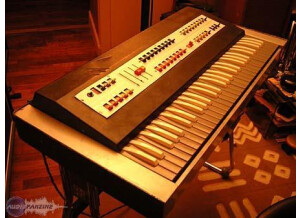
    The Farfisa Compact Professional I organ is an analog keyboard that spans about four octaves. It has a 1/4 inch output to send to an amp, as well as a number of other 1/4 inch outs for varying uses. This is a fairly versatile instrument, but there is a core tone that makes it recognizable. It is a fully polyphonic organ. UTILIZATION The configuration of the Farfisa Compact Professional takes some time to get fully used to, as there are a lot of parameters to adjust your tone. Once you play with it a bit, it is easy to understand all of the functions as they are smartly laid out and everything is easy to access. Being that this is a fairly old instrument, I don't have a manual for it so I can't speak to if it is helpful when trying to learn this or not. SOUNDS The sound of the Farfisa Compact Professional I organ is pretty specified, but is suitable for all types of music if you want to get creative with it. This organ will give you the type of organ sound that has been made famous by Elvis Costello and other artists with a similar style. It is kind of a cheesy sound, but this cheesiness is a lot of the reason it is so popular. It is overall a unique sounding organ that sounds pretty different from what you would think of as your traditional Hammond organ sound. OVERALL OPINION I've been using the Farfisa Compact Professional I organ for about two years and I really love the sounds I get with this. I'm a huge Elvis Costello fan, so naturally I would like the sound of a Farfisa, but this keyboard really is versatile and has an overall awesome tone quality. These are somewhat rare, so the price isn't all that cheap and I would really only recommend this to those who really want the real deal in terms of a compact organ sound. Overall, a classic instrument that is completely unique to itself.

  • « classic organ »

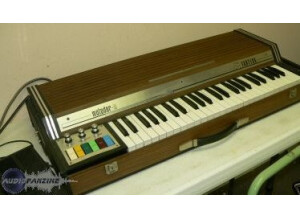
    This is a really classic organ that has been heard on countless recordings from the 60s and 70s. The most obvious examples that I can think of would have to be The Doors' Ray Manzerak who used them a decent amount, and especially Steve Nieve of Elvis Costello's band the Attractions. There aren't any ways to update this organ, it predates Macs and PCs, as well as MIDI for that matter. It has minimal controls, drawbars for tones (two tones) and four for octave selection. There is no controller for vibrato, it is unison for all settings. It is polyphonic. UTILIZATION It's an easy organ to use, actually far less of a burden to operate than a B3. I haven't seen a manual for one officially, I found guides on the internet to help me find out how to set it up and operate it, etc. The setup isn't that simple, but with the guide I was able to do it, and I'm assuming most people could do the same thing. I could have just asked the owner but I wanted to know exactly how to do it myself. SOUNDS The sounds that come out of this organ are really cool. While they don't really have the intensity of a B3 or most Hammonds for that matter, they are actually really sweet on their own right. I would say that the best way to describe it is a little bit brighter than a Lowry or B3, but also a bit more nasal and colorful. They are certainly rather thin, though not annoyingly so. OVERALL OPINION I think that the relative portability, as well as the nostalgic and classic sound, are the two main selling points about the organ. The worst part is that they are really really hard to find nowadays, and if so, they are extremely expensive. I had the fortune to have a client use one so I got to really experience it firsthand (especially since I had to set it up for him).

  • moosers's review

    The Farfisa Commander organ is a dual keyboard compact electronic organ. It has outputs for a speaker cabinet, as well as for a sustain pedal and organ foot pedals, among other connections. The Farfisa Commander has all types of sounds, but specializes in a cheesy organ sound, rather than your traditional Hammond or pipe organs sound. The keyboard is fully polyphonic. UTILIZATION The configuration of the Farfisa Commander is pretty easy to follow, but it does take some time to figure out what everything does because there are a lot of parameters and functions available on this organ. It is easy to get basic tones and to explore different sounds, but mastering the uses of the Farfisa Commander can take a little while. I don't have a manual for this keyboard, so I can't speak to how helpful it is or not. SOUNDS The sound of the Farfisa Commander is awesome, but it does have its specified use and isn't incredibly versatile. It is more versatile than most of the other compact organs made by Farfisa, but still outputs a similar tone throughout the entire spectrum of the instrument. The Farfisa Commander is easy to play, with the keys being quite light and pretty sensitive. Overall, a great sounding organ for what it is when you are looking for that compact organ sound. OVERALL OPINION I've been using the Farfisa Commander compact organ for about a year and it is one of my favorite organs of this type that is out there. I'm a big Elvis Costello fan, so naturally I would be a fan of the sounds that this has. It is somewhat rare at this point, and isn't that cheap if you can find one used, but also isn't that expensive. Overall, this is an awesome keyboard that I highly recommend for those interested in a great compact organ.