No affiliation to the company. Pedal Mob’s true bypass ORBIT CODE is a modified OCD that resolved the OCD high impedance issue (and how it affects downstream pedals with too much emphasis on the upper mid-range and treble frequencies). In essence, Orbit Code has low impedance at output, which means you can have any pedal before it (high or low impedance) without causing signal issues. Conversely, if the OCD pedal has a low or mid impedance input pedal before it, you would experience a volume drop. I never tried an OCD pedal, but will take the builder’s word for it. The results are a smoother and more transparent tone, and the Orbit Code does have that in spades; it has a very natural sounding grain and touch response. On that note, it does amaze me how many good pedals there are out there for under $100 (Orbit Code is $65 on eBay.com). The sound is excellent, as quality components are under the hood of this South Korean build (not to be mistaken with cheaper Chinese pedals). But Orbit Code has a few tricks up its sleeve, such as providing multiple textures, viz., overdrive up to 11-o’clock (with very little bottom end emphasis) and more of a fuzz-like bassy (more bottom end) distortion at 12-noon and beyond. Now, it’s not exactly a fuzz sound, for fuzz haters, but thicker and hairier in texture. With the gain down all the way, it acts as a Boost, albeit not 100% clean and with a small amount of grit in the signal… only enough to heighten the details and definition so that the original tone pops better in the mix. Bump up the Gain slightly and you begin hearing a crisp response that blossoms into a meaty, defined drive around 9-o’clock and beyond. Moreover, Orbit Code has a three-position toggle switch, as opposed to only two positions with the OCD, the latter of which has a HI Peak with an upper frequency tilted up, and a LO Peak having a slightly lower frequency focus. Orbit Code has an upper (toggle switch down) and lower frequency focus (toggle switch up), but also a middle position (toggle switch in the middle), which has more bite or cut than the lower frequency, but not as much as the upper frequency position. I reached out to Pedal Mob to get a better understanding of these three positions and their intentions for use. The LO and MID Peak (it’s the middle position, but I’ll call it the MID Peak position, which has only a 5Hz gap between itself and the HI Peak position) resemble a Fender amp’s tone stack curve. Conversely, the HI Peak position (toggle down) resembles a Marshall tone stack. This design concept also separate the Orbit Code from the OCD’s original tone curve. The builder suggested using the MID and HI frequency settings if paired with a Fender amp or single coil, and the LO frequency setting for the Marshall, so it doesn’t sound as ‘harsh’ with the HI frequency setting (which resemble the Marshall tone stack). In my opinion, and based on my limited gear and tinkering (and not playing through Fender or Marshall amps/cabs, but direct playing through my computer and Kali Audio IN-8 monitor speakers), I could go either way, as I find Orbit Code sounded awesome no matter the frequency position and whether using humbuckers, single coils or a Fender vs. Marshall cab sim. And so, it comes down to one’s taste, but also the style of music and being able to cut through the mix. This is the fourth pedal I reviewed from Pedal Mob (they currently have only four), and after years of reviewing and tinkering with gear I will say that although Orbit Code and the other Pedal Mob pedals are budget priced, they are anything but ‘cheap’ pedals. There are serious electronics and quality standards you will find that are not in cheaper budget pedals (‘cheap’ refers to quality and not price), and if you’re looking for a brand name that Pedal Mob replicates, I do suggest delving into the less expensive arena, particularly considering how pricey gear is becoming. A few other details: Size & weight - 3.7x1.9x1.9(inch)/93x47x47(mm), 0.33lbs/150g; Power: DC9V center-negative, 30mA current. draw https://www.pedalmob.com/pedals
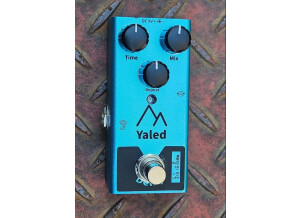
YALED DELAY is a true bypass pedal by Korean creator Pedal Mob. It’s a simple delay with Time, Repeats and Mix. But as simple as this delay is, it is quite exceptional for $65. And so, what makes it exceptional? There are two main factors: 1) It is an analog delay, which makes the effect warm; and 2) It is amazingly clear with digital delay characteristics. In fact, I pitted the YALED DELAY against the Universal Audio Del-Verb and found the YALED DELAY superior in sound quality. This is not a cheaper Chinese-made delay, and those are fine for some players, but the audio-grade components in each individual part-hand-built YALED DELAY takes this effect to a different level. It also has no negative influence on the original tone, which I demonstrate in the demo by comparing the guitar tone with the pedal on versus off (and Mix turned all the way down). I notice slight changes in tone with other delay pedals that cost far more, and even hundreds of dollars. Now, YALED DELAY is far simpler than many other delays, in that it doesn’t offer modulation or types of delay. But if you need a basic delay effect for rhythm that ranges from a quick slap-back to something more spacious and open for lead, then this is the ticket. Nonetheless, it has another feature that allows you to power it via 9VDC or 12VDC (100mA current draw), the latter of which offers more headroom and clarity. I really like it on 12VDC because as you turn up the mix, the result is more noticeable: The delay repeats sound bolder and to the point of being as loud as the original signal once the mix pushes past 12-noon and particularly up full. And therein lies another feature, with its internal design including a slight 2-3dB boost. This is fantastic as some delays can muddy the waters slightly (a slightly lower and duller sound). The Time element goes up to 600ms, which may not be enough for some ambient players who like that distinct separation in time between the original tone and the delay response, but this delay suits my needs in general; if I need something broader, then I’ll utilize a different delay pedal. The same is true if I need modulation of some type, which I rarely use, preferring something clean, clear and bold. The Repeats range from barely noticeable (even somewhat less than a slap-back, which is good for doubling the signal for a thicker response) all the way to infinite repeats. One thing that may dissuade a buyer is that when you turn off YALED DELAY, the repeats are cut off immediately, due to it being true-bypass and not buffered bypass. I don’t recall needing the trails to continue after I shut off the pedal, so that does not affect my compositions nor playing. My final verdict? Well, YALED DELAY now has become my main delay pedal. And I should add, as demonstrated in the video, that it blends very well with other delay pedals due to its exceptional clarity. And for those who like mini-pedals, to fit better on small to large cluttered boards, that’s a plus (size & weight: 3.7x1.9x1.9(inch)/93x47x47(mm), 0.33lbs/150g). YALED DELAY currently is available through www.eBay.com https://www.pedalmob.com/pedals
HwaCha Distortion is a true bypass pedal by the South Korean company Pedal Mob. It derives its name from a weapon described as ‘an arm shooting many arrows at once, used from the 15th through 17th centuries in Chosun (formerly Korea) to fight against Japan and China. You will see this depicted in the background images in the demo below: The HwaCha Distortion was engineered and based on MESA/Boogie’s V-Twin tube pedal distortion section. It has a very thick and robust mid-range with intricate highs, and although there is excellent bottom end, it remains tight and articulate. This was achieved by filtering out rarely-used low frequencies, and also the top high-end frequencies, which makes the Tone knob act more like a Presence control. In effect, the Tone knob’s entire spectrum is usable, although that would depend on your mix. Power chords remain clear, and when playing lead, you get those grainy screeches and squeals. This pedal definitely pops in a mix, as it remains smooth, yet gritty with a focused sound pressure you can feel while playing and when listening. Although not a pre-amp, it has amp-like response and sound with its meaty characteristics and percussive response. Unlike many cheaper made Chinese pedals, the standards and quality of Pedal Mob’s HwaCha is spot on, and for a fantastic price of $72.80 USD through eBay (I address quality of standards in the review I did on the Choir Master Chorus, also by Pedal Mob). Music gear is increasing in price quite dramatically, and so I find Pedal Mob’s offerings a serious consideration if you’re looking for that MESA sound at an unbeatable price. At a standard pedal size and weight (4x2.8x1.9 inch/101x71x47 mm and 0.45lbs/205g), the HwaCha Distortion is powered by DC9V center-negative with a current draw of 30mA. https://www.pedalmob.com/pedals
Choir Master Chorus is one of four Pedal Mob pedals (S. Korea) I plan to review. Three things that stand out with this company is pricing, simplicity and quality of standards. Pricing is very reasonable, and the Choir Master Chorus retails for $64.80 USD, which gives musicians a choice apart from cheaper quality Chinese productions or more expensive lines that range up to boutique. Pedal Mob also keeps thing simple, with three or fewer knobs (Choir Master has only two). As for quality, I’m not completely knocking products that come out of China, but there’s a reason you often can get an effect pedal for $20 or less off Temu and other such sites. The Choir Master Chorus integrates the BBD analog chip, which is the same found in the classic CE-2 chorus sound. The result is a natural modulation, which I don’t find most digital chorus sources (particularly in digital multi-effects units) can match. And by ‘natural,’ I’m referring to a result that sounds part of the guitar’s tone and not something that sounds rigid or harsh, as if it’s a different layer. Further to the quality of standards, Pedal Mob made the following statement on its site, although I’m unfamiliar with any regulations associated with it: “Our pedals are certified not only with Korea’s KC mark, but also with international standards such as FCC (United States). Unlike many foreign brands that rely on Chinese OEM production, Pedal Mob Korea sources key components from Korea, Japan, Europe, and other regions—never from China. All assembly and fine-tuning are carried out domestically, balancing both quality and price.” Although you can place chorus anywhere in the chain, depending on one’s preference, it did not sound ‘right’ when I placed it after a power amp, which has an additional gain stage. It sounded dark and muddy. After dirt pedals is a logical option, but with gain driving into the Choir Master Chorus, the effect was VERY noticeable and in-your-face, even with the controls down all the way. Nothing wrong with that, but I much prefer it prior to any dirt and near the front of the line. All the tone examples in the demo have this pedal in that location. What makes the Choir Master Chorus so crisp and clean, yet natural, is inherent in its design: the peak curve was moved to the right (to the direction of high frequency), as opposed to the middle, which was adopted by the BOSS CE-2. Overall, low frequency goes down, but overall volume of frequencies from 1.2kHz goes up, thus providing a very articulate and clearer result. If placed after dirt, the Choir Master Chorus provides an even brighter tone, driven by the gain/distortion, and I found, as stated, such placement a bit intense for how I want it to sound. Now, I already spoke about the sound, but will point out how great the Chorus Master Chorus works as a type of ‘doubler’ when the Depth is set low (or all the way down), and while adjusting the Rate accordingly. A very slow rate seems ideal for rhythm, giving it a thicker and more defined tone that fattens just right. Depending on the dirt pedal and rhythm/riff, I may increase both a touch. With lead, I still keep the Depth somewhat low (10-o’clock or all the way down) and tweak the Rate based on what I’m playing (lower Rate with slow and hanging notes, but perhaps a higher Rate with faster notes). Of course, you can achieve those classic Rock chorus sounds with ease (Rush comes to mind). All this is explored in the demo. At its price and size (3.7x1.9x1.9 /93x47x47, and only 0.33lbs/150g, I recommend chorus lovers to look into this simplified and great sounding pedal. The Choir Master Chorus requires DC9V center-negative and 20mA current draw. https://www.pedalmob.com/pedals