Log in
EN
FR

SeriesRoland UA

14 products found

Filter
Sort by
Evaluation
  • Reviewed or not
  • Editor’s award
  • Reviewed by Audiofanzine
Availability
  • Available or not
  • Sold new or used
  • Sold new
  • Sold used
Must-have products
  • All products
  • Flagship products
  • Best rated products
  • Hot products
  • Popular products
Price
  • Freeware
€
Clear
Sort by
  • Popularity
  • User ratings
  • Price - low to high
  • Price - high to low
  • Used price, increasing
  • Used price, decreasing
  • Name (from A to Z)
  • Name (from Z to A)
  • Added on
Sort results
  • Popularity
  • User ratings
  • Price - low to high
  • Price - high to low
  • Used price, increasing
  • Used price, decreasing
  • Name (from A to Z)
  • Name (from Z to A)
  • Added on
Filter results 14 results found
Evaluation
Availability
Must-have products
Price
  • Freeware
Show results

The best Roland UA reviews

The reviews Audiofanzine members found the most helpful.
  • « It's perfect »

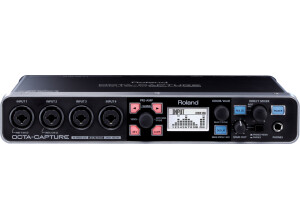
    8 inputs with preamp, USB connection, compact design. Possibility to output 4 different mixes via the 4 outputs and possibility to connect 2 together to have 16 inputs in total. I had a 2-input card before, so I wanted to go to the next level to be able to record demos of my band track-by-track or live. I wanted a soundcard that was easy to take with me on a backpack from my place to the rehearsal room. I use a laptop PC (core 2 duo 2GHz, 4G ram and 7200rpm HDD) running Vista. That's why I wanted USB. USE The drivers are very stable, I have never had a crash with Cubase. As for the latency, I get 8ms at the input and 14ms at the output with a medium-sized buffer. I've recorded up to 13 tracks (with a 2nd octa-capture as an extension) at 24bits 44.1 and I have played back up to 30 tracks, I think. I have never tried it with more. Sometimes, when I'm working on a project with lots of plug-ins I've been forced to increase the buffer to avoid crackles. But my computer is no performance beast. Regarding the preamps, there's not much to say, they do their job. They sometimes sound a bit "stiff" with some mics, but they have the virtue of being neutral. OPERATION Easy and fast installation. I haven't noticed any incompatibilities. The manual is useful and clear enough on certain points, especially when it comes to connect two octa-captures, the different routing possibilities, etc. It's easy to set up, you plug in, adjust the gain or use Auto-sens (automatic gain adjustment) and that's it. Also note the built-in (digital) compressor and the possibility to insert a reverb in the headphone out, for the singer, for example. OVERALL OPINION I've been using it for 3 years and have no intention of replacing it. I actually might get a second one. The pros: Well-built, compact for 8 mic inputs, easy to use, it has very practical stuff, like when everything starts flickering when it's distorting, making it impossible to miss it. The soundcard knows how to make you forget about it, which is much appreciated. The cons: I could quibble about 2-3 details...but nothing's really worth it, in my opinion, at least for what I use it for.

  • « A good soundcard »

    I wanted a not-too-expensive soundcard to be able to compose without the master set to the minimum (I'm on a 1.8Ghz desktop PC, so it was a bit hardcore...). All the soundcards I saw were the same to me. What caught my eye was the looks of the UA-55. The connections are somewhat ordinary: Two xlr/jack combo inputs, midi in/out, RCA output (which I have used as SPDIF with a Presonus Firebox, two jack outputs, a HiZ switch, phantom power. Something to meet my needs for some time. I use (now) a Dell 17R, intel core i7, 8Gb RAM, 1Tb, an M-Audio Oxygen 49, MDP 26, and Mackie MR8. UTILIZATION Unless you really put some strain on it (I abused Reaktor with the "replayer"...), the drivers won't give you any trouble. Further, like on any other soundcard I guess, you can adjust a fader according to ten levels, going from "stability" to "real time," which is really useful depending on the situation. With my i7 and with maximum stability (I don't like to keep it low-key when adjusting the parameters...) I run 96 tracks, most of which have at least 2 inserts, and some of them have even 8 inserts, and I can hear no crackles, the master is set halfway I have 10ms when recording, and if I really push it, the latency goes to 30ms, but you have to try really hard. In other words, if you optimize, you have no latency. You can control it via the potentiometers (with LED level indicators, which are really nice and useful). The auto-sens function adjusts the sensitivity automatically, which can be very useful when you use the built-in preamp, which is very useful. It's made of solid metal to withstand transport. It is very sturdy, mine has no scratches yet. GETTING STARTED I use it with Cubase 5.1 and have no issues. The driver is very useful and well thought-out. OVERALL OPINION I've been using it for almost a year. I just tried the firewire Presonus Firebox. I don't know what to say regarding its value for money, but I love to think I made the right choice. It is very cool, nice-looking and sounds good. To wrap it up, if you are starting out with your home studio, it's a good choice and a very good value for money, given all its features (level LEDs and pots, drivers, etc.). I think I would buy it again.