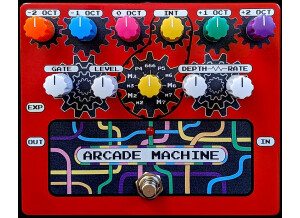
The Arcade Machine is a PLL-based (phase locked loop) monophonic synth that will take on different tone characteristics based on the instrument involved. A guitar produces a different output result from a bass, and various synth patches (e.g., piano vs. vibraphone vs. flute) likewise produce different results. The included demo exemplifies this with both keys (vibraphone patch) and guitar. Although monophonic, it is possible to achieve a fatter sound on guitar when playing intervals and double stops, since you strike one string slightly ahead of another, and the outcome is more chaotic as the two notes merge and battle one another to be heard. As well, there is a wide range of settings that influence what you hear. First, the Gate can produce a quick stabbing effect or it can remain opened for a longer sustain (with some interesting artifact weirdness when fully opened). Second, there is the main note or octave (0 Octave on the pedal) that can be mixed in any amount (very loud or shut completely); but, there also are four other octave notes that can be blended in to any degree (a lot or not at all), being -2, -1, +1 and +2. If that wasn’t enough, the Arcade Machine has a harmonizer, allowing you to mix in any minor or major interval – as well as the Devil’s interval for some extra creepiness and musical tension. And there’s also a Vibrato function, ranging from a slow wave to a rapid-fire pulse that can be controlled in the mix via the Depth control. Turned low (about 9-clock) it can be very subtle and unassuming – enough to thicken the sound, but very boisterous when turned up to 12-noon or beyond. Finally, there’s an Expression input that varies the intervals chromatically up or down with an expression pedal, or use of a control voltage (CV) input allows you to operate a sequencer so that you can run through any sequence of intervals programmed. The latter option has more flexibility, as you can produce simple trills, to arpeggios, to composed melodies. Overall, the bass response of the Arcade Machine is fat, the mids have good fullness and edge, and the treble has a substantial ‘cut through the mix’ effect. The pedal has a true synth response and sound. Below is another demo that goes through the steps of using the Arcade Machine to produce a huge sound (although simple sounds can be produced with ease). The Arcade Machine is a true bypass pedal on the larger size, measuring 145mm (W) x 119mm (D) x 57mm (H with knobs) or 5.7 x 4.7 x 2.25 inches. It has a steel chassis power coated red and the overall build quality is quite excellent with its solid feeling and noiseless pots, color coded knobs for easy location and adjustment, and a ‘soft’ noiseless footswitch – hand-built and wired individually in the USA. This pedal works on a standard 2.1 mm (negative tip) power supply, drawing about 70 mA of current. Overall, the Arcade Machine may be a simple monophonic synth, but it offers up a rather diverse palette of sound possibilities. Designed to be used by different instruments and musicians, this pedal is ideal for those into experimental music composition and desiring a different effect from the usual assortment of pedals on the market. The price of $265 places it in the middle range of gear investment (since some boutique pedals cost upward of $500), but this well-made USA pedal by RPS Effects has a reasonable price relative to its overall functions and uniqueness.
SOUND: The Bit Reactor may be considered a lo-fi ‘type’ pedal (1-8 bits of crushing and downsampling), but it can sound very complex when combined with delay, reverb or a hint of drive/distortion. As you reduce the number of Bits (you can choose 8, 7, 6, etc., and down to 1) the signal levels cannot be reproduced properly (they sound more primitive), thus allowing you to achieve anything from a subtle square wave to a high-clipped distortion (resembling a heavy and thick fuzz). You then combine this with the Sample rate, which affects the high frequencies. With the Sample knob turned all the way clockwise the original signal (whatever your raw signal is) is barely affected, but as you turn the Sample knob counter-clockwise you begin cutting off the high frequencies (and those frequencies become recreated as different inharmonic frequencies). Obviously listening to the accompany demo video will clarify the effects produced while adjusting the Sample rate knob and relative to the number of Bits (refinement) in the Bit Reactor’s signal. With a clean signal and on its own, you can create some very interesting and futuristic type effects with the Bit Reactor, which is somewhat ironic as the Bit Reactor’s crushing and downsampling produces lo-fi sounds that sound as though they came from decades past. And if you add the Bit Reactor in a small dose to an already distorted or high-gain signal, you can produce some awesome Industrial Metal tones that are raw and incredibly edgy. Other FYI data (for the pedal nerds out there): Sampling Frequency = 800 Hz – 20 kHz; Input Impedance = 1MΩ; Output Impedance = 1kΩ. OVERALL IMPRESSION: A true bypass pedal, the Bit Reactor’s price tag of $180 is very reasonable – neither overly expensive nor on the ‘cheap’ side. Developed by RPS Effects, the Bit Reactor was reviewed by a guitar player, but it takes very little imagination to realize how awesome it would sound with a Bass guitar, Synth/Keyboard or even electric Drums. There are a number of sweet spots when tweaking the Sample rate knob and depending if your signal is clean or distorted (and how distorted). And if you have good control of an Expression pedal, then you have access to the entire Sample rate range without having to adjust the knob at all. This may be a tad tricky for some individuals, since very subtle movement of an Expression pedal’s treadle can produce a very different outcome, which is why I suggest one needs to have good control of that foot rocking back and forth. Nonetheless, there are various bit crushing and downsampling pedals on the market and the Bit Reactor sits very nicely with the best-of-the-best, with an incredibly wide range of Sampling (via the Sample knob or an Expression pedal) and the ability to make the quality of the effect either fairly refined (8-Bits) or punchy and raw (1-Bit). EASE OF USE: The Bit Reactor certainly is not straight plug-n-play, but it doesn’t take long to begin getting some interesting and sometimes whacky effects – which certainly helps to expand one’s creative abilities and ideas. The Level function is straight forward, dictating how loud you want the signal. The Crush knob indicates how lo-fi you want your sound, e.g., at 8-Bits the effect is more refined and less edgy, whereas at 1-Bit you get a full bit crushing assault. Further to the Crush knob, there is no obvious ‘click’ when shifting from one setting to another; the knob turns smoothly and you need to keep your eyes on the LEDs that are lit so that you know when you have transitioned effectively from one setting to another, e.g., from 3-Bits to 4-Bits or whatever the desired setting. The easiest way to think of the Sample knob is that there is hardly an effect when turned fully clockwise, and you are able to hear all the frequencies relatively well (there is modest effect, but not much). As you turn the Sample knob counter-clockwise, you slowly reduce the high frequencies and begin introducing other inharmonic frequencies (to the point of the signal becoming deep, fat and broken up). For some really cool on-the-fly effects and results, you can control the Bit Reactor with an expression pedal, so that the entire Sample range is at your feet (or foot in this instance) and without having to adjust the Sample knob. However, the overall range of the Sampler in quite extensive and a small tweak of an Expression pedal’s treadle can produce very different results. Obviously some practice is required as to where the ideal effect is (that you want); but with the amount of fun you can have with the Bit Reactor, it won’t feel like practice. RELIABILITY & DURABILITY: The Bit Reactor’s steel chassis has a quality gloss paint job, measuring in at 4.7 x 3.7 inches (1195 x 94 mm). The small LEDs that form the points of the Atom design around the Crush knob (which looks very cool when fully lit) are far removed from the foot switch. Likewise, the small tough plastic knobs and the larger ‘on’ LED all are far removed from the footswitch and should not pose a concern with regular use. The pedals’ In, Out and Expression inputs are along the side, and so some modest care is required to prevent damage from a stomping foot slipping sideways. The footswitch has a very solid and obvious click. The three knobs (Level, Crush and Sample) both turn with a smooth quality rotation. The Crush knobs selects the number of Bits for downsampling, but it turns smoothly (you do not feel or hear a click as you move from 1-Bit up to 8-Bits). The power input is located in the back, requiring a standard 9VDC 2.1mm negative tip adapter (while pulling only 60mA).