Log in
EN
FR

Victory Amps

88 products found

Categories
Series
Filter
Sort by
Evaluation
  • Reviewed or not
  • Editor’s award
  • Reviewed by Audiofanzine
Availability
  • Available or not
  • Sold new or used
  • Sold new
  • Sold used
Must-have products
  • All products
  • Flagship products
  • Best rated products
  • Hot products
  • Popular products
Price
  • Freeware
€
Clear
Sort by
  • Popularity
  • User ratings
  • Price - low to high
  • Price - high to low
  • Used price, increasing
  • Used price, decreasing
  • Name (from A to Z)
  • Name (from Z to A)
  • Added on
Choose a category
Sort results
  • Popularity
  • User ratings
  • Price - low to high
  • Price - high to low
  • Used price, increasing
  • Used price, decreasing
  • Name (from A to Z)
  • Name (from Z to A)
  • Added on
Filter results 88 results found
Evaluation
Availability
Must-have products
Price
  • Freeware
Show results

The best Victory Amps reviews

The reviews Audiofanzine members found the most helpful.
  • « A really great lunchbox amp ! »

    Specifications : - Power level : 30 / 15 / 9 / 2W - Tubes : 4x 12AX7, 2x 6L6 (can be switched to EL34) & single-ended mode - 6L6 / EL34 (re-bias) - 2 channels - 4-8-16 ohm outputs - FX loop I had this gem for Christmas in 2015, I’ve use dit quite a lot since then and here are my conclusions : The amp offers 2 channels with a shared EQ, which is a problem to some users. I play it with an N.O.S. oversized 2x12 cab loaded with V30s with an Ibanez JS2410 and honestly the result is really excellent ! The EQ is very efficient on both channels, which of course will be a problem to some who find a good clean sound that turns out to be too bassy or else in disto, this remains to everyone’s taste but I did find a good, common setting rather quickly. the clean channel has a very good headroom thanks to the 6L6, a very clear sound that reacts rather well to pedals – I use different dostp/OD pedals depending on my mood and until then everything has been alright. Even when maximizing the clean channel’s gain the amp doesn”t crunch much. As for the distortion channel, it’s a real bombshell! Gain at ¼ already goes for AC/DC-like heavy crunches, at half its course allows an easy legato, past the 2/3 mark you get into a metal solo register with sometimes almost too much gain (for my guitar and playing style at least). In a nutshell, you get an awesome versatility, and what a dynamics! This blow you feel in the low-end even with a 2x12 with a good old power chord! Really excellent, and the distortion is perfectly defined, make a huge chord and you’ll hear each chord resound, which is simply great to hear. The amp’s power is high enough for any amateur musician stage configuration, they say it’s 30W but the manual rather goes up to around 42W when pushed, with a Variac power system in the front that allows to reduce the power as well as a back switch that allows to use only a single power tube (and you can even choose which, so as not to always use the same). Still, I feel that on distorted sounds, using the Variac feature takes a bit away from the amp’s punch, so I prefer to keep it in full power and turn one tube off. I also own a Marshall JVM410H Joe Satriani that I also plug into the same N.O.S. cab – or a 4x12, depending on the stage. Frankly, even if I wouldn’t split from my JVM as it remains a superb amp, the Victory is one notch over any other amp I’ve played so far (including the Marshall Satriani) in many fields including build quality, power, sound definition, dynamics and all I’ve mentioned above – exceptions being in terms of versatility and comfort compared with the Marshall Satriani’s 4 channels and integrated noise gate. I still had to add a few pedals to find my settings on this small yet monstrous 2-channel amp but it’s really worth it, as it also provides little to no hum in distortion mode ! Also, both channels react really well to your playing attack and volume knob, resulting in the fact that even with a heavy distortion the result is excellent when you lower the guitar’s volume control. Also, the JS features a Hi-Pass filter which is great for preserving the guitar’s trebles while lowering the volume, keeping a great sustain and a nice sound definition! In a nutshell, that’s a really great amp – and one with character. I never owned a Cornford but former users from this brand almost all say they can recognize Martin Kidd’s signature. I had hesitated for a while with a Mesa Mark V:25, which is also great but the Victory really blew me away, with a really strong, punchy British character , a price that is really worth paying, 2 excellent channels, 18lbs (8 kg) with an included gigbag, all in all it’s just plain great! Go and get it, pals!

  • « True Valve Sound and Great Gain Tone »

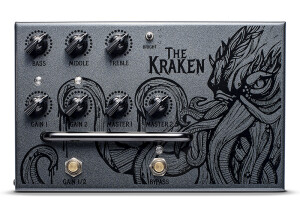
    SOUND: Working with a beast that has four valves produces such a lively and incredibly detailed and responsive tone that you become aware of why the digital/modeling age hasn’t quite caught up with the analog – particularly where there are tubes or valves involved – unfortunately, the sound compression inherent with YouTube videos will not do my demo justice. Nonetheless, the sound of the Kraken V4 is pure British, although unique to Victory Amps and its chief engineer, Martin Kidd. It produces a wickedly grainy, yet sweet tone, which is the hallmark of Victory and why the company has produced such a great fan following over recent years. Channel 1 has more of a vintage British drive sound with a super crisp and cutting distortion when cranked full. Channel 2 has more gain, but with tighter bass and a more biting mid-range (fantastic for chugging and lead playing). The cleans are exceptional, as well; place the gain of channel 1 at about 10-o’clock and then dial back your guitar’s volume a bit for a sparkling glassy timbre. The unit’s EQ has a very workable range, in that you can use a lot or not so much bass, midrange or treble (any combination) and it sounds pretty darn good regardless, which makes it very practical since both channels share the same EQ and for the most part you simply can keep the same EQ settings and still hear a difference between the channels. The Kraken V4 also has a global tone control or Bright switch – I suspect it remains neutral in position ‘0’ if used as a stand-alone pedal, but if used within your amp’s effect loop you may want to reduce the treble by a little (-1) or a lot (-2). Setting the Bright switch will depend on your gear and your ears. Bear in mind that the Kraken V4 is a preamp and still requires some form of cabinet for the best sound (since it’s only a preamp), which is where cab-simulators come in handy – although reproductions of actual speakers, whether using a cab-sim pedal, DAW software or if you’ve entered the Axe-Fx and Kemper world, it’s nice to be able to choose from dozens of offerings without having a room filled with wooden crates housing speakers. In fact, it’s difficult to demonstrate and appreciate just how good the Kraken V4 is without taking into consideration the cabinet/speakers you’re using, since each produces different tonal qualities. Nonetheless, and regardless of your speakers, or simulation thereof, the nature and grainy quality of the Kraken V4 shines through incredibly well and I demonstrated this in the video with Mesa, Marshall, Fender, Friedman and Vox cabs. Furthermore, this extraordinary preamp accepts pedals without reservation and better than other preamps I’ve tested. You can hear an actual hybrid of tones happening, as though the Kraken V4 is merging with the pedal in question and then producing an off-spring. As an example (demonstrated in the video) I combined a Friedman BE-OD Deluxe drive pedal (channel 1 gain at 25%) with the Kraken V4 (both channels tested at 50% gain) and the results were very pleasing – you could hear both the character of the Friedman and of the Kraken V4. OVERALL IMPRESSION: Victory Amps has won several awards through various guitar magazines/sites, and this preamp makes those reasons obvious, with its magnificent tone. The four valves running the Kraken V4 produces a rich tone and quality that I have not heard through other preamps or digital mimicking, making its $499 USD price a bit hefty to some, but definitely an investment if you’re looking for the crème de la crème. In fact, and although a pedal, the Kraken V4 was designed primarily to be integrated into an amp’s effect loop, to give access to additional amp tones at a fraction of the price of a new amp (and so, you can set it atop your amp head or amp/cab combo). Consequently, go ahead and keep your Marshall, Fender, Vox, Friedman or ENGL amp and still get the tones from Victory’s Kraken at a third the price and a fraction of the weight (an important factor for gigging musicians). It could be argued that various amp sims in a pedal offer up plenty of tonal variety, but if you are a gear snob and want the best in your tone, then an all-valve solution is the best solution – and that’s where Victory’s preamp collection (The Kraken, The Countess and The Sheriff) come in. Not only is the overall quality of sound note-worthy (pun intended), but the quality of construction is outstanding and other pedals sound awesome through both channels of the Kraken V4. And because you’re feeding this 4-valve beast a lot of power, it comes with its own 2-amp 12-volt adapter (together with plug ends to accommodate any country’s electrical concerns). GENERAL USE: You can use the Kraken V4 preamp in two different ways – it can be a standalone unit (on your pedal board) or used with your current amp in the effects loop. I use the unit as a standalone, going into an Axe-Fx II for my speaker simulation (as demonstrated in the demo video). However, its chief design was to afford musicians the ability to use an amp’s channel(s) as usual, and also the Kraken V4 for additional sounds and tones (perfect for those who run clean single-channel amps). Because the Kraken V4 is valve-driven, it has that pure analog quality and will sound incredible with other valve amps. And so, you can have your channel(s) in your amp, then switch to the Kraken V4 (which bypasses your amp’s preamp) while giving you great sound. Adding dirt or delay pedals, for example, will need to be arranged as usual and to your preference. In standalone mode you place whatever you want before and after the Kraken V4 (dirt before, delay/reverb after and modulation where it sounds best). If integrating the Kraken V4 within your amp’s effect loop you can add pedals direct to your amp’s input or along with the Kraken V4 in the loop, whatever works best for you. The Kraken V4 operates just like any other amp/preamp. There is a switch to bypass or turn the unit off (the LED is on when the pedal is on) and a switch to navigate between the two channels. Each channel has its own Master Volume and Gain, but both channels share an EQ. The Bright switch likely will remain on ‘0,’ which is neutral, unless you find your effects loop (or even a single-coil guitar) a bit bright or harsh, then you can remove some treble by flipping to -1 or -2. If operating in standalone mode you would want to adjust the EQ and reserve the Bright switch for when using the Kraken V4 in an amp’s effect loop. There also is a TSR input that allows remote switching, which is required if you have the Kraken V4 mounted atop your amp. OTHER DETAILS: Measuring in at 225 (w) x 140 (D) x 80 (H inc. feet) mm (8.85 x 5.5 x 3.1 inches) and weighing 1.7 Kg (3.75 lbs), the Victory Kraken V4 is massively built and of great quality. With an all-steel chassis (held-together with high-torque 8-blade Posidrive screws and machine bolts) you are certain to keep the four valves protected. The pedal comes with a 5-year warranty and the valves come with a 2-year warranty (good for approximately 6000 playing hours, which works out to two-hours-per-day over eight years – they can be replaced for approximately $15 USD). The pots have a very smooth feel when turned and both pots and foot switches are silent when turned or engaged (no static, crackling or clicking sounds). The Kraken 4 boasts a protective kick bar with what appears to be a powder coated dark grey metallic paint – and the Kraken graphic look pretty cool. The LEDs for on/off and channel selection are raised only slightly and well located, and so they are free from foot stomping trauma. All connections are made through the back (with the exception of the TSR remote switching input), which is good for protection of the cables and inserts, but also saves on pedal board space. The rubber feet under the unit are not the cheap stick-on type, but screw into the bottom of the base.

  • « Fantastic Cleans and Chewy High-Gains »

    SOUND: Incredible tone driving this 4-valve preamp barely scratches the surface. I’m in awe at the Countess V4’s clean channel, with its vibrant, detailed and glassy tones, ranging from ultra clean (gain at about 9-o’clock) to somewhat grainy and glassy (12-noon) and even low-gain drive when cranked. Channel 2 has a wonderfully thick and meaty (chewy) quality that definitely has a unique tone that keeps me from wanting to add other gains or distortions in front of it. Although British made, by Victory Amps and its chief engineer, Martin Kidd, the Countess V4 does not sound British, nor does it sound German, US or anything else. It really does have its own characteristics, which I’m very much enjoying. The three-band EQ has a very usable range that allows you to push the Bass, Midrange or Treble (or to cut back on any of the three) without it sounding out of place. A lot of bass does not sound muddy, nor does a lot of Midrange. A lot of treble does not sound brittle or harsh. And although adjusting any of those EQs brings forward certain frequencies (obviously), you could keep everything around 12-noon and be content. Like the other preamps in the V4 series (Kraken and Sheriff) the Countess V4 has a global tone control or Bright switch – typically this is left in the middle or neutral position ‘0,’ particularly if used as a stand-alone pedal. However, if used within your amp’s effect loop there may be instances that the treble response is too bright and this can be calmed by flipping the Bright switch to reduce treble by a little (-1) or a lot (-2). Setting the Bright switch will depend on your gear and your ears. For best sound you still require some form of cabinet for the best sound (since the Countess V4 is only a preamp), which is where an actual cab comes in, but also cab-simulators via reproductions of the actual counterparts. I use my AxeFx II for cab simulation, although there are plenty of VST plug-ins and pedal-type cab sims that do a good job to fully realize the potential of the Countess V4 Preamp. I like using cab sims since each one has a different flavor and this can produce a wide array of Countess V4 tones that otherwise would require a lot of storage space to house all the actual speaker cabinets. And although my experience may be limited when compared to other gear hounds, I have found Channel 1 of the Countess V4 the best pedal platform thus far, bringing to life any modulation, delay, fuzz, overdrive or distortion thrown at it. OVERALL IMPRESSION: The Countess V4 is part of an award-winning collection of preamps, and one of the best clean tones I’ve heard – very full and clean… to very glassy (with the gain up to 12-noon)… with more of an edgy clean/slightly broken up beyond that point. Channel 2 has one of the more addictive thick, meaty and chewy tones I’ve heard, making it awesome for crunch and lead tones. With four valves pushing the Countess V4 you would be hard-pressed to find such incredible sound in a standard pedal or even many preamp pedals currently on the market, making its $499 USD price-tag a bit rich, but an obvious investment for tone snobs looking for the best. Like other preamps, the nature of the Countess V4 was designed primarily to be integrated into an amp’s effect loop, to give access to additional amp tones at a fraction of the price of a new amp (and so, you can set it atop your amp head or amp/cab combo), or it can be used as a standalone unit with your pedalboard. Because of the quality engineering and four valves, the Countess V4 integrates far better with other amps (in the effects loop) than what often is possible with lesser preamp pedals. This means you can run it into a Marshall, Vox, Fender, Mesa or any other brand and the quality of output will be equal to those brands of preamps and definitely not digital sounding or thin. In doing so, you get to keep your favorite amp and still have access to two more channels of tonal bliss at a faction of the price of another good amp (that you have to haul around). For gigging musicians looking to expand their sound pallets, you couldn’t ask for better. As well, the quality of construction is outstanding with the Countess V4 and how it responds to other pedals (modulation, fuzz, distortion), thus making it a perfect pedal platform and particularly through Channel 1. The Countess V4 does require a heft of power, and so it comes with its own 2-amp 12-volt adapter (together with various plug ends to accommodate any country’s electrical concerns). There’s a reason why Guthrie Govan likes the Countess V30 amp – it sounds incredible, as does the Countess V4 Preamp. GENERAL USE: There are two ways in which to use the Countess V4 – it can be a standalone unit (on your pedal board or on the floor) or used with your current amp in the effects loop (typically sitting atop an amp). I use the unit as a standalone, going into an Axe-Fx II for speaker simulation. And because of the incredible clean channel it makes an awesome pedal platform for anything from chorus to high-gain distortion. The main focus of this preamp was to afford musicians the ability to use an amp’s channel(s) as usual, and also the Countess V4 for additional sounds and tones (perfect for those who run clean single-channel amps) in the effects return loop. Because the Countess V4 is valve-driven, it has that pure tube quality and will sound incredible with other valve amps. And so, you can have your channel(s) in your amp, then you can switch to the Countess V4 (which bypasses your amp’s preamp) while giving a different flavor among another two channels. Adding dirt or delay pedals, for example, will need to be arranged as usual and to your preference. In standalone mode you place whatever you want before and after the Countess V4 (dirt before, delay/reverb after and modulation where it sounds best). If integrating the Countess V4 within your amp’s effect loop you add pedals direct to your amp’s input or along with the Countess V4 in the loop, whatever works best. Functional in a similar manner to other amps/preamps, there is a switch to bypass or turn the unit off (the LED lights up when the pedal is on) and a switch to navigate between the two channels. Each channel has its own Master Volumes and Sub-Volumes (which are actually Gains), but both channels share the same EQ. The Bright switch typically remains on ‘0,’ which is neutral, unless you find your effects loop/amp (or even a single-coil guitar) a bit bright or harsh, then you can remove some treble by flipping to -1 or -2 (1 = less treble and 2 = even less treble response). If operating in standalone mode you would want to adjust the EQ and reserve the Bright switch when using the Countess V4 in an amp’s effect loop. There also is a TSR input on the left that allows remote switching, which is practical if you have the Countess V4 mounted atop your amp. OTHER DETAILS: Weighing 1.7 Kg (3.75 lbs) and measuring 225 (w) x 140 (D) x 80 (H inc. feet) mm (8.85 x 5.5 x 3.1 inches), the Victory Countess V4 is built like a tank and of superior quality. The chassis is all-steel (held-together with high-torque 8-blade Posidrive screws and machine bolts) to keep the four valves well protected. The pre-amp pedal comes with a 5-year warranty and the valves come with a 2-year warranty (good for approximately 6000 playing hours, which works out to two-hours-per-day over eight years – they can be replaced for approximately $15 USD). The pots have a very smooth feel when turned and all seven pots and foot switches are silent when turned or engaged (no static, crackling or clicking sounds). The Countess V4 also has a protective kick bar with a powder coated slate grey paint – together with the Victory emblem and Martin Kidd’s signature (the engineer behind this pedal and The Countess amplifier series). The LEDs for on/off and channel selection are raised only slightly and well located, and so they are free from careless foot stomping. All connections are made through the back (with the exception of the TSR remote switching input on the left side), which is good for protection of the cables and inserts, but also saves on pedal board space. The rubber feet under the unit are heavy-duty screw-on types.