Log in
EN
FR

SeriesUniversal Audio UAFX

21 products found

Filter
Sort by
Evaluation
  • Reviewed or not
  • Editor’s award
  • Reviewed by Audiofanzine
Availability
  • Available or not
  • Sold new or used
  • Sold new
  • Sold used
Must-have products
  • All products
  • Flagship products
  • Best rated products
  • Hot products
  • Popular products
Price
  • Freeware
€
Clear
Sort by
  • Popularity
  • User ratings
  • Price - low to high
  • Price - high to low
  • Used price, increasing
  • Used price, decreasing
  • Name (from A to Z)
  • Name (from Z to A)
  • Added on
Sort results
  • Popularity
  • User ratings
  • Price - low to high
  • Price - high to low
  • Used price, increasing
  • Used price, decreasing
  • Name (from A to Z)
  • Name (from Z to A)
  • Added on
Filter results 21 results found
Evaluation
Availability
Must-have products
Price
  • Freeware
Show results

The best Universal Audio UAFX reviews

The reviews Audiofanzine members found the most helpful.
  • « Pure Fender Sounds in a Pedal - Authentic! »

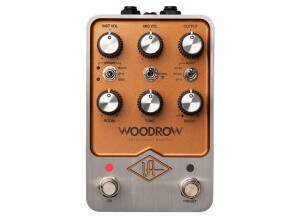
    I supposed I could joke about how this is a guitarist’s ‘Wet Dream,’ but the name Dream ’65 will suffice. Emulated from select 1965 Fender Super Reverb amps, as well as select speaker emulations, UA got as close as possible to a real amp that I have heard. And that goes for their Woodrow (Tweed) and Ruby (AC30) counterparts. I will address a few details, although they are demonstrated in the accompanying video, but first the basics. Think of Dream ’65 as a Fender Super Reverb amp, with stereo ins and outs. You have access to six select Speakers (imagine six cabinets), each providing a different tone/sound, and three Amp Modifications (Boosts), and with built-in Vibrato & Spring Reverb. On that note, both the Vibrato and Reverb sound spectacular. Some may argue the reverb is not quite as good as a real tank, but this is very close. The Vibrato has a very natural and organic flow to it. This amp has the basic functions, including Volume, Output, Reverb, Bass & Treble (the Treble and Boost double as Vibrato rate and intensity respectively) and an on/off switch. It also has a Pre-set switch, so that you can save a favorite sound and switch back-and-forth with a different knob setting, viz., a two-channel amp. Of course, add a distortion, fuzz or OD to the front end and you have three unique sounds… clean… crunch… lead. You certainly can get away with just the Dream ‘65 and its internal mods when playing lead, but for those who want a more modern and higher-gain sound, then a front-end pedal may be required. Here is the tricky or ‘adjustment’ part of the amp. One of the mods or Boosts is based on the Stevie Ray Vaughan sound, and it is great! However, you cannot apply Vibrato IF you use that mod. I thought it would be ideal if this could be achieved, since SRV is known for combining a Super Verb with Vibroverb. Regardless, there is a toggle switch that allows you to switch between Amp and Alt (Vibrato function), and that switch also serves to save the Preset. If you select the SRV mod, then Vibrato automatically shuts off. If you select the other two mods, then you will hear the Vibrato IF you set it (you can switch back to the Bass & Treble controls, but Vibrato remains UNTIL you flip the toggle to ALT and reduce both Vibrato rate & intensity to zero). And if using those other two mods, and you do not hear any vibrato, then you must flip to Alt and set the Vibrato (and while setting it, Bass/Treble do not work). The video will clarify this and it is not as complicated as it may sound. While in the ALT mode, the Bass knob also doubles as a Room function, which adds studio atmosphere or room ambience to the sound, making it more realistic to the ears. This is a great tool for clean or slightly dirty tones. The other two modifications or Boosts are Lead (‘80s OD) and Stock (clean preamp boost). The latter says it all, and you do not hear much compression or saturation with this one. The Lead mod sings best with its level past noon, and provides a less beefy OD than the SRV mod – however, the Lead mod is smoother and ideal for a lead that sings rather than screams. As mentioned, there are six speaker types, all of which are very useful (completely different results and tones). These match up so well with different guitars in my studio that I do not see the need for different speakers. But just like the Woodrow and Ruby, Dream ’65 allows you to bypass the internal speakers and go direct to a preferred IR. Overall, if you are into amp modeling or emulation, all three UA pedals have surpassed the competition – although I am basing this on my ears, and this also is the reason why I now have all three in my studio as my primary amps. I do have other amps, including tube and solid state, and I enjoy them, but the sound, size and simplicity of these pedals have caused me to leave the digital modeling world, insofar as amps are concerned. What I find modeling lacks is in producing authentic feel or sound quality (although very decent over the past 3-4 years), but also the simplicity of an amp, with dozens of things that could be tweaked, to the point that you get ear fatigue and it is difficult to dial into a great tone as easily. Now, before lambasts me about not liking digital modeling, I do realize that a quality IR makes all the difference, but I have not delved too deep into that realm. Any time I do use modeling for some high-gain tones, it is with a third-party IR, and yes, they make a significant difference. Dream ’65 does require a 400mA power supply (most bricks can handle this), and it does not have MIDI or an FX Loop. That may turn off some people, but this is emulated from 1965 amps, and that is what you are getting. On the plus side, it is an excellent pedal platform, since it is so clean (or can be set slightly breaking up to play well with high-gain gear), and it can become a secondary amp via a 4-cable method. If you have a regular AC30 or Marshall, for example, you now can have Fender Super Reverb sounds. What would I change about the Dream ’65? First, I would like to have the Vibrato function work with the SRV modification, which I think is most obvious to me. Second, I like the two-tone look of the Woodrow and Ruby (brushed aluminum framing with a color in the center). I think the Dream would look as spiffy if it were not all black and had that aluminum framing. Regardless, I am not that finicky about a pedal’s looks, as compared to a guitar, and the Dream ’65 is addictive to play through.

  • « Studio-Grade Reverb & Delay emulated from actual Vintage Gear »

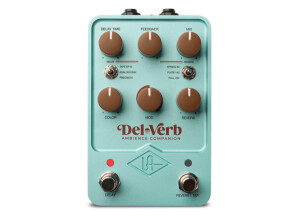
    The Del-Verb is impressive. It houses a Tape EP-III, a Deluxe Memory Man, UA’s own Precision delay, a 1965 Spring reverb, an EMT Plate reverb, and a Lexicon Hall reverb. Both delay and reverb have their own independent sides of the pedal, with stereo ins-and-outs for that true ambient environment. I am addressing the details in brief, but there are plenty of sound samples on the accompanying video, which explains things far better. The Reverb is very simple to operate, and you do not have to worry about decay or other elements – everything is tied into one knob, so that the more you turn it up, the more noticeable the depth and length. This produces a very natural-sounding reverb with plenty of vigor for ambient music. The delay side is more complex. There is a ‘Color’ knob, which affects the strength of the delayed signal (from a very light bounce to ping-pong balls exploring inside your ears). The Time knob does just that, and how many milliseconds is relative to the delay (up to 1500ms with the Precision delay). The feedback provides repeats, and with an emphasis beginning at the 3-o’clock position: EP-III self-oscillates with tape noise; DMM self-oscillates with a swelling or blossoming feedback; and the Precision delay simply self-oscillates without any volume change or distortion, etc. The Modulation knob adds flanger, chorus, vibrato, or ‘tape quality’ (depending on the delay chosen). Sound-wise, this is an impressive piece of gear, and both reverb and delay sound incredibly clear, yet natural to the ears, blending as well as could be (although each operate independently). The clarity is so impressive, that I have seen forum comments that the Del-Verb is too ‘bright,’ which I do not think is the case. If you have a bright-sounding guitar tone, then the reverbs and delays act accordingly, and the same with a dark guitar tone. Maybe a tone knob would have been a good inclusion for some players, but I’m content. Perhaps the other drawback is that you must shut off the Reverb in order to use the Tap Tempo function. This can be done quickly, but it may annoy some players who need faster switching. For ambient-style music, this is not as important – typically delay and reverb are added to taste and relative to how each aspect (Color, Modulation, Repeats, Mix) sounds within a composition. At least that is how I utilize the Del-Verb. For the price, the Del-Verb sounds incredible and I am hooked. This may be considered a pricey pedal, but if you look at the incredible vintage gear that was emulated, and how you can tailor the sound of each quickly and easily, there is a lot for the money. I have not tried delays/reverbs from a few companies, including Strymon, but I have Moore’s Ocean Machine, as well as Eventide’s H90 and a Fractal FM3, the latter of which are known for their effects and especially delay and reverb. All three pieces of gear sound great, and I have no complaints, but the clarity and quality of the Del-Verb makes this pedal stands out in the mix far better – less digital sounding. UA’s Del-Verb requires a 400mA power supply, has Bluetooth pairing/functioning, and a USB-C port (cable not included) for firmware updates. Best of all, the Del-Verb comes with an app that includes several professional presets, besides being able to save your own presets.

  • « Complete Amp-in-a-Pedal that Emulates Incredibly Well »

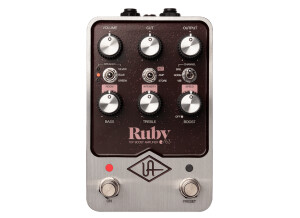
    After having UA’s Woodrow ’55 (Fender Tweed amp emulation) for only a few hours, I knew I had to review the Ruby ‘63 (Vox AC30) and Dream ’65 (Fender Reverb Twin), the latter of which I will be done soon. These are a true joy to use because they sound so authentic, which makes it fun to review. Now, the Ruby ’63 includes three amps, which is a lot of quality tones, and without considering the six speaker emulations included. The amp types are an AC30 Normal, which was a standard with Rory Gallagher, and then later Brian May. There also is the higher-gain Brilliant AC30, as well as a Vibrato amp selection (which is more of a Tremolo and not vibrato, as with the Dream ‘65). Both the Normal and Vibrato amps’ EQ are controlled by a single Cut knob, which allows you to ‘cut’ the degree of bass in the signal (Brian May has this set all the way left for maximum treble, since the tone of the Normal AC30 is dark with plenty of thick mid-range). The Brilliant amp’s EQ includes the Cut knob, but also the Bass and Treble functions –Treble knob becomes Tremolo Rate and the Boost knob becomes Tremolo Intensity when using the Vibrato amp. This may seem confusing, but the video included demonstrates how various knobs are shared and have different functions among amp types. The six speaker emulations range considerably, from a brighter, thinner sound to a robust and heavier sound. I think there is something for nearly every taste out there, but you can bypass the built-in speakers and go direct to a preferred IR. What I like about the speaker variety is that some do not sound that good with a few of my guitars, yet they sound very usable or quite good with other guitars, much of which has to do with single-coil vs. humbucker, bright pickups vs. dark pickups, or style of playing/tone you are trying to achieve. UA knew this going in, that we all have different tastes, even if liking the same amp… and they sound great! The video demo goes through several settings and functions, but I will address some of the other aspects. The EQ sections, including the Cut knob, all are sufficient, in that they range the bass, mids and treble very effectively without exaggeration – no heavy bottom end or boom, and no shrill top end (the Brilliant amp is brighter, but not harsh or brittle). There is a Room knob (which doubles as the Bass EQ knob) that provides studio or room ambience, and it is a nice feature for clean to slightly dirty sounds, particularly for that old Rock ‘n Roll or Rockabilly type comping; and it adds a slightly different dimension when coupled with a reverb or a slap-back echo. The Boost is very effective (which doubles as the Vibrato amp’s Tremolo Intensity) and it produces a very natural sounding gain as the amp responds accordingly. This sounds more like how an amp behaves, with that great break-up tone when cranked and digging in, as opposed to a saturated OD effect. There are so many advantages to UA’s Ruby ’63, and this holds true of their other amp emulations. It is small and compact, which means bringing it to a gig and going direct to a mixer or powered amp. It can be integrated into an amp via the 4-cable method so that you can turn your Marshall, Fender, etc., into an AC30 at the click of a switch. You have access to three different AC30 models, along with various speakers/cabs, which would cost thousands of dollars to replicate with the real thing (particularly if you were to hunt down the vintage models, which these emulations were created upon). In that regard, the price of the Ruby ’63 may be considered a pricey boutique ‘pedal,’ but it is more than just a pedal – it is your amp and primary tone source that fits on a pedalboard. It is well constructed with a good heft and there this is obvious quality when you hold it or work the controls. And it certainly is eye-catching (sound should be the only thing that matters, but musicians still want attractive or cool-looking gear). There are a few drawbacks, and price may restrict some buyers, particularly if they already have an amp (or amps) and may be content in that regard… others may bite at it due to curiosity or hopes of replacing a heavy, bulky amp combo. Still, other concerns from musicians tend to be “lack of MIDI,” or “lack of FX Loop,” etc. However, these were created to emulate classic amps and what functions they had available in their original format. Woodrow ’55 was an exception, as a ‘Mic Level’ knob was added, to give some heat/gain from that perspective. Regardless, some may be put off that only one preset can be saved, which you can toggle back-and-forth from the ’on’ settings you have dialed in, and this is how a two-channel amp would work anyway. The Preset could be clean (for example), whereas you set up the pedal for a crunch or something dirty. And if you wanted higher gain for lead or a heavier crunch, you step on an external boost/OD/fuzz/distortion. As well, you cannot add in the Tremolo to the Brilliant channel, nor can you add Boost to the Vibrato (since the Boost knob becomes Tremolo Intensity) – it is meant to be played clean. The only other drawback, which really is not as such, is that you require 400mA to power it. Most power supplies can handle this, but it depends what other power-hungry pedals are on your board. Regular combo amps have to be plugged in, and so, a wall-wart is a solution. Overall, if you consider the Ruby ’63 to be a classic amp, and that you get three of them (plus the speakers) under one chassis, then it is easier to appreciate what the product is and what it is supposed to offer. You lose out on a few modern additions (tech that came about long after these amps), but are giving up those features for mind-blowing sound and likely the best AC30 emulation to date.