Log in
EN
FR

Walrus Audio

105 products found

Categories
Series
Filter
Sort by
Evaluation
  • Reviewed or not
  • Editor’s award
  • Reviewed by Audiofanzine
Availability
  • Available or not
  • Sold new or used
  • Sold new
  • Sold used
Must-have products
  • All products
  • Flagship products
  • Best rated products
  • Hot products
  • Popular products
Price
  • Freeware
€
Clear
Sort by
  • Popularity
  • User ratings
  • Price - low to high
  • Price - high to low
  • Used price, increasing
  • Used price, decreasing
  • Name (from A to Z)
  • Name (from Z to A)
  • Added on
Choose a series
Sort results
  • Popularity
  • User ratings
  • Price - low to high
  • Price - high to low
  • Used price, increasing
  • Used price, decreasing
  • Name (from A to Z)
  • Name (from Z to A)
  • Added on
Filter results 105 results found
Evaluation
Availability
Must-have products
Price
  • Freeware
Show results

The best Walrus Audio reviews

The reviews Audiofanzine members found the most helpful.
  • « Alter Your Guitar Tone in Seconds or Change a Strat into a Humbucking Axe »

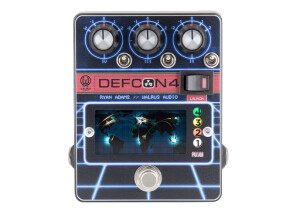
    SOUND: DEFCON4 is not your typical EQ pedal. First, it’s a preamp that offers up some compression and push in tone, and so you get some energy behind those crafted changes. Second, the choices behind each EQ setting (Bass, Midrange and Treble) are very well honed, so that each selection (adding or taking away bass, mids or treble) is obvious, thus making it easy to dial in a better (different) sound than what your pickups are producing. Third, the 10dB MOSFET boost is just the right amount to thicken up your tone and make it more three-dimensional. The YouTube video with this review goes through the various settings with a humbucker-equipped guitar and through all the various bass, midrange and treble settings. You can hear how the DEFCON4 can enhance both clean and higher-gain settings. However, what is even more impressive is how you can take a single-coil Strat and make it sound like you’re playing with higher output humbuckers. To repeat, each EQ has settings that were very well-crafted, although you can get under the Chassis and change each bandwidth if so desired. The Bass adds bass without sound muddy, or takes it away without sounding too thin. The same is true of the Midrange and Treble, in that you can tweak a bit here and there and nothing is out of whack, and yet is obvious to the ear. DEFCON4 likely is one of the best tools to reshape your tone so that you can get rid of that weak jangly sound, clear up muddy pickups, etc. And when on stage you can switch from humbuckers to single-coils and not miss a beat, all at the push of a footswitch. OVERALL IMPRESSION: DEFCON4 is the signature pedal of composer and performer Ryan Adams, DEFCON4’s original intent was to allow Mr. Adams the ability to switch from a humbucker guitar to a Strat, and still be able to produce an equal amount of output and fullness in tone. Along with Walrus Audio, DEFCON4’s claim to fame has become a super fast tone-shaper, possible with only a few clicks of a 3-band equalizer and along with a 10dB MOSFET boost, if necessary. Some of the pedal is bells and whistles, such as the name, the little Defcon 1 through 4 lights, and certainly a world map that lights up with missile launching schematics – but who cares? It looks friggin’ cool and it is fun to use. If looking cool isn’t an issue, then I suggest all guitar manufacturers stop with the fancy paint jobs, graphics, and body designs. Not likely, right? And for those old enough to remember, the overall artwork and pedal design concept comes from the 1983 movie WarGames and Ryan Adams’ “love for all things 80’s nostalgia.” The tone-shaping capabilities of this pedal are exceptional, and the gang at Walrus Audio pulled this one off very well. Each click of each EQ bandwidth seems to change a guitar’s tone noticeably and in a very usable manner. Perhaps you don’t want full-out treble, but even when cranked to the limits it still sounds good, particularly with darker pickups. The point is that you can achieve a multitude of different tones very easily so that the same guitar can become a very different guitar. EASE OF USE: Do note that there can be no change in tone if you keep all the EQ settings pointing to 12-noon (zero). From there you have four choices on each… two steps down (-1 or -2) or two steps up (+1 or +2). For example, if you consider the Bass knob you can decrease bass a bit by clicking one step counter-clockwise, or remove even more bass with two steps counter-clockwise. Conversely, if you want more bass than click one step past 12-noon for more bass, and even more bass with one more click. The same works for the Midrange and Treble knobs. This makes operation of DEFCON4 easy since the degree of change from one position to the next is noticeable, but not extreme, so that you can add or take away just a little or a moderate amount (but not so much in either direction that the tone doesn’t sound usable). This is not like many other EQs that seem to offer an almost infinite amount of fine-tuning, which actually makes it challenging to zero-in on that ideal tone. As a result, DEFCON4 makes it very easy to remember past settings, or at least easy to achieve them again in a matter of seconds. The 10dB MOSFET boost can be used on its own or in conjunction with the EQ (and vice versa) and has a number of potential uses in different situations. For example, you could use the EQ to shape your tone and then add the 10dB for lead solos, regardless of the guitar. Or you could use the 10dB with EQ to thicken up your single-coil guitar. In regard to the latter, there are some musicians that likely enjoy jamming on a Strat for some hard rock or even metal, but those single-coils just don’t have the output and thickness of tone desired. That can be rectified with one pedal… DEFCON4. RELIABILITY & DURABILITY: DEFCON4 measures about 3.5 x 4.5 inches (8.9 x 11.4 cm), with a solidly built aluminum chassis. The feel of the pots when turning the knobs are of good quality as they ‘click’ from one position to the next. The plastic knobs are of good quality, while the small switches (to engage or disengage each EQ knob) are both solid in feel and located in a protective location… just beneath and between the larger EQ knobs. The input/output for cables are located along the sides, as well as the power supply (standard 9v 2.1 mm @ 100mA) insert is on the side. This places the inserts in a more precarious position (as compared to rear chassis inserts), but being a slightly larger pedal it’s unlikely one’s foot would step on any cables while stomping. Likely the only ‘fragile’ part of DEFCON4 would be the LED screen showing the graphics, although you do not need the screen to operate the pedal (it’s simply a ‘cool’ factor). Regardless, I cannot fathom actual damage from normal and regular use, as opposed to abuse and dropping something on it. For more information you can check out the pedal at: https://www.walrusaudio.com/collections/eq-compressions/products/defcon-4-preamp or https://www.rogueguitarshop.com/products/walrus-audio-defcon4-preamp-eq

  • « Supremely Transparent Overdrive »

    The Walrus Audio Voyager is at first glance another 3-knob analog Overdrive pedal built into a painted Hammond case. Boutique makers are hand-building pedals like this all the time. Like many Overdrive pedals, The Voyager features only a Volume, a Tone, and a Gain knob. But the myriad of capabilities in the Voyager are revealed throughout the range of its controls, showing it to be a treble booster, distortion, clean boost, and overdrive pedal all in one. I've personally never encountered a pedal that did so much, yet had no mode or boost switches anywhere on it. The housing is solid, featuring a heavy-duty Carling 3PDT Footswitch, super bright white LED, and a slightly recessed 9V adapter jack. UTILIZATION The Voyager couldn't be simpler to implement into one's pedalboard, as it's very small, and simple to operate. The input and output jacks are solid and of good quality. The pots are high friction and feel nice and solid, yet smooth with their taper. The pedal's bottom is thoughtfully(conveniently) left bare, ideal for attaching velcro for fixture to your pedalboard. There is not battery compartment, however, so changing batteries requires a screwdriver and a few minutes of time. A quick peek inside reveals a circuit that, to the informed eye, borrows very heavily from one of the most infamous (and expensive) boutique overdrive pedals every conceived. If that is indeed the case, it's great to see the design brought down to a more realistic price point. SOUND QUALITY With the Gain and Tone set conservatively, the Voyager serves as a clean boost, giving you the tone you're already getting from your amp, only more of it. Upping the Gain pushes the Voyager into overdrive territory, delivering smooth, woody overdrive character without coloring your amp's tone. Upping the tone control at this point adds shimmering topend harmonics, reminiscent of some of Brian May's most memorable solos. From here, things can only go up. Cranking the Gain launches the Voyager into the distortion stratosphere, with molten saturation, upper midrange grind, and searing harmonic content. All while, once again, maintaining the basic tone of your setup. In most cases, cranking the tone knob can render a tone that's too bright, but for those with a dark amp, this might not be a bad thing. The volume control is responsive, and wholly capable. This pedal can pack a punch! OVERALL OPINION The Walrus Audio Voyager is more than an overdrive pedal. It's a tool for expression for those daring and capable enough to utilize it to its full potential. What's more, the Voyager is Boutique-quality without being Boutique-priced. I've tried many overdrives, and they all have their pros and cons, but very, very few offer the transparency, raw versatility and inspiring touch response of the Voyager. I would highly recommend any guitar player who is a fan of overdrives to give the Voyager a test launch.