Log in
EN
FR

SeriesAllen & Heath Xone

46 products found

Filter
Sort by
Evaluation
  • Reviewed or not
  • Editor’s award
  • Reviewed by Audiofanzine
Availability
  • Available or not
  • Sold new or used
  • Sold new
  • Sold used
Must-have products
  • All products
  • Flagship products
  • Best rated products
  • Hot products
  • Popular products
Price
  • Freeware
€
Clear
Sort by
  • Popularity
  • User ratings
  • Price - low to high
  • Price - high to low
  • Used price, increasing
  • Used price, decreasing
  • Name (from A to Z)
  • Name (from Z to A)
  • Added on
Sort results
  • Popularity
  • User ratings
  • Price - low to high
  • Price - high to low
  • Used price, increasing
  • Used price, decreasing
  • Name (from A to Z)
  • Name (from Z to A)
  • Added on
Filter results 46 results found
Evaluation
Availability
Must-have products
Price
  • Freeware
Show results

The best Allen & Heath Xone reviews

The reviews Audiofanzine members found the most helpful.
  • FP User's review

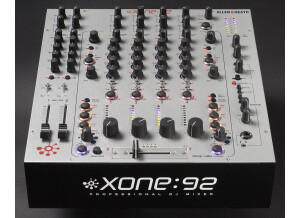
    VCF & LFO: I think the dual VCF’s and LFO’s are the features that anyone who owns a 92 will play with to start with. Yes, they are an enormous amount of fun and after experimentation you realise just how creative they can be, and this is coming from someone who was sick to death of listening to certain trance DJ’s hammer the hell out of filters. I use the VCF mostly in conjunction with the LFO and the tap button. The tap button is great as it allows you to alter the LFO to match the tempo or simply set it to any speed you want. My default setting for the resonance and LFO depth is 50%. It is crucial that you experiment with the variety of settings available to familiarise yourselves with the range of effects available. Here is my current favourite: LFO on, x 2 on, tempo tap as fast as you can possibly get it. Hi filter on. The filter is set to the main track in play. Bring in the next track with the bass killed with no filters. Sweep the filter from min to max on the main track over an appropriate 16-count phrase. On the first count of the next phrase, slam the bass in on the first count of the next phrase of the incoming track. This will create a wonderful bubbling effect leading up to slamming the bass line in on the next track. Of course, this is just one example of what you can do. Other tricks include setting one track to high and another track to low and combining the two effects simultaneously. TIP: Before using the low filter set the filter to max. Remember kids, with filters, LESS IS MORE!!!!! The filters are assignable to any channel via nice little switches and you can also set the VCF to the cross fader. I cannot comment upon that as I only use the cross fader for switching my Kaoss Pad 2 on. My only criticism of the filters is that there is a very faint click when switching the filter on. This is not a major issue as long as you switch the filter on right on the beat, then it is not really noticeable. FADERS: The Penny & Giles cross fader has an adjustment dial to allow you to set the cross fader to suit your mixing style. There are also four LED’s centred to the cross fader so you see exactly which channels are assigned to the cross fader. Those who use cross faders heavily will be delighted to see how easy it must be to replace the cross fader. Undo a few screws on the face plate and replace it in seconds. Volume faders are great. Smooth, easy to use and, of course, BLUE LED’s!!!!! How cool is that!!!! CUEING: Excellent. Best I have ever used. Nice big well lit buttons. You can post eq, split cue and add the incoming mix to the headphones to your desired level as a nice little insurance policy before bringing the next track into the mix. The only criticism I have is that whilst cueing, the level meter will only provide a read out for the cueing level. Therefore, when you are bringing a new track into the mix whilst still cueing you will only get a readout for the cueing level and NOT the master as well. If you set it to split cue, you will then get a read out on the level meters for both both cueing and master level, but some of us don’t use split cue very often. If you are not cueing at all you will get the master level only. However, I personally think it is a slight oversight to not have a permanent master level meter. MIDI: Good, but not great. But undeniably a huge advancement for DJ mixers. The LFO tap button also doubles as a MIDI tempo button to set the tempo for external MIDI devices. There is also a tempo adjust knob which, needless to say, will alter the tempo set via the tempo button. This should be quick and effective. Unfortunately it is not. It takes quite some time to get use to this system as it is ultimately flawed for a couple of reasons. The tempo button will only record the last two touches of the tempo tap button. Therefore, leaving a considerable margin for human error, thus inaccuracy. I think it would be far more efficient and accurate to calculate the average over, say, a maximum of 16 beats. This would set the tempo far more accurately, saving a great deal of time. My second criticism is the tempo adjust feature. The knob allows you to speed up or slow down the MIDI tempo. Similar to riding the pitch on a turntable, but with far more scope for error. It is crying out for some nudge buttons so you can adjust the tempo then simply nudge the tempo to line it up. As stated, good but not great. I think Allen & Heath may need to take a look at how Red Sound do things with MIDI, maybe. On a brighter note... Xone:92 + Korg Kaoss Pad KP2 = match made in heaven! I cannot put into words just how much I love this feature. Set your KP2 to the required effect. Move cross fader from left to right. Use the filter switches to control the X and Y parameters of the KP2. Plus control of the overall volume of the effect via the return channel volume control. This gives so much more control and creativity compared to rubbing the screen on the KP2 hoping to find the required effect. Also seem to find effect variations that I would not be able to find using the KP2 as designed. I know effects should not really be overused, but this set up does actually encourage you to use effects a little more than usual because you have far more control and offers scope for more subtle use of effects to really add a further dimension to the mix. A word of warning. When combining the Xone:92 and the KP2, initially set AUX and RTN levels low (for instance, AUX 25% and RTN 75%) and build them up. Otherwise your sound effects will probably resemble something more similar to a fight between two alley cats! Your mixer won’t like that as it will keep peaking on the meter. Note: VCF, LFO and external effects can be combined. Regardless of my criticisms, the full range of features warrants nothing less than 10/10. Price paid: £1,049 (approx. $1,800) UTILIZATION 4/10 when you first set it up. 7/10 after a day or two. 9/10 thereafter. Cant give it 10/10 because there is definite scope for improvement with the useability of the MIDI, as previously discussed. SOUNDS I have never owned an Allen & Heath mixer before, so I am unable to compare the 92 to, say, the 62. I upgraded from a Vestax PCV 275 to the 92. I was delighted with the sound quality on the 275 but when I switched to the 92 my first impression of the sound quality was that it was actually difficult to describe. I don’t think the 92 necessarily generates a brighter sound than my 275 but where it stands out is with its fatter, wider, more full bodied sound quality at all frequencies that seems to just fill the room without even pushing it to its potential. I am running it through a NAD C370 integrated amplifier, which is quite a high-grade machine. Of particular interest to me was the dual mid range EQ’s as I play a lot of vocals and I like to bring the vocals to the forefront as much as possible. Initially, I felt a little disappointed as they did not seem to provide the extra dimension I was hoping for. However, this was as a result of my head being between my monitors. A friend of mine, who was listening via the main speakers (high quality Bose) as I gradually increased the mids screamed out at me “what the f### did you just do to the voice!”. So I guess that they work effectively. OVERALL OPINION Built like a tank....the heart of a stealth bomber....as beautiful as a Monet! Enough said!!!! Every family / household should have one!!!!! No, it is not perfect and it can be improved upon. But using the Xone:92 with MIDI and external devices makes the Xone:92 experience something close to...I don’t know... flying the Starship Enterprise!!!...or more realistically and importantly, makes the Xone:92 experience feel like you are working with a genuine musical instrument and that you, as the DJ, are at one with a unique piece of equipment and creating something that no one else will be able to re-create. Whilst not wanting to resort to philosophical meanderings, there is a certain spiritual high associated with what can be created and achieved with the Xone:92. You will respect it, you will love it, you will be inspired by it. You will own the best piece of kit of its type. Give something back to it by learning even more about your chosen art form (music theory, harmonic mixing, production, anything!!!) so your skills will match that of your equipment of choice. That is what I am now striving to do well beyond what I hoped to be able to achieve when I bought my first decks, and well beyond all that I have achieved to date. Originally posted on FutureProducers.com Posted by: Scudge - UK ( 5-, 2004)

  • FP User's review

    Not much more to ask for from the feature list.. aux sends, individual channel peak meters, fully adjustable xfader curve. They've even got little curtains running the lenght of the faders to keep the dust out! The VCF is a joy to use, that warm analogue feel to the sound puts equivilant effects on Pioneers DJM600 to shame. Being a mid to high end offering, there are a few things it could be marked down on though. The channel peak meters don't allow for too much accuracy given there represented by only 4 LEDs. I constantly find myself fine tuning the levels by ear rather than what those LEDs tell me. All the same the cue split works perfectly so getting used to it that way doesn't mean you can't nail every mix! The gain adjustments being on the rear posed me no problems whatsoever, they're easy to reach and Humvee solid. The centre channel isn't assignable to the xfader, but I use it mainly as an effects return, so don't miss the bit of functionality it's lacking. Each of the 3 channels double up as line ins too, so CD decks can go on either of the 2 xfader assignable channels anyway. The things A&H have decided to do without on this don't really detract a lot from the mixer, just make you want one of their higher models so I suppose if you really can't do with the little gripes mentioned, you really should be looking at the more expensive models. Bang for buck on the feature list, everything's there to a major extent, and what is there is done to a very high quality. Price paid: £425 GBP UTILIZATION Dead simple to use, as it should be. The trickiest part to get used to is the VCF, and even that really is a cinch to get used too (it really does sound ace!) Nothing on this mixer is complicated, whether you want to change the crossfader curve on the fly to drop a few scratches, or recall a preset VCF setting to drop in some phasing effects, everything falls by your fingertips. Not seeing the gain pots doesn't detract from their usability either, the rock solid feeling through touch has never let me down. Reall can't think of one thing that takes away from this one. Once you've tried it for a mix, what would appear to detract from the experience beforehand simply isn't there. SOUNDS Great sound quality, as expected. Got to be one of this mixers strong points. Although there's only 3 EQs per channel, they do there job admirably, with no funny or unexpected attenuations. Really gives a nice flat response through a decent set of monitors, ready to shape as you see fit with the components in the board doing what they should to give a crystal clear signal out the back. OVERALL OPINION Coming up on half a year with the mixer now and not one glitch or problem. I hear A&H are generally good at customer support, but given the tank like qualities of this mixer I doubt I'll ever need to speak to them! They seem to have gone and designed a mixer without any frilly surfaces for grime to build up on, and the sensitive areas (namely, the faders) are flanked by rubber curtains. The pots are all solid as a house, and the xfader is replaceable (Penny&Giles here I come, once this one eventually bites the dust, probably in a long time for now!) The split cue fader could do with being a little more chunky feeling, but the dip is still there at 50/50 and clicks as firmly as ever, so I suppose it's just it's relatively diminutive size that makes it feel less chunky. All the push buttons have remained as responsive as their first push, and no complaints from loose jacks at the rear. All in all, this thing is up there with the best of them, I'm sure it's build quality is no less than the 62 or 92. This thing is just out and out class, so long as you realise what it's for (ie, don't expect not to use an effects unit too, if you want as big a range of tricks as a 600). What it does it does with ease and too the highest standard. If your looking for a mixer for that you can put in the middle of a high quality, medium sized set up, this is for you. More channels would only help if you have the stuff to plug in to it, so you should know straight away if the extra channels of bigger mixers are needed. This thing sits at the top of the 3-channel pile in my estimation. I new it was exactly what I wanted before I got it, and it really has met and exceeded my high expectations. If your looking for effects, I'd recommend this and a seperate unit over Pioneers DJM600, a jack of all trades is a master of none. What this does simply, it does to perfection. Originally posted on FutureProducers.com Posted by: costello (January 0-, 2005)