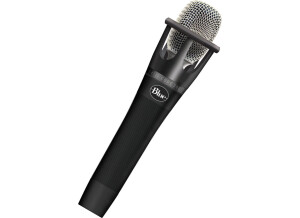
The Blue Encore 300 is Blue's only hand held condenser microphone to date. This significantly makes it much more different than Blue's other entries into the market of the live vocal mic. The 100 and the 100i are both dynamics, and the 200 requires phantom power, but this is the only condenser in that field of use for Blue so far. Because of this, it is the black sheep of the Encore line. Black sheep implies that it is bad. It is certainly not. The Aria capsule is combined with a reinforced chassis and special circuitry to keep noise low, and the floating capsule mount minimizes the noise that comes from handling the mic. As a condenser microphone it has the biggest frequency range out of all of the Encore mics. This one starts down at a quite impressive 35 Hz but it ends up going all the way up to a pretty cool but otherwise boring number of 20,000 Hz. It is a cardioid microphone like the others, but then again, you see more condensers are cardioid mics anyway. At any rate, because it is not a dynamic mic like the others but a condenser, it is only correlatively natural that it would not be able to handle as much sound pressure. This is only advertised as being able to handle about 140 dB of sound pressure as opposed to the dynamics in the Encore line which can get up to 147 before distorting and incurring potential damage. OVERALL OPINION If you want a good idea of what the Encore 300 is for. Watch American Idol. They used the Encore 300 in the latest season. The Encore is a real singer's microphone. It soars and is incredibly airy without being harsh or sibilant. However, it is not an easy mic to use. Unless you already know how to sing. It is not forgiving to the voice at all like many of the other more ubiquitous microphones like the Shure SM58.
The Blue Encore 200 microphone is a higher end entry into the hand held live vocal microphone market by the famously glitzy microphone company Blue. What is particularly interesting about this microphone is that it requires phantom power. 48 volts. Yep. Wait. What is interesting about that? All condensers need 48 volts of phantom power! I will stop you there. The Blue Encore 200 is a dynamic microphone. Phantom power is used to excite the signal. The Encore 200 like all the other Blue microphones, the 100, 100i and 300, is very glitzy and comes with a pouch and a clip. This adds to the solid weighty feel of the microphone in general. Now, the Blue Encore 200 has a frequency response rate of any average dynamic microphone. It starts down in the low end at 50 Hz and manages to extend itself all the way up to the higher airy frequencies of 16,000 Hz. Like most other microphones in this price range and this particular application as a vocal microphone, the Blue Encore 200 has a polar pattern of a typical cardioid. And again, like many other microphones in this particular live application, it has high capabilities of handling high levels of sound pressure. It is able to handle up to 147 dB of sound pressure before potentially being damaged, or significantly distorting. OVERALL OPINION This microphone does not have that ridiculous grainy quality as the Shure SM58. That is a plus for me, but for many other types of singers or even instrumentalists, having that grainy midrange push is an advantage for the punch of their sound. This microphone picks up a sweet sound like its friends in the same general line of microphones, but unlike the 100, this microphone has a particular exciting sound up top that works on some people and does not on others. You must try this microphone if you actually want to know what to do with it.
The Blue Encore 100 microphone is Blue's entry into the world of hand held microphones. This particular microphone is a dynamic microphone, and the element is biased in a cardioid polar pattern. There are many nice things about this microphone. It first off, looks incredibly glitzy and feels incredibly solid. The grooves on the side are nice. The microphone has a frequency response that begins down at a typical 50 Hz and extends up to a run of the mill 15,000 Hz. Like a lot of dynamic microphones that are meant to be used in a live setting, it is able to handle a lot of sound pressure. It can go up to 147 dB of sound pressure level before incurring any potential damage or distorting significantly. This microphone is pretty, and I feel like Blue's tendency to put a lot of their money into the look of the microphones shows here. It is certainly something that will draw a lot of attention to itself. OVERALL OPINION One thing I found out about the Blue Encore 100 is that it is a fairly soft microphone, not in output or sound level but rather in its tone. I find that it is a better choice for softer voices or voices that are more inclined to crooning or singing more classically. It lacks the midrange punch that the industry standard SM58 has, but it imparts this nice sweet tone to the sound. Because of this, I could not recommend it to the type of singer that ever seems to prefer any of the classic Shure microphone over any of the others. This microphone is not terribly forgiving, but it is certainly a pretty mic that will most definitely turn heads when you get on stage with it. It is certainly a different flavor, priced the same as every other mic in this sector.