Log in
EN
FR

Greco

80 products found

Categories
Filter
Sort by
Evaluation
  • Reviewed or not
  • Editor’s award
  • Reviewed by Audiofanzine
Availability
  • Available or not
  • Sold new or used
  • Sold new
  • Sold used
Must-have products
  • All products
  • Flagship products
  • Best rated products
  • Hot products
  • Popular products
Price
  • Freeware
€
Clear
Sort by
  • Popularity
  • User ratings
  • Price - low to high
  • Price - high to low
  • Used price, increasing
  • Used price, decreasing
  • Name (from A to Z)
  • Name (from Z to A)
  • Added on
Choose a category
Sort results
  • Popularity
  • User ratings
  • Price - low to high
  • Price - high to low
  • Used price, increasing
  • Used price, decreasing
  • Name (from A to Z)
  • Name (from Z to A)
  • Added on
Filter results 80 results found
Evaluation
Availability
Must-have products
Price
  • Freeware
Show results

The best Greco reviews

The reviews Audiofanzine members found the most helpful.
  • « A great 40-year-old Strat »

    A Japan-made guitar from 1976, before the Super Real era. This is the series which awoke Fender’s wrath, ultimately leading to the brand being bought up by the US manufacturer. SE600 Super Sound model. The guy i got it from sold it as an SE800 but i don’t care, it’s still a great guitar with a beautiful rosewood fingerboard. I had been dreaming of this exact model since my (very remote) youth :) 1st replica of a 3-tone sunburst ’62 Strat Body with nitrocellulose lacquer Flamed maple neck with a Brazilian rosewood fingerboard and pearl inlay D-profile, ideal for small hands like mine Sen wood body (1 or 2 pieces, I can’t clearly see the junction so you can tell it was a great work). The wood resounds incredibly, hit it with your finger and all the strings start resounding for a long, long time, so sustain is not a problem! Even unplugged, it sounds great… 3-way switch 22 frets 3.2 kg/7 lbs USE Almost the perfect Strat. For a 40 year old instrument, it’s in a remarkable state. String alignment is a little faulty with the low E a bit too close to the edge of the neck while the sharp E is a bit too far from it, but I’ll have it set up soon. The problem is well known on some ols MIJ guitars, but this definitely can be cured. 3 single Maxon Excel pickups: a rich, dense and never dirty sound. SOUND I play it on a 36W H&K Tubemeister, and I’ve also trie dit on my guitar teacher’s Fender Twin Reverb. It sounds good... The original single Maxon Excel sound really good, but when I can I’ll replace them with MS Tornados or Hepcat Replicas Series. I expect to gain more mids. OVERALL I bought it used in May 2013 and am happy I got one of the first 1962 “Series L” replicas. Japanese guitars from these years are the same quality compared with American models, sometimes even better, but the price is clearly not the same though used MIJ guitar prices tend to go dramatically up these years (a bit too much in the case of some Grecos). I’ve compare dit with US Standard Strats from the 80s, 90s and 2000s, there’s no match… Here goes for my third MIJ guitar. So if you hesitate to buy an old used Greco or Tokai guitar, stop hesitating and go ahead! The equivalent in Fend*r’s catalog would be a totally unaffordable (for me at least) Custom Shop model...

  • « A revelation »

    •Which amplifier and/or effect(s) do you use with this guitar? Marshall jcm800 combo and Fender Deluxe RI Leeds ov. •What playing and musical style(s) do you play with this guitar? Pop/rock, funk/blues. •What are your thoughts on the workmanship, electronics, and finish of this instrument? Great, the wood is excellent and looks really natural. Finish is very good too, and there really is something going on with this guitar, a real sort of mojo! Is this due to the long tenon Greco used for this Mint Collection series? To the quality and dryness of the Japanese wood? Probably a little of all this, but I sold my 1981 stabdard and 2008 R8 straight away after getting this one. The electronics can be perfected, at least on this one model. The pickups sound wide and vintagy for screaming sounds not very accurate yet really deep, for a typical 70s rock sound. •How is its intonation? Does its neck, touch, feel, shape, etc complement your playing style? Intonation is fine, on the first chord I played on it I had a real revelation, yhis was the one sound I'd been looking for for years. It was easy to begin with, the neck is neither too thin or wide and the guitar is well-balanced. •Do clean, crunchy and distorted sounds adapt well to different microphone positions? Are the guitar's different frequencies and sounds well-balanced? It sounds alive, ans from here it's quite easy to modify the sound to your taste as the original, basic sound is already great. •What are the pros and cons of this guitar? There are only pros! ;) There's a real mojo, which is not something you'll find on recent Gibsons (and by the way I believe only pre-'74 Gibsons can compare). Value for money is amazing. I thought the wiring was not so great, I changed ot for a 59 RI bumblebee with a 59's bursts and now this is an almost perfect guitar. Yes, I know the Bursts have a bad reputation for being too high-mid oriented to some ears, but I'd say it really depends on which guitar they're being installed ;) If you manage to find a Greco, don't hesitate!

  • nickname009's review

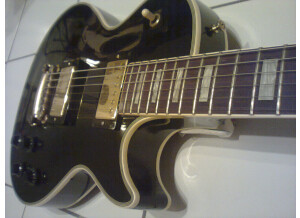
    I believe this model was made in Japan. I can't be completely sure however the quality of this guitar is still quite good. It's a LP custom copy, this one I bought used and had the pickups changed a few times. Specs: Mahogany body and neck Rosewood fretboard with block inlays Binding on the neck and body like a LP custom set neck Tune-0-matic and stop tailpiece 2 vol, 2 tones and a 3 way switch gold hardware open coil pickups UTILIZATION Like any other LP, moderate weight, and not super comfortable as it has no contours anywhere. The binding is of course on the neck, front and back of the body as well as the headstock. It's got the gibson diamond inlay on the headstock just like a real one. You probably wouldn't even be able to tell this was a greco from the 4th row, but that's not why I bought it! The set neck is always good, though the upper fret access is just the same, difficult for most players. If you've played LPs before, and trust me, I have played MANY, then you'll know the drill and the workarounds and how to get about playing this guitar the way they are. SOUNDS To be completely honest, since I bought this used I have no idea what the pickups in them were and I didn't even care, I knew they were generic and immediately swapped them out. They might have been after market seymour duncans. However I eventually replaced the bridge pickup with a bill lawrence L500Xl pickup and put a duncan '59 in the neck. This is a great combo for such a warm sounding guitar like a LP. The brightness of the lawrence pickup is balanced sounding and has more than enough gain to accomplish any type of genre. The '59 is the original PAF styled pickup with a bit more gain and low mids, yet is very clean and sounds great for soloing or for cleans! So for the sounds I can't really fairly comment on it as I don't even remember how it sounded stock and what the stock pickups were, but with the aftermarket pickups they were great! I saw no need to get real gibson! OVERALL OPINION I've owned many different types of LPs from many different manufacturers and I seldom keep buying one and flipping it, and buying another one etc. It's a vicious cycle, why do I do this? I don't know myself really, I love the look of it but just can't seem to be happy with the way they play, maybe they're too uncomfortable for me? Anyway, the Greco LP definitely did the job. I would be completely happy with it and not needing a 'real gibson'. As if gibsons are good anyway? They're generally not, and usually overpriced in my opinion. The MIJ copies have always been amazing, in fact I remember a time in the 80s when MIJ everything was outselling the american stuff cause it was just better!