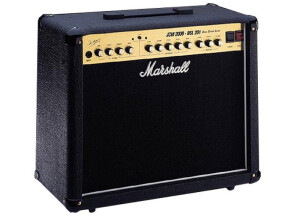
The Marshall DSL401 is a 4 x EL-84, 4 x 12AX7-powererd 1 x 12 combo amp that "officially" has two channels but really functions as a three-channel amp. The DSL401 has a clean channel and an overdrive channel. The DSL401 is rated at 40 watts and has a single 12" Marshall-designed 50-watt speaker specially designed to complement the DSL401. The Clean channel controls are simple: Gain, and the standard Bass, Middle, Treble controls. The Overdrive channel has the same controls and adds a channel master volume to allow you to better match the volume between channels when switching between channels. Then, there is an overall Master amp control section that consists of a Master volume, a Master reverb, and a Mix knob for the desired amount of effects coming from the effects loop. As noted there is an effects loop on the back with send and return controls. The FX loop is parallel, hence the Master FX control on the front. There is also a 1/4" speaker jack to connect an external speaker cabinet and there is a switch to choose between 8 and 16 ohms load. Even better, there is another 1/4" jack that is an emulated line out for going direct to a console or for recording, and in my opinion the Marshall emulated line out isn't half-bad. Other rear panel features include the mains input, fuse holders, and the 1/4" jack for the included 2-button foot switch that allows you to switch between the clean and overdrive channels, and switch between Overdrive 1 and Overdrive 2. The DSL401 is compact in stature and leads to a more compact, punchy feel, more than enough to play small-to-mid-sized venues, and larger venues either mic'ed up or with an extension cabinet. Overall, a great grab-and-go solution for when you have to have "that" Marshall sound. I wish it had one more speaker output and a 4-ohm selection, but suppose that would be pushing it. If you need that much sound you should probably step up to the DSL50 head and 1/2 stack. UTILIZATION The operation of the amp is simple enough. There aren't so many controls as to make the amp difficult to use. The overdrive channel has two modes: OD1 and OD2. OD2 acts as a boost to OD1 and adds a good amount of gain to the mix, 20db to be exact, perfect for harder rock/metal or fluid leads. In true Marshall fashion, cranking up the gain on the "clean" channel and pushing the global Master gets you that Marshall power tube saturation that just growls for days. It is conceivable that depending on the type of music you play you could crank up the gain and master and control everything via your volume knob. Beyond that, you have a myriad of tones available in this amp and are all easily accessible. The manual is downloadable from the MarshallAmps.com web site but I really doubt you'll need it. This is an amp that sounds amazing right out of the box. SOUNDS I mostly play Neal Moser and George Riszanyi custom guitars with a smattering of Ibanez and others thrown in for good measure. If you're looking for a truly classic rock 'n roll sound, plug in a Les Paul and let 'er rip. You won't be disappointed. Personally, I'm a HUGE fan of what I call the EL84 "grease" that comes with the overdrive channels. I haven't really heard a bad note come out of this amp, no matter what I plug into it. Even at extreme settings the amp never gets too much bass or treble--almost like they put in controls to prevent people from self-destructing. Make no mistake, though, you can take this amp from a small club gig, plug it into a 4 x 12, and play the 'bowl. OVERALL OPINION Before the new DSL 40-watt combo launched I did a comparison between the two Marshall 40-watt combos: the DSL401 and the HAZE 40. They're two completely different amps. The reason the DSL401 is more expensive with seemingly less functionality is because it's a true Dual Super Lead amp. This is not a boiled-down version or any type of compromise. This is a bona fide Made in England Marshall DSL Valve amplifier. The DSL401 is a no-frills rock machine but can handle any type of music. Roll back the gain on the clean channel and you've got yourself an awesome Jazz amp. If there's a type of music you can't do with this amp I'd be interested to hear about it. I don't know if Marshall is exporting the DSL401 to the States anymore, so this may become a collectible amp as well--I know I haven't seen it's little brother, the DSL201 in some time so keep your eyes open, and if you're looking for a versatile Marshall platform, the DSL401 is hard to beat. I've heard and read about others having thermal issues with the DSL401 but I've never had ANY issues whatsoever with my DSL401. I guess the message here is that your mileage may vary, but I've never had any issues and although I can say that I would gig it without a backup the truth is I never gig without a backup rig. However, I can't buy into the claims of issues with this amp because I've not experienced any of them. If you can get your hands on one, and you're a "Marshall" player, I'd get one without hesitation.
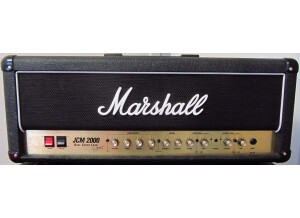
The Jcm 2000 DSL50 is a 50 watt, el34 driven amplifier that really stood apart from the rest of the 2000 series amps alongside its bigger brother the DSL100. The amp feature 2 foot switchable channels that share a global EQ. The amp has a decent number of tone shaping options including a deep switch 2 modes per channel that can be toggled between on the front panel, as well as separate EQ and gain controls for each channel. Effects loop is present on this amp and works pretty decently considering the era and pricing of this amp. The look is typical marshall, but has much less class than the 800 series and other prior models. UTILIZATION The DSL 50 and DSL 100 were a departure of sorts from the rest of the 2000 series amplifiers. These two offerings have a much more natural sounding tube distortion to them and are perfectly passable in the professional environment. The abundance of these on the used market for such low prices make them easily replaceable when on the road-- and this reduces anxieties greatly in the touring environment. With that said, the DSL50 had no reliability issues at all for me and sounded great when turned up to gigging volumes, everytime. SOUNDS I played through the DSL 50 with a Gibson SG junior. Mesa boogie 4x12. Carbon copy delay in loop. The amp's clean sounds are not exactly breathtaking, but when paired with the onboard reverb, does the job fine. The ultra channel seemed to have too much gain available and I found myself rolling back the dial to get a tame sound. The crunch setting on channel 1 is a great straight forward marshall tone and when paired with pedals can deliver a lot for the money. OVERALL OPINION The Jcm 2000 series has been around the block. Having been the most attainable tube amp to the generation that made pop punk and harcore music a big deal, it's been spotted on a lot of stage and heard in a lot of recordings. It's essentially a working man's solution for getting a useable mid to high gain sound without venturing into the more expensive mesa boogie offerings. When you look at it in this light, the amp is an amazing value. Leave your nitpicks at the door and this could be the perfect amp for you.
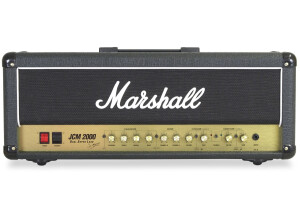
The Marshall JCM 2000 DSL 100 is a 100 Watt, EL34 based tube amp head with two channels and a comfortable variety of tones and features. Introduced in 1997, it was hailed as the next step to Marshall's famed JCM 800 and JCM 900 series. It offered clean tones, classic, plexi-style crunch, and searing high gain previously only available in modified JCM models. The DSL 100 features two channels with two modes each, a mid scoop switch, deep switch, shared 3 band EQ along with a global master volume and presence. The DSL also features an FX loop and footswitchable spring reverb, which is controlled independantly on each channel by Reverb A and Reverb B controls. UTILIZATION Channel 1 offers two modes-clean or classic crunch- at the flip of a switch. Channel 2 is the Ultra channel, dishing up two savage levels of hotrod Marshall high gain. In addition to the two channels and mode switches, there's also a Deep switch, which is essentially a pre-set resonance control, to add clean lowend punch. There's also a Mid scoop switch, which does exactly what it says, and creates a huge dip in the midrange curve, perfect for that scooped tone Dimebag enthusiasts love so much. The channels are switchable via a single Marshall-style footswitch. The channels as well as the reverb can be switched with a Dual footswitch, or two single footswitches. Obviously, with both channels sharing an EQ, some tweaking is required to get a good tone from both channels if you will be using them both. Otherwise, what might sound great on the clean channel might be too dark or boomy on the lead channel... you get the picture. SOUNDS Great tones are considerably easy to dial in on the DSL. With all controls at 12 O'clock, the clean channel produces a nice, workable clean that isn't too flat or bright. It's one of the best clean tones Marshall has ever produced, but it's still a Marshall clean, and it won't sparkle and shimmer like a Fender. Turning up the gain pushes the clean tone into low-volume JTM45 territory. Engaging the crunch switch brings about the signature Marshall Plexi crunch, and does it in convincing fashion. The Ultra Channel aims to produce and surpass levels of gain that players had already getting by hacking up their JCM 800's for years. And in this regard they succeeded quite well, though in more recent years tastes in high gain may have shifted away from what the DSL brings to the table. That being said, there are a tremendous variety of tones available simply by altering the gain, and using different guitars. An overdrive pedal also helps to cut some of the muddier lowend frequencies and peak the treble response. The major issue with the DSL was lowend response. It was indeed muddy for a high gain amp, and the deep switch made the lowend very boomy. Treble response on the high gain channel is also an issue, as it can be a bit tinny and fizzy with most EQ settings. OVERALL OPINION The DSL 100 can be had on the used market for well under $1000, and for this price point its a great investment. The tones available in the DSL and many and varied, although its not without its issues, as mentioned above. The FX loop and reverb (which is solid-state driven) also leave something to be desired, though not altogether unusable. There are some reliability issues with certain runs of the DSL 100, and these are all well documented on various forums, but fortunately there is also a wealth of information on how to address these issues. Overall the DSL 100 is almost a mandatory piece to have in your collection if you're a hired gun who plays everything. It approximates many classic Marshall tones without hauling out your vintage JMP's or JCM 800's, and it also covers a variety of tonal ground. I'm very excited to see what the new 2012 Marshall DSL 100H brings to the table.
I ordered this in Jan of 97 These were not out yet it arrived at the store in August on my birthday of all days. I paid $509.00 I wanted a small amp just big enough to gig with. I didnt like the half stack too big. that stays at home. I like the channel switching and the fact I could crank this and use the output tube sound instead of the dreaded preamp tube sound. it has separate EQ too. FX loop that I never use (dont use effects really) The reverb is ok if it works that day. The reverb wont turn off most of the time. I just have it unplugged at this time its annoying !!! No amp should gain this much I just dont see the point so if I use the gain channel its really low maybe on 2. Construction is like almost any amp these days constructed cheaper than my vintage amps they still work after decades of use this one may not. For the money its was one of the best ones out there at the time in the 20 watt range. I'm ok with it. This review was originally published on http://www.musicgearreview.com