Log in
EN
FR

Rolls

39 products found

Categories
Filter
Sort by
Evaluation
  • Reviewed or not
  • Editor’s award
  • Reviewed by Audiofanzine
Availability
  • Available or not
  • Sold new or used
  • Sold new
  • Sold used
Must-have products
  • All products
  • Flagship products
  • Best rated products
  • Hot products
  • Popular products
Price
  • Freeware
€
Clear
Sort by
  • Popularity
  • User ratings
  • Price - low to high
  • Price - high to low
  • Used price, increasing
  • Used price, decreasing
  • Name (from A to Z)
  • Name (from Z to A)
  • Added on
Sort results
  • Popularity
  • User ratings
  • Price - low to high
  • Price - high to low
  • Used price, increasing
  • Used price, decreasing
  • Name (from A to Z)
  • Name (from Z to A)
  • Added on
Filter results 39 results found
Evaluation
Availability
Must-have products
Price
  • Freeware
Show results

The best Rolls reviews

The reviews Audiofanzine members found the most helpful.
  • « Stereo DI With All The Connections »

    The Rolls DB-24 is a compact, passive stereo direct box, perfect for converting stereo line level audio to balanced, low-impedance XLR outputs. Conveniently, it has three different sets of inputs for different connection types; no cable adapters are necessary with this direct box! Whether your source uses 1/4", 1/8", or RCA connections, you can still directly connect it to the DB24. It can also function with a basic mono signal, such as a guitar, and it has a pad/level control for hotter sources. It has a basic ground/lift switch and a stereo/mono switch. Overall, the direct box is fairly hefty, and doesn't look or feel cheap. The metal casing is smooth and very aesthetic. It is a great, simply designed piece of hardware that simply works, and that is something I certainly expect from Rolls. UTILIZATION Setup with this direct box is fairly simple, as long as you know when your signal is mono, and when it is stereo. On some older Rolls devices, a needle nose plier is needed to move a jumper in order to change certain settings, but that is not the case here. It is simple and quick to use, which is why I bought it in the first place. I could've used two regular direct boxes, and split the 1/8" stereo audio signal from my laptop, but that would've required many cables and parts, and it would be a hassle to set up on stage. This simple box fixes all of that. SOUND QUALITY Almost all direct boxes function with complete transparency these days, and the DB24 is no exception. I've had no issues with noise or sound quality with this box. OVERALL OPINION Overall, this is a great passive direct box if you have stereo audio sources, such as from a laptop or cd player. It's simple to operate even without ever reading a manual, it's durable, and it just works.

  • « Great for vocal in-ear monitors! »

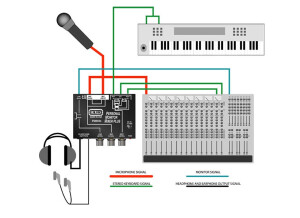
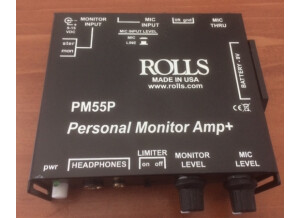
    The Rolls PM50sOB Personal Monitor Amp Plus is one of many great, simple Rolls products out there that do one task, but do it pretty well. This box features a mic input, mic through, mic level control, monitor input (1/4 jack), monitor level control, DC power input (which can accept anywhere from 9VDC to 16VDC, according to the packaging), battery compartment, two phones output (one 1/4 and one 1/8), a power switch with LED indicator, and jumper controls for stereo/mono and ground/lift. This box is perfect for intercepting a vocal signal from a standard XLR cable, and sending it to headphones. I use the headphone output to send to a wireless transmitter for my in-ear monitor system, and it works great for live shows. This way, I can tap into the microphone line without changing the vocal signal that is sent to the house. The monitor input (1/4) is also great if you want to mix in another signal to the monitors, such as guitars or keyboards or a click track. There are a few odd, archaic feature about this box that I do not like, however. There are switches on the box for stereo/mono mode, and changing the ground/lift of the box. However, both are not actually switches; they require a small jumper between three of the leads to be moved, and this requires a pair of needle-nose pliers. A bit old school. and a very big pain to use. I would expect Rolls products to have actual switches, just like most of their other devices. Also, the battery compartment is completely unsealed, as the battery sits directly on the circuit board with no protection. I had to wrap my batteries in a bit of plastic wrap, in order to prevent damage to the circuits, and to prevent short circuits from forming. But overall, this product does it's job, and it is one of the cheapest microphone amp solutions I have found. If you need it for your in-ear monitors, it is a great buy, as long as you are careful with that battery slot!

  • « Great multi-purpose passive mixer »

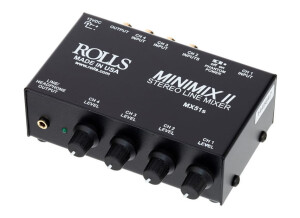
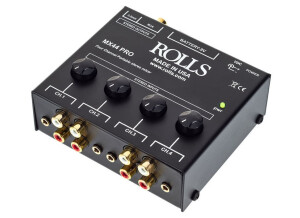
    The Rolls MX41s is a passive stereo (and mono) 4-channel mixer. It is small, less than the size of a standard guitar pedal, and it has 4 passive volume controls for the 4 inputs, and a single output. All of the connections are 1/4 inch. It weighs 1 lb, and it feels and looks solid, just like all Rolls products. When all the knobs are turned up, it can also be used backwards as a signal splitter. UTILIZATION The Rolls MX41s works with both stereo and mono signals, but not a combination of the two. This mixer is great for expanding a regular console mixer, when you run out of inputs. Also, with the proper adapters, you can convert a stereo signal into a balance-mixed mono signal with this device. The level knobs on the front feel solid, but they are a little hard to see their levels at a distance; there is a little indentation on the knob that marks it's location, and it's hard to see. Reminds me of the knobs on a Mesa Boogie amplifier, which are impossible to see from a distance. SOUNDS All of the connectors are gold, so the sound quality is great; I've never had any noise or signal degradation problems with this mixer. Just don't expect it to do something that it can't do, like handling unusual signals such as balanced, mic, or speaker. Because it's passive, you have to remember that this mixer is incapable of increasing a signal's volume, it has no amplification abilities. OVERALL OPINION Overall, the Rolls MX41s is a great little box that has many uses, especially around guitar rig setups, stage setups, studio setups, and so on. If you've ever tried mixing signals together with a splitter cable, a dedicated box like this will sound much better, not to mention the flexibility of level adjustment. Rolls are masters at making small boxes that do little things, but I find their products to always be solid and useful.

  • « Simple direct box that lasts! »

    The Rolls DB25 Matchbox is a mono, passive direct box that converts an unbalanced, high-impedance 1/4 inch signal into a balanced, low-impedance xlr or microphone cable signal. It has a ground lift switch for hum elimination, and an attenuator control for padding the input signal by -20db and -40db. The pad useful if the input source is too hot, but I find that these switch only cause problems by being switch on accident, and the resulting signal is too soft. This is especially the case on live stage, where setup and take-down happens very quickly. However, on this direct box, the switch is on the top, not on the side, and it is easy to see its position from a distance. All of this makes it much easier to manage in quick setup situations. UTILIZATION The direct box has two parallel inputs, and this is useful if you want to run the signal to another source, such as an on-stage amplifier or powered monitor. The two inputs are not meant to be used as a mixer for two sources, although I believe I have tried it with no ill effects. Like most direct boxes with two inputs, these inputs could be mistaken for a stereo input via two 1/4 inch lines. SOUND QUALITY The sound quality is what you expect from a direct box: complete transparency with no noticeable noise, or loss of highs or lows. OVERALL OPINION I originally purchased this direct box because I saw it being used at my local church, and I've had this box for over 5 years, and it hasn't failed me once. The construction is simple and solid, and nothing feels loose or fragile inside or outside of the unit. As a simple product with a simple feature, I would recommend this direct box to anyone, for any general audio purposes.

  • « Good for what it is »

    The Rolls HA43 is a 4 channel headphone splitter that allows the user to use four headphones simultaneously out of a single headphone jack. Each of the four listeners have independent volume control for their mix, but no other way of changing the mix in the headphones. The HA43 is connected to the output of your mixer using a stereo 1/4” to 1/4” male-male cable. It is a very basic system, but the HA43 is rugged. I've dropped it several times, but it always has run just fine and produces a good, clean sound. The volume pots have never gone dirty on me either, and it has not presented me with any crackling or static. I have used this in the studio, as when I record a band I will generally record the band live as much as possible. This usually involves the band being in one room with the drums, with direct bass and effects equipment recording the guitars directly to avoid any bleed. The mix is set to the drummer's content, and everyone else uses that mix in order to hear themselves. Of course, each band member can set his or own volume independently. Because the unit is so small, I generally set the volume for each band members in the control room myself and use long headphone extension cables for the band members. In the six or so years I have owned this headphone splitter/amplifier I have not had any complaints. I will likely keep using it until I either run it into the ground or I replace it with something fancier. But, as I do not record a lot of bands anymore, it will likely keep its place in my studio rig for a long time. I would recommend it for a home studio enthusiast who needs to split the mixer/headphone signal up between a few different recording artists.

  • songboy's review

    I have been using this unit for around one year. What I like about the device is it was very easy to use with my Korg TR. I just plugged it in via the midi cable and was instantly using it to scroll through patches. For that purpose it worked great and I never had any problems with it. Now, where I did run into some problems was when I plugged it into my presonus Firebox to control patch selection parameters and hopefully other parameters as well. For some reason, my computer wasn't recognizing the unit through my Firebox. Whether it was indeed the firebox's fault or my computer's fault, I haven't been able to figure out yet. I must have spent over 3 hours trying to figure out how to get the signal. After checking all the cables and looking for any possible driver issues (seemed really unlikely) I just gave up. I left it plugged in though, and a few days later I decided to just push a few buttons and viola, it worked. Unfortunately I cannot figure out how to get this device to do anything besides scroll and select patches. I would love to have it also toggle on/off certain effects, sort of making it a midi stomp box pedal, but alas, no luck yet. I run it though Mainstage (Logic 8) so i figured it wouldn't be a difficult task but I was wrong. Maybe if I ignore it again, it will decide to work...haha. If I could get that function working, I would give this pedal an 11 out of 10. Its sturdy, very simple (no frills, just 12 buttons, a midi channel selector which can be very confusing without the manual, and midi in/out(thru) connections. Mine doesn't have a usb connection but hopefully they will be releasing one that does, if they already haven't. I pad $75 for mine used and consider it a decent buy. Again, if I can get it to do the toggle on/off thing, I will want to have its children. I would make the same choice again if they added a usb connector.