Log in
EN
FR

Applied Acoustics Systems

61 products found

Categories
Filter
Sort by
Evaluation
  • Reviewed or not
  • Editor’s award
  • Reviewed by Audiofanzine
Availability
  • Available or not
  • Sold new or used
  • Sold new
  • Sold used
Must-have products
  • All products
  • Flagship products
  • Best rated products
  • Hot products
  • Popular products
Price
  • Freeware
€
Clear
Sort by
  • Popularity
  • User ratings
  • Price - low to high
  • Price - high to low
  • Used price, increasing
  • Used price, decreasing
  • Name (from A to Z)
  • Name (from Z to A)
  • Added on
Choose a category
Sort results
  • Popularity
  • User ratings
  • Price - low to high
  • Price - high to low
  • Used price, increasing
  • Used price, decreasing
  • Name (from A to Z)
  • Name (from Z to A)
  • Added on
Filter results 61 results found
Evaluation
Availability
Must-have products
Price
  • Freeware
Show results

The best Applied Acoustics Systems reviews

The reviews Audiofanzine members found the most helpful.
  • songboy's review

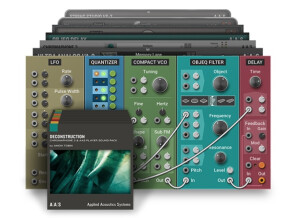
    I run this on a Macbook with Leopard (10.5) and the Tassman 4 works perfectly. The manual is decent enough and is very useful when it comes to really learning this massive synth. The general configuration and setup is fairly simple in my opinion. Once you start using it more it becomes easier but this synth has a ton of options. One thing that is nice is the different units (effects, oscillators, etc...) are designed to resemble hardware rack units so the interface is familiar to those who use analog gear. Yes, the typical functions are all laid out in front of you (and there are a lot of them). SUITABILITY/PERFORMANCE I run this synth in Logic 9 and Ableton 8 and so far it has performed very well. So far it has never crashed and I have made a bunch of sounds on this thing and all of them were saved and recalled without any issues. I give this thing a 10 out of 10 because it is huge, very tweakable and sounds AMAZING!! I have been using this for about a month and a half. OVERALL OPINION What I like most about the Tassman 4 is how many great sounds you can pull out of this thing. I started with a lot of presets first to develop sounds, but now I am getting used to starting from "scratch." Another really cool option is the "builder" mode. In this mode you can create synth setups physically by dragging modules into the Builder area and connecting them together in specific patterns. This aspect definitely takes a little more thought and it definitely helps if you have an understanding of general synthesizer concepts. So far, I don't dislike anything about this synth. It Rules!! My studio partner bought this (actually he updated from Tassman 3) so I looked up the price and it is $349 for the whole thing. In all honesty, that's a lot of money and its hard to spend that much on software. But, this is one of the best software synths I have ever used so I would say it is worth it. The sound it really great. They are very full and warm and in a recording can fool most people into believing its a real analog synth. I have used many software synths and this one ranks very very high on the charts. It might even be the best wide ranging synth I have used. Yes, I would definitely buy this if my partner hadn't already.

  • « A Virtual Analog workhorse! »

    Ultra Analog VA-1's installation and setup process uses a standard challenge and response registration system. Once you start to use it, the user interface is immediately familiar if you've ever used a Virtual Analog synthesizer. Everything is on one panel, there's no complex routing, and everything has very clearly labeled knobs. The manual also explains the functions well, should you need to reference something. The plugin is a little old at this point so the interface is actually a little too small for use on modern high resolution displays and that's definitely a concern for those with impaired vision. SUITABILITY/PERFORMANCE I've used VA-1 regularly in my productions since I purchased it several years ago and I've encountered no instability or performance issues. It has both a 32-bit and 64-bit version and has loaded fine in all of my hosts: Renoise, Reaper, and Maschine. The performance is admirable. On my Intel i5 2500k @ 4.5ghz, 8 instances of VA-1 running an arpeggiated patch with the built-in delay and reverb effects enabled only uses about 12% of CPU combined. OVERALL OPINION It's a standard two-oscillator setup with two filters, two filter envelopes, two LFOs that can manipulate a number of parameters, and two amplitude sections as well as chorus, delay, and reverb effects. The built-in effects don't offer a ton of options, but they're still decent. Both oscillators have your standard virtual analog waveforms as well as a sub-oscillator. As I mentioned before, the interface is immediately familiar and this is one of the best parts about it. There's only one page, all of the oscillator, LFO, envelope, etc. sections are placed from left-to-right as you'd expect. Compared to some more complex plug-ins, Ultra Analog is almost comforting, especially when you're just trying to whip up an analog-ish organ or brass sound and you don't need the insane routing or multi-stage envelope generators from something like Massive or Rapture. The sound quality of Ultra Analog is pretty solid, even for such an old plug-in. It's not trying to emulate any particular hardware synth, but rather just the style of analog in general. It doesn't capture some of the sonic quirks that add so much to real analog, but it is more than capable of delivering decent virtual analog sounds. It can give you your warm, lush pads and also searing hard sync solo leads, but it doesn't really have a standout sonic "character" to set it apart from the many other Virtual Analog synths. The factory preset library is decently diverse and shows a lot of the sounds you can coax from this relatively straightforward synth. One caveat to this review is that Ultra Analog VA-1 has been superseded by VA-2 which adds a few new effects and changes the interface to a more modern, paged setup. So far as I've heard, the synthesis engine hasn't had any noticeable changes, so that should be what you'd consider if you're interested in purchasing this plug-in. The price for VA-1 used to be drastically cheaper than it is now before AAS released VA-2. VA-1 is currently the same price as VA-2 at the few stores that seem to still sell it, so I can't recommend purchasing this over VA-2, which has the same synthesis engine but with some new features and an overhauled interface. So that said, VA-2 should be a consideration if you're in the market for a virtual analog-styled synth, especially if CPU usage is a concern for you. It's also worth noting that this is more-or-less the same as Ableton Live's Analog, so if you have Ableton Live Suite, you don't really need this. Pros: + Low CPU usage + Clean, single page interface + Versatile, capable of a variety of classic analog sounds Cons: - Old and superseded by VA-2 - Though the interface is laid out well, it is not sized appropriately for modern computer displays.

  • « upgrade to the newest version »

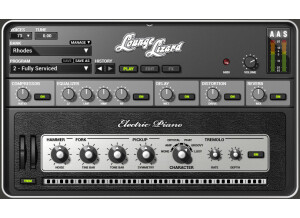
    Applied Acoustics systems Lounge Lizard EP -1 can be used on either mac or pc. I have used it on both and it works perfect. There really isn’t a platform or operating system that it wont work in. I have used it in several different sequencing softwares and the only one that gave me a little trouble was in Cubase a few times. Also for some reason when using it multiple times in the same session it can lag a bit which I didn’t understand because it only does this in cubase and not in any other program that I use. Maybe there is a setting that I have in Cubase that is toying with its performance, so I just don’t really use it in Cubase anymore which really isn’t a problem because I can use it in a bunch of other programs and not have to worry about anything. So that’s just a minor problem that im having with Applied Acoustics Lounge Lizard EP 1 in Cubase. SUITABILITY/PERFORMANCE It is quick and easy to install, no manual was needed and all of the knobs and sliders are labeled so anything you want to do just look for it and start tweaking and see what happends. You can do some neat stuff with Lounge Lizard EP -1, I no longer use Lounge Lizard EP -1 now, I have Lounge Lizard EP -3. I have upgraded it a while back and im very happy with some of changes that have made and using Lounge Lizard EP -3 has allowed me to not have that issue with Cubase anymore. OVERALL OPINION This plug in is very light on my cpu and works great, very good sounding piano’s and some cool effects you can get with the Phaser Tremolo and Delay knobs. Just play around a little bit and you can get some cool sounding stuff pretty easy.

  • « A flexible, unique rhodes soft synth »

    Applied Acoustics System's take on an electric piano synthesizer plugin is unlike the rest. It is not based on samples from the real Rhodes or Wurlitzer pianos, yet it sounds surprisingly real, and it infinitely more flexible. Immediately, you'll see controls that are beyond the standard soft synth parameters: Stiffness, Tine, Geometry, Damper, etc. This is a smart soft synth that gives you deep control over the electric sound, with incredible sounding results. If you want a synth that sounds exactly like a Rhodes or Wurlitzer, this may not be the best tool. But if you like electric pianos, but would love to change tonal details, and adjust every little parameter to your liking, then this is the soft synth for you. Compatible with Mac and Windows systems, it also includes a tremolo, EQ, and multi effects section in addition to the basic electric piano controls. You can easily save and organize your presets within the plugin as well. SUITABILITY/PERFORMANCE I've personally never used an authentic Rhodes or Wurlitzer piano, but I use them a lot in my music and are familiar with how they sound in most modern recordings. Alongside my Native Instruments version of the Rhodes, the Lounge Lizard does seem slightly more digital and synth-y, but the Native Instruments uses hundreds of megabytes of samples, and it is extremely inflexible: one sound is pretty much all you get. Lounge Lizard is much more lightweight, and cpu processing has not been an issue: I've used it live at low latencies with no problems. OVERALL OPINION Overall, this is a unique synth and a unique take on electric pianos, and for fans of synthy pianos and realistic pianos alike, this is a product worth checking out. The official price for this plugin may seem a bit steep, given that it's installation is just a few megabytes, but it is certainly unlike any other, and it is capable of producing some amazing electric piano sounds, with little hassle and little tweaking necessary.