Log in
EN
FR

Dwarfcraft Devices

40 products found

Categories
Filter
Sort by
Evaluation
  • Reviewed or not
  • Editor’s award
  • Reviewed by Audiofanzine
Availability
  • Available or not
  • Sold new or used
  • Sold new
  • Sold used
Must-have products
  • All products
  • Flagship products
  • Best rated products
  • Hot products
  • Popular products
Price
  • Freeware
€
Clear
Sort by
  • Popularity
  • User ratings
  • Price - low to high
  • Price - high to low
  • Used price, increasing
  • Used price, decreasing
  • Name (from A to Z)
  • Name (from Z to A)
  • Added on
Choose a category
Sort results
  • Popularity
  • User ratings
  • Price - low to high
  • Price - high to low
  • Used price, increasing
  • Used price, decreasing
  • Name (from A to Z)
  • Name (from Z to A)
  • Added on
Filter results 40 results found
Evaluation
Availability
Must-have products
Price
  • Freeware
Show results

The best Dwarfcraft Devices reviews

The reviews Audiofanzine members found the most helpful.
  • « Whoa what is this? »

    Lately I've really caught onto this Dwarfcraft stuff and as a collector of odd pedals it seems every one i get my hands on is more awesome than the last. Basically you have an on and off switch, a volume knob, a texture control for voicing purposes, and a starve knob which reduces the power and makes crazy noises. There are also two switched. One which creates upper octave tones in the sound and another which is a kind of squeel switch for the starve knob. It also has a switch to turn the starve circuit on and off. UTILIZATION At first glance this pedal is somewhat intimidating just because you aren't sure what everything does exactly. But after some trial and error it becomes apparent that there aren't any rules to this thing at all. It's totally a beast by itself. I run mine with a Les Paul Custom through a few pedals and a Bogner Shiva most of the time. I haven't had any issues with it. Seems very solid. SOUND QUALITY I'm not sure how to describe this thing. It really likes to oscillate...a lot. In fact, it's hard to get a sustained and not choppy signal out of it sometimes. If you like out of control rhythmic patterns this is the pedal for you. I can see this thing being used for a lot of obscure indie type rock. It's very synced up and melodic with the overtones but at the same time it's super noisy and has a sub bass thing going on. It's actually pretty easy to use. You really just plug in and start turning knobs to get results. OVERALL OPINION These Dcraft pedals keep surprising me by doing way more than I expect. I really had no idea what this was when I got it and it has turned out to be a lot more than another noisemaker. I think the great thing about it is its ability to be noisy and out of control while staying musical and melodic so it still has a use. I recommend it to anyone who does electro indie or crazy sounding rock stuff. It's totally sick.

  • « Nasty noisy fuzzy distortion »

    Fairly basic design. Input and output. Has your usual volume tone and gain knobs. But the starve knob is what makes this unique. It reduces the amount of power allowing into the circuit. I'm not entirely sure why but this is meant to induce a ton of noise and nastiness to the tone. UTILIZATION I'm a collector of weird pedals and I recently found this brand and fell in love. All of their pedals seem very well built and super unique and The Great Destroyer is no exceptions. I'm the kind of player who has used all the typical fuzzes and the idea of a box that "starves" itself for power is crazy and interesting. Structurally this pedal (and the other Dcraft pedals I have tried feel solid.) I believe they are handmade by one guy. SOUND QUALITY With the starve knob off this is just an evil sounding fuzz pedal. It sounds very doom death metally...? If that's a way of saying things. It seems to like lower tunings also. Perhaps it could be used for bass? Anyway, the starve knob is where things get crazy. You an literally make this pedal scream...fart...short out...whine...whatever. There's all kinds of insane noises to be made here. A lot of the time it sounds like AM radio feedbacks or alien noises. If you're sitting here wondering how you could possibly use this in your music, maybe you play the wrong kind of music... OVERALL OPINION I really like this pedal. I was expecting something a lot more vanilla. It seems to react differently to different amps and pedals. The special effects possibilities are endless really. If you want a doomy sounding fuzz pedal with the ability to make you some scary noise rhythmic effects, I highly recommend you give it a shot. I'm loving every Dwarfcraft pedal I can get my hands on.

  • « Modulate your way into a soundscape »

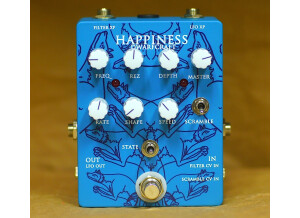
    SOUND: Wow… if you like creating or playing music that takes on a different edge, and in the realm of soundscapes or the futuristic then Happiness is up your alley. Below is a sample demo I put together: Now, the quality of the sounds is amazing, and the people at Dwarfcraft are of a different mindset, developing gear for keyboards/synths as much as guitar. And so, their perspective is a bit different from most pedal manufacturers. I really enjoy working with modulation pedals because they often offer up something completely different and unusual from typical fuzz, distortion and pre-amps. You can get lost in fooling around with modulation and creating unique combinations. Happiness certainly is no exception as the 8-minute video I created only grazed the surface. Here is a rundown of what the controls do and how each affects the outcome. Starting at the bottom, the STATE switch selects from three filter modes (removing high frequencies, low frequencies or both high and low frequencies). You could almost think of it as a tone control on your guitar. You can get some interesting ambient background drone-type effects when you cut off the high frequencies – ideal for layering sound to fatten up a composition. The RATE controls the speed of the modulation, from a slow ‘glow’ to a faster ‘thrust.’ The SHAPE controls the LFO’s (low frequency oscillation) waveform (at 12 o’clock you have a triangle, but turning it left or right will create a slow ramp or saw). The SPEED controls the rate of the SCRAMBLE effect (if Scramble is turned off the pedal behaves as a steady modulated filter, whereas when it’s on it acts as a ‘sample and hold circuit’ for more of an ‘off-then-on’ modulation… similar to a kill switch on a guitar!). Moving to the top controls, the FREQ defines the cutoff frequency of the filter. I like it sitting around 10 or 11 o’clock, but as you dial it up you can achieve some interesting lo-fi sounds. The REZ controls the resonance, and it can give you a nice subtle ‘zing’ to the tone. However, as you crank it up you may get a whiplash from your speakers… some really wicked stuff can be produced (I demoed this a bit in the video). DEPTH controls the depth and direction of the LFO modulation (at 12 o’clock it is cancelled, whereas either direction produces modulation, whether you want just a little or a lot). MASTER is the volume control. What gives Happiness some extra joy is that there are two EXPRESSION pedal inputs. Not sure if there’s a Y-cable out there that allows you to control both at the same time (there must be), but that would be awesome to try. The FILTER XP allows you to control the cutoff for the filter, obviously, whereas the LFO XP controls the rate of the internal LFO. What I like about this is that you get nothing but dry signal when the expression pedal’s heel is down, and then you can tap into just a bit of effect or a lot of effect when you want to… to bring emphasis to certain chords or notes, etc. Now, there’s a lot more on this pedal that I’ll never use, but the people at Dwarfcraft designed this beauty with studio musicians and keyboardists in mind as well. Happiness includes a Filter CV In and LFO Out, so that you can use other gear to control the pedal. The same with the Scramble CV In, which allows you to substitute another control voltage signal for timing of the scramble effect. OVERALL IMPRESSION: I really enjoy using this pedal, and it’s simple enough to use when turning on and off. However, you’re going to spend a solid day having fun to discover what happens when you turn one knob quarter way, another full, and another half-way… and all the other combinations possible. In that regard, Happiness is not a plug-and-play type pedal, like a basic distortion or fuzz, and it may seem overwhelming to some. What I suggest is that when you discover a sound you like, write down the settings. Because there is so much this pedal can do and in so many combinations, I can see gear sluts buying up this baby only to later throw it away with the bathwater… either forgetting what cool sounds they once had or not devoting the time to dial in something useable in the first place. Further to that last point, although I have addressed how great this pedal is for weird and unique sounds, very modest modulations can be created and then set low in the mix. This helps to give an added and different dimension to a guitar’s tone, but also helps to fatten up the signal. If I could change something, I would have preferred the cable input and output at the back (at the top) and the Expression ins along the side(s). However, reversing these would suit my pedalboard configuration better, whereas it may be suitable for someone else. Finally, Happiness uses a standard 9v center negative plug and draws only 110mA, perfect for most adapters and any pedalboard power source.