Log in
EN
FR

SeriesEpiphone Special Run SG

8 products found

Filter
Sort by
Evaluation
  • Reviewed or not
  • Editor’s award
  • Reviewed by Audiofanzine
Availability
  • Available or not
  • Sold new or used
  • Sold new
  • Sold used
Must-have products
  • All products
  • Flagship products
  • Best rated products
  • Hot products
  • Popular products
Price
  • Freeware
€
Clear
Sort by
  • Popularity
  • User ratings
  • Price - low to high
  • Price - high to low
  • Used price, increasing
  • Used price, decreasing
  • Name (from A to Z)
  • Name (from Z to A)
  • Added on
Sort results
  • Popularity
  • User ratings
  • Price - low to high
  • Price - high to low
  • Used price, increasing
  • Used price, decreasing
  • Name (from A to Z)
  • Name (from Z to A)
  • Added on
Filter results 8 results found
Evaluation
Availability
Must-have products
Price
  • Freeware
Show results

The best Epiphone Special Run SG reviews

The reviews Audiofanzine members found the most helpful.
  • « Cool take on the G400 »

    The Epiphone Negative SG is one of the many special runs that's been done over the years by the company to appeal to different markets of consumer. This particular model has a white/black colour scheme that is supposed to seem like the guitar is a photo "negative" of a regular black SG. To that point it features a mahogany body and neck, a maple fretboard (unusual for a Gibson/Epiphone) black trapezoid inlays, 22 frets, sealed tuners, tune-o-matic bridge and stopbar tailpiece and a pair of alnico humbuckers with a typical SG control layout. It's topped off with an Arctic White finish. These guitars were made in one of Epiphone's overseas factories in 2009 (likely China by this point). UTILIZATION The SG is a guitar that is particularly ergonomic for a Gibson designed instrument. This particular model is fairly light and easy to hold for long periods of time. It balances well on a strap and doesn't suffer acute neck heaviness like some SG models do. The shape of the guitar allows for the body and hands to rest comfortably for extended periods as well. The upper fret access is decent on this guitar too - you can get right up to the 22nd fret without issue. Getting a nice sound out of this guitar isn't too difficult. The stock humbuckers aren't the greatest quality but they do the job. It's got a decent range of tones available from clean to distorted that all sound good enough for what they are. SOUNDS The guitar like many Epiphones has cheaper pickups/electronics that do inhibit the tone somewhat. They're a bit more muffled and dead than I'd like to hear in a guitar like that... but ah well. The clean tones are reasonable enough. The neck pickup does a nice jazzy tone, the center position is good for some funk, and the bridge pickup does an okay facsimile of country tones. The drive tones are great considering the electronics. The neck pickup is excellent here for lead work involving legato or other technical items, and the bridge pickup is tight enough for rock and metal rhythms and fast alternate picked items too. OVERALL OPINION All in all I think the Epiphone G400 Negative is a decent take on the SG. Like any Epiphone it is bound to be plagued with some cheaper parts and sometimes hit or miss workmanship, but for the $400 price that they were new, it's not too bad. They are now discontinued but you can find them used for about $250, which is a decent price to pay for a unique take on the classic Gibson SG!

  • « Stick with the hardtail »

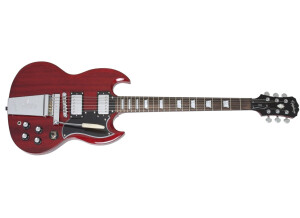
    Epiphone is Gibson guitars more affordable line of guitars. So this guitar is the affordable version of the Gibson SG but with the maestro tremolo system. The SG was introduced in the early 60s to compete with the stratocaster. They discontinued the Les Paul and made the SG. The SG was lighter and some came with a tremolo system. The Maestro system is not very good. I would recommend a hardtail version over the maestro system. The G-400 comes with Grover tuners on the headstock of a 22 fret neck with a rosewood fretboard. The fretboard is bound with rosewood instead of plastic. It is made from mahogany and has a veneer for the Korina. It has the classic Les Paul electronics setup with dual humbuckers and dual tone and volume controls with a 3 way toggle pickup selector. And of course this guitar has the Maestro tremolo. UTILIZATION With the dual cutaways of the SG design the upper frets are very easy to reach. It has the Gibson 60s profile neck which is the preferred profile for guitar players. In the 50s Gibson necks were very large and referred to as baseball bat necks. In the 60s Gibson switched to a slimmer neck design. This slimmer design is what the G-400 has. One problem SG's is that the neck is mounted far out on the body and with the body being thinner than a Les Paul the guitar is slightly neck heavy. When you are standing up and playing the neck may want to drop down and you may find yourself holding the neck up. One thing the Maestro does is help to balance out the neck dive with additional mass towards the back of the guitar. This does not outweigh the tuning problems it causes by being non locking and just a bad design. SOUNDS This guitar sounds basically like any other G400 Epiphone. The mahogany slab is nice but the stock Epiphone pickups let it down. Bad stock pickups are a problem on most lower priced guitars. The pickups could be better. They are pretty muddy and dead. You do not get much attack with these pickups. Since these pickups do not have much definition the neck position can get really muddy. With a high gain amp the sound might get muddy due to the lack of definition. With some types of music these pickups are great. If you want a bluesy sound these pickups will do really good and you will be able to get a smooth tone out of them. With a pickup swap this guitar can sound great so I would recommend to anyone who has one of these Epiphones to try it out with some after market pickups. A set of Seymour Duncans would liven this guitar up greatly. OVERALL OPINION If you are looking at this guitar I suggest you save some money and get the normal G400. The Maestro trem does not add much but it takes away a lot in terms of sustain and tuning stability. The G400 is a good guitar overall so why bother getting one with a bunch of crazy add ons that take away from the goodness.