Log in
EN
FR

SeriesEpiphone SG

30 products found

Filter
Sort by
Evaluation
  • Reviewed or not
  • Editor’s award
  • Reviewed by Audiofanzine
Availability
  • Available or not
  • Sold new or used
  • Sold new
  • Sold used
Must-have products
  • All products
  • Flagship products
  • Best rated products
  • Hot products
  • Popular products
Price
  • Freeware
€
Clear
Sort by
  • Popularity
  • User ratings
  • Price - low to high
  • Price - high to low
  • Used price, increasing
  • Used price, decreasing
  • Name (from A to Z)
  • Name (from Z to A)
  • Added on
Sort results
  • Popularity
  • User ratings
  • Price - low to high
  • Price - high to low
  • Used price, increasing
  • Used price, decreasing
  • Name (from A to Z)
  • Name (from Z to A)
  • Added on
Filter results 30 results found
Evaluation
Availability
Must-have products
Price
  • Freeware
Show results

The best Epiphone SG reviews

The reviews Audiofanzine members found the most helpful.
  • « It's BIG, but good for Led Zep fans! »

    Made in Korea Laminated mahogany body Flamed maple top Heritage cherry finish 2 set mahogany necks, both with rosewood fretboards, 20 frets, split parallelogram inlays 1 neck is a 12 string, 1 neck is a 6 string 1.85" nut width 24-3/4" scale 2 Alnico Classic humbuckers for each neck, 12 string neck has covers Chrome hardware Tuneamatic bridges with stop tailpieces UTILIZATION This doubleneck is one cool guitar! It is based upon the Gibson EDS1275, which is one of the most iconic guitars in history, all because of the playing of Jimmy Page of Led Zeppelin. In Led Zep's 1973 film "The Song Remains the Same", JP's Gibson doubleneck is prominently featured during the song "Stairway to Heaven". I've never played the Gibson version, but this Epi is quite a neat instrument. It weighs a whole lot - I feels heavier than my Country Gentleman I had, which was 12 pounds. I think this is in the 14-15 pound range, so it wouldn't be an all-night, 4 hour bar gig guitar. It plays easily enough - all the frets are easy to reach. Workmanship is pretty good on everything, and the hardware is of better quality than the price would indicate. Tuning it can take a long, long time, however. SOUNDS The sounds are where this thing excels! It is so neat to be able to have a 6 string for power riffs and solos, and a 12 string for jangly clean rhythms, all in one guitar. One thing I experimented with a lot was having the twelve string neck in an open tuning that fit the key of the song I was playing it, then having both necks active, and playing on the 6 string. The 12 string neck would sympathetically resonate in the correct key, and it sounded really neat, a bit eerie, and very exotic. OVERALL OPINION This is quite a cool axe if you can find it. If you can deal with the weight, size (the case is ENORMOUS), and time it takes to tune it, you've got a bonafide winner on your hands.

  • « Looks great but the pickups are noisy »

    I'm always using TH2 program via computer. (and only for monitoring, I use an old East German amplifier, called 'Regent') old school sounds, I like it: https://www.youtube.com/watch?v=8_BeyPcqzg4 pros Mine guitar was made in Korea, so because it is no longer manufactured (even in China) it bacame rare :-) great looking shape and finsih Groover tuners (but it feels not very solid) Mahogany body, and neck (set, not bolded to the body as the Special versions) Because of the SG shape the access for the high frets is extremely easy relatively good fret finishes cons the body is too thin, so not heavy enough for the neck and head. In other words, it is not well balanced. pickups are noisy even without distortion effect.

  • « Epiphones tribute to the original SG »

    In the early 60s Gibson felt that their Les Paul design was getting a bit long in the tooth. To help compete with Fenders Gibson decided to modernize the design to make it play better and cheaper to produce. In 1961 the new Les Paul came out with the design we now know as the SG. For 7 years if you went to a store and asked for a Les Paul this is what you would have gotten. Lots of people like the original SG design to the newer ones with the larger pickguard. This is Epiphones tribute to the early SG guitars. This is the 61 SG Special in a very vintage color of TV Yellow. It is called TV Yellow because it would stand out better on black and white TV's. This guitar has the early SG bodystyle with the sharper horns and the small pickguard. The neck on this is the 60s slim profile and it is made of mahogany with set neck construction. The fretboard is rosewood with 22 frets. Up top you get some standard tuners. The bridge is a locking Epiphone wraparound bridge. The electronics are a set of P90s for that 60s crunch. The controls are typical Gibson with a volume and tone for each pickup with a 3 way toggle. UTILIZATION The SG was originally designed to play better than the Les Paul and it does for the most part. The upper fret access is much better. The necks are traditionally thinner and more playable. This all falls into place on this guitar as well. This guitar has the 60s profile neck which is thinner than what you get on most Les Pauls. The only major playability problem with this guitar is the wraparound bridge. They used an old obsolete style wrap around bridge. There are wraparound bridges with fine tuners for intonation that they could have used but they used an older design straight from the 60s. This means that the guitar is impossible to intonate if you plan on using alternate tunings or different string gauges. SOUNDS With the P90 pickups in this guitar you get a classic sound that give you more crunch and edge that a set of vintage style humbuckers would give. The P90 being a single coil has more top end twang and clarity than a humbucker but still has some of the humbucker fullness and body unlike other kinds of single coils. In the neck you get a edgey tone that is when wide open isnt very smooth but is very agressive. When you roll off some tone you can smooth up the tone a bit. The bridge is rough and ready for all sorts of music. With the single coil top end it retains it clarity but you can get a nice drive sound from it. OVERALL OPINION If you are looking for a good SG with P90s you should check this out before you go spending big bucks on a Gibson. A guitar like this has 90 percent of the features you would get on a Gibson but at a fraction of the price. The only problem I find on this guitar is the bridge and you can easily replace it with a fine tuner wrap around unit and then the guitar is essentially perfect for what it is.

  • « Great guitar for the money. »

    SPECIFICATIONS Body Mahogany, double cutaway Neck Mahogany, glued-in Scale 24.75” Neck Profile SlimTaper™ “D” Nut width 1.68 Fingerboard Rosewood, 24 fret with vintage style SG Les Paul signature at end of fingerboard Fingerboard Radius 12” Trussrod cover Les Paul signature Pickups 2 Alnico Classic Plus™ humbucker Bridge Gold LockTone™ Tune-O-Matic Tailpiece Gold Stopbar Controls Neck pickup: 1-Volume, 1-Tone/ Bridge pickup: 1-Volume, 1-Tone w/full-size 500K O potentiometers Hardware Gold Tuners Gold Grover® 14:1 ratio Color Antique Ivory (AI) UTILIZATION This guitar is Epiphone's version of Gibson's SG design, which came out in 1960-61. The Epi has a thicker finish than the old Gibson, being a polyurethane coat instead of a nitrocellulose, and the neck has a different feel, as well as a different heel on the back. These are not bad things - the poly finish will be more durable, and the price point suggests that more kids will be playing these. Kids need a durable guitar, as they can be a bit clumsy with taking care of them. And the neck heel and feel seem a bit more robust as well, so this is a plus. The guitar plays easily enough, and with the tuneamatic bridge, it is very easy to setup with good action. SOUNDS The G-400 sounds nice, like an older SG, but with a bit less bite and smoothness from the different pickup settings. Of course, I'm comparing these Epi pickups to original T-Top Gibson humbuckers, so the comparison is not exactly fair - those original Gibson pickups were sublime. But these Epiphone humbuckers do the job very convincingly and admirably. Nearly any genre - rock, blues, metal, even jazz - they all can be represented well with these pickups. OVERALL OPINION For the price, this guitar is a great deal. Anyone picking this for a first, second, or backup guitar will not be disappointed. 9 out of 10 overall.

  • « Passive alternative for the SG Prophecy »

    Everyone knows what Epiphone is. They are the budget line of Gibson guitars. They are all made overseas and have much of the same specs to the Gibson guitars. They are more marketed towards younger people so they are more likely to put out aggressive metal style guitar. This is one of those metal guitars. The Epiphone Prophecy series is a really nice line of guitars from Epiphone. These guitars have a real metal attitude to them. All the guitars in the Prophecy series feature 24 fret ebony fretboards on special satin finished necks with EMG or super hot passive pickups. The necks are nicely bound like on custom models They all have cool quilt maple tops and special inlays. This guitar is the SG of the Prophecy line. The SG shape fits with the series more than the Les Paul shape does. This is the SG model with the passive pickups. The control layout is stripped down with just a volume and tone with a 3 way toggle. UTILIZATION Since this is an SG the 24 fret neck goes naturally with the cutaways. You get much better upper fret access on this model than on the Les Paul model. Epiphone calls the neck on these guitars their Speedtaper necks. The back of the necks have a satin finish similar to if you took steel wool to the neck. The finish is still there but there is not gloss to it so it is smooth and not sticky. This is the ebony fretboard and jumbo frets means you can really zip along. An ebony fretboard on an Epiphone is pretty cool not even all Gibsons have ebony fretboards. Another thing most Gibsons dont have is the locking bridge and tailpiece these guitars have. All new Epiphones have their locktone locking bridges which are great. Gibson is just now starting to put these on their guitars. SOUNDS Its pretty cool that they found a guitar to drop the old Dirty Fingers pickup in. The Dirty Fingers is an old school heavy metal Gibson pickup from the 80s. You rarely see it nowadays. The people from Epiphone are crazy to put one in the neck as well. These pickups are really hot for a Gibson passive and they were pretty bright. In the bridge position this brightness is good. It will really cut through any heavy mix. In the neck position I dont think it is a great pickup. You cant really get a smooth neck position tone with the brightness of the Dirty Fingers. I dont know anyone who likes a bright neck position tone other than Kirk Hammett. I would have thrown in a more traditional PAF style pickup in the neck position to balance out the dirt from the bridge. OVERALL OPINION Its pretty cool that Epiphone is putting out good midlevel guitars that will cater to what the kids want nowadays. This isnt the Epiphone Les Paul special junk Epiphone was known for. This is a real serviceable guitar with great features and quality pickups. This guitar is perfectly road worthy and with a nice setup will play as well or better than any out of the box Gibson. Personally I would get the EMG model over this one but if you are into passive pickups this is the one to go for.

  • « Heavy metal Epiphone SG »

    Epiphone is Gibsons budget guitar line. Recently Epiphone has been putting out their own unique guitar models. One of these lines is the Prophecy guitar line. The Prophecy line has a few guitars of different shapes but they all pretty much have the same basic features.The Epiphone Prophecy series is a really nice line of guitars from Epiphone. These guitars have a real metal attitude to them. All the guitars in the Prophecy series feature 24 fret ebony fretboards on special satin finished necks with EMG or super hot passive pickups. The necks are nicely bound like on custom models They all have cool quilt maple tops and special inlays. This guitar is the SG of the Prophecy line. The SG shape fits with the series more than the Les Paul shape does. The upper fret access is much much better than the 24 fret Les Paul model. This guitar has active EMG pickups with an 81 in the bridge and an 85 in the neck. The controls are simple with master volume and master tone knobs and a 3 way switch. UTILIZATION The upper fret access is much better than on the Les Paul guitar in this series. There are other 24 fret SG guitars out there so the design isnt anything new. The speedtaper neck that is on all the Prophecy guitar is really nice and it is a good alternative to a raw neck like you would get on an Ibanez of Zakk Wylde guitar. The ebony fretboard is something you do not see much on Epiphone guitars. The 24 jumbo frets let you get a nice low action. The tune-o-matic bridge is locking so it will not fall off when you are changing strings. This is something that many Gibsons do not have. SOUNDS The EMG set in this guitar is benchmark in the metal industry. The guitar sounds great with any high gain setup. The 81 in the bridge has been an iconic metal pickup for decades. It has a high end crunch and distortion that gives it clarity no matter how much gain you are using or how low you tune. The 85 in the neck is a great pickup too. Since the neck pickup is pushed farther back it will get more bite than a normal neck pickup. It has a more fuller sound than the 81 so in the neck position you can get fat lead tones. The 85 is also good too in the bridge. With EMG's quick connect system you can easily swap these pickups position without soldering anything. The 85 in the bridge produces a super thick tone and cleans up better than the 81. Speaking of cleans if you do the 18v mod on the EMG's. With the 18v mod you run the pickups on two batteries instead of one. This provides a more organic tone with more headroom. This tone produces better cleans than stock EMG's and clean tones are usually the weakest part of the EMG sound. With the SG double cut body and the 24 frets you can really wail on the frets and make your solos sing. OVERALL OPINION This guitar fits the Prophecy line better than the Les Paul version does. The 24 fret neck on the SG body fits well. The SG body lets you reach the upper frets better. And the SG shape just looks metal. If you are looking for a metal SG and dont mine it being an Epiphone this is a good choice.

  • « Epiphone Korina SG »

    The G-400 Korina does not mean the body is made out of Korina as you would expect. The Korina G-400 actually has a mahogany body with Korina veneers on it to make it look like Korina. So this guitar essentially is a normal G-400 with a different finish. The Epiphone G-400 is a budget priced version of the Gibson SG produced in Asia by Epiphone. The design is based off the early 60s version of the Gibson SG with the small batwing style pickguard. The G-400 has been produced for over 20 years and has been a standout of the Epiphone line. It is less than half the price of a Gibson SG but it is more than half the guitar. The G-400 comes with Grover tuners on the headstock of a 22 fret neck with a rosewood fretboard. The fretboard is bound with rosewood instead of plastic. It is made from mahogany and has a veneer for the Korina. It has the classic Les Paul electronics setup with dual humbuckers and dual tone and volume controls with a 3 way toggle pickup selector. UTILIZATION With the dual cutaways of the SG design the upper frets are very easy to reach. It has the Gibson 60s profile neck which is the preferred profile for guitar players. In the 50s Gibson necks were very large and referred to as baseball bat necks. In the 60s Gibson switched to a slimmer neck design. This slimmer design is what the G-400 has. One problem SG's is that the neck is mounted far out on the body and with the body being thinner than a Les Paul the guitar is slightly neck heavy. When you are standing up and playing the neck may want to drop down and you may find yourself holding the neck up. SOUNDS The guitar has the classic SG sound. With the mahogany body you get a full sound and since it is slightly thinner than a Les Paul you get more high end bite on your sound. The medium output humbuckers provide the ideal tone for the classic rock sound. So many classic tones were produced with SG guitars. AC/DC has used them for decades as has Tony Iommi of Black Sabbath. OVERALL OPINION The Epiphone G-400 has all the same pieces that a Gibson SG has. The only difference is that it was made in another part of the world. I dont think Gibson even makes a Korina SG anymore. In a blind sound test no one would be able to tell the difference between an Epiphone SG and a Gibson SG. If you are looking for an SG and dont have much money to spend this is your best bet. If you go any cheaper than this you will start getting into guitars with bolt on necks and this will not give you the classic SG sound.

  • Audiofanzine FR's review

    (Originally written by snole/translated from Audiofanzine FR) The features have been previously described and I give it a 9 because it is very good for this price range. UTILIZATION The neck feels very nice (much better than on the Squier I used to play) but the bolt-on neck is not the best to get to the upper frets. The body is shaped after an SG, so it looks great... SOUNDS The sound is a bit muddy with distortion and the clean sound has not enough punch. But it's not so serious and overall the sound is ok. I recommend you to upgrade to Duncan pickups, the guitar sounds much better. OVERALL OPINION I've owned it since 2006 and I'm satisfied with it... Anyway I'm an SG fan. With a couple of changes the guitar becomes great so it's value for money is good. I would buy it again.

  • « Epiphone SG400 »

    I started playing in the late 1960's with various blues bands, and although I don't make a living from music, but I still play blues lead occasionally. These days I find my musical listening divided between old Blues and classical. I don't have much time for new rock bands; rock is the music of my generation and I can't be bothered with the weak imitations perpetrated by current children. They should invent a musical genre of their own. They are so devoid of ideas that most "new" music seems to be based on a Bonham drum beat. I bought my Epiphone in London's Charing Cross Road - guitar heaven - for just under £250. Prices seemed to be quite variable in the various shops, and the option of Epiphone and Gibson pickups seemed to be the main determining factor. I chose the cheaper Epiphone option - my reasons follow later. I love the finish of this guitar. It is vastly superior to a current Gibson SG. Epiphone still seem to care, while Gibson have become arrogant. The machine heads operate very smoothly, and the nut has an internal finish that allows you to tune down to a note almost as reliably as up. I had to do quite a lot of adjustment to the neck when I got the guitar, particularly the truss rod. Relief actually went the wrong way! And the pickups were a disaster (but I knew that), but they were very quickly replaced by a pair of Seymour Duncans and I now have a sound far better than a standard Gibson. My pickup choice was the SH2 Jazz at the neck and SH1 59 at the bridge. Between them they provide a huge range of tone, and never sound less than brilliant. Construction is solid. Everything just fits together so well and it stays in perfect tune for days on end. If you want a Gibson SG, think again. Buy the Epiphone, change the pickups and enjoy a vastly better guitar. Then buy a nice amp and a second guitar with the savings. This review was originally published on http://www.musicgearreview.com

  • « Epiphone SG Special »

    Purchased at an independant ma & pa shop. I had very little $$$ at the time and wanted a good guitar (who doesn't?) I paid $299.99 canadian. The playability of this guitar is very good, regardless of price. It has a standard stoptail piece bridge which is very easy to use and intonate. The tuners are metal with a high ratio which kinda sucks but it is still usable (still way better than anything close to this price). The neck is bolt on but feels very solid. The neck is finished like the body too which you don't normally find on something this price. There is nothing about it that is really awful. The drawbacks it does have are not even comparable in this price range; only if it were a $900 guitar or something. The pickups are not the greatest sounding, but they do sound good. (www3.telus.net/mechatohm to listen to this guitar in action) The switch does cut out once in a blue moon. I can't quite get the low E string to fully intonate on lower tunings, it's damn close though. Oh, the color. I got the red and it's kind of a weird foggy purple/red. I don't like the color but oh well. It is constructed quite well. It is light yet sturdy. Once again, put in relation to it's price category, in my opinion, it far surpasses any competition. Even though it is a bolt on neck, it has been very solid. I have had this guitar for 4 odd years now. I will never sell/trade it. It never seems to let me down. That's pretty good because I play it a lot. For the money, it was an excellent value. The only real drawback I see is the finish. I really don't like it much at all, but hey, at least it's not pink or some damn thing like that! This review was originally published on http://www.musicgearreview.com

  • « Epiphone SG Standard »

    I bought this Guitar from Music44 for $189.00 I love the strings, the pickups, and the sound is awesome! I don't like the width of the neck, its way to fat for soloing. I also wasn't fond of the strap pins, they keep falling off. The construction of the SG is just what you would expect from an Epiphone, the quality is top notch! This is a great beginner guitar. It looks cool, the sound is awesome, and the tone is just right! If you're taking lessons, this is the guitar for you! This review was originally published on http://www.musicgearreview.com

  • « Epiphone Emily the Strange G-310 »

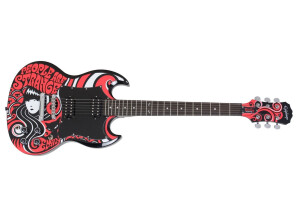
    Bought at Guitar Center in Hollywood for $300. The artwork was so distinctive that I couldn't resist, and I'd wanted a backup for my Gibson SG anyway. The graphics are very well applied, beautifully colour co-ordinated, with matching artwork on the headstock, customized control knobs, and a special 12th-fret inlay. The body is heavier than my Gibson SG Classic's and feels more like a "slab", but one surprising advantage to this is that this SG is less neck-heavy than most because the body counterweights the neck better. The feel is good, the neck is better than any Epiphone I've played so far: Better feel than my Dot archtop, and better than SGs I've tried in stores and my friend's Epiphone Les Paul Standard. Excellent tuning machines, too, extremely smooth and responsive. Like many of Epiphone's guitars, the pickups are a little bland. They sound good, but don't have much character. The pickup selector switch is a little stiff, though I'd rather it be that than floppy and loose as on my Epiphone Dot. The bolt-on neck joint seems a little rough and the classic SG body bevelling isn't as pronounced as it should be, but the great finish and design work deserve high marks -- the look of this guitar has a distinctively psychedelic feel, The fretwork is smooth and neat, and the hardware is solid (especially the tuning machines). To be honest, I'm probably pre-sold on the stylistic appeal of this guitar. But I can also fairly say that my hands feel good on this guitar, and I'm very picky in that field -- many guitars that I thought I would love (the Gibson ES-333, the Line 6 Variax, the Rickenbacker 360 12-string, the Epiphone version of the Firebird VII) have all been ruled out based on left-hand feel. This one I didn't have a problem with, and I'm very happy with it. And it's definitely a lovely art piece to look at. This review was originally published on http://www.musicgearreview.com