Log in
EN
FR

SeriesFender Jazz Bass

96 products found

Filter
Sort by
Evaluation
  • Reviewed or not
  • Editor’s award
  • Reviewed by Audiofanzine
Availability
  • Available or not
  • Sold new or used
  • Sold new
  • Sold used
Must-have products
  • All products
  • Flagship products
  • Best rated products
  • Hot products
  • Popular products
Price
  • Freeware
€
Clear
Sort by
  • Popularity
  • User ratings
  • Price - low to high
  • Price - high to low
  • Used price, increasing
  • Used price, decreasing
  • Name (from A to Z)
  • Name (from Z to A)
  • Added on
Sort results
  • Popularity
  • User ratings
  • Price - low to high
  • Price - high to low
  • Used price, increasing
  • Used price, decreasing
  • Name (from A to Z)
  • Name (from Z to A)
  • Added on
Filter results 96 results found
Evaluation
Availability
Must-have products
Price
  • Freeware
Show results

The best Fender Jazz Bass reviews

The reviews Audiofanzine members found the most helpful.
  • « Top of the line Fender »

    This is my main instrument, a 1996 '62 Jazz reissue, made in USA. I play it since 2004 and it is a monster. Wherever I plug in - in a studio or at a gig, soundmen get eargasms. I've bought this thing used from my friend, who bought it from some other guy in the early 00's. The condition of the instrument was nearly mint which was surprising - the bass was my friend's main instrument for a couple of years. The bass dates back to 1996 (serial number V077741), and there's a little golden "Fender 40 anniversary" sticker on the back of the neck. All the rest is usual '62 specifications: two-piece sunburst alder body, one-piece maple neck with a very thin yellow nitro finish, red tortoise shell 4-ply pickguard (black-white-black-red), two vintage single coils, two concentric knobs (volume and tone for each pickup), top loading bridge, reverse open Kluson tuners and so on - you can always find it at Fender site. The package also included tweed case, thumbrest and "ashtrays". Thumbrest was installed once, but the previous owner uninstalled it, and there were two holes in the pickguard. Ashtrays were not installed, and there were no holes in the body, only two small holes in the pickguard for the neck pickup's ashtray. There were also two small paper bags in the case intended to absorb moisture. Pretty nice! Previous owners were smart guys and did no modifications to the whole thing, keeping its' "vintage" value. So let's get straight to the details. Sound This is why you should buy this thing. It sounds pretty amazing for a passive bass. Far better than standard and deluxe Fenders. The sound is very full, rich and bright. It sounds more a modern instrument than a vintage bass - compared to real vintage Fenders I had a chance to play. Maybe someday it's sound will change to be "more vintage", but I like it the way it is now. It has a sort of "clicky" attack, followed by fat j-growl. The "click" is probably a string touching the last fret on the neck, just like with slap, but on this instrument it happens regardless of the technique - even with fingerstyle. To avoid it you must touch strings very gently and very close to the bridge - Jaco style - but, IMHO, this click is a very pleasing sound giving every note better definition. It also means fast runs sound better on this bass, and you have that "pick" sound even if you don't use a pick. Each string sustains very nice and the sound is more balanced and compressed than on many other jazz basses, which means you will have to use less compression in the chain. It's harder to play piano piano since the notes ring even when you touch strings very gently. You also get tons of highs with all controls wide opened, so it's good to roll off the tone controls for about 30%. By the way, the whole story with two tone control knobs - you really don't need two of them. It's okay to be true to the original specifications, but it's not useful and it takes more time to adjust the tone. I've heard that slap on early Fenders was not that good due to the small frets. I had no chance to play original '62, but this one slaps very nice. The frets are small, but not that small. The sound is not as bright as on ash-bodied '75, but it's very fat. I've played jazz bass with ash body before this jazz, and now I think I prefer the "alder sound". Overall, the sound has a sort of "heard it before" vibe, it cuts through the mix and it does not conflicts with other instruments. Construction: Construction of this bass is one big weak point. 1. Truss rod: The truss rod is hidden inside the neck and you can see its' tail at the point where the neck joins the body, but you can't access it - the neck pocket overlaps half of the hole. You have to remove the neck for that. You don't have to miss with the truss rod a lot, maybe once in a couple of years, so I guess that's not a big problem. 2. Two tone knobs - you don't need them. Volume pots are that shiny telecaster/precision style that I hate - you can't see in which position exactly the pots are. I think regular Jazz bass controls are much better. 3. Top - loading bridge: Usually Fenders feature string through body bridges, and this is a top loader. I don't have problem with that, but there are people who certainly dislike it. 4. Vintage-style pickups: Okay, I know, all Fenders singles hum, but since there's a Vintage Noiseless option, I'd go for it if I had a chance to order a custom-shop instrument. You do meet this annoying BZZZZZZZZZZZ problem at certain clubs with poor grounding or nasty stage lights. 5. Thumbrest: Nobody could explain me this thing. I mean, it's located on the treble side, not where your hand is. Probably, in the early days there was some sort of technique when this thing was useable, but now it's very painful when slapping. I guess it's good if you play the bass upside down. 6. There's a peg on the back of the neck - right under the tuners. There were times when bass players were using a long rope going from the end of the neck to the end of the body. Funny. 7. Ashtrays. They look so cool - I could not resist putting them on. I didn't want to drill the instrument so I used a double-sided scotch tape. It does make it look a killer bass. No question. The problem is - there are only two small areas left where you can touch strings with your right hand. You either pluck or slap strings near the neck (say, early Geezer Butler style) which is the most comfortable position, or you use the neck ashtray as a thumbrest and pick the strings between the pickups. This area is relatively small and you can even hurt your hand. You can not palm-mute strings near the bridge, you can not play that Jaco-style near the bridge, and playing with a pick is extremely difficult. Several times I found myself automatically trying to mute the ringing opened string near the bridge (to shorten the sustain) - and hitting my hand on this shiny thing. Enough! You can use the neck ashtray as a thumbrest, but the bridge cover is a real pain (that's what Marcus Miller did on his '75). 8. Finish: I feel comfortable with the glossy neck and body, and it still looks new with no cracks at all. 9. The tweed case: It's heavier than a regular black case, it's bigger and it can be damaged easily. The yellow tweed can get very dirty. There are no metal corners, and if you need a road case, don't use this one. Details: A man who assembled this bass was a rough and brutal person. Today even Squiers are cut out with CNC machinery, so they are clean and you don't find bugs and gaps. However, my bass was made by hand. There are countless flaws in the construction, which become noticeable after a close inspection. There is an ugly chunk of glue at the nut, frets do not look perfect, there are gaps between the tuners and the neck, and all the parts of the bass assembled in a manner which tells you it was very fast. The neckplate screwed in so violently that the finish cracked around it. All the screws holding a pickguard are seated under different angles. If I compare Fender's craftsmanship to Gibson's - there's a large gap. I've got a '99 Les Paul Special, which is really not the top-end model in the Gibson line, but it's very clean and tight - every single piece of hardware sits on its place without gaps, flaws or whatever. I can't say the same about Fender. Playability The neck on '62 Jazz is narrow and comfortable. Although you can't "fly" as on several "modern" instruments, such as Warwicks, ESP's and others, it's still very fast. The bass invites higher action, just like Precision. It's not that vintage when you start playing it, and that's a good point to my taste. Reliability No questions here: due to the simplicity of the construction, it's very sturdy. The finish wears out and it has dings all over, but that's how Fenders look. Pros and cons at '62 jazz bass +It sounds amazing. -It was probably assembled by some local drunk. +It looks a killer (just don't get too close). -the construction features many useless and stupid things. +It's a collectable item. -If you need just a good working instrument; you might be considering another model. As I figured out from the price list, vintage reissues are among the most expensive models - they cost more than standard and deluxe. Although there are very expensive FMT's, but they are hotrods, and here we're talking about plain jazz bass. So, regarding the value, this bass should cost about $1000 - considering the worst craftsmanship possible (street price is about $1300). But, since Leo Fender was a real genius, this simple instrument remains one of the best instruments ever designed - even all the low-tech detailing cannot kill the true spirit of this bass. It worth buying it if you find one for a reasonable price and you had a chance to try it. Don't even think about purchasing any of Fender products without trying it - they are very different. You can find two new bases from the same year and the same model, one with the neck curved like a bow and falling off, and another just perfect. And it's very sad that the instrument produced to celebrate the 40 anniversary of the company clearly shows the gap between the original '62 pre-CBS jazz bass and it's handicapped copy. It's a good bass, but I'm afraid it won't be as good in another 40 years as original '62 today. Now here's something you won't see on Fender website. I've got this bass strung with 40's and at some point I wanted to switch to 45's which I prefer. So I've got a nice set of Fender nickelplated 45's and put them on. I've made a couple of bridge adjustments and expected to adjust the neck as well. And yes, the neck started bending, bending, bending... whoa! I disassembled the bass and wanted to rotate the truss rod - the experienced guys told me to make about 1/2 turn a day. Surprise! The truss rod didn't want to rotate at all. I could unscrew it but the opposite direction was blocked. I think the previous owner screwed it completely. What to do? I've put the neck back, tuned the bass... the neck told me goodbye and took a shape of a nice arc. The end of the story: I had to repair the neck. The repairsman told me this is the most common bug with old Fenders. The truss rod ends with a nut which must be fixed inside the neck. My bass had a not-that-hard maple neck and the nut was simply rotating inside, destroying the neck. Gibsons, for example have a BIG nut on the truss rod's end and it never does such things. He installed a new (not fender'ish) trussrod, made a new fingerboard, frets and binding. That was one piece of work and I've paid about $280 for the repair. Now my Fender is not stock but the neck is stable, I can adjust it without disassembling the instrument (he made me a small cavity in the pickguard to access it) and he even kept the logo - although the neck was refinished and completely re-worked. The moral of the story: While guitars might survive with old-fashion neck construction, basses put a lot of tension on the neck and many old Fenders suffer from this disease. It's probably a big secret of Fender corporation, but I've already heard a couple of similar stories. There's no cure from this, and if you have vintage or vintage reissue Fender - keep in mind that one day it might surprise you. If you want to hear how it sounds - check out the last release from my band, SHOOM. I played my '62 on all the songs, with Genz Benz Shuttle 600 head and it was recorded line out from the amplifier's preamp (no microphone). www.shoom.band

  • moosers's review

    Fender's Mexican JazzBass (Standard Series) is an electric bass guitar that I've got experience using in the recording studio and for practicing. The bass player that I'm currently playing with has one of these, so I play it a lot and have recorded it a number of times. Don't let the Mexican implications fool you, as this is a great instrument. The bass has two single coil, bi-pole pick ups, with standard tone and volume knobs. I don't know what kinds of materials this bass is made out of... UTILIZATION Playing the Fender Mexican Jazz Bass is really easy, as it's got a really slim neck. It feels good on the fingers pretty consistently, and I've always found getting a good sound to be fairly simple as well. Even so, there are a good amount of differing tones you can get even just between the two pick ups. The bass is about average in terms of weight and size. SOUNDS The sound of the Fender Mexican Jazz Bass is round and full and is pretty much the ideal tone for a bass guitar, only being surpassed by a better built American Jazz Bass. For recording I'll usually take a direct signal as well as an amp'd sound, but it all starts with the bass. The last record that I did with the Fender Mexican Jazz Bass, I also used an American P Bass for some songs, and ended up like the Mexican Jazz Bass more. This could just be a preference thing between Jazz and P Basses, but it's still worth noting. I believe that Jazz Basses in general are the best available basses. OVERALL OPINION If you're a bass player on any level except for maybe a high end professional, the Fender Mexican Jazz Bass is a great bass to have. It's got a superb sound and excellent feel, and since it was made in Mexico, it has a really small price tag. Don't get me wrong, if you can afford an American Jazz Bass, you should absolutely spend the extra money as they are better basses, but if you can't afford one, the Mexican Jazz Bass is a very fine substitute. Coming from the masters in guitars in Fender, the Mexican Jazz Bass is probably the best bang for your buck that you'll find in a bass guitar....

  • « A disappointment »

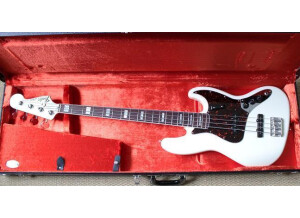
    A friend of mine bought it for his home studio, he wanted a basse that would be easy to play so as to play it himself on demos when producing other artists. Considering the Jazz Bass as THE reference for that purpose, he jumped on this model which was available at the nearby shop. He bought it new for slightly under the 1000€ mark. The model in question is white with a black pickguard and rosewood fingerboard. Rather on the lightweight side, this bass is well balanced and the neck is pleasant and comfortable to play. However, when you play in unplugged you notice a lack in volume and a rather unpleasant, twangy sound. OK, it’s not plugged in yet, but you’d expect a certain “bare” sound quality from a passive bass at that price. Well, that’s not the case so you’ll have to depend on the pickups, which do manage to compensate a bit yet can’t do miracles. Technically, I must admit this US Fender doesn’t give me the same feelings that other instruments from the same range that I’ve tried did. I even find it less charm than a Mexican model and a less convincing look compared to a made-in-Asia “Classic Vibe” one (which is way less expensive)! I won’t even bother comparing it to my ’71 Jazz Bass, and I tell myself that for the same price you’d get a much better instrument from other brands. I’d already been disappointed with recent Fender instruments, and i feel that the brand has its customers play lottery for getting a great instrument from them, and that’s a real pity. I’m sure you can find American Special instruments that sound amazing, but that’s not the case of this one, which is a little so-so considering the price.

  • moosers's review

    The Fender American Series Jazz Bass is a classic bass guitar that is one of the most used basses worldwide. It has two single coil pick ups that have tone and volume controls to set your own unique tone. UTILIZATION While I don't know what type of wood the neck of the Jazz Bass is made out of, it has an awesome feel to it that makes it extremely easy to play all around the neck. It has a classic look and shape to it that has become known by all bass players and musicians alike. The weight of the guitar is about average and isn't too heavy at all. The inherent sound is unique to the Jazz Bass series and is both full and rich in tone. Getting a good sound is quick and easy, as the Jazz Bass has a truly great tone to it. SOUNDS The Fender American Series Jazz Bass is great for all types of music, and is definitely not just limited to jazz as the name might suggest. While it is suitable for all types of music, I use it mostly in country, folk, pop, and rock. I use this bass guitar both for recording and for live use, but the majority of time I use it for recording. For recording I usually record the signal direct with a Countryman DI box, but for live I like to use it with a Fender Bassman amp. Overall, it doesn't get too much better than the inherent sound from the Jazz Bass. OVERALL OPINION I've been using the Fender American Series Jazz Bass for about five years and it is definitely one of the better bass guitars that I have played and recorded with. It is aimed at the professional bass guitar player and has a price that is right considering you are getting a truly great instrument. If you are a bass player, you probably already know what this can do, but if you don't it is absolutely worth looking it.

  • Audiofanzine FR's review

    (Originally written by cykklop/translated from Audiofanzine FR) - Where was it made? (USA, Japan, Mexico, France...) Entirely made in the USA. - How many frets, what kind of pickups and what is the pickup configuration? 22 frets. The guitar was made in 1989 and 22-fret necks were trendy. Like most Jazz Bass models it has two passive single-coil pickups. - What about controls (volume, tone, pickup selector...)? Two volume and one tone control - What kind of neck? C profile neck with rosewood fingerboard. UTILIZATION - Is the neck comfortable? Wow! It's the third bass I own and I had never heard such a sound. I previously owned a Fender Precision (it was my first love... different!) and an Ibanez SR series (awful... I don't like active instruments!). This bass guitar is in a whole new level! This neck is a incredibly fast! You feel immediately comfortable with it, your hand slips smoothly allowing you to play accurately. The neck is very narrow at the nut... Perhaps it's somewhat bothersome for some people but it was one of the reasons I fell in love with this instrument... It's all a matter of taste! - Is the access to the upper frets easy? No problems to get to the upper frets. It's just PERFECT. Since the neck has two more frets than a standard Jazz bass, access to the upper frets is even easier and it opens new musical horizons... - Is the instrument ergonomic (body shape, weight...)? I think there are many reasons why this old bass is still a standard. The weight is also perfect, neither too heavy nor too light! The balance is perfect both sitting and standing. - Is it easy to get the right sound? It couldn't be easier... and what a sound!!! Great! You can play everything from jazz to rock, punk and funk... Everything is possible and the sound is always very good!!! I don't think it's a coincidence that it's the favorite bass of musicians like Matt Freeman (Rancid), John Paul Jones (Led Zeppelin), Tim Commerford (Rage Against the Machine), Flea (Red Hot Chili Peppers) and many others. SOUNDS There's nothing left to say about this instrument. OVERALL OPINION - How long have you been using it? I played this bass one and a half years. I just sold it for a P Bass which matches my style better. - Which feature do you like the most / the least? I like almost everything about this Jazz Bass: first of all the sound, the neck, the playability, the looks, etc. However I find it has a disadvantage: the pickguard is not a standard pickguard. The number of holes is not standard and it's too wide in the neck area. It's not a problem regarding playability and sound but there's no way to change it unless you pay for an expensive custom-made pickguard. - How would you rate its value for money? I bought it on ebay (the Fender case was included). It was in perfect condition and I couldn't find a better deal... it's nearly 20 years old and it's better than most modern Jazz Bass models I tried. I wouldn't buy it again only because the (very good) sound doesn't match my taste. I prefer a MusicMan, Precision or Rickenbacker sound. Then again it's only a matter of taste. PS: I give it a 7 because 9 would be the mark for a Precision Bass with a Jazz maple neck, Gibson-type inlays and MusicMan pickup ... and 10 would be the mark of the Rickenbacker 4003!!!

  • « Fantastic vintage tone, great look and feel. »

    The first time I saw this bass was many years ago, when watching a Led Zeppelin video. I fell in love instantly. The color, the sunburst tone and punch of this Jazz bass captivated me. As any bass player would, I listened carefully to John Paul Jones' basslines and wondered how many different basses he had recorded with (in early Led Zep recordings), cause the sound was so different every song, sometimes deep and expressive and then aggressive and harsh. Then I read that he used the same Jazz bass for all those songs! I was determined to get this bass, and when I finally did, I was delighted with its versatility, punch and feel. My bass is made in Mexico, but it sounds perfect and overall quality is excellent. The electronics are great and the tone controls give you a lot of sound-shaping options. It has an alder body, (so it's fairly heavy) a 'C' shaped maple neck and rosewood fingerboard. Like the original 60's bass, it has 20 frets and vintage-style reverse tuning machines, which you have to get used to tune the other way, but this is obviously not an issue. It also features 2 Jazz bass single-coil pickups and purple shell pick-guard. UTILIZATION This bass has a very nice feel; the neck is very slim and this makes it very easy to reach all the notes in the fretboard easily. However mine has a fret buzz in the F# note of the second string, even if the bass has been recently adjusted. I don't know if this is production related or the previous owner had something to do with it. The most important flaw my bass has is that the neck has to be readjusted somewhat often, otherwise the strings feel too high and playing gets a little uncomfortable. I will have to change the truss rod soon, the luthier that recently fixed the bass said it had had a bad time with humidity, so maybe this flaw is the not the factory's fault but the previous owner's. However I have heard some other owners of this specific model also complaining about this issue. Anyway, I hope that after the truss rod change the neck will remain straight longer. The tone controls are: Volume 1. (Middle Pickup), Volume 2. (Bridge Pickup), Master Tone. I usually set the tone I specifically want for a determined situation by balancing between the 3 controls and the amp's EQ and bass and treble controls. I love the design of this bass. As a 60's and 70's music fan, I love the vintage look, slim body and the sunburst color. It's a little heavy but not too much. SOUNDS I play this bass through a Hartke HiDrive 112C and the sound is wonderful. But I feel it sounds slightly better through a BA 112 Ampeg ,because this amp has middle and high frequency controls that make the bridge pickup really shine . Anyway, it sounds excellent through both amps and it's incredibly versatile. One issue when playing with a lot of treble is that you get some hum, but if you balance it well with the tone controls and the amp this won't be an issue. I think it's also a part of the 60's sound. The growl of this bass is true vintage and when played with a pick it will sound harsh and percussive but also warm and full. I usually don't play with effects, apart from the built in EQ and compressor my Hartke has. I play indie rock but with a 70's style too, and this is exactly the sound I want. OVERALL OPINION My first bass was a P-Bass, and while I really liked the sound, I needed something with more mid and high end, and as I said before, this Jazz bass was just what I was looking for. Regarding sound quality and precision I could not be happier. Perhaps the only issue I have had with this bass is the truss rod thing. Apart from that everything is superb, I bought it used for $600 and it was some of the best investments I have made. However if you want to buy it new it's also not too expensive and you get a much better sound that most basses at that price range. If what you want is a true vintage 60's growl and warmth, you shouldn't be looking for another bass. Definitely would buy again. In conclusion: Pros -Good tone -Good feel -Vintage Sound -Versatility -Great pickups Cons -Truss rod needs to be adjusted often.

  • « Fender Deluxe Active Jazz »

    I play everything, bass, guitar, drums, keys, vocals... mainly bass though! I've been playing nearly 4 years, and in true bedroom-artist style I have practically stayed in and learnt music for pretty much most of those 4 years... I bought it online from Soundslive.co.uk for about £475. It arrived but with a horrific dent in it that had taken the lacquer clean off! Quickly sent it back and got one straight from the Fender shop. There is a certain good feeling about playing a Fender, its a brand you can trust, its a brand that has those around you (of my age anyway) going "ooooh" and wanting to stroke it in various ways, some a bit more worrying than others. But anyway, it gets a brilliant range of warm tones, from bassy to treble, and with a good mid. The pickups are beautifully noiseless and with no hum, the action is comfortable (however I had to tweak it a lot, as it was all over the place when I got it!) and the neck is smooth and great to play. The active pickups with the 3 band EQ are great for on-the-fly tone adjustments. The tone pots are in easily accessible positions so you can just modify your tone on the spot and keep playing. For the money I paid, I expected something great. Its a Fender. Its a Deluxe series. Its a Jazz bass. But, whilst it suits many styles of music, I find myself constantly going back to my beaten up... I mean "well loved" Yamaha RBX 774. The Jazz simply does not beat it. It's a case of value for money really, the Yamaha (£375) offers AMAZING tone etc, but that's not part of this review, whereas with the Jazz, I find myself a bit... lost. I feel like its built for the bassist who wants to disappear. The tone is either bassy or treble. Whilst you can get a great range of tones, you can't get that certain treble growl atop a bass sound. Almost perfect! Its INCREDIBLY heavy though, another reason why I go back to my Yamaha for the sheer lightness. But other than that, the construction is great, except the volume pot seems to "scratch" on the scratchplate as I turn it, which doesn't scream Fender quality to me... A great bass. A great to play, great to listen to. But its not really for the bassist that wants to stand out and be original, its for those content with standing at the back letting the guitarists do the work (and we all know that's not how it's supposed to be!) This review was originally published on http://www.musicgearreview.com

  • « Fender Standard Jazz Bass »

    I went in to one of the good guitar shops around and saw the bass and it was wanting to be played! I tried it and a couple of others but really it was the one for me. I paid 400 pounds for it. I love the tone that you get from it, I haven't been playing for years so it was a big step up from my yamaha rbx170. It's also really easy to play with. It looks great too, mine is black.. beautiful. It's quite heavy which some people don't like. Generally the construction is good but I and a friend of mine who has a standard p bass found that the bridge was dodgy. Apart from that it's excellent construction quality! Excellent bass for anyone, good intermediate-advanced bass. This review was originally published on http://www.musicgearreview.com

  • « Fender Highway 1 Jazz Bass »

    Online auction - 450 bucks Nice satin sunburst finish, great neck and thick old school sound from the noiseless pickups. Sold a MIM jazz to get this and there is definitely a big difference in quality. So far I like everything...well almost everything. The fretboard is kind of a light brown color which doesn't really do anything for me ( or the bass). Nice and lightweight. Very solid neck/body fit. Superb sustain. Finish is satin....no gloss. I prefer this finish but if you like gloss then this bass is not for you. In my opinion a good compromise between the Mexican Fenders and more expensive made in USA models. Great looks (satin finish), lighter weight than the MIM and noiseless pickups make this the ideal bass for me. Definitely worth every penny and a bass you just might fall in love with. This review was originally published on http://www.musicgearreview.com

  • « Fender Aerodyne Bass »

    I paid $630 for this bass and bought it online. I have been playing bass for about 1 year and only seriously started practing the last 6 months since I joined a band. I had a ESP bass and I liked alot but the wireing somehow went bad. A friend fixed it for me but after a couple of weeks I had the same problem (a strange rattle for a while and then it would stop making a sound at all). I had bought my neice a fender squire bass along time ago and she never used it. so I borrowed that and the guys in my bad said the squire bass sounded great. I missed the feel of my ESP bass but the sound was good on the squire. So I decided to upgrade to better Fender bass. I chose the Fender Aerodyne bass because it seemed to have the smallest neck radius and it was light weight. I thought that this would help me with my left hand. During fast parts of songs like Tom Sawyer by Rush my left hand/arm was reaching the failure point and I couldn't play until the song went back to a less intense part. I know that more practice is the best cure for this but I thought since I am buying a new bass anyways I might see if a smaller neck raidus helps. Also, the light weightness of the bass would prevent my neck and back from getting a little sore the next day after practice. The weight of the bass is light and I can play all night without getting a sore neck or back. I like the placement of the input jack on the body of the bass. With my old ESP bass the guitar cable would always hit the floor and bend at the head of the cable when sitting in a stand. This doesn't happen when the input is on the body under the volume and tone controls. Also, I like the placement of the tuning machines. I just like having them on one side of the neck instead of having some one side and the rest on the other. I guess the most important thing is the sound. So far I like the sound I am getting out of this bass. When my band recorded some of our stuff during practice I was very happy with the sound of the bass on the recording. It sounded very good. When I first got the bass in the mail I was a little suprised by the look compared to what I had seen on the web. I thought it was solid black but around the edge of the body there is a very thick and noticable wood/white color strip. It changes the look alot in my opinion. It looks kind of like white wall tires. At first I was unhappy and when I called Fender they said it should be solid black. But the person I talked to on the phone didn't know what they were talking about. I mailed their customer service department and some guy from Fender called me and told me that the wite stripe is supposed to be there and that you can't see it in the pictures on the web since they were taken using a white background. The fender guy said they were not going to get new photos for their web site. I had a few other questions/complaints but the Fender guy seemed pretty hostile and I was busy at work so I tried to get off the phone with him as soon as possible. Anyways, the guys in my band like the look of the bass and I am starting to come around. I guess the strip gives it a sort of classy look and it would fit in being played in jazz band as well as a rock band. My ESP bass was solid black and I loved the way it looked. But when I am playing all I really care about is a great sound. I am still playing around with the volume controls on the Aeroydyne. Right now I am turning the middle volume control all the way up (I think this gives the bottom jazz pickup the most control/volume). I am turning the top volume control all the way down. I seem to get alot of fret rattle and harmonics when I turn this control up. I think this control affects the percision pickups but even when I have it down to zero I think the percision pickups are still contributing to the sound. So its kind of confusing. Since there is not a manual for this bass I can't read about exactly how the volume controls are supposed to affect the sound of the different pickups. It almost seems like each volume control affects both pickups. Note, I can probably fix the fret rattle by adjusting the action but but for now I like the feel of the strings and I don't want to change anything. On the back of the bass there is a small cover that you can unscrew to get access to the wiring of the controls. When I got the bass the cover looked like a piece of cardboard. It stuck out like a sore thumb compared to the high gloss black color of the body. Later when I took off this cover to see what was inside I found that the other side of the cover was plastic and had the high gloss black color. So the cover had been screwed on backwards. The Fender Customer rep seemed angry when I mentioned this to him and he stated that they do not come out of the factory like that. He said my bass must have been used and someone else screwed the cover on backwards. It wasn't a big deal to me since I could just screw it back on the correct way. But when you spend alot of money on something you want the little things/details to impress you. You don't want to find minor flaws like this. Which brings me to the pickups. One of the pickups was tightened down alot on one side and barley screwed in at all on the other. One of the swrews looked in danger of falling off. All the pickups seemed to be very loose. The guy from Fender said it was supposed to be like that and that it made the pickups fit the contour of the bass. I had no idea what he was talking about. I have read about how the hight of the pickup can affect the sound of the bass but I haven't heard that you would want to have one edge of the pickup very high and close to the strings while the other edge is screwed down tightly. I may be wrong since I am not an expert. But I went ahead and tightened the screws a little and tried to adjust the pickups to be alittle bit more even. I am getting a good sound out of this bass and I like the fact that it is so light weight. Because of this I am keeping the bass and am happy with it over all. My experience dealing with Fender customer support was not good. But when I am jamming with my band I am not thinking about that. I thought my old esp bass looked better but stoped working and my new Aerodyne bass is serving me well. This review was originally published on http://www.musicgearreview.com

  • « Fender Jazz Bass Fretless »

    I bought this MIM bass used but in like new condition at auction on Ebay for $240. I wanted a fretless with a thin neck and this fit the bill nicely. The neck is thin and fast and the fretlines and side markers make it easy to find your place on the neck. The classic J-Bass body is well balanced and still looks as cool as ever. The tone with flatwounds is pure warmth. This lends it perfectly to old rock and jazz and, being old, well, that's what I play. The tuners seem to be too easy to knock out of tune with their big, clunky keys. The pick-ups are weak and produce a prodigious hum if you crank the volume too high near the amp or a computer, or a flourescent fixture, or...for instance. This thing would make an excellent weapon for hand-to-hand combat. It's built like a fortress and could easily kill a man. The neck joint looks like it could have a little gap in it, but it's tight and stable. The finish is smooth an glossy and shines up nice. The bridge is standard Fender (read: cheesy) but works to get the job done. Good sustain and tone and an overall solid feel make this bass a classic for a reason. Here's the skinny: If you want a fretless that sounds good, looks good, is reasonably priced and plays like butter, look no further. Be ready with a good amp, since the pickups need help, but other than that, it's definately a keeper. This review was originally published on http://www.musicgearreview.com

  • « Fender Active Jazz Bass Deluxe »

    I got the bass through musicians friend as my second bass. For about 550 dollars. It sounds great, it feels tight and precise. Makes for very easy slapping but doubles for nice deep tones. I really enjoy it. Its awfully heavy but thats not too big of a deal. It also had a few problems with the screws. I had to make some modifications in my shop but its great now. Like i said it had some problems with the screws and the bridge but easily fixable. And that is just the one i got i'm sure it varies from bass to bass. The neck feels great and the playing part of the bass is excellent. The bass is awesome besides the bridge and screws. No doubt it was a good buy and i would buy it again. Its great bass that i will always use. This review was originally published on http://www.musicgearreview.com