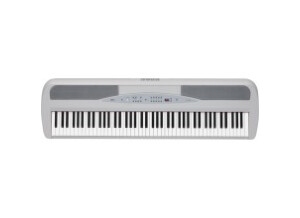
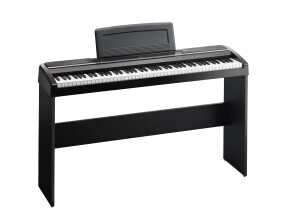
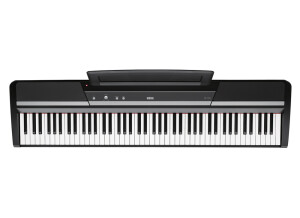
The SP-250 is an 88 note, weighted key digital piano with its own built in speakers and plastic music stand attachment. The keyboard is of plastic construction, with rubber buttons and a metal stand to hold it up. The keybed itself is Korg's "RH3" which has been used on many of their instruments, including the M3 and Kronos if I am not mistaken. On the front there are 2 1/4 inch jacks for headphone output, a power button, plastic faders for Master Volume and Metronome Tempo, and 17 rubber buttons for changing the sounds. There are 3 effects- Reverb, Chorus, and Touch (sensitivity). The keyboard can be transposed up or down with the Transposition button. There is a Demo mode that can be activated by another button which plays example music on the keyboard to show you the sound potential, and there is a button for turning the metronome on and off. The sound banks, which can be triggered by their buttons, are as follows: Piano 1 and 2, E Piano 1 and 2, Harpsichord, Clav, Guitar, Vibes, Organ 1 and 2, Strings, Pad, and Choir. Each bank has 3 alternative modes, which can be activated by pressing the "Bank" button. The back panel has 5-pin Midi In and Out ports, 1/4 inch Left and Right audio output, and a Sustain Pedal input. UTILIZATION Using the keyboard is as simple as can be. You turn the power on and begin playing piano. The manual is easy to understand, and I highly recommend reading through it to get an idea of the extra features hidden under the hood. There is an impressive amount of options considering that this keyboard is intended to be a basic practice instrument. I have never used the SP-250 as a midi controller though it does have the proper midi-jacks. As a controller it would be very limiting- you would be able to plug it in and play the keys to trigger more sounds. Patch selection is as easy as pressing the button for the instrument bank you want. One feature I really enjoy is that you can layer 2 sounds by pressing 2 buttons at the same time. This makes for some fun practice if you want a little more going on in the background of your piano playing by adding strings to the piece. There is no "split" function though so you are stuck with the notes playing together every time. The volume and tempo knobs are a bit weak feeling. Maybe I am just rough with my equipment but I can see myself breaking those if I ever slipped on them the wrong way. The tempo knob only lets you select the tempo by sliding from left to right. I find this a little annoying if I want an exact tempo when I'm practicing and wish there was a way to be more precise. Especially considering that this is a practice keyboard, I would think they would have included a more detailed metronome. Everything works as intended and shouldn't cause any confusion if you are familiar with the terms such as "reverb" and "tempo." SOUNDS The sounds are very nice. The pianos could be used in a mix comfortably, though I would not rely on their sound for a solo act. That is how I feel about all of the sounds actually, they are fun and get the job done, and really are great sounds, but the keyboard is a little dated now and you wouldn't want to perform a professional job using these sounds alone. The touch sensitivity is decent. I don't notice that I am using a digital keybed very often. That is to say that nothing sticks out to set it aside from a real piano as far as play-ability goes. I personally feel that the dynamic range on this keyboard isn't as wide as it could be. You can certainly play soft, medium, and loud, and everything in between those, but I have actually had moments where I use the master volume to get softer and louder within a piece. The touch sensitivity remedies this to an extent, but compared to something like the Roland FP series I find it lacking in dynamic freedom. The effects, much like the sounds, are very good and get the job done. They are nothing too special and have little room for change, but they work and you can hear them. I don't like that Reverb is on as a default. I think they did this to make it sound more realistic, but sometimes I like to keep it off and just use the natural reverb of my practice room. I don't use external speakers with this and never have so I can't comment on the converters. My brother has an SP-250 as well, and I can say that when he records it from the Stereo Outs and sends me the WAV file the piano doesn't sound very good. This could be his fault in some step of the recording process, so don't assume it is the converter's fault. If anything I would recommend that you find an SP-250 you can use and hook it up to speakers if you think you would use external systems often. OVERALL OPINION I love the ease of access. There are no loading times to use any feature. You turn it on and are ready to make music. The keybed itself is very nice and everything works as advertised. I don't like the plastic construction too much, and I'm not particularly in love with the metronome, but other than that and the little complaints I mentioned above it is a great keyboard for practice at home. The SP-250 is quick and reliable. If you are a student who needs something that you can plug headphones into and practice late into the night this is a good choice. Likewise if you are a professional who just wants a decent keyboard in another room of your home in case inspiration hits you, this would not be a bad option. I have played more digital pianos in my life than I can remember. I like Roland's FP series much better, particularly the FP 4 if you can find one. The FP series has more and better sounds, better construction, better metronome, and a better keybed. The only reason I have a Korg SP 250 as well is because I got a great deal on one and needed a cheap second keyboard for my studio to teach children's lessons on. I had previously had access to 2 of these at my parent's home and knew it would be reliable. Additionally, if you are in the market for one of these and have extra money to spend, check out the newer Korg SP-280, which offers updated, yet similar features.
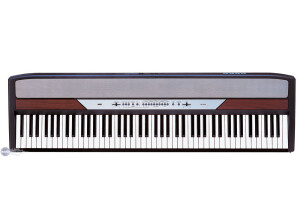
The Korg SP 170 is a rather striking entry level digital piano, in that it has no buttons on it! It looks like an instrument instead of a machine. Visually, the SP 170 is a thing to behold, and the way the chassis itself feels screams quality when compared to its competition in the Yamaha P95 and Casio Privia PX-130. Thankfully, the SP 170 doesn't share the polyphonic plight of the Yamaha P95. I has enough to get by, a strange 120 note polyphony, just under the generally used 128 note polyphony but just as acceptable. Especially since you can't layer voices with this piano. Yup. That's something that this piano doesn't do, unlike its competition. This piano also has the weird lack of 1/4" outs. Like its friends, it can be fixed with adapters, and considering the market, it's acceptable, but it's still quite annoying to have to deal with. Thank goodness again, for the MIDI. UTILIZATION Everything that needs to be a button is painstakingly tucked away where no one can see. Even the volume is out of the way; this gives the SP 170 a very clean look. It is quite deceptively full of features though. Hold down the top three keys and depress another key to change the sounds, and to adjust reverb, chorus, etc. It is a bit clunky at first, but it's endearing once you get used to it. It also discourages drunk groupies from pushing a lot of buttons on your piano (speaking from personal experience with the Casio Privia PX-330 I personally own here). SOUNDS Once again, I urge you to listen to samples and if possible, try the feel of the piano itself; this area is entirely subjective. In my opinion, however, this is where the SP 170 gets a little erratic. I'm NOT a fan of the samples at all. The only samples I really like are the Rhodes and the FM piano, the grand piano doesn't do it for me; the decay of the notes is very bizarre. The feel of the piano is also strange. While it's obvious that these pianos are all artificially weighted, this makes it the most obvious. It's heavier and spongier than its competition, but it doesn't seem to be because of hammers. However, the speakers of the SP 170 are godly compared to its peers. While the Casio's speakers are acceptable and the Yamaha's speakers are awful, the Korg SP 170 speakers are incredibly usable. OVERALL OPINION If you're stuck in this class of digital piano, go for the PX-130. It's the most comprehensive and easy to use. Once again, you should try them out to see what works for you. They are all roughly the same, except the Korg and Yamaha have a strange set of limitations that the PX-130 seems to transcend. Again, see for yourself. The Korg SP-170 is still a perfectly great piano if it's going to sit in a living room!