Log in
EN
FR

Live Sound Packages

80 products found

Filter
Sort by
Evaluation
  • Reviewed or not
  • Editor’s award
  • Reviewed by Audiofanzine
Availability
  • Available or not
  • Sold new or used
  • Sold new
  • Sold used
Must-have products
  • All products
  • Flagship products
  • Best rated products
  • Hot products
  • Popular products
Price
  • Freeware
€
Clear
Sort by
  • Popularity
  • User ratings
  • Price - low to high
  • Price - high to low
  • Used price, increasing
  • Used price, decreasing
  • Name (from A to Z)
  • Name (from Z to A)
  • Added on
Sort results
  • Popularity
  • User ratings
  • Price - low to high
  • Price - high to low
  • Used price, increasing
  • Used price, decreasing
  • Name (from A to Z)
  • Name (from Z to A)
  • Added on
Filter results 80 results found
Evaluation
Availability
Must-have products
Price
  • Freeware
Show results

The best Live Sound Packages reviews

The reviews Audiofanzine members found the most helpful.
  • « 400 watts on paper »

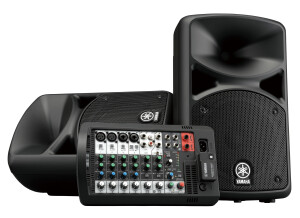
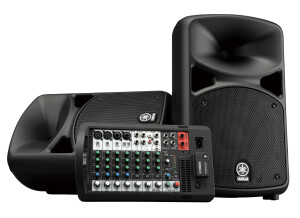
    On paper, 400 watts into 4 ohms! It's obviously "dynamic." An exotic output power. In fact, it's rated at 125 watts before clipping (with 1% THD, 1khz @ 1W) per channel into the same impedance (percentage of the 3rd harmonic with respect to the root note). Nominal, it's no more than 37 watts! The power divided by 5, two times 40 watts RMS!!! In practice, you will never have more than 50 watts per channel. Enough for a musician to do a small hall, especially if you connect all your instruments to the small mixer. The mic inputs are very faithful for vocals, especially with dynamic mics. As a PA system with around 100 people in the audience (applying a 1 watt/1meter per person rule), it's a reasonable choice that won't hurt your budget. The Stagepass 400I is rated at 125 db SPL, but in the manual there's not a single word about the speakers, which is 8" big and seems quite stiff, so you will need to break it in to get the best of it. The Bass Reflex speakers almost don't vibrate at all and have a good diffraction. The StagePas 400I is IPOD and IPhone compatible, according to the manual. But not only. First generation IPADs are also welcome. And even more so the later versions. The Stagepass 400I plays the audio and recharges the iPAD! MP3s obviously. A good EQ is needed for pre-mixing. A limiter and an EQ per band will do the job. To get better results you can use an external CD player. You should preferably listen to the mix using the monitor's mono output to avoid phase shifts. A drawback is that it has no stereo headphone connector for the controls. The simple addition of a powered sub of at least 120 watts RMS will give this system the power it lacks in the bottom end. In conclusion, the Yamaha StagePas 400I is not exceptional on paper, in terms of power characteristics, for a low-end PA system. On the other hand, its overall quality is all right. And its durability is a bonus.

  • « As Basic A PA As You Can GET! »

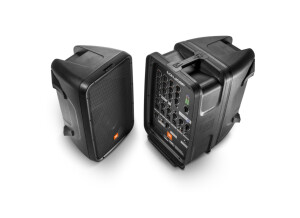
    We have used several Kuston KPA-100's for rock n roll summer camp rental. They are almost perfectly suited for this. Unfortunately, the price went up over $100 in the last year. Should not have happened, and it moved the PA from a great value to only okay. This little PA sounds quite good for what it is. Use this for vocals, only- you won't get chest-thumping bass from 10" PA speakers, but in a rehearsal, the bass should not be going through the PA, anyway, and use a keyboard amp for the keys. 4 input channels are usually more than enough for most bands. You could even use it for the PA for a house party, but don't bring it to a mall, club or outside performance- it just does not have the power to be heard there. Eventually, this or any other entry-level PA will let you down- either because it does not have the power you need for larger spaces, or because it breaks down. If it breaks down, toss the mixer/amp unit, get a bigger PA, and hack off the back edge of the speakers, making them into floor wedge monitors!

  • « Good dependable Portable PA »

    Best uses: solo performers, small ensembles. I use this for both. I have used it at block parties, open mics, and even on parade floats. It is a very dependable unit which produces a large amount of sound for such a small size. I have used other portable PAs as well as some larger systems--but this is my go-to for small ensembles and solo performances. PROS: (1) Small size. Speakers and mixer weigh less than 30 pounds and is about the size of a medium sized suitcase. (2) Powerful for its size. This thing cranks out 200 Class D watts . The first PA I ever owned only cranked out about 60 watts, weighed 3 times as much and took up four times the space. Although it is lower powered than many other portable units from other manufacturers, it also costs less totally and in terms of cost per watt/volume units. It is also lighter--a significant factor when a performer has to be his/her own roadie. (3) Because of the small size of the speaker cabs, one can use mic stands as speaker stands. (4) Mixer control layout. This has faders instead of knobs for controlling the levels. My 45 years of experience in sound engineering makes me consider this a better means for fine control than tiny little knobs. (5) Three-band EQ on each channel. Most competitors only offer two-band or a single "Tone Control" knob. (6) Seven-band EQ in the master section with proprietary FBQ function CONS (1) The included speaker cables are only 12-foot each and are not well constructed. This is a minor consideration since Hosa makes some quality cables which are not very expensive. (2) Only two mic input channels. While this is good for solo performers, if one uses this for small ensembles, an external submixer is a necessity. (3) No pan/balance controls on the channels. Considering this has stereo amplification , this really sucks. However, using a small external mixer , and running the external mixer's outputs through the stereo channels in the Europort's powered mixer channels 4/5 yields not only more mic channels, but true stereo output.