Log in
EN
FR

Loudspeaker Management Processors

385 products found

Sort results
  • Popularity
  • User ratings
  • Price - low to high
  • Price - high to low
  • Used price, increasing
  • Used price, decreasing
  • Name (from A to Z)
  • Name (from Z to A)
  • Added on

The best Loudspeaker Management Processors reviews

The reviews Audiofanzine members found the most helpful.
  • « Great analog gear »

    The Klark Teknik DN800 is an analog active filter conceived for sound reinforcement, recording studios and fixed installations. It may be configured as a four-input, two-way systems or as a two-input, three or four-way system. Klark-Tekink includes interchangeable cards to adjust the frequencies and slope to the speakers. If Klark-Tekink doesn't have the card corresponding to your speakers, a technician can install the adequate capacitors and resistors for the filters recommended by the speaker manufacturer. The manual of the DN800 lists the capacitors and resistors per frequencies. It has no buttons to choose the frequencies nor slopes, on the other hand, it's extremely precise, it doesn't move and it's as silent as a tomb. The input and output levels, as well as the mutes, are accessible on the front panel. The phases and limiters are on the rear. It's not as versatile and comprehensive as the DN8000, but it's 10 times cheaper (secondhand, because it's not manufactured anymore). Four-channel, Two-way LEDs Indicate: 2 WAY Input 1 : Output 1 Low / Output 2 High. Input 2 : Output 3 Low / Output 4 High Input 3 : Output 5 Low / Output 6 High. Input 4 : Output 7 Low / Output 8 High. Two-channel, Three-way LEDs Indicate: 3 WAY Input 1 : Output 1 Low / Output 2 Mid / Output 3 High / Output 4 Direct Input 2 : Output 5 Low / Output 6 Mid /Output 7 High / Output 8 Direct Two-channel, Four-way LEDs Indicate: 4 WAY Input 1 : Output 1 Low / Output 2 Low Mid / Output 3 High Mid / Output 4 High. Input 2 : Output 5 Low / Output 6 Low Mid / Output 6 High Mid / Output 8 High

  • « The EQ is perfect »

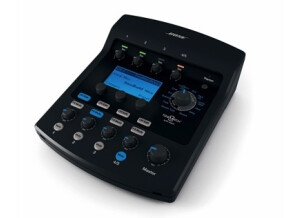
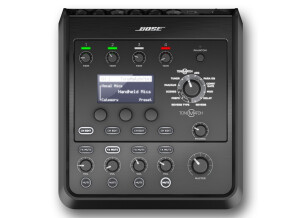
    The Bose T1 ToneMatch is a 4 channel mixer with 3 microphone inputs, 1 stereo channel and over 100 presets built into it. After about a weeks worth of learning the unit in full, I started to mess with some of the effects and man there are some good ones on here. This unit is very easy to use and understanding it will not take long at all. It only took me a while just because I didn’t have time to sit down all at once and learn everything about it. It does come with the manual, but it is not that big of a book and you really don’t need it. This is the type of mixer that you just need to dive in head first and start messing with it if you want to learn how it works. UTILIZATION I love the design of it; it is something different from Bose. They have really tried to switch things up with this T1 unit. The EQ system on the T1 is where I think I really got my money out of this unit. It has an “Intelligent EQ” system that can get your a better sound with better accuracy. Even if you just use the EQ presets you will be amazed on how good they are, and you can always edit a preset and get it sounding exactly the way you want it to sound. SOUND QUALITY Because this is a Bose mixer you can bet your money that it is made well and will not have any issues. Yes, it is pretty expensive but when it comes to Bose no money is really too much because they have proven themselves time and time again on how great the quality of the equipment they make is. This mixer is great, you can even get free driver and preset updates online free of charge from Bose’s website. OVERALL OPINION I love the quality and build of this mixer. I know it will last a long time and I am looking forward to using it for a long time. I would make this choice over and over again if needed. The quality for the price is spot on!

  • « Feedback eliminator a bit disappointing »

    The Behringer Shark DSP110 is a unique multi-fx and anti-feedback unit that is designed to be used with live PA systems. It features an ultra low-noise Mic/Line input stage with Gain control (and +48 V phantom power), automatic feedback destroyer with an auto-learn function, a delay line adjustable by time or distance, adjustable noise gate, super-musical compressor with controllable density, conversions from line level to mic level, subsonic filter and cutoff, and more. The Behringer Sharp DSP110 has both 1/4 inch and XLR inputs and outputs, so it can be used in a variety of setups and applications. You can insert it directly into a mic signal to reduce feedback from that single mic, or put the unit through the line-level PA system, to use some of the other features on the overall PA sound. The box is nice and small, but for some applications, it would be nice to have the unit in a standard one-space rack mount. Clearly, you can rack-mount this unit with additional hardware, however. The main reason I bought this unit was for the feedback elimination, and overall, feedback eliminating units are just not as good as you may think. The DSP100 has 12 available narrow-band filters that can be activated to reduce feedback, and the unit automatically detects what frequencies are problem frequencies. You can even set up the unit to produce an inputs sound through your PA, and it will detect the problem frequencies before you even begin to use the microphones. However, in many cases, the unit will detect too many frequencies, and it will affect the overall sound greatly. It is not transparent whatsoever, and it was a bit disappointing to hear some of the results. Overall, this is a multi-functional unit that can be useful in the right lights, especially if you need the compressor, low-cut, and delay. But don't expect the feedback eliminator to perform miracles.

  • « A great 12 band Parametric Eq ! »

    Many people use this great device to hunt down feedback on the PA systems. Back in 2002, I looked up the features of the 1124P's Parametric Eq capabilities and decided to use it to to work on the frequencies that my two 31 band Graphic Eq's didn't handle. After I adjusted the Parametric Eq's, my guitar sounds were further enhanced for the better. It's not hard to program, but it's slightly difficult, so you're definitely going to need to go thru the owners manual to get this device to do its magic to yours sounds. The device has only 10 programs for the user to use for different Eq curve settings. I have the different Eq curves to handle an Acoustic/ Electic guitar sound, one for clean electric guitar sounds, one for my acoustic guitar simulator/ Modeler, one for Classic Rock, 80's Hair Metal and one for Thrash sounds . If you really want or need a Parametric Eq, this is an excellent device to help you zero in on your sound .

  • « fantastik speakers »

    I am a competent DJ and have used several loudspeakers from competing brands. I have used the Mackie SRM 450s and found them to be too harsh. The dB loudspeakers I had tend to be similar but the bass was muddy. The Bose Panaray 802 Series III loudspeakers I use now deliver a clear, clean sound throughout the room. They are also really easy to tear down, and the portability makes them a cinch. The only drawbacks I've found is the bass response can be poor. The rooms acoustics seem to affect it a fair bit, but it's difficult if you need the 802s in a specific place for high-mid coverage. The way I resolved this was to purchase the MB4 bass units. I was looking at 502B - but they were big and didn't extend deeper than the 802s. From experience of them in the past the omni directional nature tended to cause bar staff to go crazy at the level of bass. The MB24 was another consideration, had the sound but was too loud and too heavy to take to mobile DJ events. I settled on the MB4 because of portability and performance for the size. Together the 802/MB4 system provides great sound for about 500 people, even at nightclub volume levels (110dB A) The 802s tend to have a warm, less harsh sound than their counterparts. However I have found them to require a huge amplifier to cope with the extra EQing the Controller puts out. Overall through, the system never fails to perform and 802s have always been reliable for me and many of my DJ buddies who have used them for years. I use a QSC 2450 RMX to drive these speakers - and have found it a good match. I think a lot of the time with the 802s you just need the right set-up, correct placement and good amplification to get those cones moving. They do the job very well

  • « Peavey Feedback Ferret II »

    I needed a Feedback eliminator with as many filters as possible, as my Roland AF-70's only have 12. I paid £354.00. The unit was acquired from an online music website. I had hoped that the 32 filters would solve my feedback problems, I needed the unit to stop electric guitar pickup, which has flucuating feedback frequencies. However, the Ferret produces significant sound quality deterioration, and doesn't actually have 32 filters. Having looked at various websites, it became clear that the Peavey Feedback Ferrett II was the one with the most filters, as it had 32. As the description on all the websites I visited was a bit ambiguous (it mentioned "32 filters in Dual Mono Mode"), I rang Peavey and spoke to their Tech department, and I asked the question " Is it possible to use all 32 filters on the Feedback Ferret II on one channel". I was told that the answer was yes. Having aquired this information, I then ordered the Ferret, only to discover when I received it that: a)The box had been opened prior to the dealer receiving it b)The manual was the wrong manual - it was for the ordinary 1-chanel Ferret, not the Ferret II c)It was not possible to use all 32 filters on one channel. So I returned the Ferret to the dealer and asked for my money back. As the Ferret had to be insured for £354, this cost me £18.95. The dealer has refunded the £354 I paid for the Ferret, but not the return postage, as they say that this is Peavey's responsiblity, since they gave me the wrong information. So I have tried to reclam the return postage from Peavey. I was given approx 25mins of excuses by Peavey, so the dealer then tried contacting the MD of Peavey - who does not ring them back. The dealer hasalso spoken to their Peavey rep, and the General Manager of Peavey, but still no refund. In fact, Peavey refuse to admit that they gave out the wrong information, and are now telling the dealer that they will not accept the Ferret back. So don't bother dealing with Peavey, they give out wrong information and then deny it when you complain! I will never buy any of their products again! The construction is very good. The unit itself it not that bad as long as you don't want excellent sound quality. But £354 is a lot to pay for something that is not as good as a unit discontinued 4 yrs ago, and Peavey's Tech support are useless! Don't bother buying the Ferret. This review was originally published on http://www.musicgearreview.com

  • moosers's review

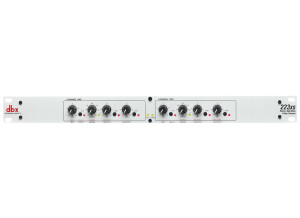
    The Dbx 223 is a stereo 2-way or mono 3-way crossover designed for live sound use and for DJ's. It allows you to easily switch between two or three different sources, depending on the way you are using it. I'm not a DJ or anything like that, but we have one of these in the studio where I work, as sometimes we'll do some live shows. I've only had a need to use it once, and don't think I'll be using it again since we just sold it. As far as the characteristics are concerned, each of the two channels on the Dbx 223 have 1/4" connections for input, as well for both high and low summing. It also has a button for setting your crossover frequency, which is essentially either a low or mid range set of frequencies. It also has buttons in the back for using the unit in either mono or stereo, and for setting low frequency sum options on or off. The front panel of the 223 has parameters on each of the two channels for input level, low/mid or low/high (depending on if you're using it as a 2 or 3 way crossover), low output, and for high output when necessary. There's also a button between the two channels on front to link them up as a stereo pair if you so choose. In theory the 223 shouldn't color your sound at all, and in my time using it I've found this to be the case. There is a new version of the 223, the 223XL, although I don't know too much about the differences between the two. I don't claim to know all that much about this sort of equipment, but for what I needed it for it got the job done just fine, so I'd recommend it for anyone in need of a simple crossover unit with a good amount of flexibility and a low cost...