Log in
EN
FR

Rjm Music Technologies

22 products found

Categories
Series
Filter
Sort by
Evaluation
  • Reviewed or not
  • Editor’s award
  • Reviewed by Audiofanzine
Availability
  • Available or not
  • Sold new or used
  • Sold new
  • Sold used
Must-have products
  • All products
  • Flagship products
  • Best rated products
  • Hot products
  • Popular products
Price
  • Freeware
€
Clear
Sort by
  • Popularity
  • User ratings
  • Price - low to high
  • Price - high to low
  • Used price, increasing
  • Used price, decreasing
  • Name (from A to Z)
  • Name (from Z to A)
  • Added on
Choose a series
Sort results
  • Popularity
  • User ratings
  • Price - low to high
  • Price - high to low
  • Used price, increasing
  • Used price, decreasing
  • Name (from A to Z)
  • Name (from Z to A)
  • Added on
Filter results 22 results found
Evaluation
Availability
Must-have products
Price
  • Freeware
Show results

The best Rjm Music Technologies reviews

The reviews Audiofanzine members found the most helpful.
  • « After a few months of han... well, feet-on experience using it... »

    I wanted a new MIDI pedalboard to control my brand new Axe-Fx. Experience has taught me that while playing in the night time is not a problem, playing outdoor and in the sun in something else: reading the indications on my previous MIDI devices’ screens was most often very difficult with a natural high luminosity, which had been a problem on multiple occasions. So I was after an easilt readable foot controller to come with my new “precious”. RJM Mastermind GT pedalboards seemed to match my criteria, but it’s always difficult to know for sure without trying one, and getting your hands on one in France where I live was more than difficult… So I decided to trust web reviews, and since the pedalboard is fully configurable this 16-button version seemed the most adapted to my expectations. The pedalboard (which I bought from the brand’s official European dealer in Germany) comes in a sober (yet protective anough) cardboard box. Along with the pedalboard itselt, you get a power supply, a USB key that contains the software and a manual in English. RJM’s website features the latest version of the soft which can easily be used to load into the pedalboard. I use the 7-pin MIDI connector for power supply. Be cautious as the phantom power mut not in any way get through the Axe FX, as the pedalboard’s consumption is superior to the Axe’s capacity. Adapters exist, but I made one for myself. I added 2 expression pedals directly plugged to the MMGT. Be cautious again, as the jack connections must be crossed with those of the Fractal pedals. The pedalboard’s configuration is very simple and rather intuitive. The pedalboard is programmable, either autonomously using its buttons or using the MMGTEditor software through a USB connection. For those who won’t bother configurating it, there are presets for a huge majority of controllable devices. Just select your device in the list (Axe-Fx II+ in my case) and all buttons are assigned to the maint functions with the right CC#. The two expression pedals that I’ve added are even already set up in the MMGT. The pedalboard also can go further by controlling several devices. Pressing a single switch, you’ll then be able to switch the Axe’s scene, change a parameter then send other codes to other devices chained to it –MIDI switch…). Each of the 16 footswitches can be configured, the actions, order, colors (On/Off independent), texts, control hold (and time), double click, button groups, macros, tuner, looper management and even more… The pedalboard features its own configurable setlists (which I don’t use as I use the Axe-Fx’s order). I play in a cover band. Each song on our setlist has its own preset. The Axe features 8 scenes per preset, but I currently only use 4 scenes at most per song. So, I remapped the bottom row with 5 scenes (one more, just in case – you never know) and the button on the far right of the pedalboard: Preset + (next song). Long button hold = previous preset. The row next up to it allows to view and/or directly load the 5 closest song presets, plus a “previous preset” button (which is actually redundant with the long hold on the button downstairs, I may change it for a “preset #call”). Finally, the 2 buttons on each side of the main display are used to launch: - the tuner - view of modify tempo - access other pages (I set page 2 for a preset access via bank+/bank-, with presets 5 by 5), or direct preset call through its 3-digit number (the MMGT allows up to 16 pages). - IA mode allows to access the Axe’s different blocks (which I don’t use while playing a song as I change scene instead – so two pages are enough for me) The whole can be configured as you like. For instance, I set up two independent tuners, which is quite practical. As I like to view the tuner during some solo parts and I’m used to play my solos in scene 3, I’ve configured the buton 3 so that it activates the tuner after sending the scene CC, while the 1, 2, 4 and 5 buttons set the tuner off. However, in between songs, I need to mute to tune my guitar. And as I’ve set the Axe so that it doesn’t mute in tuner mode (well, that’s not something you’d like during a solo, is it?), I set the tuner-dedicated button so that it sends the 0 value to the OUT1 & OUT2 volumes, and back to 127 when pressing again to exit the tuner mode. I’ve only used this pedalboard for a few months, but it’s perfectly up to my expectations: configurable at wish and rather easily. Te displays are very easy to read, even in the brightest sunlight. The text is easy to read. At night or in dark ambiances, I set the luminosity down (as light, contrast and colors are all adjustable). This pedalboard isn’t cheap, but to me it’s well worth its price. What remains to be seen is how it lasts. The switches seem sturdy, as for the display (as many as there ar switches + the main display), time will tell. Finally, the designers are very receptive and reactive – you just have to see how quick they react when someone asks for a precise improvement on the dedicated forum. Updates come in no time...

  • Audiofanzine FR's review

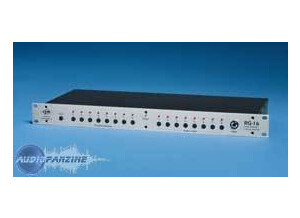
    (Originally written by Doc Plus/translated from Audiofanzine FR) Audio/Function Switcher with MIDI capabilities in 1U rack format. Audio: - One buffer that you can use or not. I like its sound, close to the Axess Electronics BS2. The buffer has its own input and output so you can place it anywhere you want in the audio path (before loop 1 or behind loop 6 depending on your pedals). - 8 loops in total: the first 4 ones are serial loops (only Send/Return per loop), the 4 others are independent which means they have their own inputs and outputs. So you can use the latter to switch four functions. To summarize, you either have 8 audio loops + 8 functions or 4 audio loops + 12 functions, and of course all other possibilities in between. Functions: - 8 functions. Connection via an 8-pin DIN connector. You have two isolated inputs (Amp1 and Amp2) that allow you to use two amps without ground loop problems. - RJM provides a custom cable and the amp list can be found on the RJM Music website. I made my own cables. I use Amp1 to switch four functions of my Engl preamp and Amp2 to switch one function of another pedal. Midi In, Thru, Out Phantom power: the RG-16 can power your Midi footboard if you use a 7-pin Midi cable. What else do you want? The mix of serial and independent loops is a good idea. The unit provides enough audio loops and functions for most applications! You even have phantom power. What a great manufacturer. Programming: - Midi PC or CC. - Easy Midi channel selection. - Regarding PC and CC data, you can choose continuous controller values. In the default setting audio loops are assigned to 80-87 and functions to 88-95. But you can easily edit them. - Regarding audio loops, you can even switch them in pairs for a stereo application. - The front panel has one switch (and an LED) to activate each loop and function plus a write button that allows you to store the settings described above, and also to save presets (2 banks with 128 presets each). I use it only with CC data but the possibility to activate each loop or function is a big advantage (like its daddy, the Rocktron Patchmate). The buffer sounds fine. You can bypass it or insert wherever you want. Very nice! The RG-16 is audio "transparent" and the switching is noiseless and instantaneous. FYI I previously used an Axess GRX-4 and CFX-4 but I needed more possibilities. Axess Electronics is an excellent manufacturer so I was afraid to be disappointed by the RG-16. Famous American rack processor manufacturers use the RG-16 so I thought it can't be bad... and it's true! I give it 9/10 because the finish is not perfect. It would be nice to have all LEDs in the middle of the unit ;-) RJM's customer support is very good but not as quick as Axess Electronics' (but Mario is unbeatable). Don't forget the name of this brand: RJM Music! The Amp Gizmo, their Midi function switcher is also an amazing product.