Log in
EN
FR

SeriesMoog Music Moogerfooger

11 products found

Filter
Sort by
Evaluation
  • Reviewed or not
  • Editor’s award
  • Reviewed by Audiofanzine
Availability
  • Available or not
  • Sold new or used
  • Sold new
  • Sold used
Must-have products
  • All products
  • Flagship products
  • Best rated products
  • Hot products
  • Popular products
Price
  • Freeware
€
Clear
Sort by
  • Popularity
  • User ratings
  • Price - low to high
  • Price - high to low
  • Used price, increasing
  • Used price, decreasing
  • Name (from A to Z)
  • Name (from Z to A)
  • Added on
Sort results
  • Popularity
  • User ratings
  • Price - low to high
  • Price - high to low
  • Used price, increasing
  • Used price, decreasing
  • Name (from A to Z)
  • Name (from Z to A)
  • Added on
Filter results 11 results found
Evaluation
Availability
Must-have products
Price
  • Freeware
Show results

The best Moog Music Moogerfooger reviews

The reviews Audiofanzine members found the most helpful.
  • « Classic synth sweeps for guitar players »

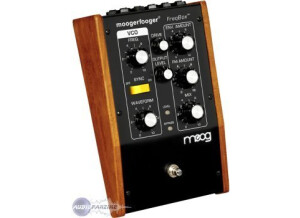
    This box is a noise maker's analog dream. It is a Voltage controlled oscillator that can latch onto your guitars frequency (note) and add a layer of synthy goodness. Think of the synth sweeps in classic songs like Rush's Tom Sawyer ( the "bwaaaahh" sound during the verses) or any Pink Floyd song and imagine being able to cop that sound with your guitar. Controls: Freq.- controls the frequency of the oscillator waveform- allows you to use sawtooth,square,tiangle, skinny pulse waves and inbetween sounds envelope amount- changes how much the freq. is raised when the pedal gets a signal. fm amount- sets the frequency modulation dependent on the audio signal mix- blends your dry sound and the sound of the oscillator sync- on allows the oscillator to track to your note and off mixes in whatever freq. you choose on the freq. knob Input- adjusts the gain at input allowing you to achieve distortion before the vco. very useful output- adjusts the gain after the VCO and mix knob In typical MOOG fashion it has more inputs and outputs than most people will even understand how to utilize until they dive into the manual. You get a jack for each knob, except input and output, that allows you to plug in an expression pedal or voltage control device such as the MOOG cp-251. This gives you real-time hands free operation of every parameter on the pedal. In addition you get your standard 1/4" inputs and outputs plus an output to hook the envelope into other devices that support control voltages. Previous MOOG pedals had an always active preamp that many guitar players complained about. MOOG wised up on this model and gave the unit a clearer bypass that does not overly color your signal. I say overly because there is a slight change but nothing that a quick amp EQ adjustment won't fix. There is also a rack kit (sold separately) that allows you to rack three separate Moogerfoogers together. UTILIZATION Getting a classic synth sweep is very easy to accomplish. Right out of the box you can start making some serious noise and once you tire from that you can get into the manual and start exploring the even wilder sounds. The manual gives you a quick and painless explanation of VCOs (voltage controller oscillators) and how to utilize the controls and rear jacks. This is not the type of manual that you want to throw away. Being analog there are no hidden features so everything is right in front of you for quick changes. SOUND QUALITY I mainly use this with my guitar. I have dabbled with synths but really I just end up zoning out and making sounds that will cause most animals to scream and cry. My rat terrier in particular. I always loved the sound of synths and tried for years to emulate that sound using many different distortion pedals, wahs, ring mods, etc... I was lucky enough to be in Asheville ,NC and took a tour of the MOOG factory just before this pedal was announced. I got a rather lengthy demo there and put in a pre-order as soon as I got home. One thing I will say is that you honestly cannot get too much use out of this pedal without having some control devices to go along with it. At least an expression pedal will get you many more sounds and make the pedal much easier to work into something musical. I personally own almost all of the MoogerFooger line along with 3 exp. pedals and the CP-251. Some people would probably find this to be a specialty effect that can only be used once in a set. Using the mix knob makes it so you can add subtle textures that can liven up many sounds without being overpowered. It can also be used as a wild wah sound by plugging an EXP. pedal in to the frequency jack and manually sweeping through it. I would say that is probably the sound I use the most with it. OVERALL OPINION This pedal is surely not for everyone but for me it's perfect. The price may seem steep but after touring the factory and seeing how the workers are treated I would say the price is perfect. This is not built in a massive plant like other manufacturers. All of the people I met at MOOG were musicians and seemed to really care about what they were doing. Open up the lil guy and it looks like a tiny city inside. There aren't many devices like it out there and the closest I've had was the electro harmonix micro synth. I can't really say which is better but I will say I still own both. The MOOG line is a slippery slope though and could put a dent in your wallet. I started with the phaser in 06' then went on to buy the delay, murf, freq., and the cp251. If I had to I would do it all again in a heartbeat. Even without making any conventional music you can get hours of entertaining noise out of these boxes and it increases exponentially with each Moogerfooger added to the chain.

  • « Its the real deal »

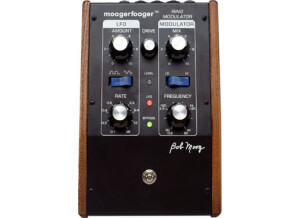
    Frequency rotary control, which varies the carrier frequency over a six-octave range. Rate rotary control, which varies the LFO's frequency from 0.1 Hz to 25 Hz. LFO Amount rotary control, which adjusts the amount that the LFO output sweeps the carrier oscillator. Mix rotary control, which crossfades continuously from unmodulated to modulated audio. Drive rotary control, which adjusts the gain of the audio input. Square-Sine rocker switch, which chooses the LFO waveform. Lo-Hi rocker switch, which chooses between the low frequency carrier range (2 Hz to 130 Hz) and the high frequency carrier range (60 Hz to 4,000 Hz). Level, a three-color LED that is used to set the DRIVE control. LFO, a LED that indicates the LFO rate. Bypoass, a two-color LED that tells whether the ring modulator is on or bypassed. On/Bypass, a rugged, smooth-acting stomp switch UTILIZATION This is a totally analog device that is basically a clone of the original...by the original maker. I use mine for freakout ambient spacey music with a guitar. I honestly am not an expert on these and I've learned mine in the last few months just by messing with the knobs till something happens. I didn't even read the manual and I honestly don't see it being a lot help beyond having a bunch of techy mumbo jumbo. One thing i found out soon is that it isn't true bypass which is unfortunate for a pedal of this quality. A lot of boutiquey companies have their own ring mods and I have tried them but at the end of the day I really think this moog is the real deal. I don't use mine terribly often but when I do it hasn't failed me and has been reliable. It seems built well. SOUND QUALITY If you have used a ring mod before there won't be (too) many surprises here. It takes time to experiment to get the sounds you want or didn't know you wanted. This will make your guitar sound...not like a guitar. The easiest way to describe it is an oscillating wah pedal on steroids. It also has a tendency to take you out of tune which is a constant issue with ring mods. What can you do? Just be careful and learn how to control it, you'll be okay. The wierd spacey sounds you will get are well worth it. OVERALL OPINION My big complaint I guess is the size. For such a wacky effect, it takes up a ton of board space. For this reason I see it as more of a studio pedal and I only take it to gigs where I know I'm gonna need it. I'm not omar from The mars volta with some massive pedal board. If you want a classic ring mod and not someone's version of it, I would say get this. It's not terribly overpriced and it seems solid.

  • « filtered moog goodness »

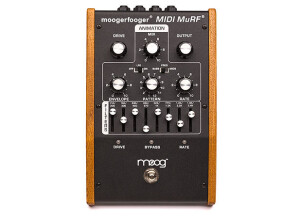
    The Moog murf is a digitally controlled analog filter. On the front panel it has controls for drive, output, mix, envelope, rate, a/b bank, and pattern selection. There are also 8 sliders to control which frequencies are altered. The rear panel has 1/4" jacks for input and stereo output. There are also stereo 1/4" jacks that allow you to use an expression pedal to control the rate, mix, envelope, and sweep along with a jack for tap tempo. UTILIZATION This is not a simple pedal by any means. Hooking it up is pretty straight forward but understanding the functions and knobs is a whole other story. You can just twiddle knobs and play with the sliders to get neat sounds out of it but it will just be guessing. The manual is long and very much necessary with this pedal as with most of the Moogerfooger line. I bought this used and did not receive a manual but it can be downloaded from the Moog website. Once you get a general idea of which pattern does what it becomes much more apparent what is happening when you turn the sliders. SOUND QUALITY The Moog murf has an active preamp in it that is always present in bypass and effect mode. Many guitar players complain about the preamp but I did not find it to be too bad, definitely not something that would stop me from using the murf. The effect itself is just amazing sounding. There are not many other companies that can make modulation effects that sound this thick. From bubbly to bleepy all the sounds are just other worldly. I find it equally useable on guitar and synth with maybe a slight edge to synth as you have a wider range of tones to work with. I would describe the sound as a highly tweakable mix of sample and hold and step filter. The pedal sweeps through the frequencies selected by the sliders and filters them in the most Moogish of ways. It is hard to rate it on functionality as it's really up to the user to understand how it works to get the most out of it. I really think the tap tempo is absolutely necessary. The effect really needs to be synced to the ebat you are playing otherwise it just sounds off. One you get it synced it can totally transform the tune you are working on. OVERALL OPINION This is pricey piece of gear that requires lots of reading and experimenting to really use well. If you like to just plug and play I suggest you find something like a sample and hold pedal to get similar sounds easier. If you are like me and enjoy tweaking and options then this is a great pedal.

  • « Glorious analog echoes »

    All analog goodness. Not some sort of emulation, digitally controlled, "analog" signal path with digital chips, or any other misrepresentation. This is the real deal old school sound and feel. -1/4" ins and outs with additional dry output. -effects loop -short/long switch to adjust the taper of the time knob -Knobs for time, feedback (amount of repeats), mix, and loop gain -Stereo jacks allowing external control over every sound parameter with optional expression pedals or other voltage controllers. -input and output knobs to adjust levels for your set-up -optional rack kit to install into a standard rack mount with two other Moogerfoogers UTILIZATION Set-up is a breeze until you get yourself wrapped up in the world of control voltages. The 104 hooks up just like any other stomp box with the exception of the level settings. I find the best sound is to set the input gain so you get just a bit of red (clipping) on the indicator light and then set the output to match the bypassed sound. Set your mix, time, and repeats then you're off into beautiful naturally decaying echoes or crazy run off repeats that can be mangled by turning the time knob. The manual gives a great explanation of how to get into the different sounds available via the rear voltage control jacks. It was easy for me to understand how this stuff works and allowed me to really expand the sounds available.You can achieve many sounds from a simple expression pedal to control mix which is extremely useful or get crazy with square wave signals from a device like the CP-251 into the delay time making some seriously whacked noises. SOUND QUALITY I've used this pedal in my live guitar rig as well as with some synths and in the studio as a vocal delay. It really works great in all of those situations but I was most impressed by the vocal processing. A lot of times delay on vocals really clogs up a mix and it pretty much has to be perfectly synced with the tempo of the song. With the moog it just sits so nicely no matter what the delay time is. Slap back stuff sounds just as good as really long trails. Overall just a very musical warm sound. There is a little tonal degradation when used in a guitar rig but a simple high and low EQ adjustment on the amp takes care of it quickly. You have to be careful not to drive it too hard as well which makes it difficult to use in some effects loops. It was perfect with my Triamp's loop but I had to use it in front of my Framus since the loop signal was just too hot to work with. Using it in front of the amp sounded surprisingly good though. I normally only use delay post distortion but the sound of the Moog's repeats into my lead channel was really unique. Kind of like the Dead Kennedy's. With synth well...it's a moog. It's made for that sort of thing and it shows. OVERALL OPINION Overall this is one of the best delays I've ever used and definitely the best analog delay I've ever had. I've owned quite a few like the old ibanez/maxon units, the memory man, some DOD stuff and they all have their place but the Moog has the most sounds available. As far as the price well I can't really say as I got mine for about half of the retail amount. Sadly the cost is what made me decide use it strictly at home and in the studio only. I had it in my live rig for a while but we get rowdy and one night my singer stepped on it. It did not do any damage but it was too close a call for me with a pedal that would cost so much to replace and honestly using it in a metal setting probably does not really represent the pedal to it's best abilities. If you're looking for a great sounding analog delay capable of everything from a standard slapback all the way to a square wave modulated self oscillation freakout this is your match.

  • « Super Warm Delay »

    This is Moog's version of an Analog Delay pedal. When it comes to effects, it is a one trick pony, but don't let it fool you. With the right twisting of knobs, you can get some really out of this world delay sounds. This pedal is not editable through a computer, strictly CV inputs/outputs and audio. This is a pure analog design with all the Moog Warmth you could ask for. With the "Rackmount" kit, you can rack this along side two other MoogerFoogers. UTILIZATION There are Main knobs and two switches on the front face. They are very easily accessed and edited. The manual is very well written and can help you understand each function very clearly. I read it too be sure not to miss anything this pedal could do, but all in all, there is not much in there that you will need. The loop gain knob is the only knob that I have never really seen on standard delay pedals. All you have to do to set it up is plug in the power supply and plug in your guitar (or keys, or horn or whatever you want). SOUND QUALITY I use this pedal with every instrument I can get my hands on. Most notably the Guitar and synthesizers I own, but its creamy warm delay sounds great on everything I put into it. The only thing that could be a slight turn off for some people is the nature of an Analog Delay pedal.....MUD. That is only a issue if you don't consider EQing your signal appropriately, but in most cases, the guitar and synth are usually "thin" enough not to be an issue. I personally love every sound that comes out of this pedal. Another thing you must be careful of is cranking the feedback volume to much and blasting your ears as it will continue to build until your head explodes. OVERALL OPINION I absolutely love the tone of this pedal but what I love most is the ability to "pitch" shift your delay sounds (by messing with the Feedback time) and not getting the alaising and other awful sounds you get out of digital delay pedals when trying to achieve the same thing. The only thing I don't like about the pedal is the absence of "Tap Tempo," which can actually be done on an analog delay by isolation the signal path (Diamond Memory Lane is a good example). If they ever release a Moog Delay with tap tempo, I will be throwing my money at them right away. I got this for far less than the original price (which is somewhere around $700) so I am extremely happy with the value. But, I would have paid full price if I had too. Top notch sound quality as to be expected from Moog. I have used a Boss DD 5 for many years as well as a Akai Headrush. Both of which fail to stand up to this Moog pedal. I would definitely buy this pedal again.

  • « chewy »

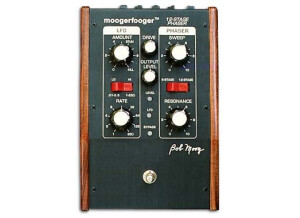
    This is a very tweakable analog Phaser built by some very talented people. 1/4" input and output drive and output controls to match your signal for unity or overdrive 6/12 stage selector lo/hi speed selector LFO out to send the LFO to other gear that can take CV signals controls for sweep, amount,resonance,and rate all of which have rear mounted 1/4" stereo jacks to send control voltage and exp. pedal signals There is a rack mount kit available to neatly house three Moogerfoogers UTILIZATION Hooking up the Phaser is as easy as any other pedal. You get your input/output hooked up and set your level knobs so your bypass signal is even with the effected signal. I generally set my input signal so it hits the red when I strum hard and then adjust the output to match my bypass signal. Getting a sound going can be as simple as any other phaser as the knobs are pretty self explanatory but once you get into all the rear CV jacks the process gets a bit more involved. Moog does a great job of explaining how all the jacks work in the manual and trust me you want to read the manual. SOUND QUALITY I typically use the pedal in my guitar set-up but occasionally hook it up to keys and synth. It sounds excellent with both. I have not found another phaser capable of the thick sound this box creates. The standard phaser sound is worth the price alone and then once you get into all the craziness with the CV stuff it's just a whole new world of sounds. I prefer the 6 stage phasing and lo speed setting for general use and keep the resonance somewhere in the middle. This gets a great but not overbearing sweep that adds a perfect amount of movement to your sound. Setting the resonance higher gets closer to a sweep sound you would get on a synth and setting the speed higher can get you all the way into ring modulation territory. The ring modulation sounds were a great surprise to me as I don't use that sound enough to warrant a dedicated pedal. I also own the CP251 which is Moog's control device. It can send all kinds of control voltages allowing you to achieve wild sounds from sample&Hold to complex wave forms that swirl the sound in a dizzying fashion. I highly suggest that box to anyone who owns more than one Moog pedal. The only issue some people seem to have is the preamp. The preamp is always active whether you have the effect on or are in bypass. This can add some noise to your signal if you are not careful with the settings and what kind of boosts/drive pedals you place after the Moog. For me it has not been a problem and I use this pedal in-front of a high gain amp. There is a little coloration of your signal as well but not enough for me to worry about it. Stick it in a bypass loop box if it bothers you. OVERALL OPINION If you just need a simple phase sound this might not be for you. The sound quality is excellent but the size and price may be too much if an old Phase 90 will work for you. Personally I don't think I will ever sell this box as it's the first Moog product I bought and it got me into all of their pedals. I did not own too many phasers before this one but none of them can get close to touching the sound of the MF-103.

  • songboy's review

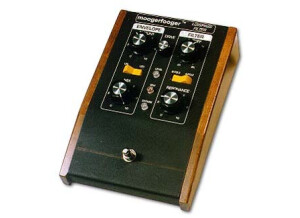
    This thing is basically a whacked out wah/envelope follower with wide parameters so you can get some great sounds. This is 100% analog lovin. The only editing is the five knobs on its face. It is all 1/4" audio. It is rackable if you buy the rackmount accessory (which holds three mf pedals all together). UTILIZATION The configuration is simple in the fact that it has only 5 knobs, but like I said earlier, the parameters are WIDE. Because of this, you get quite a range of sounds from traditional wah to birds chirping while tripping on acid kinda stuff. The manual will give you some diagrams for "presets" and I recommend you learn them. Its confusing when on stage and you want a particular sound and you don't remember what positions the knobs are supposed to be. SOUND QUALITY All the sounds out of this pedal are awesome! I write music in the vain of radiohead, flaming lips, sigur-ros, and others who love textured and melodic noise, so this things comes in very handy. I use this in my effects chain of my syth/drum sampler/alt vocals/etc. mixer and it gets used on all of them. It really sounds good on everything if you toy around and find the coolest config. OVERALL OPINION I have had this for three years now. The best thing about this is the way the "wah" effect sounds on pads. Very eerie and ambient. The worst thing is how loud it can get when you mess with the resonance, but that is the nature of analog music. I just run a compressor after it and clip the ear piercing highs. I owned a dunlop crybaby before i got this, and the mf should be what the dunlop really was... a little baby. This thing cost $265 and I recommend buying the $40 expression pedal or it won't be nearly as fun. Its a lot of money, but once you start buying high end gear, you know exactly why it costs so much. If this thing ever breaks, i will do everything in my power to get another quickly.