Log in
EN
FR

Yamaha Powered Mixers

28 products found

Filter
Sort by
Evaluation
  • Reviewed or not
  • Editor’s award
  • Reviewed by Audiofanzine
Availability
  • Available or not
  • Sold new or used
  • Sold new
  • Sold used
Must-have products
  • All products
  • Flagship products
  • Best rated products
  • Hot products
  • Popular products
Price
  • Freeware
€
Clear
Sort by
  • Popularity
  • User ratings
  • Price - low to high
  • Price - high to low
  • Used price, increasing
  • Used price, decreasing
  • Name (from A to Z)
  • Name (from Z to A)
  • Added on
Sort results
  • Popularity
  • User ratings
  • Price - low to high
  • Price - high to low
  • Used price, increasing
  • Used price, decreasing
  • Name (from A to Z)
  • Name (from Z to A)
  • Added on
Filter results 28 results found
Evaluation
Availability
Must-have products
Price
  • Freeware
Show results

The best Yamaha Powered Mixers reviews

The reviews Audiofanzine members found the most helpful.
  • « Clips a little easily, but works great »

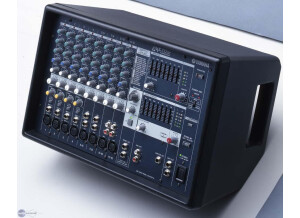
    The Yamaha EMX88s is a powered mixer with two 400 watt (in 4 ohms) amp sections, which can also be combined in bridge mode. It has 8 main stereo inputs, all which are configured slightly different. The first four channels have hi-z line inputs and mic inputs. The next two channels have super hi-z line inputs and mic inputs. The last two channels have stereo (or mono) line inputs, along with the mic inputs. This gives the user a lot of flexibility with the 8 input channels given. Each channel has a basic EQ control (high, mid, low), a monitor send control, an effect send control, a pan control, an overall level control, and the first 6 channels have a pad switch. One of my biggest (and only) problems with this mixer, is that there is no clipping indicator on any channel. So there is no way to tell if a channel's input or output are pushed too far, unless you simply hear it with your own ears. This can cause extreme distortions if you are not carefully monitoring the output sound of the mixer. There are two graphic EQ's: one for the main stereo output, and one for the monitor mix. Both of these sections can also mix in the signal from the effects section, and from the "2tr" input, which is essentially the tape input via an RCA connection. The main output also has a control to mix in the aux input as well. This gives you even more opportunities for inputs. The effects section I find to be a bit excessive, and often unnecessary, but it is nice to add reverb and sometimes delay (to vocals) in certain situations. The flanger, symphonic effects, vocal doubler, and distortion, I find to be useless as a living mixing engineer. There is even a tap delay, with a separate tap button, which is interesting, but probably unnecessary. Overall, this is a great powered mixer that is packed with power and potential. Be sure to try it out!