Log in
EN
FR

Yamaha PA & Live Sound

250 products found

Categories
Series
Filter
Sort by
Yamaha
Evaluation
  • Reviewed or not
  • Editor’s award
  • Reviewed by Audiofanzine
Availability
  • Available or not
  • Sold new or used
  • Sold new
  • Sold used
Must-have products
  • All products
  • Flagship products
  • Best rated products
  • Hot products
  • Popular products
Price
  • Freeware
  • Low-cost (< $400)
  • Mid-range ($400 - $1,000)
  • Premium (> $1,000)
€
Clear
Sort by
  • Popularity
  • User ratings
  • Price - low to high
  • Price - high to low
  • Used price, increasing
  • Used price, decreasing
  • Name (from A to Z)
  • Name (from Z to A)
  • Added on
Sort results
  • Popularity
  • User ratings
  • Price - low to high
  • Price - high to low
  • Used price, increasing
  • Used price, decreasing
  • Name (from A to Z)
  • Name (from Z to A)
  • Added on
Filter results 250 results found
Brands
Evaluation
Availability
Must-have products
Price
  • Freeware
  • Low-cost (< $400)
  • Mid-range ($400 - $1,000)
  • Premium (> $1,000)
Show results

The best Yamaha PA & Live Sound reviews

The reviews Audiofanzine members found the most helpful.
  • « Good but... »

    There's always a but... in this case it's the sound the amp's cooling fans make! It's useless in "quiet" environments, which is a pity (it seems to be a chronic issue with all stagepasses). It's OK for bars. It has the typical Yamaha sound: The mids are very present and detailed. I'm used to it but it's very particular. It's not the best for dub or electronic music with deep lows. Diverse connection options, even for iThings via USB...nice. No pan...which is strange (and a pity, in my view) Power: OK for small bars, I haven't tried it in bigger stages. The system is easily transportable.

  • « Perfect for the mobile working DJ »

    The Yamaha DXS12 is a 600 watt active subwoofer with a clean sound even at high volumes in mid-sized clubs and venues. I have worked with this sub on about 15 different occasions and the thing about it that fascinates me is that for this price you do not expect to get a woofer that you crank up the volume and still get a very low bass with no distortion at all. This sub provides very deep bass and I recommend it to all DJ’s that play house and dance music mainly because it sounds great with those bass types. It is even great for school systems and church systems as just the main sub. The low end sound is very full, deep and rich. When it comes to getting a quality sub like this one you will need to take into consideration what style of music or what exactly will it be used for most of the time. The DXS12 is good for just about anything though, that is why you cannot go wrong with purchasing it. It even has a built in XSub which will let you extend the frequency to an even lower response if you want to. This sub is very portable and only weighs around 70 pounds at the most. It has 2 XLR inputs and 2 XLR outputs with wood enclosure and no mounting, it will be need to be a floor sub which for this style of sub is just fine. It delivers a peak power of 950 watts with around 600 watts continuous. You cannot daisy chain these together so if you are looking to add more in the future you might want to pick a different sub to purchase. This sub is not very big and can fit in a regular sized car without any problems. It is perfect for the mobile working DJ!

  • « Just as good as the 15's »

    I posted a simple review for the 15" model. This review I will go more in depth. For the DSR112, I was blown away how pure, and clean this cabinet sounded. It was very warm, and crisp, exactly what I was hoping. Yamaha has come a long way, and to introduce this speaker to compete with QSC, JBL, Mackie, and Yorkville, they did a fantastic job. The exterior is solid, with a tour grade finish on it, and it was a great addition to add 2 handles, one on each side, (the JBLPRX615 only has one on one side). The amps were running super cool, and they were no where close to clipping, and it was very loud, around 119 dB. The DSR is at the same level of craftsmanship as the QSC, and JBL, but has better response, due to the wood cabinet. The inputs are simple, and straight forward. The cool feature is, the DSR has a button on the back, press it once for high pass filter, again for full range, and again for a special EQ that Yamaha designed specifically for the DSR112 and 115. Use this with either a JBL PRX sub, or even the new Yamaha DSR 18 sub, it sounds great. One little feature I love is the switch able White LED in front. The LED is recessed in about an inch behind the grill, so you cannot break it, and you can turn it off if wanted, like the QSC's. The JBL PRX do not do that, it is illuminated the entire time the cabinet is on. I recommend this speaker, and urge you to go hear it for yourself, it will give you a different opinion about Yamaha. I recommend these and the 15 inch model , they both provide a great sound that you will love and that will sound great in the club when you blast them. You get a good amp to run with these and you will be good to go. Give them a try, they arent too expensive either which is always a plus.

  • « Distortion at high volumes »

    The Yamaha DXS15 is a 15 inch 600 watt active sub with a clean sounding low end bass at moderate volumes. If you start to really crank it up you will start to notice a little amount of distortion. It does have a high power class D amplifier and it is simple to add this to your bands set up. I say this is good for a band because if you are a DJ you would not want to rely on the inconsistencies with the low end distortion problems when you are cranking up your music for the club. This is the perfect sub for like a band or a drummer because it is clean and responds well to instruments. The price is very affordable but I still feel like with its ability to deliver deep bass and with all of the power that it has; it should be able to be turned up to high volumes without getting distorted but that was not the case for me. I have recently used this twice at a club that already had it as the main sub. It did not need to bring my own sub in because they already had this set up. I do wish I would have brought my own though because I do not feel like this sub made my sound the best it could possibly be. The frequency range is 45 hz to 160 kHz which is pretty standard for smaller and mid-sized clubs/venues. This club was a mid-sized club that probably only had 350 people in it at that most and when I cranked it up I could definitely hear some distortion in the bass. The bass was very low and deep, it actually sounded great until I went to a very high volume once the dance floor was packed and the energy in the room started to change. Maybe I tried to overdue it too much because I was feeding off of the energy of the room or maybe this sub just cannot handle high volumes. Either way I was not happy and will not be purchasing this sub. I have other subs of my own that cost less and give a clean sound at high volumes all of the time. I am not sure what was going on with the DXS15 from Yamaha.

  • « very loud »

    High quality Pa Speakers with the Yamaha DSR 115, you will get a very crisp clean loud sound. I've played at the Barnes at the Wolf Trap and other larger venues in Northern VA (such as 4 ball rooms joined together); along with a variety of different sized venues to include outside events during all four seasons. While playing for a large event with celebrities, a semi-famous country guitarist and singer showed up as a guest and easily plugged into my system and sang/played several songs. I immediately kicked right in with dancing music after he finished. I write this as a DJ, this demonstrates the versatility of these speakers (an I-Pod can easily be plugged directly into the RCA inputs to play during breaks, or as a separate speaker/system in a lobby, etc.). I've had many complements on the looks and the sound quality. My only recommendation is to pay the extra bucks and purchase the protective cases to keep these looking new (and enhance your overall professional appearance). The cases help me when having to pack in and out as one DSR 115stacks easily on the K-Sub which has built in wheels easy for load-in/out I can roll two at one time). So nice to finally have a clean sounding POWERED speaker with real power! I have added my JBL EON 515's to the outs at about 50 to 100 ft away on these DSR 115 and they are finally worth plugging in to use as an extra punch/filer to the sound in a large room. But OH MY- the power and clarity of the QSC's completely blows away what I've been doing with the JBL's by themselves. If you are considering these vs JBL- GET THESE- Spend the extra money- It's a no-brainer once you've heard the power and clarity difference. Yamaha wins again.

  • « Clear sound »

    This Active PA cabinet delivers a huge sound no matter where you are. Though it is only a 10 inch speaker it sounds like it is a 15 inch speaker. Even in a larger space this cabinet sounds great. The weight of this speaker is a lot more than what I thought it was going to be. It weighs more than 20 pounds which is a lot for only a 10 inch speaker cabinet. The sound of this speaker is crystal clear; if I could make a change to it I think I would add a little more warmth to it though. Sometimes it can feel rather “light” and not thick or warm enough and the way that I like my sound to be on stage is a lot heavier but with it being as clear as it is and as loud as it is you just cannot go wrong with this speaker. The MSR 250 would be great for using it as a loud speaker the most, like for instructional purposes or for some sort of a presentation because of how well it does with vocals. It is very affordable which is one of the best things about it, and it is one of those speakers that you truly just have to hear before you can make a decision on where you want to purchase it or not. This speaker is great for all sorts of applications right out of the box. I have used many other loudspeakers from Yamaha and they all are pretty good, made well and very durable. I have not had this speaker long enough to know how it will hold up over time but so far so good. This is a great buy for the quality you will get and I highly recommend getting it; not so much for live music performances but more for smaller events, speeches and similar activities.

  • « Great with vocals and instruments »

    The Yamaha EMX5014C is a powered mixer that has 10 channels and 14 inputs. There are 16 high quality effects to choose from on this mixer. When I first read the specs I didn’t think they 16 would fit me, but after hearing how good they are it was a must have. It would have been nice to have some more though especially at this price. You can rack this unit but only if you purchase a separate rack kit because it does not come with it right out of the box. You will need to purchase a kit called the RK5014 if you want to use it as a rack mount. But using it as a tabletop mixer is not bad it will look great and fit right into your set up. I love how this mixer controls vocals; it will give you all of the tools you need to get clean and warm vocals. Plus you can add a little reverb or chorus to give them more depth. I love using this mixer for live shows depending on the style of music that we are going to be working with. This is not the ideal mixer to use for other events like weddings or banquets because you don’t need to have all of the EQ options for those events like you would a music event. There is a 3 Band EQ on each individual channel and a master 9 band graphic EQ on the main channel to let you control the whole output of sound. You can use this mixer with just about any instrument or any type of microphone. It will sound great no matter what sound source you throw at it. I love the quality of this mixer and it is a great value for the price. I would make this choice again if needed and I recommend it to people all of the time.

  • « A big and clear sound »

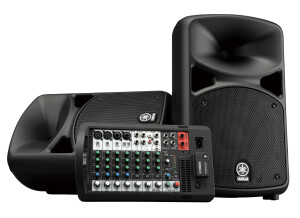
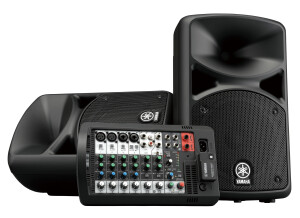
    The Stagepas 500 is a portable PA system that comes with a mixer, amp and 2 separate speaker cabinets. The overall sound with this system is amazing for this price; you will get some really clean sounding deep bass, and crisp highs no matter what style of music you are playing or who is talking. The mixer has 4 microphone preamps and a 2 band EQ. I did want to see them include a 3 Band EQ at the least but I guess I will have to make due with 2 for now. This unit is very heavy to me, it weighs well over 50 pounds and that might not seem like a lot but if you are by yourself taking it to and from places that is more weight than you want to carry. The amp is a 500 watt amp, the mixer has several inputs; 4 XLR, 4 ¼, 2 ¼ and outputs 2 1/4 (Speaker), 2 1/4 , RCA Stereo. These speakers are well made though and can handle some nicks and dings from getting them in and out of buildings. There is no microphone included with this system so you will need to have one or purchase one separately (I already had one so no need to purchase another). The sound of this system is the only thing that makes me a happy that the I bought it, I dislike the fact that I get no 3 band EQ and I dislike the fact that there is no headphone output from the mixer/system. But I love the sound and how it projects across the room. The frequency response is great and the preamps are great as well. The price is affordable but I am thinking about upgrading to a different system soon. This is worth it just because of the sound you get, the mixer and specs are not that great but the speakers make it worth the money.

  • « I love them! »

    I have owned a pair of Yamaha S115V CLub Series speakers for years and have had great success with them. But these are cheap and you get what you pay for. I have never had a problem related to the speaker farther than an easily replaced blown woofer because of a malfunctioning amp. I have used them for countless hours and hundreds of gigs and, sometimes with subs, using a 250 watt per channel Mackie amplifier and they have always been sufficient however more wattage will help get out that final oomph. When I first got them I was blown away by the sound quality and quantity, but bying a pair of speakers that cost three times as much has raised my standards. They handle everything well as I play a variety of music. They have good bass but for big rooms subwoofers are a must. That being said, if you need speakers around this price you might not find anything better It was as simple as a CE2000 and a Ultrafex Pro by behringer, knocks these spkr's into next week. I was using a PLX 1604 and I wasn't getting the chest thumping, floor vibrating bass, I'm getting now. Loads of head room to spare unbelievable sound! These speakers sound good at any volume crystal clear, bass sounds good I use a qsc gx5 power amp and these speakers thump my first speakers i ever brought had them for about six months. Ever one love how they sound at a party loud and clear. You will not need a sub for small to medium size venues. They sound fantastic and really pump out the volume. Voices are crystal clear, they have very good low end, and the overall sound generates very positive responses from clients. These will fit in your car without a problem, and they will fit your budget. Great deals online with these as well!

  • « Good If Somewhat Limited Portable PA »

    The Yamaha Stage Pass 300 is a very usable, portable, small and complete PA system, best used for vocals-only solo or group acts needing no more than four dynamic microphones. Venues it is best used include small coffee houses, house concerts, smaller houses of worship, and outdoor events where attendance is less than 75 to 100 people, or up to about 200 people if using the Stage Pass 300 for mostly spoken voice. The Stage Pass 300's best attributes are it's portability (when used with the optional carry case,) clean sound, and easy to use controls. It's 40 pound weight (carry case and accessories not included) make it light enough to be carried, if with some difficulty, by most reasonably healthy people, although one is a bit off-balance with the Stage Pass 300 on one shoulder and nothing on the other, and balancing it with another 40-pound load on the other shoulder would be too heavy for most folks to carry any distance at all. Yamaha has done what it can, for the most part, to keep the unit's weight manageable, using poly-carbonate (reinforced plastic) cabinetry for both speakers and the PA mixer/amp unit. It appears not much more could be done to further lighten the basic "three boxes." Even when pushed to it's maximum output (main output and mic gain turned to full or max,) the Stage Pass 300 produces a (presumably) clean 300 watts. The 10% THD reported in Yammie's specs is not objectionable, so if you need to push it to it's max, you will not be punished by horrible distortion. The power amp and speakers seem to be well-matched (as you would expect, from a 3-box PA, and from Yamaha;) I have not heard speaker-destroying amplifier clipping, or self-destroying speaker distortion, even when the controls were turned to full. Tapco established the standard for non-expert mixer controls more than 30 years ago, doing away with both mic gain and input-channel slider in favor of a single "output" or "volume" knob, and Yamaha wisely follows that lead with the Stage Pass 300. Each input channel features a mic and line input, a switch to toggle between the two (but no LED to let you know which is chosen, and the push-on/push-off button lacks enough throw to give the operator adequate visual reference, a two-band EQ with up to 15dB of cut or boost for "treble" and "bass," a push-button to turn "reverb" on and off for each channel, and a level control marked for "unity" gain- marked with a hash mark, but not identified as "unity. A pro sound man would know what this is, but most amateurs who are the Stage Pass 300's core user might not. The EQ controls have a center detent, but the level control lacks this feature. Pity. Four of the input channels have XLR mic inputs (and thus, pre-amps,) the last two are stereo but lack XLR inputs. Input channel five has both TS and RCA inputs, channel six has RCA only. I dislike that cost-saving option- I like for EVERY channel to have mic capability, but that's must me- the TS/RCA inputs are actually often a plus for it's intended use- solo or small-ensemble acts can easily plug in a CD or MP3 player or a backing-track into either of these channels. Yamaha suggest channel five could be used for a keyboard, but the 10-inch speakers may not be able to handle the lower frequencies of an 88-key keyboard, so be careful. The output side of the mixer/amp is also noob-friendly, with only monitor out, reverb (global,) and Master Level knobs and a speech/music push button. Both main and monitor output jacks are 1/4" TS, and it is easy to plug in a cable to the wrong out, but at least there is a visual difference- the main speaker outs are black plastic, the monitors are chrome metal. Actually, it should have been the other way 'round- the mains will get much more use, and plastic jacks are much more easily damaged by force put on the plugs. RCA jacks are provided for Tape out, and a single LED level meter is included, too- although it is of questionable use, as the Stage Pass 300 includes an output limiter- I have never been able to make this thing distort, even when the top-most red LED was lit often. The UPC AC input is on the face of the mixer, which seems odd until you want to mount the mixer/amp in the back of either speaker cab- a very cool feature, as you have more portability (only two boxes to carry and setup,) and less room used. If the AC input were on the back or side, such mounting would be impossible. Both speakers have the same cavity (they are the same speaker, not L and R mirror images of each other,) so the mixer'/amp can be mounted in either; a filler plate fits in the other one to make for a small storage area for the user manual and perhaps a couple of microphones. The speakers are well-matched, as mentioned, but lack pole-mount cups. Additional-cost pole mounts must be bought and installed to the bottom; these are ugly, lack any adjustability, and take up room in the canvas carrying case that could be better used for cables and such. They are not cheap, either. This could have been done much better. All those features make the Stage Pass 300 easy to use and it turns out good sound. It begins to fall down on the job when you ask too much of it. Although the 5th channel's TS inputs can be used to slave a bigger mixer board to the SP3C, the user will want to limit these added mic inputs to about two- beyond that and things get muddy, fast, regardless of the room (or lack of a room, if used outdoors.) This cute little thing can only handle so much. The system has a strang 6-ohm operating impedance, you could probably use a pair of 8-ohm speakers (say, if you wanted 12-inch woofers for more bass,) but Yamaha would not comment on this, and you should NOT daisy-chain speakers- the resulting speaker load would be below the Yamaha-recommended 6-ohm load. This wierd 6-ohm load also means that if you blow a driver, you must replace it with one bought from Yamaha, which will no doubt make for a VERY expensive day (see below.) You can easily expand the output of the system by using the monitor outs and a power amp/speaker combo, or powered speakers. We've used the Stage Pass 300 for about 4 years, for Sunday morning services- a diminutive, soft-voiced interim minister could not be heard without, and the congregation has become dependent on it, even though the called minister has much better projection and can do fine without it. We's also used it for a number of rock, jazz or pops combo concerts, in the same 100-person space, and on occasion outside for the same kind of groups' picnic concerts. It has performed well, when not asked to do too much- too may added mics overwhelm it, and it does poorly when asked to reinforce instruments already amplified, like electric guitars. Yamaha put "only" four mic inputs on it for a reason- respect that limitation and you will be fine. The SP3C does not feed back badly or too easily- good thing, with it's basic-as-it-gets EQ. Just keep the speakers in FRONT of the mics, and you should be okay. If there is one fly in the ointment, here, it would certainly be the cost of service parts. This one developed a noisy, inefficient cooling fan (there are two in the unit,) and a replacement from Yamaha was almost $70, plus shipping. I found an exact duplicate, only lacking the plug (I spliced the plug from the original fan) for $12, locally. I don't EVEN want to know what one of those 6-ohm (and thus probably proprietary) drivers or horns would cost. Small, thoughtful features like the mic-stand mount (also optional) and ability to mount the mixer/amp in the back of either speaker make this a versatile little PA, much more so than the basic 3-box PA's often seen. Whether it is worth the extra $200 or so it costs is a question the user will have to answer for him or her self. We rarely move our ST3C very far, so if I were making the original buying decision (or had it to do over,) I probably would have bought a not-so-portable PA that has more inputs, power, and features, but this one has served us well. I prefer it's design over the "clamshell" type portable PA's from Peavey, Fender and others- If you need or appreciate the portability, it is a good bet.

  • Audiofanzine FR's review

    (Originally written by double07/translated from Audiofanzine FR) I use it as a bass amp and feed it with a tube preamp. Pros: Weight (only 26 lb.), connections, noiseless (no fan), jack inputs and outputs, no heat, linear sound response. It's more expensive than other amps but I trust this brand (which I know from experience) even though their products are made in China. Its only competitor is QSC but the price/output power ratio is not comparable. 2 X 700 watts @ 4 ohms, it's enough for a bass guitar. I would buy it again for this price. Update from March 2009: Still perfect: light weight, noiseless, high efficiency!!

  • « Made for the road »

    Yamaha EMX 212S is a 12 channel powered mixer that is made for the road. The construction of this mixer is heavy duty and will last a long time. There are 16 digital SPX effects on it, echo, chorus, flanger, distortion, reverb, and a few other ones are on it. All of these effects can be added very quickly at the touch of a button. There are EQ’s on the main and monitor channels so you can get the exact sound you want or get out that feedback quickly. There are 12 input channels and 4 for microphone with phantom power. This whole mixer only weighs 22 pounds and is made for use every day. It have used this mixer as well as seen this mixer used for hour upon hours and it has never over heated or shorted out. I have seen it dropped and just about thrown and it has never stopped working. I am pretty sure as long as it doesn’t get wet it will work forever. If it doesn’t Yamaha stands by their products and I am sure they will not have a problem working with you to solve the problem especially with most of their products coming with a warranty automatically. The only thing that I didn’t like about this mixer is the amps and the humming that I would hear. I would not hear this all of the time just sometimes mainly after the mixer and speakers would be on for a long period of time. This could have been the speakers, cords, or any number of issues but it just seemed like the amps in this mixer would start to make the unit “hum” after a while. This didn’t happen often just sometimes and it really was not that big of an issue unless everything was completely silent. Overall, this is a perfect mixer for the road and it is affordable for any budget.