Log in
EN
FR

Line 6 PA & Live Sound

56 products found

Categories
Series
Filter
Sort by
Line 6
Evaluation
  • Reviewed or not
  • Editor’s award
  • Reviewed by Audiofanzine
Availability
  • Available or not
  • Sold new or used
  • Sold new
  • Sold used
Must-have products
  • All products
  • Flagship products
  • Best rated products
  • Hot products
  • Popular products
Price
  • Freeware
€
Clear
Sort by
  • Popularity
  • User ratings
  • Price - low to high
  • Price - high to low
  • Used price, increasing
  • Used price, decreasing
  • Name (from A to Z)
  • Name (from Z to A)
  • Added on
Choose a category
Selected category: PA & Live Sound
Sort results
  • Popularity
  • User ratings
  • Price - low to high
  • Price - high to low
  • Used price, increasing
  • Used price, decreasing
  • Name (from A to Z)
  • Name (from Z to A)
  • Added on
Filter results 56 results found
Brands
Evaluation
Availability
Must-have products
Price
  • Freeware
Show results

The best Line 6 PA & Live Sound reviews

The reviews Audiofanzine members found the most helpful.
  • « Very good unit for multiple instruments »

    I play guitar in a touring band with 3 guitarists and a bass player. We all prefer wireless when we tour. In the past we had all used our own rigs and our own wireless systems. The only issue with this was interference. Apparently (and not surprisingly) wireless systems of different brands in the same venue don't always play nice. Now 90% of the time we never had trouble, but there would always be one or two nights on tour where something weird would happen possibly because of the venue or the way we were set up onstage. Anyway, we decided to spring for a single unit for all of us, and while we usually have a no-line 6 policy with the band, we did the research and made an exception here for what appeared to be a solid product. Features wise it's pretty abundant. 12 channels and 300 feet of range. We honestly don't use any of the XLR outs or any of that stuff. It's purely an instrument to rig interface thing for us. Line 6 pushes the no signal loss features pretty heavily with this unit which was not a huge selling point for us, since we haven't found a wireless yet that doesn't lose some signal. I have to say that this one is pretty transparent though. It does have the typical signal gain you inevitably get from every wireless but that's a fact of life. The big plus however, is the fact that we never get any interference. None at all. We've had as many as 5 transmitters running at once with no issues that we can hear at least. It's stood up to about 14 months of off and on touring in a rack. It has taken some drops too. Overall very impressive for functionality and reliability. The price is pretty decent too.

  • « Unbelievable clarity that releases your tone »

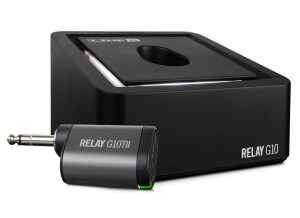
    SOUND: The Relay G10S is a 2.4GHz wireless system for guitar (and other musical instruments) that produces (allows for) incredible tone because of its 24-bit uncompressed digital transmission (best in class ADC and DAC provide very low noise). Amazing clarity is the obvious first impression. The demo video accompanying this review demonstrates how to operate the Relay G10S, but there’s also a sound comparison, which very much surprised me. I strummed some chords on a clean channel then later banged out a few riffs and double stops with some high gain. In both instances I compared two cable brands to the Relay G10S. The least expensive cable (of modest cost $25) was a Monster 12-foot. Next up was a quality 12-foot cable by Spectraflex, a company known in the industry for producing higher-end cables (and endorsed by many professional musicians). When compared to the G10S the Spectraflex cable was slightly darker and not as crisp and clean, whereas the Monster cable had an even more obvious darkness or muddiness to it. Now, what’s interesting about the G10S is that it offers a Cable Emulation function for both a 10-foot and 30-foot cable (I presume a sound difference becomes noticeable once you get upward of 30-feet). What this does is add an analog ‘warmth’ to the signal if you so choose such a setting, which can be beneficial if using bright pickups or amps. This, too, is demonstrated in the video. OVERALL IMPRESSION: The clarity of signal with the Relay G10S is nothing short of impressive. All my guitars, pedals, preamps, etc., actually sound better and slightly different… more crisp with a very apparent ‘cut-through-the-mix’ quality. At $249 USD it may seem steep for a wireless system that does nothing but transmit your guitar’s signal, but that is a typical cost for many pedals (and certainly a fraction of the price of a guitar, amp, etc.). Consequently, imagine having a pedal that enhances the sound of your music gear investment, and that’s exactly how the G10S should be viewed, besides having freedom from a chord wrapping around your feet. The Transmitter has a very fast charge of about 30-minutes, which then gives upward of 8-hours of play (by then your fingers will want a break). And if you leave your guitar for a short while and with the Transmitter plugged in, the Transmitter goes into sleep mode within 4-minutes to preserve battery life. With all all-steel construction, 130-feet of cable-free-freedom, auto channel select and a design made for a pedal board (although you can place it where preferred) there’s everything to like about Line 6’s Relay G10S and not much to gripe about. Wireless systems finally are getting to where high-end pedals have been for the past few years – excellent work by Line 6. GENERAL USE: Using the Relay G10S requires very little initial setup. The Transmitter (the part that plugs into your guitar) inserts into the Receiver for initial charging, which takes about a half-hour (which then gives upward of 8-hours of use). You can leave the Transmitter in storage when not in use, although you need to ‘press the Release Latch on the Receiver and pull the Transmitter out one stop so that the battery does not drain’ (fully inserted and the Transmitter communicates with the Receiver). If you leave the Transmitter in your guitar it will enter ‘sleep mode’ when there is no play for 4-minutes (the battery continues to drain, albeit more slowly). The Receiver has up to 11 possible channels from which to choose. Typically you would leave it on Auto so that the Receiver can search for the clearest channel with the least interference. However, if other band mates are using a wireless system you will need to select a Channel to prevent honing in on their territory and to keep their signals from interfering with your signal. Both the Transmitter battery life and the Receiver (RF) signal strength can be viewed clearly on the Receiver (3 LEDs each, with ‘RF’ on the left and ‘battery life’ on the right). When you see 3 RF Green LEDs light up you have a strong signal, whereas 2 or 1 Green LEDs mean there is some strength, but not as good (and you cannot wander as far away before losing your signal). Red LEDs indicate anything from a usable or short range to too much interference. Having good reception (3 Green LEDs) means upward of 130-feet of freedom, just in case you want to stroll through an audience while playing. In regard to battery life, you get upward of 8-hours of play time on one charge, indicated by 3 Green LEDs. As you get down to only 1 Green LED you have about 1.5 hours, or a bit more, of charge. Red LEDs provide warning with 30-minutes or less of charge. As indicated previously, there is a Cable Emulation option, to add analog warmth to the signal (since the G10S is so amazingly clear); a function that can be useful for bright amps and pickups – or perhaps you simply like a warmer tone relative to your gear. This function can be used only if you use the quarter-inch jack instrument out. The other ‘out’ option is the XLR DI Output that goes to a mixing desk, audio interface, etc. As well, there is a micro USB input for firmware updates and optional power. OTHER DETAILS: The Line 6 series of wireless systems have improved over the years. The Relay G10S has all metal construction, for both the Receiver and Transmitter. Past Receivers had a plastic housing and touring musicians had concerns about the long-term durability of the unit (I also have read this concern on various guitar forums). The antennae in the Receiver are protected by rubber pads as well, just in case your stomping foot goes awry. The unit is of standard pedal size, made for pedal board use, measuring approximately 5 (L) x 3.5 (w) x 2 (h) inches or 12.7 x 8.9 x 5 cm. The Transmitter tucks in nicely and well protected under the 2-inch height of the Receiver unit. All cable inputs and outputs are located in the back, which keeps a pedal board clean looking and cables out of the way. The Relay G10S (Receiver + Transmitter) comes with its own 500mA power supply, and you also get a USB cable if you prefer powering up in that manner, and certainly needed for firmware updates. As a side note, the Transmitter is a G10, which has existed prior to the G10S release. Consequently, if you have any G10 Transmitters you can use them in the updated Relay G10S system.

  • « A good choice for some »

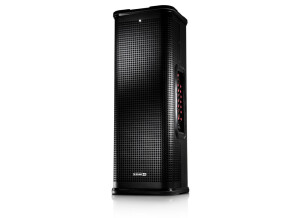
    As a live sound engineer and occasional performer, I thought it might compliment my extensive collection of P.A speakers in many brands. I decided on the L2"M"s as I do not need the built-in mixer and thought the more bells, the more opportunity for problems. Results: I take them to every gig whether it is for a fill in festival sound (with subs and satellite speakers) or a small casual stand alone. The sound is perfect for guitar, vocals, brass, strings, anything that has a mid to high range eq. I found that it is not adequate for lows, and if you are adding bass, low eq keys, low brass, kick, you should use a sub or a speaker with a 15"; and a good alternative is the latest JBL eons (own as well). I compared line 6 sound to similar powered Yamaha, Mackie, EV, JBL, QSC and found that the clarity of the sound in the mid range & highs was exactly what I was looking for. I also liked the EV and JBLs, but the Line 6 won out due to my application. I think at $750 the price is a little high, and some people might really want to consider the JBLs as they cost a lot less, equal in weight, and sound great at the lows. For about $100 more, consider the 12" QSC Ks (although I have not been blown away from them as other reviewers). Finally: I have really (purposely) pushed these speakers beyond normal and they perform without distortion or feedback. For guitar/keys/violin/and especially vocals, you will receive an increase of compliments for your sound. These speakers have paid for themselves just in the repeat business I have received for running sound alone. They have proven to be the perfect choice for me, and was pleasantly surprised at the "long-throw" especially at outdoor events. You can cover more space at low volume as the sound does not drop off when elevated on stands... (not a rule but, I like the bottom of speakers to be at 66" high when used as Mains). I would highly recommend these or "T" model $850 for the soloists over the Bose (I like the Bose L model IIs, but $2400?) ...larger coverage with no sound drop, almost equal feedback, easy use, use anywhere.

  • « Quality speaker with great features »

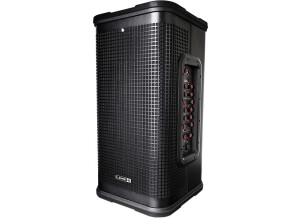
    I have been anticipating the day that I get a chance to work with the L2t from Line 6 StageSource because since it came out I have heard nothing but great things about it. At first I didn’t think the price should have been so high with it only being 800 watts. It is a 2 way powered PA speaker, a feature that is very good one this monitor is the speaker modes (smart speaker modes). There is also a digital mixer on it as well. The smart speaker modes has 6 different speaker modes in it and each one of those modes has EQ features/presets like electric guitar, keyboard backline, floor monitor and personal PA (there are also some more of them). It is very easy to use these modes and have everything ready to go right at your finger tips because all you have to do is activate the switch and you are good to go. This monitor can be pole mounted, but I used it as a floor monitor and even used it as a PA speaker once so far. I do love the way that it sounds with instruments as well. I have heard many live brass instruments through the L2t so far and I can say it sounds amazing. There is also a L6 link digital networking system in this monitor that will create a network of speakers that will automatically configure with no effort. This is not a feature that we had to have but it is a nice plus. If you have a lot of Line 6 Stage gear/systems this is a great feature to have though because it makes everything very easily synced and ready to go with no worrying or configuring on the users part. This speaker is a little bigger than what I expected too, it is not huge but it has some size and weight to it.

  • « The digital wireless revolution is here!!! »

    This is NOT Spinal Tap You've either seen it, heard it, or lived it. The freedom of wireless roaming on stage crippled by the interference of local radio stations, other broadcasts, or the wireless from the opening band's guitar player that didn't get turned off after THEIR set (I've actually seen the last one happen). All of these scenarios have led to a small backlash against traditional analog/RF wireless units and have players going back to their tried-and-true cable. What's in a cable? If you have the inclination, you can find information on the Internet that bashes guitar cables as "tone suckers" and nothing better than antennas that bleed your guitar tone and introduce interference. While this may be true, many opt for the stability of a cable over the gamble of interference on a wireless. Leave it to Line6 to solve this issue in an incredibly creative way using proven technology. When it comes to wireless, Line6 now has every other company smacking themselves on the forehead and asking, "Now why didn't WE think of that?" The Relay G30 Digital Wireless Guitar System Enter the Line6 Relay G30 Digital Wireless Guitar System. Comprised of a small transmitter and receiver, this system that Line6 represents as their entry-level package outperforms most other expensive wireless systems. The design of the G30 is both elegant and practical. The receiver is smaller than most stomp boxes and will fit easily on a pedal board, on top of, and possibly inside the back of most open-backed amps. The internal antennas on the G30 receiver makes it easily mistaken for a stomp box on a pedal board. The transmitter is just big enough for the device itself and the two 'AA' batteries that power the transmitter. Now let's talk about intelligence for a second. When you're playing, you can't see the transmitter that is on your guitar strap, belt, etc. That's why Line6 put the meter that shows the relative strength of the signal (including transmitter battery strength) on the receiver, where you CAN see it at a glance via a row of color-changing LED lights. There is, of course, a battery indicator on the transmitter, but I found myself relying more on what the receiver was telling me than constantly looking over my shoulder. I had the Relay G30 up and running in about 30 seconds. Put in the batteries, pick one of the six available common "channels" on the receiver and the transmitter, plug in, and play. No messing with antenna positions, no dealing with interference, just pure, true guitar signal getting to your amp. Line6 has accomplished this by using tried-and-true digital wireless technology. This is the same technology you've had in your house for some time now, wirelessly connecting your computers to the internet. The Relay G30 operates over the 2.4 GHz frequency band, the same as most of the older cordless telephone and computer wireless access points. Given the history of wireless systems and interference, plus the fact that I'm an admitted geek as well as musician, I decided to see if I could make the G30 fail or introduce any interference into the signal. Nope. I even put a famous-maker wireless access point made for computers directly between, beside, over, and under the G30 receiver and never encountered any interference. This is due to a pair of technologies on-board in the G30. First is Digital Channel Locking (DCL) technology that "locks" the transmitter and receiver onto the same signal frequency. The second employs some advanced technology, again borrowed from the computer world, to block out any signal that might try to interfere with YOUR frequency. But how does it sound? Once I plugged in the G30 I was amazed at the clarity, quality, and overall fullness of the sound when compared to my cable. In fact, it was a little TOO good. Higher frequencies were popping out all over the place and I thought, "I haven't changed my EQ settings, where did all this treble come from?" Well, it turns out the G30 will transmit all those higher frequencies that your guitar cable doesn't. The specifications on the G30 state its frequency response between 10 Hz and 20 kHz. My first thought was that I would have to adjust my EQ settings to accommodate the new wireless. But wouldn't you know it, Line6 thought of that as well. The G30 has a feature called "Cable Tone Simulation." Basically, this is a three position switch on the receiver that allows you to select how you want the G30 to sound. Your choices are Full Digital, 5 Meter Cable Simulation, or 9 Meter Cable Simulation. Clicking onto the 5 Meter position rolled off a good bit of the high frequencies and my guitar started to sound more like its old self. Clicking onto the 9 Meter position rolled off even MORE of the high frequencies and my thoughts of having to adjust my EQ melted away. As an interesting note, the lowest and highest frequencies listed on my 31-band famous-name EQ are 20 Hz and 20 kHz, so the G30 has got you more than covered. The high-fidelity quality of sound that the G30 produces will have you looking at your guitar and gear in a whole new light. I was afraid that while I could hear the differences live, I wouldn't be able to capture the differences when recording sound clips. That wasn't the case at all. I plugged in a variety of guitars and amps using the G30 system including Gibson and Epiphone Les Paul models, Ibanez RG and JEM models, a Fender Lite Ash Telecaster, a PRS SE Semi-hollow, a Mosier MMi-T, and various Squier models. I was treated to the same crystal-clear beautiful tone every time. Overall, I think the Relay G30 Digital Wireless Guitar System far exceeds any "entry-level" expectations and have a difficult time thinking of it as entry-level on any scale. The signal delivered is pure and true and the Cable Tone Simulation feature means you can gradually adjust your EQ settings until you reach that "full digital" state if desired, or leave it on to shape your tone exactly how you want it. Be forewarned that due to the power needed to maintain good signal strength the transmitter will deplete a standard set of 'AA' batteries after a few hours of playing so either make sure you put in fresh batteries before a gig, or use high-grade Lithium batteries that are specially designed for high-power devices. Either way, if you're standing right in front of the receiver and the signal strength light is showing one red bar instead of 2-3 green bars, change your transmitter batteries. The receiver is powered by the included AC adapter, so you're covered there. Say good-bye to your cable, bad wireless interference, and anything else that has previously kept you from exploring the rest of the stage, the crowd, the drum riser, or anywhere else within 30 Meters of the receiver.

  • « Great mic for speaking »

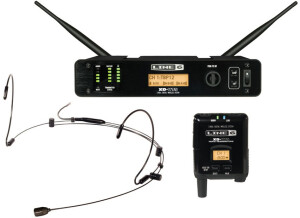
    The Line 6 mic element sounds great. I have previously used condensers and dynamics in my mics for various reasons, and their capsule sounds as good, and in my opinion better than any Shure…but if you are still a slave to those mics ( many Front of house and monitor rigs are dialed in for those mics), you can replace the element with any Shure wireless capsule ( Audix is available with an adapter from Ratt Sound as well, and you can also use Heil capsules). They also have their great modeling to emulate the EQ coloration of some very popular mics…I chose to just use their element without modeling as I thought it sounded best with my voice, I even AB’d it against a Shure 58 and a Beta 58 capsule I had from my other handheld wireless units I still have, and still preferred theirs. The wireless part of the system is great, no pops clicks or dropouts, seems easy to set up as well, I was a little disappointed with the sound of the Mic itself, from other reviews I had read it was nothing short of amazing, they compared it to handheld Condenser Quality. I have to say although it isn't bad, I am used to my Audix OM7 mics with snap-on wireless transmitters. The OM7 is heads above this mic for clarity and the way it picks up every detail in your voice. I will have to try an OM7 Capsule on this mic, they are suppose to have an adapter for it, we'll see. On the upside it picks up spoken voice really well, so when I used it at a few Weddings we did, it was easier for those who don't have good mic techniques to use, even when they held the mic down by their Belly Button we could make out what they were saying.

  • « The new king of wireless »

    Line 6 has always been known for their modelers such as the POD. However, they bought out a company that has been making some of the best wireless devices in years called Xwire. Way back in the day, Xwire was one of the most famous wireless product companies because their stuff sounded closest to a cable. They went bust for a bit, but then they were revived for a few years and started making a new revision. Line 6 then bought this company, and that’s the current product you see today. The Line 6 G50 is the “midgrade” wireless that they offer. They have the G30, the G50 and the G90. The G30 and the G50 are the closest, and they’re meant to mount to pedalboards thanks to their smaller footprint. The G90, however, is a rackmount device. For the best bang for your buck, I honestly feel that the G50 is the one to get. The G30 is a bit more slimmed down, where as the G50 is closer to the rack unit. In fact, the main difference between the G50 and G90, besides the fact that the G90 is a rackmount unit, is that the G50 has a range of 200 feet instead of 300 feet. Aside from that, it has the same bodypack, the same dB, the same frequency range, etc. Granted, the G90 has a few extra little things in there for rack guys, but they’re not needed for 90% of the people out there. If you’re looking for a wireless that’s as close to a cable as you can get, I highly recommend the G50. It’s economically feasible, it can mount basically anywhere, it uses AA batteries in the receiver instead of 9V batteries, and it can even be powered by a regular daisy chain connection or something like the Voodoo Lab Pedal Power Plus.