Log in
EN
FR

SeriesRoland JV

34 products found

Filter
Sort by
Evaluation
  • Reviewed or not
  • Editor’s award
  • Reviewed by Audiofanzine
Availability
  • Available or not
  • Sold new or used
  • Sold new
  • Sold used
Must-have products
  • All products
  • Flagship products
  • Best rated products
  • Hot products
  • Popular products
Price
  • Freeware
€
Clear
Sort by
  • Popularity
  • User ratings
  • Price - low to high
  • Price - high to low
  • Used price, increasing
  • Used price, decreasing
  • Name (from A to Z)
  • Name (from Z to A)
  • Added on
Sort results
  • Popularity
  • User ratings
  • Price - low to high
  • Price - high to low
  • Used price, increasing
  • Used price, decreasing
  • Name (from A to Z)
  • Name (from Z to A)
  • Added on
Filter results 34 results found
Evaluation
Availability
Must-have products
Price
  • Freeware
Show results

The best Roland JV reviews

The reviews Audiofanzine members found the most helpful.
  • « The 1990s in a box »

    These machines are going very cheap at the moment In much the same box as the previous flagship D550, it likewise blurs the line between synth and ROMpler. For those who want a library of bread and butter, ready made sounds, there's four banks of 128 patches. Programming is similar to the D110, consisting of four tones within a structure, which offers various modulation options. The use of one tone to modulate another is familiar to older LA synthesizers and results in flexible and unique results. Free software editors are available, as are sounds. On the ROMpler side, there's 8mb of ROM expandable to 48mb. Mono sounds with portamento , legato and so forth are catered for too. Especially cool are the two DSPs, which have flexible routing options and are midi-clocked. UTILIZATION Like digital synths of it's era, there's a lot of parameters, a small screen, a single knob and a few buttons. Use of a software editor/librarian is a must for serious programming. Plenty of outputs for multi-timbral work. There's GM, but not GS. SOUNDS Factory presets are generally very like the Korg M1, Yamaha TG55/77 and other machines of the early 90s, late 80s, slightly clearer resolution due to cheaper chip space of the later years. However, it's more programmable than the M1, and you can use analog-style waves instead of acoustic ones and create "classic synth" patches or combine the two to give a D50-style effect. Use of LA structures gives the ability to do the latter with some accuracy. Would be nice to have "pure" LA oscillators like the D50 though. Drums aren't as well catered for as the M1, say, but expansion is possible. OVERALL OPINION This sort of instrument has been sidelined by virtual analog / physical modelling and soft synths. If you're an old school muso with an Atari though, it's the bee's knees. They go on eBay in the UK for about £150. Unlike the M1, there's no software clone. Though the GM implementation is basic (no GS/XG) the results on a typical midifile are very professional. I'd recommend this machine for someone with an analogue-based tape (or non-PC hard disk) studio setup who needs a digital synth to cover all bases, maybe with a hardware midi sequencer- it can potentially replace a whole rack of midi gear. I bought mine as I needed a hardware GM machine. Being hardware and having multiple outs, it's great for putting through all your FX, peddles, compressors and so forth. To sum it up, it's probably my least used synth, however if I had to get rid of all but one, this is the one I'd keep.

  • moosers's review

    The Roland JV-1010 is a MIDI sound module that consists of a variety of different sounds. It's an older model, but still compares well to today's sounds and is a good bargain when you buy a used one of these. In terms of general characteristics, it isn't rack mountable as it's about the third the size of a single rack space. It has connections for MIDI input, output, and thru, as well as 1/4" stereo outputs and a computer port of some sort that I didn't need to use since I was using it via MIDI. UTILIZATION In general the Roland JV-1010 is a pretty easy little sound module to use. Once you've made the proper connections, operating it and getting the full scope of the sounds it has to offer isn't too hard. I've only used this on a handful of occasions, so there are definitely aspects of the sounds to it that I've yet to explore. Getting it's basic sounds and presets as it has scrollers for getting to the presets and for saving your own. Once you get the hang of it I think you'll find it to be pretty simple, but if you're thinking you might be lost it might be a good idea to have the manual to get started with. SOUNDS The sounds on the Roland JV-1010 are definitely realistic enough in my opinion. While they aren't earth shattering, they'll give you a nice handful of basic sounds and beyond here. I like synth and organ sounds the best, as they seem to come off as the most authentic to me. I've certainly heard better sound MIDI sound modules by today's standard, but also considering that this is a bit older, it's definitely got some cool sounds. OVERALL OPINION While not the best sounding MIDI module out there when compared to those of today, the Roland JV-1010 is a great little box that is easily transported and has a plethora of sounds. There are plenty of these hanging around out there to be bought, so even though this is older and is no longer being made, it should be easy enough to find one at a reasonable price from somebody. If you're interested in something like this, it's definitely an option worth exploring as a portable MIDI module.

  • « This rack module has quite a bang in sound quality with an external sound editor »

    The product is used for studio use. I have the studio setup for DAW and non DAW. I was impressed with several Youtube presentations of the JV-880 that I purchased 2 units. The JV-880 has: MIDI/in/out and thru. I've added some internal extension cards and retrofitted the screen with a newer technology screen which is white (letters) over blue - extremely easy to read in brightly lite or in low light environments. The screen worked out so well, I order and second one for the other unit. Background on the synths I desire: Roland JD-990, Access Virus (model C and the T-series), Blofeld and the Novation Peak. This will help to quality what my expectations are when acquiring a music instrument and while reviewing the Roland JV-880. Superb sound quality and a free editor (https://www.youtube.com/watch?v=UPQ5tBsh1ZE). The creator, Leandro Cleto has done a superb job with many options to adjust. (download: https://ctrlr.org/jv-patched-roland-jv-880-patch-editor/) Having the Roland JD: 990, the Famtom X and the Korg M-3, I see the JV up with these other synths on sound quality. Pros: Many pros - especially when you think of when it was released. Cons: No cons, I am with gratitude for this module.

  • « JV90 build and sound »

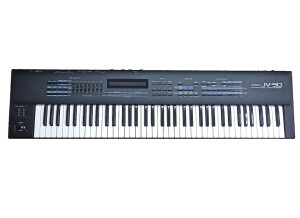
    Build Keyboard has good feel and is quiet. The body is lightweight and slim. Knobs and switches are safely indented in the face. Screen is bright clear and simple. Sounds Piano The piano has always been robust and cutting. Organ I've never used for organ Strings Pads are lush Analog synth Does pads or solo with portamento and effects, and 4 parts per note. Brass Brass is superb and capable of analog sounds Drums Gives enough kit choices from natural to special effects Polyphony Polyphony is definitely the issue. Nothing new there. Layering with another keyboard is recommended. Editing Editing is super easy and able to leave menu parts you edit the most on screen Overall Review Love it. Sounds can be put in my 2 JV880's giving me 84 notes of polyphony without the need for expansion boards. 76 keys and lightweight.

  • Audiofanzine FR's review

    (Originally written by jm16s/translated from Audiofanzine FR) Digital synthesizer. Five octaves. Small joystick for pitch and modulation control. Standard connections: - MIDI (in, out, thru) - Phones - L/R output - Sustain pedal - 9-volt PSU Polyphony: 24 notes. UTILIZATION In spite of the easy configuration, you'll have to take a look at the very clear user's manual to understand every function in detail. Very intuitive sound editing. SOUNDS Standard Roland GM sound. The presets allow you to play any music style and they sound authentic. Regarding the effects I wish the controls had a more analog feel (rotary controls) but you can solve that with external sound generators. OVERALL OPINION I got it yesterday and I'm already a fan! It's exactly what I was looking for. Now that I have it, I'll keep it. I will add sound generators to it. It's rare to find a keyboard at this price with a such good finish. No key noise and perfect playing feel. It' doesn't feel like plastic!!! It's perfect for a synthesizer beginner like me!!!