Log in
EN
FR

SeriesSennheiser evolution 900

16 products found

Filter
Sort by
Evaluation
  • Reviewed or not
  • Editor’s award
  • Reviewed by Audiofanzine
Availability
  • Available or not
  • Sold new or used
  • Sold new
  • Sold used
Must-have products
  • All products
  • Flagship products
  • Best rated products
  • Hot products
  • Popular products
Price
  • Freeware
€
Clear
Sort by
  • Popularity
  • User ratings
  • Price - low to high
  • Price - high to low
  • Used price, increasing
  • Used price, decreasing
  • Name (from A to Z)
  • Name (from Z to A)
  • Added on
Sort results
  • Popularity
  • User ratings
  • Price - low to high
  • Price - high to low
  • Used price, increasing
  • Used price, decreasing
  • Name (from A to Z)
  • Name (from Z to A)
  • Added on
Filter results 16 results found
Evaluation
Availability
Must-have products
Price
  • Freeware
Show results

The best Sennheiser evolution 900 reviews

The reviews Audiofanzine members found the most helpful.
  • « No stand? No problem. »

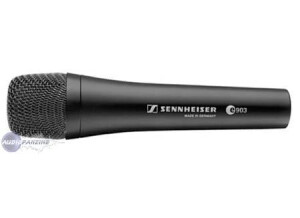
    This microphone was pretty much made for live use. I suppose you could use it to record but given all the options out there, it's really not that special for studio use. It does excel in the live environment however, as I think it was designed to. Despite the look of it, this mic has a very tight pickup pattern and it's a try dynamic to the bitter end. I think some people buy these thinking they are some kind of ribbon or even a condenser mic but they aren't. It really is just a dynamic mic. Think SM57ish in function. OVERALL OPINION I tour sometimes with smaller bands, and some of the stages I play are so small that I simply don't have room for a stand to use to mic my cab. This is bad since I typically like to use an SM57 or a large diaphram condenser to mic my cabs, which both require a stand. I used to mess with special compact SM57 stands but if they break on tour, you are stuck up river. I was recommended this mic since it is able to be hung from the mic cable over the back of the cab. Pretty genius actually when I think about it. But is the sound good? Well yes it is. It's like an Sm57 almost but with more bass response. It does require a bit off low end roll off at the board with certain speakers. No big deal. The main rig I use this with is a simple AD30 with an Orange 2x12 setup. It's pretty flat. Or flat for what it is. Usually these kind of mics have crazy peaks in certain spots. Not this one. It has held up well to road abuse. I actually have 2 in case one dies on me. But it hasn't in the two years I've used it. I've heard they break easy but I've dropped mine maybe 6 times and so far so good. A little disclaimer...it's not the best guitar mic in the world and I'm not saying that. But when you don't have a stand it's probably the best you're gonna get. I wouldn't use it in the studio because it doesn't have enough character or flavor for a track.

  • moosers's review

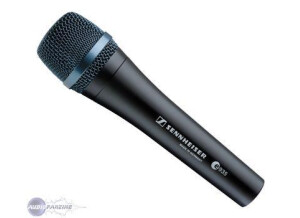
    The Sennheiser E 945 is a dynamic hand held microphone that is best suited for use during live shows. It has a hyper cardioid polar pattern pick up and the shape makes it perfect for vocals. While it would certainly be usable in the recording studio, I would say that it doesn't excel in this situation and should probably only be considered a mic for use on the stage. The Sennheiser E 945 is a sturdy microphone that has the ability to last a while if used and treated right. OVERALL OPINION I've been using the Sennheiser E 945 dynamic microphone for about two years and I've found that it is great at what it is suited for, which is on vocals for live shows. This is what it is made to do and it works great for this. Sennheiser has a great reputation for making top notch microphones and I've found that this microphone is a nice choice for the professional singer who wants a nice vocal microphone to use for live shows. The sound comes in cleanly and is always pretty full sounding. While I like to use the Sennheiser E 945 for vocals, it can be used for pretty much whatever instrument you would like to use it with when it comes to using this for live shows. The price of this mic is about double for the Shure SM 58, so I would probably first recommend the 58 because of this price difference. However, if you are looking to spend a bit more money on something that sounds slightly better, the Sennheiser E 945 wouldn't be a bad choice. Sennheiser makes some great microphones and I have definitely come to trust them and the products they make. Overall, the Sennheiser E 945 is a great microphone for live shows for amateurs and professionals alike.

  • Deleted member's review

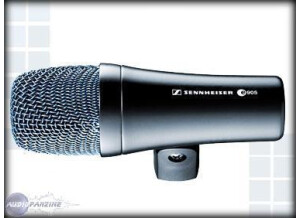
    The Sennheiser E 905 microphone is another one of Sennheiser's E 90x microphones, which along with the E 60x microphones, are intended for use on drums. The E 905 is a bit strange, as it is a microphone designed specifically for applications on a snare drum. The E 60x line lacks an equivalent microphone. That being said, the E 905 is a quite good microphone that will give you some very nice hits from a snare, and it is a good choice if a person is very intent on mic'ing up a drum kit very meticulously; I am no drummer, so I am not. However, the snare is an instrument that often needs more processing than others, and it is nice to have a track dedicated only to the snare. The Sennheiser E 905 microphone is a dynamic microphone specifically engineered to use on a snare. It is claimed to have a very fast attack time, and the short body makes it less cumbersome to stick on a snare: a huge advantage. It has a standard cardioid pickup pattern and a rather impressive frequency response range of 40-18,000 Hz. This all comes together to bring forth an element of the Sennheiser E 905 that I am absolutely enamored by: Remember when I said that the snare is important to mic up individually because it is often an instrument in need of EQ? Well, when you decide to use the E 905 to mic it up individually so that it can be EQ'ed, the snare just so happens to lose that very need to EQ. OVERALL OPINION I should consider it a blessing that I am not a drummer, because when I talk to my drummer friends, their minds seem to wander toward the $1000 they spent mic'ing up their drum kit with BUDGET drum microphones. However, the E 905, along with most of Sennheiser's Evolution instrument microphones will give the user the flexibility to tweak the sound, and quite frankly, less need. I wholeheartedly recommend this microphone to anyone who wants to mic up their drum set and has a bit of cash to burn.

  • Deleted member's review

    The Sennheiser E 902 is supposed to be Sennheiser's successor to the very nice and interesting E 602. The E 902 is intended primarily for use with a kick drum, although Sennheiser advertises it, like the E 602 as a "bass instrument" microphone. I am quite sure that it will work well on bass cabinets, but it was not an application that I got around to testing it on. This review will, consequentially, cover their use on kick drums. The Sennheiser E 902 is a dynamic microphone specifically designed to be used with bass instruments, so it will get utilized mostly on kick drums. It has a cardioid pick up pattern, which is nice, because if it gets placed in the hole of a kick drum, it will pick up some of the boominess in the kick. It has a bass-heavy frequency response from 20 Hz all the way to a respectably high 18,000 Hz. The E 902 has a stand mount built right onto the microphone, and this resulted in considerably less hassle in setting it up inside of the hole. This mechanism is a markedly noticeable improvement over the E 602. In my review of the E 602 II, I mentioned how the E 602 II seems to magically fix low end kick drums that had a tendency to sound boxy. In keeping true with the fact that it is a higher end microphone, the E 902 does not have this compensation built into the curve. The E 902 will make a good kick sound good, and a bad kick will continue to sound bad, so it is not a magical solution to a bad kick like the E 602 seemed to be. This particular microphone from Sennheiser tends to be very clean, very honest about the sound it imparts. OVERALL OPINION I like the E 902 more than the E 602, but they are differently colored. The E 902 is not designed to compensate for any bad bass signals like the E 602 is not only engineered to do, but is also advertised to do. Do your research before you buy anything, and you'll have a great kick in no time!

  • Deleted member's review

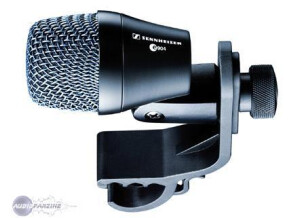
    The Sennheiser E 904 is Sennheiser's would be follow up to the already fantastic E 604. The Sennheiser E 604 was a great microphone, having a really nice transient response for snares, and in the absence of the legendary MD 421 II, toms as well. Despite this, the E 604 was a strange spike at 5,000 Hz that oft times introduced a bit of strangeness into the sound. Despite this, the E 604 was described as thunderous, so does the Sennheiser E 904 improve upon this while keeping the essence that everyone has grown to love? In a word, yes. In many, many, words, I find that the E 904 is a bit less explosive than the E 604, and thus, has a bit less of that thunder, but it is not enough of a deficit to really make a true difference in the sound unless one were looking for it. Instead of the explosiveness of the Sennheiser E 604, the E 904 is a bit warmer, and a bit punchier, so it has a bit more low end than the E 604. If you look at the frequency graph, you can find a very strange chart: the chart almost looks like it belongs to a condenser! The Sennheiser E 904 is a dynamic microphone with a cardioid pickup pattern, so this is quite standard, and it does a good job of managing bleed. The frequency response of the E 904 starts at 40 Hz and goes all the way up to 18,000 Hz. Also to be expected. OVERALL OPINION The Sennheiser E 904 is a great microphone, perhaps not worthy of triumphing over the God of Thunder, the E 604. Instead, it offers a different, more warm and punchy tone. Sennheiser's bid to make this the successor to the E 604 would be rather ruined if it were not for the elimination of the strange spike at 5,000 Hz that he E 604 has. So if you have a bit more money to spend, and want a warmer, less bombastic sound, the E 904's are a good way to go!

  • Deleted member's review

    The Sennheiser E 935 is, if Sennheiser is to be believed, the bigger sibling of the E 835. Sennheiser claims that the E 935 has a very high output, and I, personally, think that the hotter a live vocal microphone, the better! This review will go into the microphone. The Sennheiser E 935 is a dynamic microphone specifically tailored for live vocal performance. It has a cardioid response pattern, which is pretty standard. What I can write home about however is its frequency response; it is extended from the venerated SM58's 50-15,000 Hz response, to a very, very nice and complete 40-18,000 Hz. What I find particularly nice about the Sennheiser E 935 is the way it flatters vocals. Personally, with a richer voice, the Sennheiser E 935 is very good compared to all of the Shure microphones on my voice, from the SM57, SM58, Beta 57A, and Beta 58A, as even though both Beta microphones do mitigate the midrange muddiness of the SM58, neither do so well as the Sennheiser E 935. What is especially nice about the Sennheiser E 935 is its hot output. I dislike cranking up the gain of the pre amps in order to get a usable signal out of the less high output microphones like the Shure SM58, as not every venue has a preamp nice enough to do so without introducing very noticeable noise. This is a huge plus, and it is also apparently a big deal to Sennheiser; the slogan for the microphone mentions its high output. OVERALL OPINION The Sennheiser E 935 is a little higher output than the E 835, which is already quite a fantastic microphone at the same price as the SM58. This is a little more, on par with the Betas, and it blows them out of the water as a vocal microphone. I am not, however, familiar with using them as workhorse microphones. So if you need a workhorse and can't try any microphones, the Shures are safer bets, but this will surely excel on a voice, especially if it's a richer one.

  • joshsound's review

    This very cool mic is a boundary layer mic from Sennheiser. I just recently got to test one out, and it sounds great! You connect this mic with an XLR cable just like most mics, and since the technology is based on a condenser you are going to need some phantom power to get it working. The pickup pattern on the mic is half-cardioid, so you need it to kind of face the general direction of the source if you want it to work correctly. The mic can be placed on any flat surface, whether that is directly on or inside of an instrument, or on the floor, wall, or ceiling. This mic comes in very handy in tight quarters when you don't have room for a traditional boom stand with a mic. With this boundary mic, you can just slip it into a tight spot and get a very nice sound that is something like a cross between a dynamic and a condenser. The frequency response does cover the entire spectrum, and sounds relatively even. The top end can at times sound a little dull, but it's nothing that a shelf of EQ can't correct. This sounds great inside of a bass drum and on the underside of a piano against the soundboard. It can sometimes be a little hard to affix it from walls or ceilings because it isn't that lightweight, but it's usually nothing some extra duct tape can't handle. OVERALL OPINION I have used this on 2 session fairly recently. Once we used it inside a kick drum and once on the underside of a grand piano in direct contact with the soundboard. Both applications sounded very full and crisp, which I was surprised about. This mic is a little exotic, but it's definitely something worth having in your locker if you wan't to be prepared for every recording situation. It is also priced reasonably at less than $250. I recommend it!