Log in
EN
FR

SeriesSennheiser evolution

72 products found

Filter
Sort by
Evaluation
  • Reviewed or not
  • Editor’s award
  • Reviewed by Audiofanzine
Availability
  • Available or not
  • Sold new or used
  • Sold new
  • Sold used
Must-have products
  • All products
  • Flagship products
  • Best rated products
  • Hot products
  • Popular products
Price
  • Freeware
€
Clear
Sort by
  • Popularity
  • User ratings
  • Price - low to high
  • Price - high to low
  • Used price, increasing
  • Used price, decreasing
  • Name (from A to Z)
  • Name (from Z to A)
  • Added on
Sort results
  • Popularity
  • User ratings
  • Price - low to high
  • Price - high to low
  • Used price, increasing
  • Used price, decreasing
  • Name (from A to Z)
  • Name (from Z to A)
  • Added on
Filter results 72 results found
Evaluation
Availability
Must-have products
Price
  • Freeware
Show results

The best Sennheiser evolution reviews

The reviews Audiofanzine members found the most helpful.
  • Deleted member's review

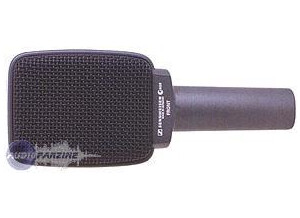
    The Sennheiser E 906 is a marked improvement over the E 609, already a fantastic microphone. In this review, I will go into why it is. The Sennheiser E 906 is a dynamic microphone designed for picking up the sound of a guitar amplifier. It is supercardioid, which means that it has an extremely tight pickup pattern, so when using the E 906, you will never once have to worry about bleed or the sound picking up anything else. The Sennheiser E 906 has a frequency response from 40-18,000 Hz, so it naturally has a bit of an advantage over the mainstay Shure SM57 when it comes to clarity and detail. What makes the Sennheiser E 906 special, however, is that like the E 906's little cousin, the Sennheiser E 609, it is shaped and engineered specifically to have low profile. It is side address, and very flat, meaning that especially on a crowded stage or in a crowded studio, no one will ever have to worry about kicking the guitar amp microphone and ruining the sound of the gig. People often thread the XLR cable through the handle of the amp and hang the E 906 from it, which is especially easy if you tip your amp back like a normal person. What makes the E 906 special over the E 609, however, is its switch that invokes either flat, smooth, or bright sounds. This makes the E 906 more versatile, and it captures percussion and horns just as well as it captures a guitar sound! OVERALL OPINION The Sennheiser E 906 is an improvement over the E 609 microphone, which was already an improvement over the SM57 when it came to guitar amps, What I did not see coming, however, was the E 906's ability to mic up other sources as well, making it markedly more versatile than the E 609. For a little more money, you have have a little more microphone, and I think it's worth it.

  • joshsound's review

    This mic is a very low cost, very good sounding mic, but only for very specific applications. It is a side address dynamic mic by Sennheiser which was designed to be used to record loud, mid-heavy heavy sources. Obviously the major intents are going to be guitar cabinets and horn instruments. The pickup pattern on this mic is a supercardioid, so there is some very steep rejection of the sides and back on this mic. You will get a very defined picture of your source, which is great since you often want to have a very isolated sound for your guitar and horn tracks. It has a great SPL handling capability, so you can crank your amp all the way up without breaking this mic up. It doesn't have a low-roll off or a switchable polar pattern. The output tends to be a little low, so it seems like a pad is not necessary even though this mic is meant to record loud events. You will connect this with an XLR cable and you don't need any phantom power. As for the sound, think of an SM57 but move the focus of that mic an octave lower. This mic is great for when you want guitars to sound powerful, because it really makes the mids and low mids sing. The SM57, which is usually the traditional guitar amp mainstay, can make isolated guitars sound a little hollow at times, whereas guitars through this mic are much more full. OVERALL OPINION I used this mic at a friend's home studio and was not expecting much, but I was very surprised at the great guitar tone we were able to get very quickly. Actually, the sound coming out of the amp itself was not nearly as nice as what came through the mic, so you could definitely argue that the frequency curve of the mic itself is like a nice EQ for electric guitars. It is only around $100, and it's very handy for guitar tracks and the occasional trumpet solo. I recommend checking it out.

  • « Best on Snare and Floor Toms »

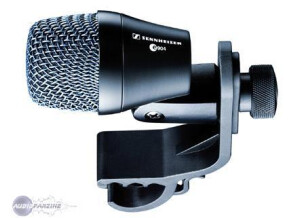
    Back in December we ordered the e604 3 Pack for drum recording. The e604 is a smaller microphone that is very portable and reliable. Its small and flexible enough that you can move it around pretty quickly and easily from drum to drum. The e604 sound its best when used on a snare and the larger toms. It comes with a clip so you can get it pretty close to the source (drum head). The e604 is better than most of the Shure SM line of drum microphones because of the sound quality and the price. I was able to get the 3 pack of the e604’s for 350 dollars last year. We have been using them a lot since then and never had any issues with them. There is no feedback and the amount of noise is very low. I have never used the e604 in a live setting, mainly just in a recording studio or home setting. OVERALL OPINION The sound quality of the e604 is very good when used in certain situations. I don’t think it’s a very good microphone for some of the smaller toms, but for the larger floor toms it is great, and the snare. I am happy that I spent the money to get three of these. We can move them around very quick, and it’s a huge plus that it comes with the clip. I have tried many other similar microphones and some of them where pretty good, but they cost a lot more than the Sennheiser e604. If you are looking for a great drum microphone then look no further. The e604 is a must have if you are a drummer looking to record simultaneously. I don’t recommend getting just one of these, you mine was well get the 3 pack and save money rather than just buying one separate. You will be able to mic your whole set up quickly.

  • « An affordable and surprisingly good sound. »

    Sennheiser has always had a fairly good reputation, there are several Sennheiser mics that are literally studio staples now. The Evolution series 825S was an instant classic for me. I first used these right when the Evolution series was first launched. At the time I was working as soundman for a jazz club. I must admit at first I complained to the owner, "Why didn't you buy the Shure 58's and 57's that I told you to?" After a few evenings with the E825S's I was completely sold and cursing myself for being a hardnose. Obviously, my first instinct was to use them as vocal mics, but then I started experimenting with using them on piano, upright bass, and even as a drum overhead! All I can say is that I was very impressed with the clarity and durability of the E825S, not that your typical jazz musician is overly rough on equipment, mics will be dropped and cables will be stepped on, yanking the xlr out of the mic. These mics stood up to the challenge and have won a special appreciation from me as being a very solid choice for live situations. At the time, through a special arrangement with certain groups and the management, I recorded many, many live performances and the E825S always held it's own. As a standard cardioid mic it's clarity is impressive, I always ran it through an 'almost' limiting compressor and it produced a very warm, rich vocal sound every time. Dare I say, if given the choice between a 58 or the E825S, I honestly would choose the Sennheieser. Sorry Shure!! Have you ever had a screamer in your studio? The kind of guy that you wouldn't trust to even look at your nicer condenser mics? Well, in most cases that's where your trusty standard cardioid mics come out to play. Give the man a E825S and let him scream and spit all over it, it can take it, and still sound pretty darn good too. OVERALL OPINION Overall, the E825S is a really solid choice for live applications and can come in handy in the studio. In my opinion it's better than the Shure 58 for vocal and it can hold it's own on snare and toms. For a musician or club owner on a budget it's definetly worth buying one or two, you may very well find yourself buying some more.

  • « price »

    This mic is a pre polarized mic that has a half cardioid pick up The mic is rather expensive to me and can cost over 300 dollars brand new and I don’t believe that it provide quality that is worth that amount of money. There are other mics in Sennheizers line of mics that are better and cheaper than this one. This mic is an ideal mic for like a open area, this is not a studio mic so don’t think you can purchase it to use in yoru studio. This is more for a speech situation or maybe to record some real piano’s in an open space it just doesn’t perform that well to me in a confind studio space. I have tried using it in a small studio and it recorded but when using it on a stage in a auditorium you will really be able to pull all of its capabilities out. But like I said the price isn’t high, but its too high for the quality of the mic. OVERALL OPINION It does have a good frequency response to pick up instruments and can be used on vocals as well for stage and shows. When purchasing it you will get a manual, which is easy to understand and you really wont need It because if you purchase this mic then you know what you are purchasing it for so no need to pick up thte manual. It will also come with a pouch to carry it in. the mic wasn’t as big as I thought it was going to be which is a good thing since I travel a lot and picking up piano’s was a breeze with it. The E 912 is a good mic in the end. I just feel like it should be a little cheaper than 300. It should be more in the range of 200 -230 and that would make me respect it a little more. But you wont be un happy if you get it. It does sound great.

  • « Sennheiser E865 »

    Sing. Got this used Sting Signature E865 over Ebay for about $140 as the principle mic to replace the wirelesses. Not knowing which was better, I also got a Shure beta 87A for about the same money. Both are top of their line condensers and I expected them to sound and work alike. But no! Even without comparing, the Shure was a toy, unpleasent to use. When comparing, the shure was trash: The Sennheiser E865 has execellent, uniform, and sensitive pickup that does not varies too much with the distance from mouth. I have amazed friends who told me they like this mic, totally on their own initiatives. The Shure Beta 87A sounds weak when farther and sounds harsh when close. It is very sensitive to distance that you must hold it very steadily. It has a slim handle that may not be comfortable to hold. One person prefer this one because of its high frequency emphasis. Nothing wrong about this one. Good metal construction. For professionals. This review was originally published on http://www.musicgearreview.com

  • « for clean vocals »

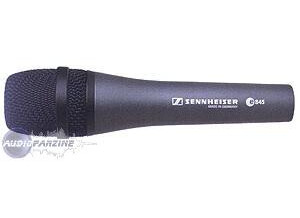
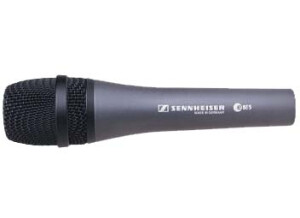
    The Sennheiser E 845 S is a very nice looking vocal mic intended for the stage. It is very stunning to look at as a throwback to the retro mics of the 50's and 60's. You would expect to see Elvis grabbing one of these and singing into it. Apart from the extraordinary appearance, it is actually not a bad mic for live purposes. I find that it sounds very similar to the Shure SM58, and I would not be surprised if it is actually the same cartridge inside. This is a dynamic mic and you don't need any phantom power for it. It will connect with a standard XLR cable. It doesn't have a low cut filter switch on it, but the frequency response definitely seems to drop off fairly quickly below 65 Hz or so, so one is not very badly needed. It is a cardioid pickup pattern, so you will get the rejection you need for this perform well on a stage. One handy feature that it has apart from turning heads is the on/off switch. I think those are very underrated for live vocal mics since they come in handy all the time. OVERALL OPINION I bought this mic many many years ago when I was doing more gigging. I thought the sound was definitely passable for a live club setting, and the fact that the mic really caught the eye was a nice bonus. The frequency response is tailored for vocals, with a presence peak for intelligibility and a low roll-off to reduce rumbling. You end up with a pretty full and even sounding vocal coming through this which your live engineer will appreciate. These will cost you around $150, which is not much more than the similar sounding SM58. I think it's worth it and a good value. I'd get it again.

  • Deleted member's review

    The Sennheiser E 945 is a microphone that sits at the top of this range of microphones. In a nutshell, this microphone probably is the best of them. Read on to find out why, everyone! The Sennheiser E 945 is a dynamic handheld microphone designed for use with live vocals. The wonderful thing about the E 945 is that it has a supercardioid pattern, which, to be fair, is not so terribly rare these days, but it is worth mentioning because I personally prefer using supercardioid microphones to cardioid microphones for their rejection characteristics. Also note that this means that the microphone is no good for group vocals at all, because of how narrow their pattern is. You may be thinking, "These types of microphones are not designed for that anyway!" and you may be correct, but it does not stop them from being used in these ways anyway. The SM57, for example, can work on group vocals quite well when needed. The Sennheiser has a nice frequency response of 40-18,000 Hz, which is typical in this line of microphones, and superior in this range compared to the other brands' competitors for the most part. The microphone is also advertised to give more gain before feedback, and when testing this, I can confirm this is actually quite true, so if this is an issue, this microphone is one to consider! OVERALL OPINION The Sennheiser E 945 is a wonderful microphone for the price. Sure, it may be more expensive than the industry standards, but there is a tangible reason for it. The industry standards are workhorses, but vocal microphones are specialist microphones, and thus, I have only tested it on vocals. I am not sure whether these will fill a workhorse role as well as the venerable Shure models, but it cannot hurt to give it a shot if you really need a vocal microphone anyway!

  • FP User's review

    The mike came with a neat little pouch and its own head for a mike stand. £90.00 OVERALL OPINION This mike has a very high out-put, with hardly any noise even when pushed quite hard. The sound is clear and warm and would suit live vocals well. In recording it works well but seems to enhance sibilance due to a peak in frequency response at around 5khz. It works quite well on acoustic guitars, yet its frequency response only goes as high as 16khz. A harmonic exciter lifts it nicely and sounds fine. Just plug it in and away you go! The manual gives you a detailed map of the frequency response. This is really a hardcore giging mike, I reckon it would take a good knocking around without giving up the ghost. Its feel and look is very solid. Its streamlined look and bullet grey metal body oozes quality! I love this mike, its helped me record many a song and will help me record many a song in the future. Originally posted on FutureProducers.com Posted by: Unknown (January 0-, 2002)

  • « Not for live use! »

    The sennheiser e815S is a dynamic vocal microphone that is very affordable only costing 130 dollars for the 3 pack of them which is what I bought. At first I thought I was getting a great deal on a great microphone but after using them I noticed they were not very good with handling stage noise. I ended up returning them about a week after I purchased them because if they cannot handle stage noise then I will have no use for them. OVERALL OPINION If you are in a completely silent room using them the sound was not too bad, but in a real club or night scene using these sounded awful! It was a good thing that we also do a quick run through before we do the real show; we had a chance to use them with just some general bar sounds going on in the back ground it picked almost everything up. We knew that we could not use them when it came time to go live so we sent them back and got a refund. These would be great practice mics because they are small and have decent quality but if you want to use them for performance I just don’t think it is possible to use them because of everything they pick up. It will make you sound horrible using these on a stage with noise going on all around them. I do not recommend getting these for live use, I do however think it is a great practice microphone and if you are getting 3 of them for that price it is almost a steal. Just do not use them for a real live show or it could end your career quickly. On the upside they do have an on and off switch on them and they are rugged and built to last.

  • « For your low frequencies »

    If you are in search of a great sounding kick drum or bass microphone then the Sennheiser e 602 II will serve you right. It cost under 200 dollars and has a fast response and low frequency extension. If you have a bass instrument or a kick drum that has that really low frequency this is the microphone to have that will pick it all up. It has a cardioid pick up pattern and it is a very rugged microphone. When its all said and done, it will depend on the angle that you have the Sennheiser e 602 II pointed toward your instrument or kick drum. If you find that sweet spot (on the kick drum) it will really give you the punchy sound and make those low frequencies pop. You will really tell when you listen to the play back of what you just recorded. We have used this microphone for about 4 long years now off and on depending on where we are recording at. OVERALL OPINION The ability to pick up those really low frequencies is the Sennheiser e 602 II finest quality. I don’t have anything bad to say about this microphone. It is very rugged and is made to be dropped a few times. We are very happy that we chose to use this microphone and after using it for 4 years we still have it and still use it, it sounds and looks brand new. I recommend getting this microphone for your kick or bass instruments if you really want those low end frequencies to pop in your mix. The sound quality for the price is un-beatable, a microphone this good could easily cost around 300 bucks today. You can compare this microphone to the D112 but I still think the Sennheiser e 602 II sounds a lot better even though they have similar specs.

  • « good horn mic »

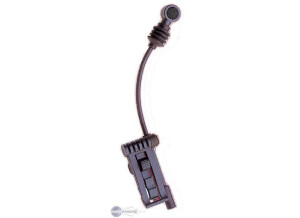
    \the E 908 B is made by Sennheiser and this particular mic is pretty expensive but it is a special scenario mic. Its mainly for Saxophone and a few other wind instruments. I have seen a few mics being used by saxophones and other wind instruments and comparing the E 908 to those I would have to say that it is better than the rest. It will give you a crystal clear recording very easy. The mic is rather expensive but if you are a sax player or in a band then this is a must have. You cannot purchase a cheap mic and expect great results. This mic is perfect for live jazz bands as I have see and used it several times in that situations. OVERALL OPINION It does have a shock absorber that will get rid of any handling noise or noise from movement of your instrument. When you purchase you will get a pouch or carrying case to keep it in and a clamp for it to go onto your sax. You will get a manual but you wont need it unless you don’t know how to clamp a mic to your horn. Great sound quality , one of the best sax mics that I have ever heard. It does cost more than 400 bucks though. Which really isn’t a lot when you look at similar mics, and when purchasing a sax mic you don’t want to take that decision lightly. You will need a good mic to carry your sound throughout the room and make it sound very clean and clear. This mic does require phantom power and it comes with the phantom power adapter so you wont have to worry about that. This mic is ready to go right out of the box , just clamp it and start playing. Its great in live situations.