Log in
EN
FR

Ross

Series

45 products found

Categories
Series
Filter
Sort by
Evaluation
  • Reviewed or not
  • Editor’s award
  • Reviewed by Audiofanzine
Availability
  • Available or not
  • Sold new or used
  • Sold new
  • Sold used
Must-have products
  • All products
  • Flagship products
  • Best rated products
  • Hot products
  • Popular products
Price
  • Freeware
€
Clear
Sort by
  • Popularity
  • User ratings
  • Price - low to high
  • Price - high to low
  • Used price, increasing
  • Used price, decreasing
  • Name (from A to Z)
  • Name (from Z to A)
  • Added on
Choose a series
Sort results
  • Popularity
  • User ratings
  • Price - low to high
  • Price - high to low
  • Used price, increasing
  • Used price, decreasing
  • Name (from A to Z)
  • Name (from Z to A)
  • Added on
Filter results 45 results found
Evaluation
Availability
Must-have products
Price
  • Freeware
Show results

The best Ross reviews

The reviews Audiofanzine members found the most helpful.
  • moosers's review

    The Ross 15 Band Stereo RX15S is a dual channel graphic equalizer, with each consisting of 15 bands. It's an analog piece of gear, although I'm not sure what years these were made for. I also don't remember the connections on it, as the one I've used was hooked into the patch bay for making connections. It is rack mountable and will take up a single space in your traditional rack casing. UTILIZATION You don't need to have too much experience or knowledge about sound in order to use the Ross 15 Band Stereo EQ RX15S, or at least I've found it very simple. Beyond the 15 bands on each channel, there is a low cut and an in/out button for each as well. That's everything there is to know about the RX15S, or at least on paper it is. I haven't seen a manual for this, so I can't say anything about it. SOUND QUALITY The sound of the Ross 15 Band Stereo EQ RX15S is about average, as it isn't bad but also isn't anything special; it is what it is - a 15 band stereo EQ. It's really what you do with it that counts, although here they do make it very easy. It's not the cleanest EQ in terms of sound, but sounds good enough for making simple moves, either for live sound or in the studio, although I believe it would be better suited for live sound, even though I've only used it in the studio. OVERALL OPINION While I don't know that it would be worth it to seek out the Ross 15 Band Stereo EQ RX15S, if you do come across one at a cheap price, it's worth considering if you're looking for a graphic EQ. This isn't very much different from most of the other graphic EQ's out there, but while it doesn't stand out, it is pretty good at what it does...

  • mooseherman's review

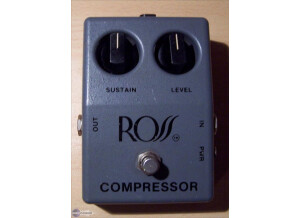
    This is one of my favorite compression pedals out there. It's a relatively simple pedal, but it will cover a broad spectrum of good-sounding compression. There aren't any modern additions to this thing, it's pretty old and usually hard to find. No MIDI, no audio ins/outs, and no computer editing. This is a pedal, and as such is not rackable. UTILIZATION The editing of these effects couldn't be simpler. There are only two knobs on it. I've lately gotten more into pedals like this, I tend to think the lack of too many precise controls is liberating. That being said, you better know exactly how it's going to sound with your setup, because it's not exactly the most versatile thing in the world. It's simply a question of really knowing whether or not this is going to work. SOUND QUALITY It's got a great sounding compression that really brings one back the old days. There's a point where I realized the reason I wasn't very good at getting jazz tones, live and in the studio, was because I didn't have the right setup. A barely-there helping of compression can help correct this issue for many people. It should never squash the dynamics forcefully, but if it minimizes the distracting elements of a flubbed not or a volume discrepancy. I think this is a great choice, mainly for jazz and blues, and perhaps some country although I haven't used it in that context. OVERALL OPINION I definitely like the real tame quality of this compressor. I don't always need my compressor to squash everything I own. This is actually better for just getting a little more sustain and evening things out a little bit. It's really expensive, and it's mostly good for jazz blues and light rock, so I'm thinking, demographically speaking, most interested buyers are either gonna be older amateurs (with other jobs), or pros. Either way, probably a good investment. I think rocker kids should avoid it, for there is not much for those kinds of players here.

  • « Ross RG 10 »

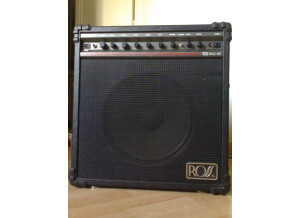
    Bought the amp second hand; it was really old, but was in mint condition and was really great. Paid about £100 for the lot, which is an amazing price. I dont think they make these anymore, so it was great to have found one. Was dated on the back too, 12th.June.1990. It's immensely powerful for its size. Its an old TubeBlaster, so is really good quality too. So much noise for such a small amp! Also it has a line out on the back, so can be hooked up to another amp, cab, or mixer.. even directly into the PA! Good controls too; quite good control over treble, middle, bass, + the volume, drive, and master. Ive never had any trouble from it at all. Only problem with it is that its obviously quite old, but the quality hasnt actually deteriorated in my opinion. Also, the distortion is very fuzzy; I just plug in my Digitech RP, which is a sound processor pedal, so the clean setting is all I need really. Its a tube blaster so its got glass inside.. apart from that its really sturdy and strong. Great because im frequently carrying it across distances. Its got some sort of very strong plastic which is rounded over each corner, and the main body is kinda cool... its really strong but im not sure what it is, probably a mixture of things. I absolutely love this amp, its so powerful and yet small and portable. About 14"x13"x7" i reckon. I could use this amp all the time. This review was originally published on http://www.musicgearreview.com

  • moosers's review

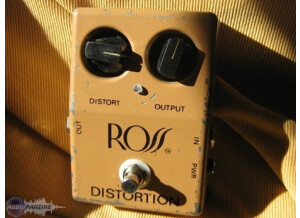
    The Ross Distortion pedal is a simple effect that can be used for any electronic instrument, but will be most often used for electric guitar. This is the only application that I've used the pedal for, although you could definitely use it for bass, keyboards, or another electric or electronic instrument if you wanted to. It's got 1/4" connections for your instrument input and amplifier output, as well as a jack for a power supply, although it is the mini plug type of jack for the power supply. It isn't rackable as it is a pedal that is controlled by your foot. UTILIZATION The Ross Distortion pedal is really simple, so there isn't too much that you need to know in order to use it. The only two parameters that it has are for distortion and level. Even if you know nothing about distortion pedals, you should be able to figure out how to use this without any help from a manual. SOUND QUALITY The sound quality of the Ross Distortion isn't outstanding, but it's definitely more than useful. It's fine for use either for live shows or in the studio, but there are definitely better sounding distortion pedals out there with more versatility. Having said this, it is possible to get both heavy and more subtle overdrive sounds from this pedal. I would say that it's best at getting a thicker type of sound somewhere in between a heavy distortion and an overdrive sound. OVERALL OPINION The Ross Distortion pedal wouldn't be the first thing that I would recommend if you're looking for a distortion pedal, but that doesn't mean that it isn't a good pedal with it's own color. I'd say that it is most useful as an extra distortion color rather than a go to, main distortion pedal. If you're able to find one, I'd definitley recommend checking it out, as it should generally be cheap enough where it might be worth adding to your rig...

  • moosers's review

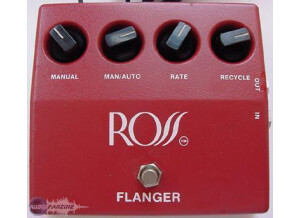
    The Ross R60 Flanger is a vintage guitar pedal, that is usable with any electric instrument that you'd want to use it with. I've only used it with electric guitar, so I'll be focusing on this application of the pedal. This is an analog pedal, consisting of 1/4" connections for your input and output. This isn't rackable as it is a foot pedal. UTILIZATION The make up of the Ross R60 Flanger is fairly easy to follow, although it did take me a little bit of time to get used to the parameters since they aren't exactly traditional for a flanger. It's got four knobs for manual, auto/manual, rate, and recycle. It's hard to describe what each of these parameters do without actually listening to them, but more or less they do what you'd expect for a flanger pedal. A manual might be a good idea for a new user, but I haven't seen it so I can't comment on it's configuration. SOUND QUALITY The overall sound quality of the Ross R60 Flanger is really quite good in terms of the different flanging effects that you can get. I've used the pedal with a Fender Stratocaster and a 1976 Fender Twin Reverb amplifier for a recording session. We were only using this pedal, with no other effects in the mix. I do however, notice that we were losing a good amount of signal with the pedal in the chain. This wasn't too big of a deal for recording as we could just turn it up when we needed to, but it's never good when a pedal kills your signal. I could definitely see this being a problem for live shows more than in the studio. OVERALL OPINION The Ross R60 Flanger definitely has a 'classic' sort of sound, consisting of a good amount of a warmth and fullness to the sound. While perhaps not the cleanest sounding flanger out there, the vibe of the pedal more than makes up for it. The only real downside to the pedal is that you'll lose some signal when you're using it, but besides this it's a great pedal. I'd recommend checking it out if you can get your hands on one, but there are plenty of other flanger pedals out there if you can't. I wouldn't stress on getting this one, but it's definitely a good overall option if you're looking for a vibey flanger pedal for guitar.