288 Connected   /   Login   /   Register !

No Parent Category   Products User-reviews
Add a user-review
Godin Signature Series - LGX-SA 3-Voice
By RickD on 04/16/2008 at 16:43 Serious about music, want to make it your profession.

Characteristics  
- In What Country was it made? (USA, Japan, Mexico, France...)
I believe this is Canadian and possibly part made in the USA but i'm not sure.
Godin is Canadian, though.

- How many frets, Pickup Type and Configuration?
From memory i'd say it's a 22 with jumbo's.

- What type of Bridge(Floyd, Wilkinson...)?
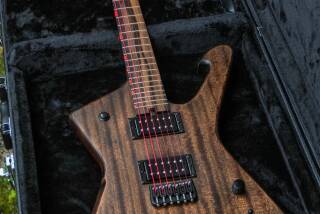
Not sure but there is no tremolo and the strings go vertically through the body for added sustain. This bridge has an integral piezo pickup for the electro-acoustic sound (dedicated output) and a MIDI sensor inside too! Simply amazing!

- What are the setting controls (volume, tone, pickup selector position)?
An amazing array of controls on this magic piece of 'wood'...it's just full of electronics!
Listen up:
= volume & tone for the electric mics, with push-pull on the tone that carves out the mids for a gentler sound, very useful on rhythm. Electric output.
= electro-acoustic preamp with 3 band EQ and volume. This uses a 9V battery, fairly easy to replace but you need a screwdriver. Dedicated output.
= Midi volume and dedicated output. You'd plug this into a MIDI guitar expander, such as the Roland GR series, for instance.

En extra switch lets you toggle what is sent to one of the outputs, so you can mix the sounds inside the guitar!
Another switch let's you change MIDI presets!
Utilisation  
- Does the neck have a nice feel?
The neck is fine! Just the right width for me...easy to play.

- Easy access to the top notes (last frets)?
Yep!

- Is it's design ergonomic(in terms of the shape, weight...)?
It's a bit heavy after a while, and real heavy to carry around, but...well...what did you expect? ;-) Probably no worse than a Les Paul...

- Can one easily get a nice sound?...
Hell yeah!
Sounds  
You can do pretty much anything you like with this guitar, although i would suppose a metal-head would prefer a Jackson or an Ibanez...

You can get jazzy sounds on the right amp, that electro-acoustic feel, or various electric sounds. Put it through a TC G-Force and you'll have an even wider palette to play with...it's a very versatile guitar.

I love that jazzy warm sound you get on a tube amp with the neck mic on and the tone half way.
But this is great too on a british 70's tube amp with distortion on 5 or 7...
Overall Opinion  
I've had it for about 8 years.
The wood used is probably not the best, apparently Godin guitars 'move' a bit with age...so you might want to get the harmonics reset every year or so.

Overall, a fantastically versatile guitar with almost endless possibilities. Probably not the best electric in the world, but pretty damn good i say!
The guitar itself feels precious. You can just FEEL it's a good guitar! :-)

Watch out not to leave the case or guitar in a damp environment. Some of the metal parts on the case have gone rusty...and even some of the less used frets are showing signs of rust. This, of course, won't happen in a normal environment.
[ More info : Godin ]
Epiphone Hummingbird
By goodbyebluesky on 04/16/2008 at 16:08 Music is a hobby.

Characteristics  
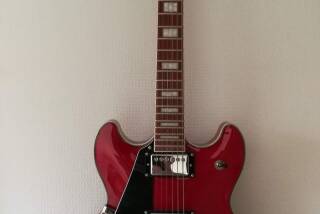
The Epiphone Hummingbird HS is made in China. It has a 25.5" scale with frets. It has mahogany sides and back with a solid spruce top, and a rosewood fingerboard. It features pretty standard chrome hardware, split paralellogram fingerboard inlays, and of course the obligatory brilliant sunburst finish that Epiphone calls "Heritage Cherry Sunburtst" along with funky decorative pickguard. I was quite impressed of the quality of the finish on a 300.00 guitar.
Utilisation  
The neck had a decent feel, nothing spectacular. At least this guitar is built to mimic the more expensive Gidson model so they already had neck specs to copy. Unfortunately, the action on the guitar I sampled was terrible, I mean absolutely dreadful. Anything beyond the 5th fret was increasingly difficult to fret, and playing anything beyond the 12th fret was almost impossible due to the high action.
Sounds  
Even for a 300.00 guitar, I was not at all impressed with the sound of this guitar. It had a "harsh" tonal quality that made me wonder "why?" I mean, its got a solid spruce top, a fairly large cavity to resonate, but you are left with a shrill bottomless tone.
Overall Opinion  
The finish, look, and overall style of this guitar would draw many in. It looks like something your daughter would want for her first guitar based on the grand appearance. Sadly, Epiphone fell flat on every front when you get beyond its looks.
If you had 300 to spend, I would keep looking because there are better playing and better sounding guitars out there in this price range.
[ More info : Epiphone ]
AKG C 3000
By RickD on 04/15/2008 at 01:06 Serious about music, want to make it your profession.

Characteristics  
- What type of microphone? (live, recording, mixed...)
This is mainly a home-studio mic, but i have seen it used live before, on percussion at an African music concert.
It's got an 80 hz high-pass filter, and you can switch between two patterns : cardioid or hyper-cardioid, if i remember correctly. Don't think it has a pad but you might want to check the manufacturer's site to be sure.

- What technology? (electret, condenser...)
It's a condenser, i believe, and so requires Phantom power...
It's a very sensitive mic, in any case a lot more sensitive than any dynamic mic of course, and so if you've got an SM-58 and want to move onto this then you'd better be ready for a big surprise.

It's got foam and a grid to protect the large gold-plated diaphragm but you do need a pop filter with this, and you might want to tilt it a bit to attenuate further any direct wind coming from the vocalist. I sometimes use two pop filters at the same time.

You can modify the mic and remove the inner foam: this supposedly transforms the mic but of course you will then need to use even more precaution when recording.
Overall Opinion  
I bought this in 2000 or so and never once regretted it.
It's a transparent mic, flat across the whole range you can hear...20hz to 20.000hz.
It's very sensitive and detailed, sometimes can seem a bit harsh so if you have a warm preamp you might want to use it in conjunction with the C3000.

You can use this on acoustic instruments, it works just as well as with vocals. I've recorded a cello, violin, wooden ladder (yes, a wooden ladder!), toy keyboard, guitars, flute, clarinet, etc. It's good. On strings you might want to prefer an Audio-Technica ATM-33 though, that works wonders on violins & cello...but the C3000 is good for pretty much everything.
It's unforgiving and don't expect that flattering high-end from this mic, but if you're looking for a real good all-rounder and you have a sound-proofed room then this is definitely worth considering.
[ More info : AKG ]
dbx 286 A
By RickD on 04/15/2008 at 00:50 Serious about music, want to make it your profession.

Characteristics  
This 100% analogue, there is no digital circuitry involved at all.
And so it's perfect if you have a digital recorder: compress the signal and add the gate before you go into the digital domain and you end up with optimal use of the dynamic range in your recorder and pretty much no noise at all.

XLR and TRS input.
XLR and TRS output if i remember correctly.

Preamp, compressor, deesser, enhancer, gate. It does all of those very decently for the money, by the way.

It's a normal 19 inch 1 unit rack.
Utilisation  
You can't get much simpler than this: compressor has only 2 settings but in 7 years i never found that a problem. Used mainly on vocals and acoustic guitars, the unit did a good job and the gate worked great.
You have to be careful with your settings or you'll bring up hiss (enhancer and compressor). The unit is not exactly silent when you turn everything up but if you stick to the preamp then there's not much you can complain about.

Never needed the manual and when i sold this on, just recently, i realized the manual was perfectly new. I doubt the new owner will need it either...
Sound Quality  
This is budget product so don't expect miracles, but if you can't produce decent results with this then you need to learn how to use it! The sound is fine, it's just not going to rival with much more expensive gear, which is obvious anyway.
Overall Opinion  
Took me a looong time to outgrow this!
It's an excellent swiss knife, it's just not the best knife or the best corkscrew.

If you want to upgrade from this, the only thing i can think of is the SPL Channel One...and that is about 7 times more expensive...
I would think the DBX286A is a very very good starting point and i don't regret the purchase at all.
[ More info : dbx ]
TC Electronic G-Force
By RickD on 04/15/2008 at 00:36 Serious about music, want to make it your profession.

Characteristics  
This is a stereo preamp (with adjustable input gain on the front) with all the main guitar effects except a proper distortion. The flangers & phasers are lovely and the delays & reverbs are wonderful.

It's digital, of course, with 8 processors, 1 per effects module. So, unlike with other gear, you don't have quality loss when piling up effects, the quality remains optimal throughout.

2 high impedance asymmetric 6.35mm jacks, 2 line level TRS outs on similar jacks.
SPDIF in & out on coax.

24 bit 44.1 khz conversion, but not sure the digital I/O's can convey 24 bit signals...someone told be that they were 20 bit...(check that, i'm not sure).

There's MIDI in & out i believe, and you can easily set up a MIDI pedal board such as the Roland FC-200...the G-Force has a ready made template for it all set up.

For the price, i think they could have made this a 96 khz machine and/or have AES/EBU I/O's in addition to the SPDIF coax...it's just not a pro machine without AES/EBU!
Utilisation  
Extremely easy to use, all is very very intuitive. You can see it wasn't designed like a TR-505 or an MC-303! :-D

Editing & saving presets is real easy.

Great manual, that is even nicely made...not just some cheap photocopy look-alike, this is nicely bound & all...a high-class manual for a high-class piece of gear. ;-)
Sound Quality  
The effects are nice but you can be tempted to overdo it...because they are so nice!
Then again, you'll have that problem with any effects processor...it's just that the others don't sound so good! ;p

The reverbs are amazing, of course, and you can use this for vocals or anything you like if you come in digital.
This is a very good effects processor.

The dynamics are good but not perfect: i still prefer going direct into a good amp, but if you accept that the sound is just different then you can enjoy it for what it is. It's still good, it's just not 100% the same...maybe only 95%? Anyway, incomparable with any Boss or Roland or Digitech effects i've tried...and i have tried a lot of those. True, the price isn't comaparable either! ;-p
Overall Opinion  
I've had it about 7 years.

Best thing? Everything!
Worst? No real distortion. You can add crunch, or boost existing distortion, but this is not a SansAmp or a POD...no cabinet simulation here worth mentioning, that just wasn't the aim of the machine...but you want those luch choruses or reverbs then this is the way to go.

Was 11400 Francs when i got it, that was the best price in France at the time...say £1140 or 1700 €. Now it's below 1000 €. Still expensive, but possibly the best for the money. The price actually remained stable on this for 6 or 7 years i believe! The only other piece of gear i know of to do that is the Roland VS-2480 multitrack recorder...which stayed at 4500 € in France...
[ More info : TC Electronic ]
Roland VS-1680 VXPANDED
By RickD on 04/15/2008 at 00:13 Serious about music, want to make it your profession.

Characteristics  
- What connection types are there(analog, digital, MIDI)?
Inputs: 2 XLR, 6 TRS jacks (that's symetric...), digital SPDIF coax & optical (Toslink, not ADAT), RBUS (Roland proprietary interface that allows for the addition of various expensive boxes...such as extra analogue inputs or ADAT), MIDI in and out if i remember correctly.

- what is the sampling rate (bits/kHz)?
Good question. The machine is 24 bits, they say, but the converters are only 20. BUT this gives you extra headroom at mixdown, i think. No higher than 48 khz, but you can go down to about 32 khz, which can be useful to create different pitches without the use of a pitch-shifter: record at 32 and playback at the regular 44.1 or 48 and you get that funny high-pitched voice you used to get when playing an LP at 45 RPM.

- What storage format is used (ZIP, MiniDisc, hard disc...)?
2 GB internal IDE hard drive. Now you think that's small, it isn't. You can record a whole album with virtual tracks and still have space left. If you want, you can replace this drive with a 40 GB i believe.

- What types of synchronization are supported?
You cannot set the SPDIF to use external or internal clock: so if you can't set the device you're connecting to digitally you can end up having problems. For example, if you use a TC Electronic G-Force as an effects loop, you can't do that digitally unless you add a third device in the loop, or the VS will try to lock onto the G-Force while the G-Force is trying to lock on to the VS. I added in a Minidisc player with optical and coax inputs and it worked fine.
As far as pure synchro goes, you have MIDI and i think various modes exist in the menus but i never needed them so i can't remember.

- How many tracks can be recorded/read simulaneously?...
8 in compressed modes, 4 in linear mode. However, the Roland compression is a 3 to 1 lossless compression-decompression so i'm not sure there is much point in using the linear mode. Use 'MTP' mode.
You can playback 16 and 2 mastering tracks exist, so you can bounce these 16 to a virtual couple of extra tracks.
========================
You have 8 outputs on RCA connectors that can be used as direct outs. You can freely assign signals to these, and you can send what you want to pretty much any track or output too. Same for the monitor outs and headphones. It's a powerful mixer.
I put 8/10 cos the analogue outs are not symetric (which they are on the 2480), and that's a shame. Also, would have been good to have 2 digital ins that can be used at the same time, here you must choose between optical and digital.
Utilisation  
- Is the general configuration/setup simple? - Is the manual clear and sufficient?...
Takes some getting used to, hardest thing to understand is the routing (as for the 2480...which works differently again, eeek!).
But the manual has a very clear, step by step approach, so you can't go wrong.
Overall, it's an easy machine to use, i find.

- Are the typical functions easily accessible?
Yup. One button gives you access to input or channel settings. Other features also have dedicated buttons.
Sounds  
- Are the A/D and D/A convertors transparent?
Sound ok to me! I usually bypassed the pres and A/D's though, and came in digital. That does definitely improve the sound if you're using some high-end piece of gear to do it with...
I'd recommend a high-end pre and compressor with a digital out.

- are the effects and filtres good?
The EQ is not so efficient or nice, but the onboard effects (optional with the VS8F-2 and VS8F-3 cards -- the latter takes third party VS plug-ins) are very useable.

- Are the dynamics respected?...
You've got to be careful not to reach that 0dB mark, of course, but if you avoid that then all is well, and you can make some very decent recordings indeed.
Overall Opinion  
I used it for about 7 years and just moved up to the 2480.

Best thing? Portable, reliable, NO LATENCY!!! Go find that with a PC...call me in a 100 years when you've found something... ;-p
Can be used as a control surface for a PC too...although the faders are not motorized...

It's a complete box that will do everything. Probably the best 16 track portastudio ever.

Worst thing? The software is obsolete compared to PC's...you can't use a proper screen like on the 2480...or a keyboard or mouse...
The options are too expensive...

The price when new was about £2000 / 3000€. That was with the external CD burner (which you desperately need) and a couple of effects cards, ie complete. That was not cheap, but was the best value at the time. Now second hand the machine is an amazing deal, and definitely worth having as a first. It's cheaper second hand than my 8 track cassette machine was when i got one, about 10 years ago!!
[ More info : Roland ]
Epiphone AJ-200SCE
By goodbyebluesky on 04/14/2008 at 18:39 Music is a hobby.

Characteristics  
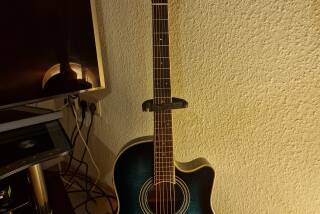
The Epiphone AJ200SCE has a 25.5" scale, with mahogany neck and sides, and solid spruce top. It features an Epiphone-made Shadow pickup and a cutaway for ease in playing higher on the fret-board. The solid spruce top and pickup suprised me to have both of these features on a guitar that retails under $300.00.

I didn't particularly enjoy playing this guitar. It did not inspire my playing in the slightest, and I had no problem putting it down after a short bit of playing.
Utilisation  
The neck had a nice feel to it, a good thickness and nice-feeling radius for string-bending and single-note runs as well as chording. The cutaway allows great access to the upper fretboard when you desire it.
The tone and overall sound did not initially impress me.
Sounds  
While this guitar boasts a feel and ease-of-play that is rare for this low of a price range, its sound did not impress me in the slightest. It sounded muffled and lacking the volume and projection I would expect of a full-size guitar such as this, although new strings could have revived it a bit. The sound was balanced; not harsh in mids or shrill in the highs, or boomy or muddy in the low end. But it was lacking in dymanics, responding very coldly to my finger picking and varying pick attack.
Overall Opinion  
Overall, I was just unimpressed and uninspired and I am aware of a few other budget guitars from Takaminie and Seagull that just simply perform better than this one, hands down I'm sure if one looks hard enough and plays enough guitars they will find one that suits them better. I really wanted to like this guitar, with a solid spruce top, a great feeling neck, and decent action but I can't give it better than a 5 out of 10
[ More info : Epiphone ]
Zildjian A Custom Ping Ride 20''
By goodbyebluesky on 04/14/2008 at 17:15 Music is a hobby.

Overall Opinion  
I used this 20" Ping Ride from the A Custom line for a short while.
I'm not typically a fan of ping rides or dry rides since I've come to like (and expect) a good wash underneath the ever present "ping" of a ride cymbal. So I was pleasantly suprised with this cymbal. It is fairly "wet" for a ping ride, so you get a nice low to moderate "wash" or "shimmer" underneath the ping. I've compared this cymbal side-by-side with Zildjian's K Custom Ping Ride, and the K is markedly drier and has significantly less capability to produce a noticeable "wash" underneath the ping than the A Custom will produce when you induce it by playing harder and further out from the bell. In other words, the wash is there when you want it.

I had no problem getting excellent stick definition playing complicated patterns anywhere "in the field" of the cymbal while still getting a gentle wash and sustain underneath it, which pleases me and my playing style greatly.

My only dislike is the small size of the bell, although you can still get plenty of "ping" almost anywhere on the cymbal.

I think this cymbal is versatile enough for use in multiple styles. Its well suited for heavy rock music since it has a good density and its well-definied "ping" would do a good job of "cutting through". It could also be adequate for modern jazz or fusion style music since it has a fairly "wet" sound. I would also reccomend checking this cymbal out side-by-side with the 22" version to see if the larger, more expenzive one is better for you.
[ More info : Zildjian ]