- Short-cuts : Products
- DJ Gear >
- Hi-Fi >
- Resources >
- Misc. Products >
Ibanez TS-9 Robert Keeley Baked Mod
By Rockmonster on 03/24/2008 at 04:23 Serious about music, want to make it your profession.
See all user-reviews
Hmmmm..let's see... All analog, improved bypass,chip, capacitors,filaments, etc. classic overdrive reissue pedal. Good old fashioned ingredients. Texas Instruments integrated circuit. A buncha other stuff I have no idea about.
Easy knob twisting...no editing software, rack mounting, etc... just a great clean boost and/or overdrive.
Easy, easy, easy. Twist the knobs. Find your tone. No manual required, but the controls do function a bit differently than a stock Ibanez unit. The range of gain is higher, the level has become more of a clean boost...but..um. Honestly, no manual required.
Great overdrive. I mostly use my amps distortion (Voodoo labs Preamp) with this to push it into molten territory. Adds searing harmonics and "hair" to the signal... On a clean channel, this does add grit...giving a tweed overdrive characteristic...in front of my rhythm channel..all the way from Stevie Ray Vaughn to Eddie Van Halen. Lead channel...well, VH to whatever. This pedal is a bit geared toward mid tones, but won't impact your tone negatively if you have dialed your amp into a scooped metal sound.
Using this with a Strat, Les Paul, Telecaster, and some other humbucker equipped guitars, this offers something different with each. My favorite combination is using this with my Strat.. I have a Dimarzio HS-3 stacked humbucker in the bridge for this guitar. You don't typically think of a Strat as a screaming guitar..but this setup rocks. It adds harmonic richness and sustain. I am not one to say "notes leap off the fretboard"... but.. this has sure made them more "jumpy" :b
This pedal, even with the mods adds some noise to my signal, but let's face it. It IS an overdrive pedal...it IS noise!
Using this with a Strat, Les Paul, Telecaster, and some other humbucker equipped guitars, this offers something different with each. My favorite combination is using this with my Strat.. I have a Dimarzio HS-3 stacked humbucker in the bridge for this guitar. You don't typically think of a Strat as a screaming guitar..but this setup rocks. It adds harmonic richness and sustain. I am not one to say "notes leap off the fretboard"... but.. this has sure made them more "jumpy" :b
This pedal, even with the mods adds some noise to my signal, but let's face it. It IS an overdrive pedal...it IS noise!
I've had this pedal for about 4 years. The honeymoon is DEFINITELY over.... and I still love it. Tried a few different pedals before this..this being the only Keeley modded pedal I tried (sight unseen). Mmmm..value, well, that is very subjective. You can get close to this tone without the mods...but let's face it...sometimes it is worth paying an extra 50 bucks to get an extra 7% of tone on an already good pedal...pushing it into an exceptional pedal...
As far as buying a distortion pedal again...I would definitely buy this again..although I may consider the Keeley DS-1 if my financial situation was restricted...it has less of a midrange thing going, and a bit smoother gain...less gritty, but that is more of a distortion pedal..as opposed to overdrive. Hmmm... I might have to go get one anyway!
Eminence Patriot Cannabis Rex
By Rockmonster on 03/24/2008 at 03:13 Serious about music, want to make it your profession.
In search of..... a Great speaker... providing superb balance, smooth response, and most importantly.... those elusive, non-screechy trebles.
Enter the Cannabis Rex from Eminence.Yayyyy! 8 ohms.. but offered in 16 as well.
Using a pair of these in 1-12", closed back,ported birch cabinets with a Voodoo Labs Preamp...Carvin T100 poweramp (SED Winged "C" tubes), Digitech GSP2101 for effects only. Les Pauls, Strat's,Tele's, Yamaha's,Ibanez..I throw a Keeley TS9 and a BBE Boosta Grande in front of the Strat. Sometimes in front of the humbucker equipped guitars when I really want loads of gain. These really do sound great with everything.
Enter the Cannabis Rex from Eminence.Yayyyy! 8 ohms.. but offered in 16 as well.
Using a pair of these in 1-12", closed back,ported birch cabinets with a Voodoo Labs Preamp...Carvin T100 poweramp (SED Winged "C" tubes), Digitech GSP2101 for effects only. Les Pauls, Strat's,Tele's, Yamaha's,Ibanez..I throw a Keeley TS9 and a BBE Boosta Grande in front of the Strat. Sometimes in front of the humbucker equipped guitars when I really want loads of gain. These really do sound great with everything.
After years of the limitations using Celestion's products, I have found a speaker with an e.q. curve that eliminates piercing highs... while maintaining clarity and detail. Yum. I'm impressed. I had basically resigned myself to being stuck with icepick highs, scooped mids and flubby bass. Some of the speakers in my former arsenal were V30's,G12-T75's,G12M70's, even Greenbacks. I found something in the treble registers of all these speakers that could not be dialed out to my liking. Screechy highs. Even changing saddles to string savers in my Strat and Les Paul...changing my stop tailpiece to aluminum.. STILL had too many highs. Something indefinable. Not really measurable on an e.q. curve...but an unpleasant artifact I could not get rid of. The Cannabis Rex is different. Soft midrange.. nice smooth bass response and sweet treble response. Tones you hear on classic rock albums available here. And I'm talking Van Halen 1. With a STRAT.
I find this speaker to be adequate in ALL applications, although Eminence lists it as a "Country, Rock, Jazz and Classical" speaker. Even though that description covers a lot of ground, Funk,Metal,Blues and Fusion should not be left out of this mix. It can do it all.
Using it for about 6 months now. So..the honeymoon is still sorta on..but I feel objective about it. Given that I am a musician...and am always searching for my "ultimate" tone....I give a solid "9"...and really...These will NOT produce the brutality or scooped tone of a Vintage 30 on their own...BUT using your e.q. controls..you can easily dial in an even more versatile scooped tone. Still scooped..but with more presence and girth. The basic sound is so much more versatile..you are not limited to an e.q. characteristic that you cannot get away from. With any Celestion product..I have always fought with the tone. Now I just tweak my sound according to the room..and find those sweet highs that save my teeth from grinding.
A tremendous value at the price. $70.00 as opposed to Celestion V30's or Greenbacks at $110.00.. with twice the versatility (in my opinion).
Of course.. I will keep searching... (yes, it IS a curse
) But these are the best I have heard so far!
A tremendous value at the price. $70.00 as opposed to Celestion V30's or Greenbacks at $110.00.. with twice the versatility (in my opinion).
Of course.. I will keep searching... (yes, it IS a curse
Vox V848 Clyde McCoy Wah Wah
By Rockmonster on 03/24/2008 at 01:42 Serious about music, want to make it your profession.
Classic wah tones. Pure and simple.. at least the closest available using Fasel inductors.. maybe not the EXACT same tone as the original Clyde, but certainly the closest you can get without running the boutique route at about 100+ bucks more.
This is a pure analog device.. pivoting rocker pedal.. True Bypass, shiny chrome.. no modeling,chips or silicone...
No editing options.. Put it on the floor. Step on it. Click the button. Wiggle it back and forth. Yay! It's a wah wah.
This is a pure analog device.. pivoting rocker pedal.. True Bypass, shiny chrome.. no modeling,chips or silicone...
No editing options.. Put it on the floor. Step on it. Click the button. Wiggle it back and forth. Yay! It's a wah wah.
Um.. no manual necessary... no editing options... see characteristics. My kid can figure this out. (of course.. he already thinks he knows everything... so.....
Very sweet. The closest to classic tones available without spending at least $100.00 more. Great midrange manipulation within the lower ranges... it gets a bit screechy in the upper registers. The treble range becomes a bit tinny... almost similar to the high speed pitch shift on a Whammy effect... this can be neat, or annoying. Depending on the application. The best feature of this effect is the fact that it is not a watered down Morley effect.. with virtually no sweep, and tasteless generic flavor ( I cannot speak for the Vai or Tremonti wahs.. just their basic offerings. Never played the signature wahs..) And it is stronger than a Crybaby...(although from my understanding, this is built in the same facility) The recent addition Crybaby Classic also uses a Fasel inductor.. so.. the tones may be similar.. and at only $99.00.. it IS a worthy consideration... unless you need to see chrome on the floor. Whatever does it for you..
I have owned mine for almost 2 years.. and the pots are beginning to get scratchy. Yuck. Used with Les Pauls, Strats,Teles... running thru a Voodoo Lab Preamp, Carvin T100 poweramp, Digitech GSP2101 (for effects) into 2 closed back cabs with Eminence Cannabis Rex speakers. (more on those later
This wah provides realistic, classic tones heard on your favorite albums. As with any instrument.. the more you practice with it... improve your technique and level of control, the greater the sonic reward. It's sweep can be construed as a limitation.. in the fact that it gets TOO trebly, but this can be relegated to a control issue... when you become accustomed to the sweep, it is great to have the "gas in the tank". You may not need it.. or use it.. but it's there!
I have owned mine for almost 2 years.. and the pots are beginning to get scratchy. Yuck. Used with Les Pauls, Strats,Teles... running thru a Voodoo Lab Preamp, Carvin T100 poweramp, Digitech GSP2101 (for effects) into 2 closed back cabs with Eminence Cannabis Rex speakers. (more on those later
This wah provides realistic, classic tones heard on your favorite albums. As with any instrument.. the more you practice with it... improve your technique and level of control, the greater the sonic reward. It's sweep can be construed as a limitation.. in the fact that it gets TOO trebly, but this can be relegated to a control issue... when you become accustomed to the sweep, it is great to have the "gas in the tank". You may not need it.. or use it.. but it's there!
Using this for a bit over 2 years. Love the classic wah tones and True Bypass. For years, the only options where tone draining washed out Morley or Crybaby options..To be truthful, the boutique guys like Fulltone, RMC,Budda, etc did everyone a favor. They raised the bar for quality. The wah had become an almost passe' effect.. brought back to life by the likes of Slash and Joe Satriani..(thanks guys!)... hence, the demand for better quality bypass... and a more pronounced effect.
I don't like the fact that it is getting scratchy...I will investigate my options and try some contact cleaner. We'll see.. should do the trick!
I find the value to be acceptable in the $150.00 price range.. although, being that I am not exactly a "gear snob" I would probably opt for the Crybaby Classic.. which I believe is also True Bypass and equipped with the Fasel inductor as well...At about $50.00 less. Other considerations would be the new Morley George Lynch model wah.. or perhaps the Vai Bad Horsie stuff, although these may not cut it for classic tones.
I don't like the fact that it is getting scratchy...I will investigate my options and try some contact cleaner. We'll see.. should do the trick!
I find the value to be acceptable in the $150.00 price range.. although, being that I am not exactly a "gear snob" I would probably opt for the Crybaby Classic.. which I believe is also True Bypass and equipped with the Fasel inductor as well...At about $50.00 less. Other considerations would be the new Morley George Lynch model wah.. or perhaps the Vai Bad Horsie stuff, although these may not cut it for classic tones.
Basically, I bought the 002 rack so that I could run Pro Tools. I use it with Pro Tools 7.4 with a Macbook Pro (2.2 Ghz Processor, 2 Ghz Ram) and use the ADAT feature to send it to a Behringer ADA8000 for more inputs. I used to have a MOTU 896HD and while I liked that more as an interface, I needed to start using Pro Tools.
It's pretty easy to set up depending on what other things you are using it with. I haven't had any compatibility issues with the interface, although I do have occasional issues with the Pro Tools software. The interface layout really couldn't be easier, plenty of monitoring options. I haven't had a need to ever look at the manual as it was easy enough to figure out.
Using the 002, I've had no issues with latency, but it depends what kind of machine you are running it with. I have heard it doesn't work as well with a PC, but I have no experience with that. As the 002 only runs with Pro Tools, I have had no option of trying it with another type of software. I can run 16 tracks at once, using the 4 built in preamps, the 4 1/4'' inserts and my ADAT external 8 channel preamp.
I've had this for about a year and a half and there is no going back from it. Although I wish it had more built in pre-amps, it does everything I really need it to do (most of which is to run Pro Tools with). The 002 is a bit pricey but since Pro Tools is the industry standard theres nothing that can really be done to control the price of it. All in all, I'm very happy with my 002 and I would recommend it to anyone looking to do multi-track recording with Pro Tools.
The Universal Audio LA-610 channel strip in my opinion is the best channel strip you can get for your buck. Both the pre-amp section and the compressor section are extremely useful. Most of the time I will record using the compression straight to Pro Tools, but many times I'll go back and use the compressor on previously recorded things. It has XLR inputs and outputs and is it rackable.
In terms of ease of use, it doesn't get much easier. The pre-amp has a bunch of equalization options as well as gain and a leveler. The compressor is only two knobs, like the LA-2a which it is based off of. I haven't had a need to use the manual, it is easy enough to use if you have any sort of experience with recording and compressors.
I couldn't be happier with overall sound this thing produces. It sounds great on vocals (I'm using a Neumann TLM103) as well as on guitars and drums. For bass I just plug directly in...I have no need for my direct boxes anymore when recording keys or bass, I just use this. The pre-amp is pretty transparent if you run it with no EQ, but I love having the options of boosting or cutting using the pre's EQ.
I've been using the LA610 for about 6 months. The thing I like most about it is that it is a compact channel strip that I can use over and over again for my overdubs. I haven't had any complaints, although I wish there were some 1/4'' connections in addition to the XLRs. I've used all sorts of other Universal Audio products (LA-2a, 1176, LA-3a, etc) and this definitely can hold it's own. If I lost it or broke it I would definitely buy a new one. Being that I work out of my project studio mostly and I am on a limited budget, I couldn't have asked for anything more.
I purchased this product about six months ago. I was in the market for a drum set and living in an appartment, this seemed like the perfect choice. I looked at the electronic roland drum sets, but they just seemed way too expensive(although the feedback/response of the roland drum sets felt of higher quality and more realistic). This product was the best value that I was able to find for an electronic drum set. I found it relatively easy to assemble and also easy to position the drum heads to suite the needs of the user. The sound bank has many different drum kit sounds and you can plug any of the drum heads into any of the inputs on the control module which allows you to easily switch two pad sounds without re-mountin them. The pedals seem to be good quality although at first it wants to double tap the bass drum when you tap it once with your foot, although with practice this can be overcome. Overall I am satisfied by my purchase. You get what you see when you buy this product. I would reccomend this product to anyone as specially a new student learning how to play the drums.
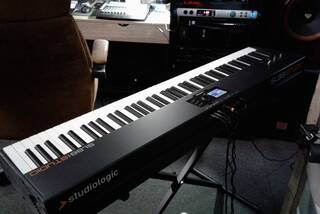
Full 88 key weighted keyboard.
Typical no-frills stereo analog outputs, midi-in, out, through, 2 ports for damper and volume pedal.
Nice, diverse bank of effects which are easily edited or disabled when necessary. 4 rotary controls which perform a variety of functions-octave shift, reverb density, 3 band EQ control, and 2 assignable switches which will do just about anything you need them to do.
Acoustic piano sounds are my first priority and the ones on the PC1X don't disappoint. I wouldn't rate them as the best out there, but they do a fine job of cutting through a less-than-perfect stage mix and crowd noise. Like all stereo acoustic piano samples, they won't satisfy unless they are played in stereo. But, I can always find one that matches the room I am playing in well. Rhodes and Wurly sounds are decent--not the best but decent. Strings are a mixed bag. My personal favorite is the "Intense Strings" patch which is rich and full, with plenty of attack, yet offering excellent dynamics. You can set up your favorite programs from the 6 available preset banks and 2 user banks so that you can access them on-the-fly from their assigned buttons. The PC1X is also very easy to do splits on, as well as layering up to 4 sounds. One of the songs I perform with one of my artist gigs requires 10 program changes within the same song and the Kurzweil gets it done effortlessly.
Typical no-frills stereo analog outputs, midi-in, out, through, 2 ports for damper and volume pedal.
Nice, diverse bank of effects which are easily edited or disabled when necessary. 4 rotary controls which perform a variety of functions-octave shift, reverb density, 3 band EQ control, and 2 assignable switches which will do just about anything you need them to do.
Acoustic piano sounds are my first priority and the ones on the PC1X don't disappoint. I wouldn't rate them as the best out there, but they do a fine job of cutting through a less-than-perfect stage mix and crowd noise. Like all stereo acoustic piano samples, they won't satisfy unless they are played in stereo. But, I can always find one that matches the room I am playing in well. Rhodes and Wurly sounds are decent--not the best but decent. Strings are a mixed bag. My personal favorite is the "Intense Strings" patch which is rich and full, with plenty of attack, yet offering excellent dynamics. You can set up your favorite programs from the 6 available preset banks and 2 user banks so that you can access them on-the-fly from their assigned buttons. The PC1X is also very easy to do splits on, as well as layering up to 4 sounds. One of the songs I perform with one of my artist gigs requires 10 program changes within the same song and the Kurzweil gets it done effortlessly.
The action sold the PC1X to me. It is lighter than a Yamaha, Korg or Roland, and even significantly lighter than it's more developed sister, the PC2x. I could have bought either,but opted for the PC1X because I flat-out loved the performance of the keyboard. I'm 52 and have been playing all my life. I can play just about as fast as anyone, but the Kurzweil's keyboard keeps up with me no matter what I throw at it, yet it is extremely dynamic. To me, it is the single most inspiring aspect of the instrument. If I am doing session work and the producer or engineer wants a piano sound that the PC1X is not capable of, I still use its keyboard to play their sample of choice. I can outrun any Yamaha or Roland, so I hope Kurzweil never lets go of this action. However, if you are a classically trained Steinway fan, you might not appreciate the lighter action as much as I do.
The manual is big and complete, although not always easy for this technophobe to understand.
I think the horns and organs leave a lot to be desired. The strings are deceptive. Many of the string settings don't sound that good by themselves, but most of them sound surprisingly fine in a mix. I've often been amazed by how well some of them lay in a recording mix when I listen to the playback. This makes me believe that there are--or at least were--some brilliant sound designers under the employ of Kurzweil.
The Rhodes samples are kind of funny. It really seems that the PC1X's action sucks as badly as an old Fender Rhodes suitcase piano when using any of the Rhodes patches. I find that the Rhodes and Wurlitzer samples have about a 3 octave limit in the center of the keyboard. If you go beyond that zone in either direction, the sound is both unconvincing and unplayable.
I still manage to glean a lot of inspiration from this board after over 3 years of owning it.
There are several things you should be aware of, however.
1. There is a tiny screen contrast knob on the back of the board, which is very necessary, especially if you are going to be using it outdoors. If you try taking this keyboard to a gig in a soft case or with no case, I promise you that you will eventually break that knob off of the circuit board that it is soldered to. It will get pushed back in to the body and the screen will be rendered unreadable. After the 2nd time this happened to me, I glued a large rubber grommet around the knob to prevent this from happening. I'm not the most mechanically inclined guy to come down the pike, but this girl was a bear to get inside of to solder that control knob back on to the circuit board. It took 3 of us wrestling with it to get the job done. This was a terrible engineering oversight.
2. Another completely idiotic afterthought is the fact that you have to scroll down through 16 pages of the global menu to find the transposer. Fortunately, I can make all the setups I need prior to a performance so that I can just keep the screen set on page 16 of the global settings. For someone who plays with the same band all the time, this might not be a problem, but I have as many as a half dozen different gigs, many times having some of the same songs in different keys. A transpose button is a Godsend in those instances. What were they thinking??
3. You have to periodically go around the keyboard and tighten all the screws. It seems that they come loose rather easily.
4. While I haven't broken any yet, the 4 multi-task rotary knobs I mentioned earlier are very spindly and I know quite a few guys who have broken them off, so that is another thing which requires a little TLC.
Well, nothing's perfect. But, overall it is a great board. Mine is over 3 years old and I will likely buy a new one soon and keep this old girl around for a spare. I ride 'em hard and have put 'em away wet more than once and this one has yet to let me down. Kurzweil has had some hurdles in its transitions between companies, and hopefully they have been able to maintain the integrity. Those questions aside, it's a fine tool.
There are several things you should be aware of, however.
1. There is a tiny screen contrast knob on the back of the board, which is very necessary, especially if you are going to be using it outdoors. If you try taking this keyboard to a gig in a soft case or with no case, I promise you that you will eventually break that knob off of the circuit board that it is soldered to. It will get pushed back in to the body and the screen will be rendered unreadable. After the 2nd time this happened to me, I glued a large rubber grommet around the knob to prevent this from happening. I'm not the most mechanically inclined guy to come down the pike, but this girl was a bear to get inside of to solder that control knob back on to the circuit board. It took 3 of us wrestling with it to get the job done. This was a terrible engineering oversight.
2. Another completely idiotic afterthought is the fact that you have to scroll down through 16 pages of the global menu to find the transposer. Fortunately, I can make all the setups I need prior to a performance so that I can just keep the screen set on page 16 of the global settings. For someone who plays with the same band all the time, this might not be a problem, but I have as many as a half dozen different gigs, many times having some of the same songs in different keys. A transpose button is a Godsend in those instances. What were they thinking??
3. You have to periodically go around the keyboard and tighten all the screws. It seems that they come loose rather easily.
4. While I haven't broken any yet, the 4 multi-task rotary knobs I mentioned earlier are very spindly and I know quite a few guys who have broken them off, so that is another thing which requires a little TLC.
Well, nothing's perfect. But, overall it is a great board. Mine is over 3 years old and I will likely buy a new one soon and keep this old girl around for a spare. I ride 'em hard and have put 'em away wet more than once and this one has yet to let me down. Kurzweil has had some hurdles in its transitions between companies, and hopefully they have been able to maintain the integrity. Those questions aside, it's a fine tool.
Gibson Les Paul BFG (Barely Finished Guitar)
Built by Gibson USA
Mahogany body, maple table in a wood milled "Tiger", round mahogany
22 Medium Jumbo frets - Channel profile Rounded 50s glued to the 16th
Tune-O-Matic Bridge / Stop Bar
Pickups P-90 in neck position and Burstbucker Zebra 3 at bridge.
2 volumes - 1 tone - 1 switch selector micro instead of the second tone
An unusual feature of this model, the Kill Switch instead of the usual position selector microphones. Its purpose is "turn off the guitar"
Built by Gibson USA
Mahogany body, maple table in a wood milled "Tiger", round mahogany
22 Medium Jumbo frets - Channel profile Rounded 50s glued to the 16th
Tune-O-Matic Bridge / Stop Bar
Pickups P-90 in neck position and Burstbucker Zebra 3 at bridge.
2 volumes - 1 tone - 1 switch selector micro instead of the second tone
An unusual feature of this model, the Kill Switch instead of the usual position selector microphones. Its purpose is "turn off the guitar"
The neck does not stick because it is satin finish, it is becoming increasingly fluid as with the other models of the series "Faded"
She is light for a Les Paul
In my humble opinion, this guitar is made ideally for the Blues
Hello,
So the real significance of BFG is Barely Finished Guitar
In recent months, following various changes in my life, I went back to the guitar after a ruling 15 years ...
My first visits to shops instruments greatly disturbed me ...
The Fender Mex at a price of US (at the time) and other increases, modelling and many other things made me realize that I had a few time behind.
In fact, I wanted to return to her that I had at the time with the Gibson Les Paul, a Deluxe Pro of the year 1977 (two P-90) in a good Fender amp tube.
After extensive research and hesitations and especially given that the model in question is not found at that time, I resolved to take a PRS Singlecut Soapbar.
But it still was not what I was looking for, in the meantime, my game had changed and my tastes are more affirmed (Cotton Blues until more modern blues of different types, Texas, Chicago, the Louisiana brief rally starting Delta (Highway 61)
My main access to news, test and criticism being the net, I had already seen this BFG which could respond to my mind my expectations (I play with the neck pickup only on all my guitars) So the P-90 in handle perfect position on a Gibson Les Paul.
Unfortunately, after having read many opinions who criticized especially the poor finish, the race's 50 qualified as "not comfurtable" and also big problems of noise. That scared me because my electric facility is not equipped to take ground (I am a tenant, I can change the installation)
After some time, I did acquire a Faded SG Worn Brown at a price promo at an open-door day. I was really amazed by the satin finish, the absence of varnish thick wood allows better "breathed"
I was on my hunger for a Les Paul and resold after having several things in my old hobby, I made several purchases including an LP Standard Faded in Honey Burst series that I discovered while reading various post on the net.
I think that people who qualify for the Faded "sub-Gibson" or "gibson of the poor" are not objective, I had also been misled in response to their opinions and also on the weight.
Finally, I found a Les Paul with whom the feeling passed.
But I had still not found a real LP with P-90 (and Historic collection is too expensive)
In recover from a guitar that I tabled for review at my luthier, I saw the BFG, which I had heard so hard.
In Trans Black, the finish did not matter to me, I found it rather mild compared to the view that I had read. The neck satin well fluid, transparent plates are nice, well-polished and frets without being trendy, guitar sounded good, remained the problem of "buzz"
Plug in a Fender Blues Junior identical to mine, no noise except for the P-90 which responded well to my games, in such a drive, the combination of two excellent pickups, Burstbucker 3 easel later as well, but less used in my game
(This is the most powerful of this series to vintage structure, not dipped in wax, it includes a single magnet gross ALNICO II and enjoys a slight little more winding. Both coils of wire size 42 do not have the same number of laps, phénomêne current at the end of 50 years. micro That makes the less effective against interference but gives him a bite compared to a creamy its models equal to two coils)
The P-90 is not impregnated with wax too.
In terms of sound, after some time, I sensed that it was with this Les Paul that I found my sound, while taking into account the fact of my "maturity" more sophisticated level and blues music of my expectations.
My wife had already understood that the guitar was made for me, just by listening, in addition, I was virtually isolated from the outside world, immersed in the sound coming out of the amp. With the 50's neck, no problem despite my small hands ...
After discussions with my wife who had completely changed his mind about the finish of the guitar (as she said, the photos did not undermine the value) Game comfort, weight, etc ... We decided to make the acquisition.
Back at home, I set a black truss-rod cover that I had in reserve. The buttons add one side "wooded touch" guitar. For the switch to change a microphone, I ordered a black on the net.
Plugged in my Deluxe Reverb, not unpleasant buzz (thought to acquiring quality cables!) On the contrary, curves, deep, powerful and respected attacks, and sustain medium in front ...
It is amazing with Maxon 808 or OCD with or without the Fat Boost upstream, the DP-1 in the Junior Blues is great for a good Texas blues, Maxon OD-9 provides crunchs well bluesy ...
In the end, I am very pleased with my purchase, I found what I was looking like his guitar and does shock not in the middle of my material more "classical"
On this Gibson has been in the hunt for costs, combining artistic creativity, value analysis, marketing and boldness ...
Certainly, it does not please everyone, and from experience, I know that many people have easy criticism.
I think that when he formed opinions and made a critical, it is preferable to see a real and give it a try and after only give an opinion or criticism.
For me, with the truss-rod cover I added that, in my view, it is perfect.
My only regret is that it took into account the opinion that in the end are not appropriate in my case.
Like what tastes and colors ...
Kilroy
So the real significance of BFG is Barely Finished Guitar
In recent months, following various changes in my life, I went back to the guitar after a ruling 15 years ...
My first visits to shops instruments greatly disturbed me ...
The Fender Mex at a price of US (at the time) and other increases, modelling and many other things made me realize that I had a few time behind.
In fact, I wanted to return to her that I had at the time with the Gibson Les Paul, a Deluxe Pro of the year 1977 (two P-90) in a good Fender amp tube.
After extensive research and hesitations and especially given that the model in question is not found at that time, I resolved to take a PRS Singlecut Soapbar.
But it still was not what I was looking for, in the meantime, my game had changed and my tastes are more affirmed (Cotton Blues until more modern blues of different types, Texas, Chicago, the Louisiana brief rally starting Delta (Highway 61)
My main access to news, test and criticism being the net, I had already seen this BFG which could respond to my mind my expectations (I play with the neck pickup only on all my guitars) So the P-90 in handle perfect position on a Gibson Les Paul.
Unfortunately, after having read many opinions who criticized especially the poor finish, the race's 50 qualified as "not comfurtable" and also big problems of noise. That scared me because my electric facility is not equipped to take ground (I am a tenant, I can change the installation)
After some time, I did acquire a Faded SG Worn Brown at a price promo at an open-door day. I was really amazed by the satin finish, the absence of varnish thick wood allows better "breathed"
I was on my hunger for a Les Paul and resold after having several things in my old hobby, I made several purchases including an LP Standard Faded in Honey Burst series that I discovered while reading various post on the net.
I think that people who qualify for the Faded "sub-Gibson" or "gibson of the poor" are not objective, I had also been misled in response to their opinions and also on the weight.
Finally, I found a Les Paul with whom the feeling passed.
But I had still not found a real LP with P-90 (and Historic collection is too expensive)
In recover from a guitar that I tabled for review at my luthier, I saw the BFG, which I had heard so hard.
In Trans Black, the finish did not matter to me, I found it rather mild compared to the view that I had read. The neck satin well fluid, transparent plates are nice, well-polished and frets without being trendy, guitar sounded good, remained the problem of "buzz"
Plug in a Fender Blues Junior identical to mine, no noise except for the P-90 which responded well to my games, in such a drive, the combination of two excellent pickups, Burstbucker 3 easel later as well, but less used in my game
(This is the most powerful of this series to vintage structure, not dipped in wax, it includes a single magnet gross ALNICO II and enjoys a slight little more winding. Both coils of wire size 42 do not have the same number of laps, phénomêne current at the end of 50 years. micro That makes the less effective against interference but gives him a bite compared to a creamy its models equal to two coils)
The P-90 is not impregnated with wax too.
In terms of sound, after some time, I sensed that it was with this Les Paul that I found my sound, while taking into account the fact of my "maturity" more sophisticated level and blues music of my expectations.
My wife had already understood that the guitar was made for me, just by listening, in addition, I was virtually isolated from the outside world, immersed in the sound coming out of the amp. With the 50's neck, no problem despite my small hands ...
After discussions with my wife who had completely changed his mind about the finish of the guitar (as she said, the photos did not undermine the value) Game comfort, weight, etc ... We decided to make the acquisition.
Back at home, I set a black truss-rod cover that I had in reserve. The buttons add one side "wooded touch" guitar. For the switch to change a microphone, I ordered a black on the net.
Plugged in my Deluxe Reverb, not unpleasant buzz (thought to acquiring quality cables!) On the contrary, curves, deep, powerful and respected attacks, and sustain medium in front ...
It is amazing with Maxon 808 or OCD with or without the Fat Boost upstream, the DP-1 in the Junior Blues is great for a good Texas blues, Maxon OD-9 provides crunchs well bluesy ...
In the end, I am very pleased with my purchase, I found what I was looking like his guitar and does shock not in the middle of my material more "classical"
On this Gibson has been in the hunt for costs, combining artistic creativity, value analysis, marketing and boldness ...
Certainly, it does not please everyone, and from experience, I know that many people have easy criticism.
I think that when he formed opinions and made a critical, it is preferable to see a real and give it a try and after only give an opinion or criticism.
For me, with the truss-rod cover I added that, in my view, it is perfect.
My only regret is that it took into account the opinion that in the end are not appropriate in my case.
Like what tastes and colors ...
Kilroy