



Roland drum machines have benefitted generations of musicians and producers. After years dominated by all-digital models, the TR-1000 marks a return to analog and has sent the small world of electronic music into a tizzy.

It only takes two letters, TR, to set the hearts of electronic music aficionados aflutter. The TR-808, TR-909, TR-707 and TR-606 have left their mark on hundreds of hits. From the round kick of an 808 to the dry snap of a 909, Roland has forged the alphabet of electronic rhythm.
If, for a long time, the brand kept its distance from this glorious past, it has revisited its heritage in recent years with the Boutique TR-08, TR-09 and TR-06 Drumatix, while modernizing it through the TR-8 and TR-8S — but always relying on analog modeling.
However, many users were clamoring for a true return to analog. Roland turned a deaf ear for a long time, but behind the scenes, it was preparing the machine we’re talking about today: the TR-1000. Not 1001, not 1010, just 1000.
With it, the brand opens a new chapter — an assumed hybrid — where analog circuits, analog ACB modeling, PCM, FM, and even sampling come together in a big gray metal box.
The TR-1000 is the epitome of Roland know-how: an instrument capable of combining the warmth of analog with the flexibility of digital. It remains to be seen whether this renaissance lives up to its promise — and whether it deserves its price tag.
Roland TR-1000: drum machine design and philosophy

But the TR-1000 is not just a simple addition of sound generators: it reflects considerable engineering effort. It required more than four years of development, during which Roland sought to reproduce the analog circuits of its legendary 808 and 909, while combining them with ACB, PCM, FM and sampling.
The aim was not to reedit a glorious past, but to merge these approaches to offer a machine capable of moving from pure analog grain to sophisticated digital textures. This search for balance was carried out in close collaboration with several artists from different scenes. Roland consulted influential producers such as Carl Craig and the Underground Resistance collective in Detroit, Overmono and Floating Points in London, and Kuniyuki Takahashi and Satoshi Tomiie in Japan. Each brought their own feedback on timbres, dynamics and ergonomics, orienting the TR-1000 towards an instrument capable of satisfying both analog purists and the most modern electronic producers.
Ergonomics, construction and connectivity of the Roland TR-1000
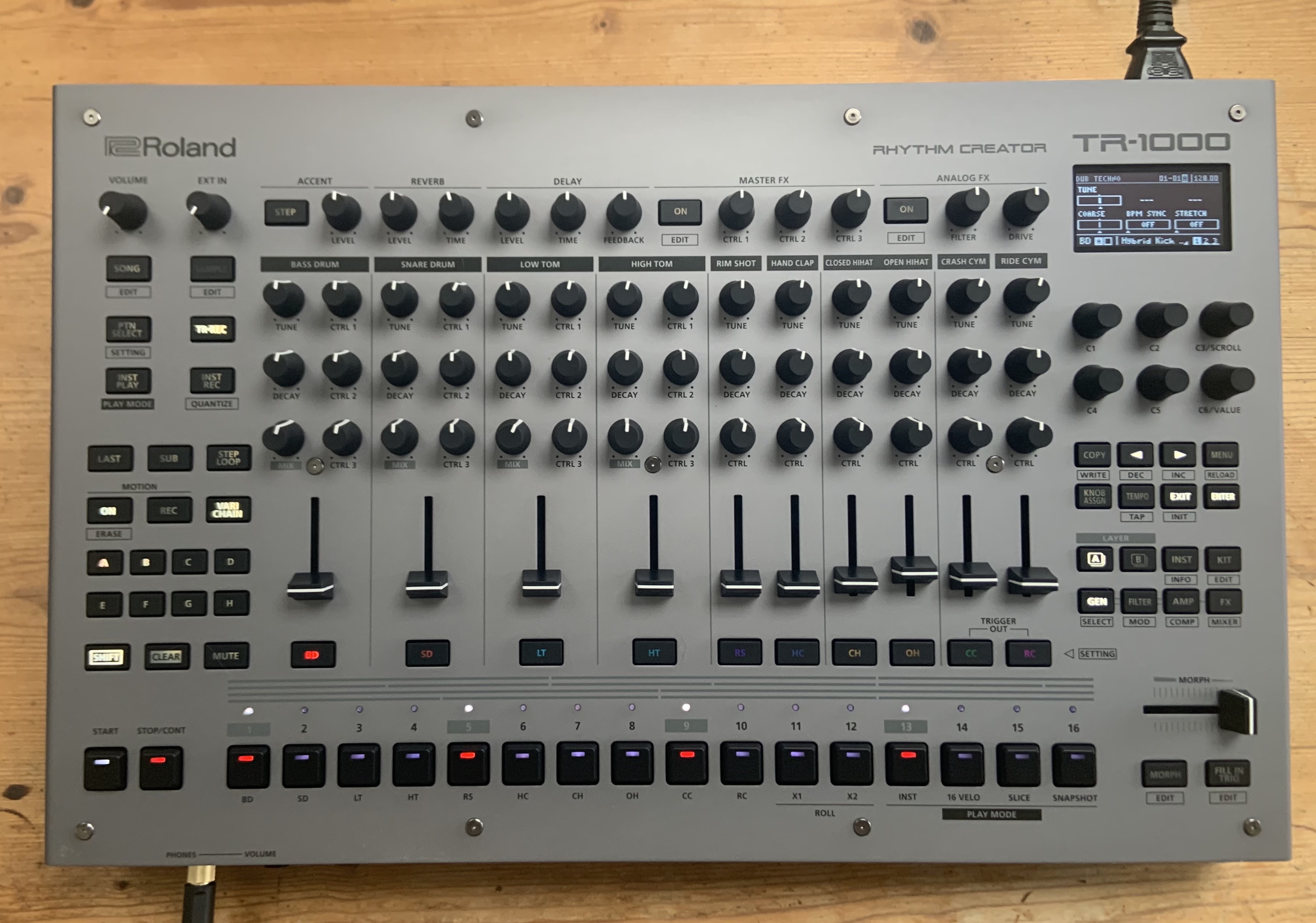
While the layout of the controls retains many similarities with the TR-8S, the TR-1000's form factor is closer to that of the TR-909. Its sloping profile, wide surface area and well-spaced controls invite easy handling, while its weight of 5.5 kg (12.1 lbs.) and dimensions of 486 × 311 × 125 mm (19.1 × 12.2 × 4.9 inches) seem more suited to the studio than the stage, although, of course, it’s still possible to take it live.
The finish, aluminum front panel and metal chassis immediately inspire confidence: the TR-1000 seems built to last. All controls offer a reassuring and pleasant mechanical feel. In the center, the instrument editing controls feature ten faders — one less than on the TR-8S — each accompanied by a selection knob.
Above the faders are three rows of rotary knobs for editing (Tune, Decay, Mix…), two columns of which are reserved for the first four instruments. On either side of this section are general controls: pattern selection and settings, drum kit selection, tempo, and an OLED display at top right, below which are six context-sensitive knobs. At the very top, on the left, the master volume and external input potentiometers precede the effects control, which includes a very nice analog section.
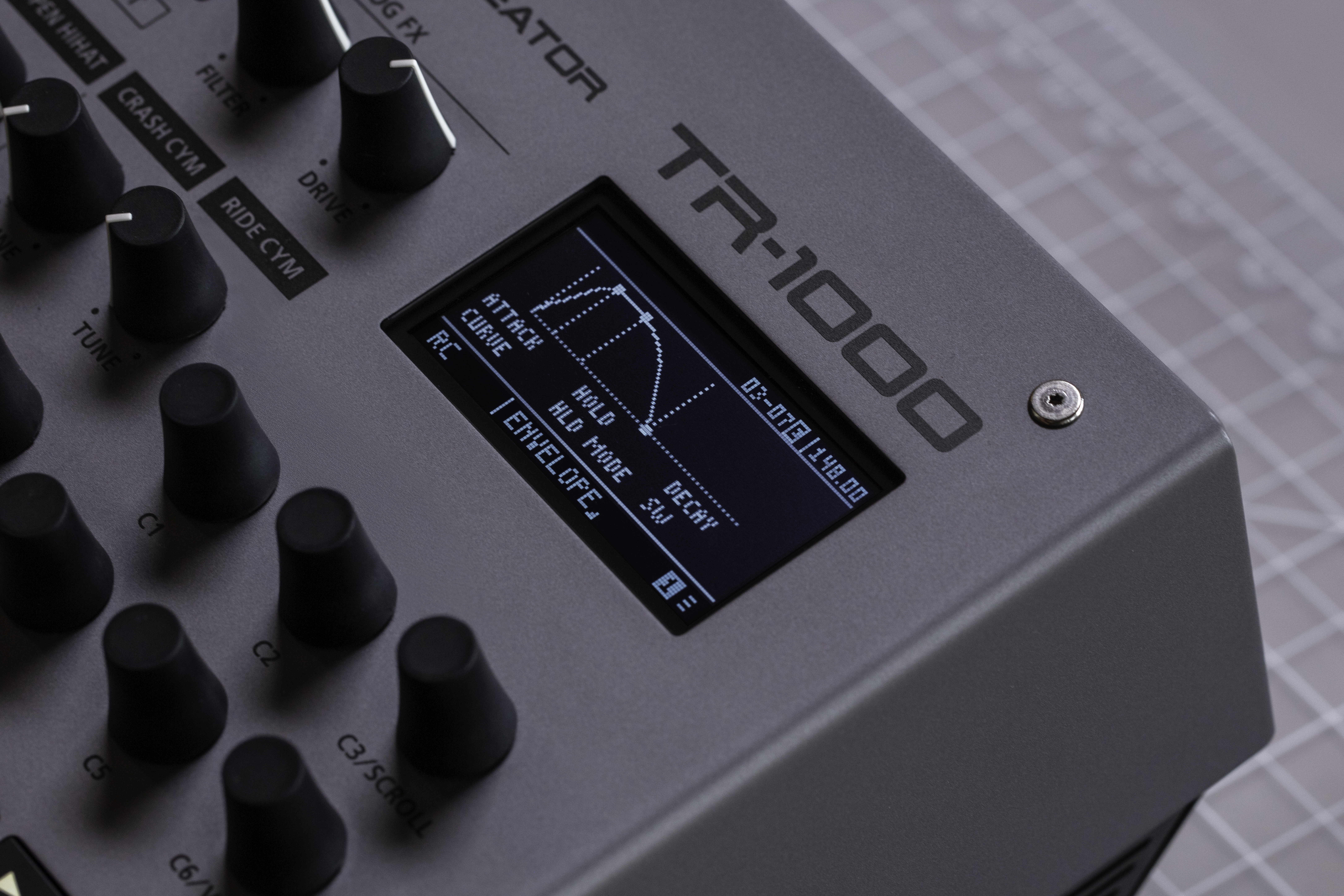
The TR-1000's ergonomics continue the evolution begun by the TR-8S, while retaining the TR spirit: direct, immediate access to sounds and sequencer steps. The six context-sensitive knobs below the screen change their functions based on the page displayed, enabling rapid editing of instrument, mix, or effect parameters without navigating endless sub-menus. This principle, familiar to users of Elektron machines, actually goes back to older instruments. Some Ensoniqs, as well as the Oberheim Xpander and Matrix-12, already exploited this type of contextual editing linking display and physical controls. Here, Roland manages to marry this approach with its typical workflow and the TR-1000's abundance of controllers, to offer a machine that is at once familiar, fearsomely efficient and far more accessible than its Swedish competitors.

Another pleasant surprise: Analog FX Out (L/MONO, R) outputs the processed signal to an amp, mixer, or other device. The two external audio inputs (L/Mono 1 and R/Mono 2) are ideal for sampling. All inputs and outputs are in 6.35 mm (1/4-inch) jack format, but the connectors are plastic. It’s a shame. At this price level, we’d have preferred screw-on metal sockets.

There’s also a pedal socket, and dual USB connectivity: a USB-C port for audio/MIDI communication with the computer — as on the TR-8S, the TR-1000 can serve as a multichannel audio interface — and a USB-A port for connecting an external device, be it a dongle or a controller.
Please note that the TR-1000 is not intended for use as a stand-alone unit.
Finally, the 6.35 mm (1/4-inch) TRS stereo jack headphone output, accompanied by its rotary adjustment potentiometer, is judiciously placed on the front edge. The internal power supply is also a nice touch and will please our national Synthwalker. All in all, a fine piece of work that confirms the TR-1000's high-end positioning.
A multilingual paper manual accompanies the machine. Documentation in PDF format remains available on the Roland website.
Sound engines of the Roland TR-1000: analog, ACB, FM, PCM

Each instrument can be edited individually via its dedicated section: filter, amplification, LFO, effects and compressor. The first four tracks allow superimposing two instruments, each with its own generator, filter, and amplifier.
On this type of track, it is thus possible to combine, for example, an analog sound and an FM sound. Both can be mixed directly on the front panel via a dedicated Mix knob, and each can be sequenced independently via a sub-track.
For the analog part, Roland set out to reproduce 16 instruments from the TR-808 and TR-909 (kicks, snares, low and hi toms, rimshots, claps, hi-hats, cymbals and cowbell). Not all have been reproduced, like the congas and mid tom, but the toms (low and hi) offer an extended pitch range, compensating for this absence. As for the resemblance with the originals, the main thing is to know that you immediately recognize the pedigree. Above all, it sounds fantastic, with a beautiful presence that’s a pleasure to hear. The 808's kick is nicely rounded, while the 909's packs a punch that can pierce a mix. The 808's snare is based on that of the “early” models, a little higher and snappier. Fans of later versions can turn to the ACB models. Special mention also goes to the 808's hi-hats and cymbals, which are particularly well done.

- 01 – TR808 – 100000:43
- 02 – TR808 – OG100:55
- 03 – TR808 – OG200:41
- 04 – TR808 – OG300:52
- 05 – TR909 – 100000:50
- 07 – TR909 – OG200:46
- 08 – TR909 – OG300:33
- 10 – 80800:26
- 11 – 90900:44
- 12 – FM Mix tweak Morph Filter Drive Delay01:36
- 13 – FM Dirty Morph Diive Filter01:03
- 14 – CR-78 Tweak01:58
- 15 – Rise01:42
- 16 – Chrome Ghost00:29
- 17 – Evaporate00:37
- 18 – Eccentic01:42
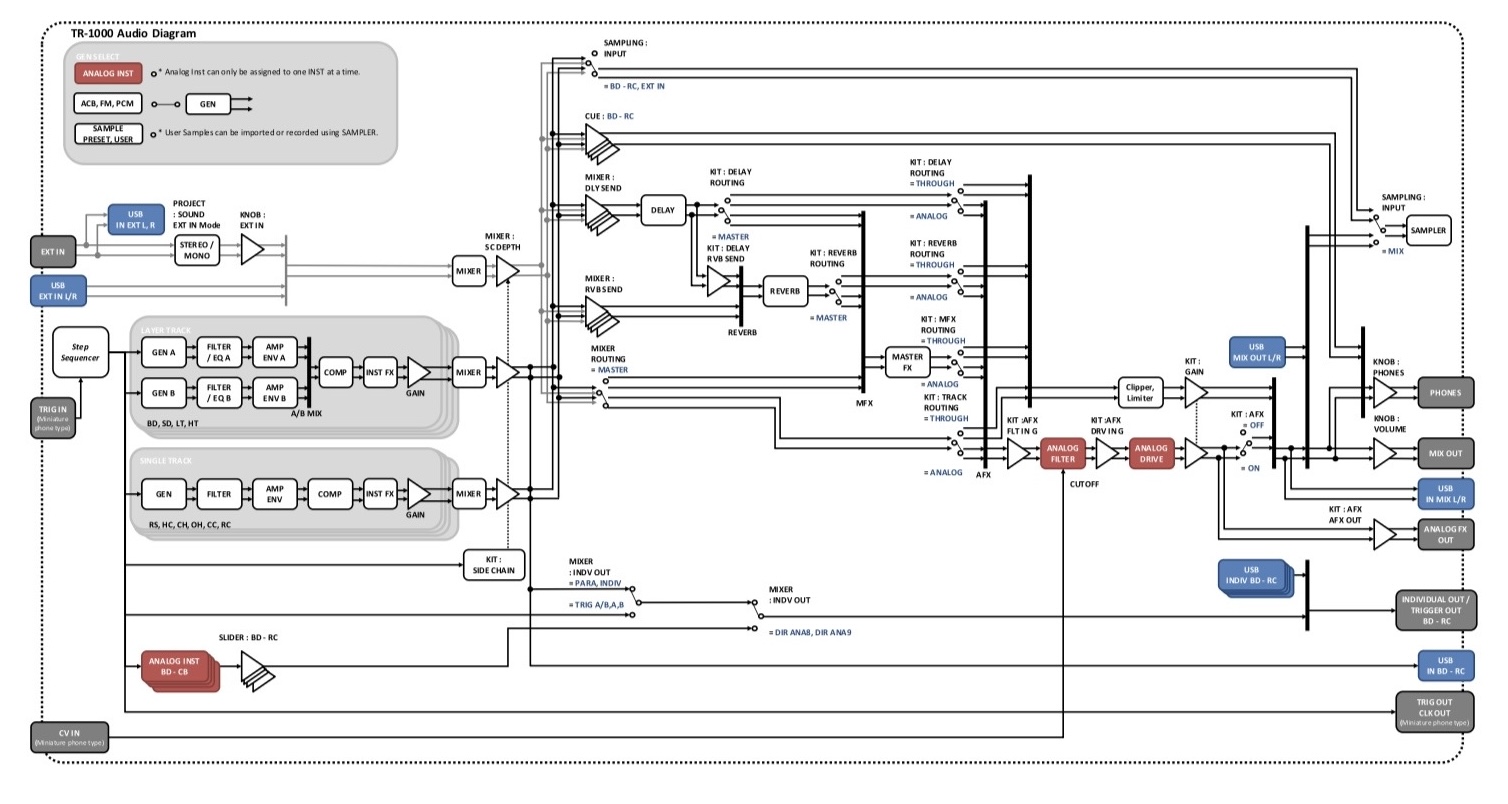
These modified versions allow much greater control over pitch, dynamics and character, opening up new perspectives in sound design. Needless to say, we’re impressed with the quality of ACB modeling.
Alongside the ACB, the TR-1000 incorporates PCM sounds, relying on high-quality digital samples to reproduce sounds impossible — or at least difficult — to achieve by synthesis alone. This section provides access to realistic percussion, cymbals, claps and a wide range of sound effects. As with other engine types, each PCM instrument has its own filter, amplifier and compressor.
The TR-1000 also features FM synthesis, particularly useful for creating metallic percussion, claps, toms, effects and complex timbres. This synthesis proves highly effective in enriching the sonic palette of contemporary electronic patterns, providing industrial, noisy or, on the contrary, crystalline textures. In addition to classic FM synthesis parameters — such as ratio, decay or feedback — the TR-1000 offers explicitly named Body and Click controls, as well as a high-pass filter and a resonant low-pass filter.
.
Sampling on the TR-1000: sample memory, import and editing

Each sample can be assigned to any generator, modified via start, end and pitch settings, and then sliced into non-destructive slices. These slices can be played, reordered or reworked independently, without altering the original file. Time-stretching is also available. On-screen waveform display greatly facilitates all editing operations, and context-sensitive knobs come into their own here. The engine also allows internal resampling: it’s possible to record the output of a pattern, ACB or analog engine, then rework it as a sample. A fine addition that’s bound to remind some of the heyday of the SP-1200 and other mythical samplers, but with a resolutely modern approach.
Integrated effects and analog-processing section of the TR-1000
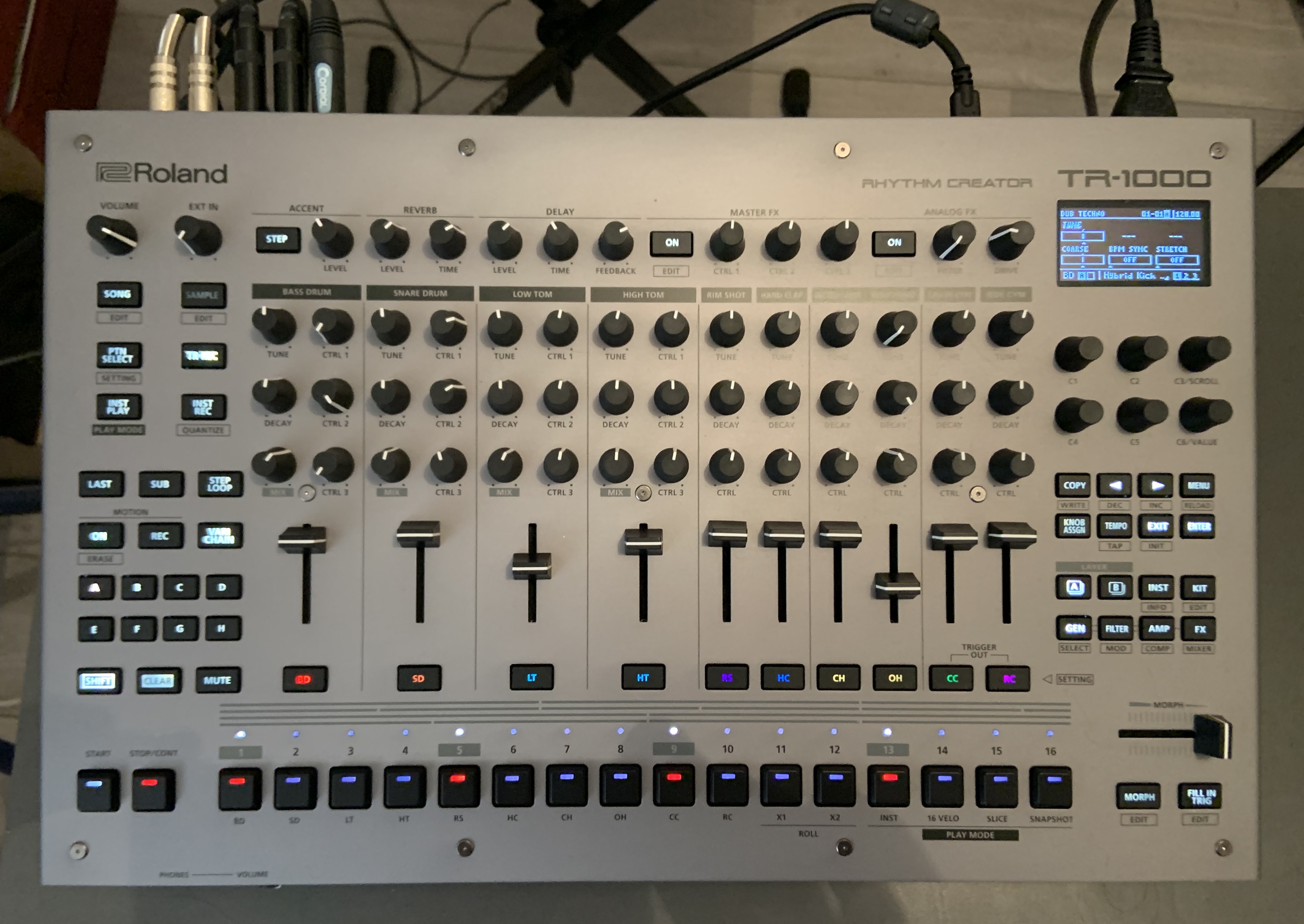
All these effects are of very respectable quality. The delays and modulation effects are particularly effective, and the Crusher works wonders, dirtying the signal just enough to recall old 12-bit drum machines without ever sinking into caricature. The reverbs, meanwhile, remain perfectly usable, but could be a little deeper.
Each instrument can then be routed to reverb and delay, with independent metering. The same logic applies at the kit level.
The master bus then hosts a digital multieffect focused on mixing and mastering, followed by a superb analog section that combines a state-variable filter with OTA inspired by the Jupiter-6. Pushing the resonance, which doesn’t crush the bass, produces a fine, natural saturation. Gentle yet muscular, it breathes new life into kicks and snares that are a little too wise. This filter is followed by an analog drive that warms and compresses the sound with unbridled elegance, bringing that typically analog roundness. As mentioned above, this section can also be used to process external sources via the Analog FX Out.
Finally, the audio input’s Sidechain function can be used to create a ducking effect applied to the input signal, a useful feature for music that moves.
Advanced TR sequencer and performance functions of the TR-1000

Tempo and shuffle can be set at the pattern or project level. Of course, the TR-1000 can be synchronized with other devices, both as a master and a slave. However, several users — and our tests confirm this — have observed slight synchronization irregularities when the machine is a slave. Roland has acknowledged the problem and is working on a corrective update, which should arrive shortly (note: corrected in version 1.13).
For programming, two approaches coexist. The classic step-by-step mode (TR-REC) lets you program each step with its own volume and velocity, in the purest TR tradition. At the same time, real-time mode offers free play, off-grid if desired, to record a natural groove without rigid quantization. Like the famous Parameter Locks, you can modify an instrument’s parameters (tune, cutoff, pan…) only on a given step. Several of these “locks” can be cumulated, up to the memory limit.
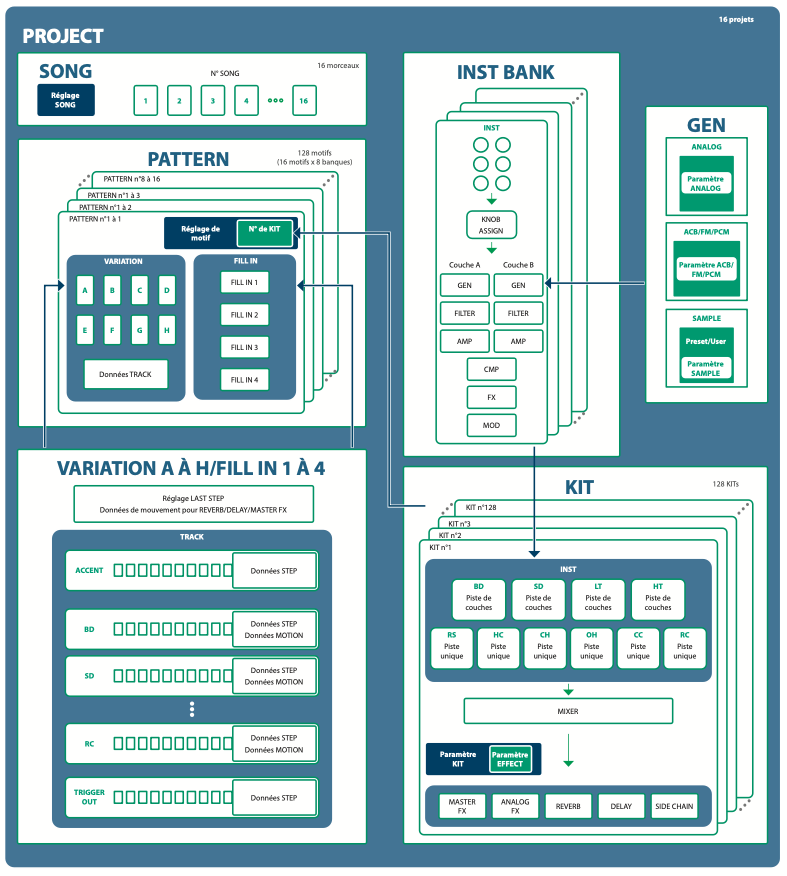
In practice, the approach combines simplicity and depth: you can lay down a beat in seconds, then venture into finer experimentation — changing the direction of a track, activating a B variation every four bars, or introducing 30 % probability of “forgetting” a snare hit. In certain respects, Elektron’s machines come to mind, particularly in the way they balance programming and performance. The ergonomics, which enable instant switching between step-by-step and real-time mode, offer ideal terrain for blending rhythmic programming and improvisation.
Control movements can be recorded and, in performance, the Morph fader lets you manipulate several assigned parameters in real time, while the Snapshot function allows instant recall of control configurations on each track. Finally, patterns and variations can be chained together in any order, enabling the creation of complete tracks directly from the machine.
Firmware, editing software and current limits of the TR-1000

The editor remains a useful management and organization tool, but a little frustrating when you consider how much a full-featured editor could streamline workflow. We also regret the absence of a VST, AU or AAX version, which would have enabled direct integration into a DAW environment. All in all, a handy companion for sound preparation and maintenance, but far from the creative extension the machine deserved.
In addition to the grievances mentioned above — concerning MIDI synchronization and the clock when the TR-1000 is used as a slave (in version 1.11) — several users also reported slight micro-holes or cuts when switching between kits or patterns. Nothing dramatic: in practice, this doesn’t really affect the game, but for fans of fine-tuned live performance, it’s worth keeping in mind.
Another point to watch out for: software stability and maturity. The TR-1000's firmware is evolving rapidly, and version 1.11 (note: version 1.13 has just been released) states in its release notes that it improves synchronization time with an external device and reduces the cut-off time when changing models. Proof that Roland is fully aware of these shortcomings and that they are already being corrected.
Thanks to Coyote14.
