Log in
EN
FR

SeriesIbanez Joe Satriani

35 products found

Filter
Sort by
Evaluation
  • Reviewed or not
  • Editor’s award
  • Reviewed by Audiofanzine
Availability
  • Available or not
  • Sold new or used
  • Sold new
  • Sold used
Must-have products
  • All products
  • Flagship products
  • Best rated products
  • Hot products
  • Popular products
Price
  • Freeware
€
Clear
Sort by
  • Popularity
  • User ratings
  • Price - low to high
  • Price - high to low
  • Used price, increasing
  • Used price, decreasing
  • Name (from A to Z)
  • Name (from Z to A)
  • Added on
Sort results
  • Popularity
  • User ratings
  • Price - low to high
  • Price - high to low
  • Used price, increasing
  • Used price, decreasing
  • Name (from A to Z)
  • Name (from Z to A)
  • Added on
Filter results 35 results found
Evaluation
Availability
Must-have products
Price
  • Freeware
Show results

The best Ibanez Joe Satriani reviews

The reviews Audiofanzine members found the most helpful.
  • « Another Satch Sig »

    Satriani is a guy who sticks to what he likes. He has been playing Ibanez guitars for years and his model has barely changed. Joe Satriani is one of Steve Vais peers. He is a modern guitar player and uses a lot of modern equipment. He does a ton of session work for people and has won Grammys. He also leads the G3 tour which takes him and 2 other great guitar players around the world. The Satch sig is a pretty cool design. It is kind of based off an S series Ibanez. The guitar features a basswood body in the super smooth JS body shape. The neck is 22 frets with a rosewood fretboard and his own neck profile. Early models had the original Edge tremolo but this was changed later as Ibanez advanced in their tremolo designs. This guitar has two humbuckers and a master volume and tone knob with a 3 way for switching. It has a PAF pro in the neck and a FRED in the bridge. The FRED is one of Satrianis signature pickups. UTILIZATION Being based off an an S series Ibanez the guitar retains a lot of the comfort that was built into that original design. The shape of the guitar is designed to fit comfortably against your body. It gets very thin up at the top so its fits well against your body and arm. The smooth contours along the cutaways help with upper fret access because you do not have any hard edges around anywhere. A lot of RG's have hard edges in the cutaway that can make the guitar pretty uncomfortable to play on the high frets. This model being so old has the old style Ibanez neck join which is similar to what you would find on a Fender guitar. While the body is thin at the top it gets nice and thick towards the bottom so the guitar has a thick tone and nice weight to it. It does not feel flimsy like some Ibanez guitars tend to feel. Satriani prefers a more traditional feel to his guitars so the frets are not as big and the radius is that that flat but it still retains all the great Ibanez playability. SOUNDS The sound of this guitar is pretty love hate. Satrianis style requires pickups that get a ton of harmonics and this is what you get on this guitar. If you do not play like Satriani this could be a problem for you. With the Satriani designed FRED in the bridge this guitar has a crazy sound that only Satriani can really take advantage of. I am not a huge fan of the Fred pickup. The FRED works well for him though. You can really get crazy harmonics from it and it is super clear. It is kinda like Steve Vais EVO pickups cousin or something. The PAF pro in the neck is a classic tone. With this guitar only having 22 frets you get a classic neck position tone. Satriani only gave this guitar 22 frets for that reason. With the neck pickup that much farther out you get even fatter tones from the position. The further away a pickup is from the bridge the more beefy it sounds and this is as far as you can get it. This beefy sound with the basswood really give the PAF pro a nice even tone that you want for smooth leads in the neck position. The neck pickup tones are classic but its the bridge tones that I dislike, and since the bridge is what you use the most I find myself not liking the overall tone of the guitar. I should probably be happy that this guitar comes with something other than stock Ibanez pickups. OVERALL OPINION This is pretty much a classic guitar now. If you can find a good deal on one of these they are great guitars if you are Satriani fans. The models have not changed much so I would not pay more for an older one. If you get a new one you are pretty much getting the same thing.

  • « Extremely unique finish »

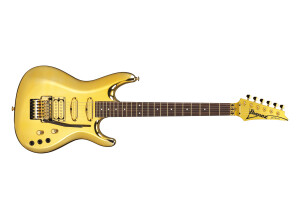
    These guitars are EXTREMELY rare, and they're even harder to find in good condition. The one at the store came from a trade-in, and it had a few nicks and dings here and there. The guitar has a Luthite body with a maple neck and a rosewood fretboard, 22 frets with dot inlays, a LoPro Edge bridge, two DiMarzio humbuckers, one volume, one tone and a three way toggle switch. UTILIZATION The guitar has some major flaws, and the biggest is in the finish. There are tons of finish flaws that can occur with these guitars right out of the factory. They can be small things such as little paint pimples, or they can have chunks of the chrome flaking off. It's real bizarre, and I'm not sure why they didn't just use a form of chrome paint. The overall neck and construction is pretty good. The frets were nicely crowned and didn't slice your hands when moving up and down the neck. The bridge is also one of the best floyd rose bridges out there. SOUNDS The guitar really doesn't sound that great, and that's mostly due to it being made out of Luthite. The Luthite body is just really odd sounding. It's some acrylic or some type of plastic? I'm not exactly sure. The bridge DiMarzio sounds really bright in this, and that's not a normal attribute when comparing this to the other Satriani guitars out there. The neck is also way too bright for me, and I couldn't sure it at all. That said, the coil split tones weren't too terrible. A pickup swap might have fixed it. OVERALL OPINION The guitar looks awesome, but there are lots of flaws with these guitars from the actual choice of body material all the way down to the finish that was used on these. If you're a hardcore collector, be sure to thoroughly go up and down these to make sure there are no flaws. I would also recommend keeping it in its case most of the time.

  • « JS2000 review »

    I use a mesa boogie rectoverb with my JS2000. PROS Ergonomic to hold and light. (Lies in your arms like a beautiful chick) Neck is simply excellent. Smooth like butter so your finger tips just dance around. Sustain and tone excellent via fixed bridge. Versatility of sounds - from sweet gentle smooth jazz to monstrous hyperspace rock. Offers an alternative, modern and compelling sound to Les Paul and Fender Strat, who tend to dominate the history of rock and roll. Beautiful to look at, like a sculpture. CONS They ceased production. Hold her gently as to not damaged her.

  • « Ibanez JS2400 »

    With a maple JS Prestige bolt-on neck and rosewood fingerboard, moving quick on the JS2400, whether sweeping or performing scalar runs, is far more effortless than with other guitars in its price-range. There is a sense of fluidity with this guitar. The small neck (20mm at the 1st fret and 22.3mm at the 12th) may have something to do with it, together with my smallish hands and fingers (I have tried Vai’s JEM models, and its larger neck to accommodate Vai’s long fingers resulted in more struggled playing on my part). The curve of the neck also has an influence on the ease of play, as string bending not only is easier than with the other quality guitars in my collection, but you can achieve higher notes while bending as a result. The finish on the neck is worth talking about: the silk-like lacquer does not make the neck ‘sticky’ as the hand sweats, unlike heavy, glossy lacquer found on other guitars. This allows the player to maintain speed and technique without having to fight the ‘stick.’ The basswood body allows for a very rich and somewhat mellow tone, although the harmonics and squeals that can emanate from the guitar are some of the best and easiest to achieve. What make the body special, in terms of appearance and comfort, are the many contours and rounded edges that fit the guitarist like a glove. Further, the lower horn of the body is cut in such a way as to allow excellent clearance of the fretting hand; it’s easy to work high up on the neck without any obstruction. The JS2400 sports a low-profile Edge tremolo bridge, with knife-edge-like pivot surfaces for near-zero friction and locking studs to help maintain tuning stability. Also, the fine-tuners are angled back to prevent any picking-hand contact and possible de-tuning. Most importantly, although this is a floating bridge system, I have found it takes a lot of whammy usage for this guitar to go out of tune. The neck pickup is a DiMarzio Pro Track ceramic humbucker that sports twin blades to prevent problems associated with string-alignment dropouts. It is a narrow humbucker, which means it can be placed right up against the base of the neck for best tone, as opposed to the larger humbuckers that shift down on the body. It gives a nice ‘throaty’ tone and offers a great blues sound. And yet, when adjusting the tone knob around the halfway position, the pinch-harmonics ring out clearly. I use this pickup frequently as it does not sound overly dark or muddy, but very rich. The bridge pickup is an Alnico DiMarzio Mo’ Joe Humbucker that is powerful (more so than the Fred pickup he used on older model guitars), yet maintains its clarity of dynamics and definition. It does not have a crass sound to it, like other pickups designed for the rock genre. Rather, even when put through plenty of distortion and overdrive, this pickup rings clear as if it is a super-charged Strat pickup. The tone possibilities are vast, as you can switch between neck and bridge, or both neck and bridge pickups. Nothing unusual there. But you also can pop the volume button (via a coil tap switch) to split the bridge pickup for a thinner tone, thus giving two more tonal variations as you use it on its own or in combination with the neck pickup. And then, as you fine-tune the tone knob, the subtleties become apparent and diverse. The volume control electronics also is of fine workmanship; as the volume is lowered you do not lose very much, if any gain or distortion. This is important if adjusting volume of the guitar to match the volume of the band, from a slightly quieter rhythm to a more searing lead. Not many guitars allow such variation as to be used from jazz to hard rock, but this guitar pulls it off. From vintage to modern tones, the pickup combination with the basswood body and the design of the neck make it possible. Purchased in Sudbury, Ontario, Canada, I have played and owned other Ibanez guitars, including the Surfing with the Alien 20th Anniversary Edition (basic model); that guitar has a street price of about $1200, and the differences in playability and tonal expression between the two are apparent. <a href="http://www.jettlandrymusic.com">http://www.jettlandrymusic.com</a> There is nothing I would change on this guitar and its only fault with some buyers may be the color choice or that such a great guitar does not have a more striking paint-job. However, color and finish is a personal preference, and even the clean white offers a classy vibe to match the JS2400’s persona. Available only in white, but the finish is thick and solid; it does not mark or chip easily. “You get what you pay for” is not always true. Often you can find quality amplifiers, guitars and effect pedals at prices well below top-end manufacturers; sometimes you pay for the name. At a street price of approximately $2000, the Ibanez JS2400 is a 24-fret work of art co-developed with Joe Satriani, and is worth every penny. <img src="http://img3.musiciansfriend.com/dbase/pics/products/regular/8/2/4/644824.jpg" /> This review was originally published on http://www.musicgearreview.com

  • « Ibanez JS100 »

    I bought this guitar at sounds great second hand (ony by a week) for £429. I bought it because I need a guitar with a locking trem. I actually went into the shop to buy a jackson, but this was £300 cheaper and I just bought there and then. This guitar is a one amazing piece of kit , If God owned a guitar it have to be one of these(Just had a mental image then, of some guy with a white beard rocking out on stage dressed like a member of judas priest). Anyway even though it's not the top of the range JS it still, out of ALLof them plays the best. The tonal range from the guitar is superb, I have changed the pickups to dimazzio rather than the ibanez standard ones, but thats only because I need branding on everything (It makes me feel big). The neck fits my hand perfectly but it may not suit everyone. The trem as most people know isn't a floyd rose, It's a edge pro 2. I works slightly differently and has more sleek design, and the sounds are great. It dive bombs like Tony Blaire's political career. The only thing I can think thats wrong with it, is that it's got somone elses name on it at the 21st fret. Whos joe satriarni anyway?(joke). The body is bass wood giving a mixture of mahogany and alder type tones. The wood is well cut and flawlessly finished. Mine is pure white and theres not a blemish. The electrics are all you would ever need.2 humbuckers with a 3 way selector 1 volume and 1 tone pot, which also is a coil tap for those sinlge coil moments. All the contols are solid and well made, pure quality. The neck joint is perfect as are the frets and inlays. The trem holds tune even after heavey abuse. the guitar was already set up when I got and there action is bang on. The very japanese headstock is again briilently finished with no l mistakes like paint run or anything like that. You need to buy one of these NOW! put it though a mashall stack and it shakes the walls off. The qualiy and value of this guitar is second to none. GO AND GET ONE. This review was originally published on http://www.musicgearreview.com

  • « Shred on! »

    SPECS Neck Material: Maple Neck Type: JS Prestige Body: Basswood body Frets: 6105 frets Fingerboard: Rosewood Inlay: Abalone dot inlay Bridge: Edge bridge NeckPU: DiMarzio® PAF-JOE BridgePU: DiMarzio® FRED® HW Color: CH Finishes: CA NECK DIMENSIONS Scale/Length 648mm/25.5" a: Width at Nut 42mm b: Width Last Fret 56mm c: Thickness 1st Fret 20mm d: Thickness 12th Fret 22.3mm Radius 250mm PICKUPS Bridge Pickup Name: DiMarzio® FRED® Model No: DP153 Construction: Humbucking Magnet: Alnico Description: Strong mids and a wide range of harmonics and overtones. Designed for Joe Satriani. Neck Pickup Name: DiMarzio® PAF-JOE Model No: DP213 Construction: Humbucking Magnet: Alnico Description: Vintage humbucking sound with blended clear low and warm mid/high. UTILIZATION Right off the bat, this guitar is a dream to play. The action is low low LOW, and the neck has a nice carve to it. It's a bit thicker than the other Ibanez guitars, like RG with the Wizard neck, but it feels incredible. Also, the tremolo system on this is unmatched - the Edge from Ibanez is my favorite double-locking tremolo on this planet, and it always comes back to tune even after the most serious whammy abuse. The build quality is top notch as well. SOUNDS This guitar smokes! It is quite a versatile beast, but it was meant for shred. These Dimarzio pickups can sear and soar with the best out there - they have a vintage Gibson quality, but with a bit more output. The only think soundwise this guitar seems to be lacking is a push-pull tone pot. I'm not saying that all guitars should have one, but in this case, with the shred neck and Edge system, it would seem appropriate. OVERALL OPINION This is a great axe for anyone wanting to get their shred demons out. The guitar just begs to be played fast, but with soulful bends everywhere. It is a lead guitarist's dream guitar, and it does the job nicely.

  • « Bizarre P90 hard tail JS »

    For some reason, Ibanez decided to make a P90 hard tail version of the JS. Why they made this, I'm not exactly sure why. On top of that, these guitars were made in both Japan and Korea, and the quality varies depending on where the guitar was made. The guitar has a mahogany body with a maple neck and a rosewood fretboard, 22 frets with dot inlays, a hard tail bridge, two P90 pickups, one volume, one tone and a three way toggle switch. UTILIZATION The number one thing that bothered me on this guitar was the bridge. It felt very odd. In fact, it was almost like I was playing some bizarre Les Paul Junior or something. The angle felt weird, and I just couldn't give with it. The thin Ibanez body wasn't doing it any favors, either. The rest of the guitar was decent, although this one was a Japanese model. The frets weren't sharp, and they were decently crowned. I didn't bother messing with the action as I really disliked the bridge on this model. SOUNDS The pickups in this didn't sound that great, honestly. I'm normally a big fan of P90 pickups, but these seemed to lack something. Usually, a P90 sounds like a polite man's single coil. It has that aggression and cool character, but it doesn't have the obnoxious treble. They also tend to stay together better than the singles, sound wise. That said, these seemed to lack all character that I normally adore about P90s. The bridge was kinda muddy, and the neck wasn't anything that impressive. The clean tones were decent, but that's about it. OVERALL OPINION The guitar didn't sound too good, and I'm not sure whether or not that was from the odd P90 pickups, the hard tail bridge installed on this, the actual wood itself or what. I just wasn't digging this guitar for whatever reason, and I'm not really sure why it was made in the first place. I can't recommend buying this, but I'm sure there are some people out there who'll love it.

  • « First Satch model »

    This was the first model released for the famous Joe Satriani. The guitar isn't that much different from today's guitars, surprisingly. The JS-1 features a basswood body with a maple neck and rosewood fretboard, 22 frets, pearl dot inlays, an Edge tremolo (later changed to the Lo Pro, I think), HH configuration (although some had HSH), one volume, one tone and a three or five way switch depending on the configuration. UTILIZATION The fretwork on this was nice, but there was some serious wear from it being used. We had to discount it a good bit because of that. The body also had some nicks and dings, so I can't comment on the overall finish. The neck joint itself was fairly tight, and that's always a good thing. The neck joint itself is an older style, so it will get in the way when playing up on the higher frets. This could bother some people, but I find these older neck joints sound better. The guitar had some decent weight going on it, but it might have been a touch too heavy. These basswood guitars can really vary in weight sometimes, so keep that in mind. SOUNDS This guitar sounds unique, and it's thanks to the bridge pickup. The DiMarzio FRED is an interesting pickup when it comes to harmonics and overall sound. The harmonics really jump out, but the FRED is kinda like an oddly tweaked PAF Pro. It can work for rhythms, but it's more of a lead pickup. The PAF Pro in the neck with basswood is heaven. Basswood helps mellow out the PAF Pro, and the additional midrange really boosts this thing into a shred machine. You can also get some extremely nice clean tones with this thanks to the coil split in the bridge. OVERALL OPINION These models can be a bit hard to find, and I find the prices they go for are a bit much. You can find a newer JS with less wear for a good bit less on eBay. Those are the ones that I'd personally seek out as they're pretty much the same thing.