Log in
EN
FR

SeriesRadial Engineering Tonebone

26 products found

Filter
Sort by
Evaluation
  • Reviewed or not
  • Editor’s award
  • Reviewed by Audiofanzine
Availability
  • Available or not
  • Sold new or used
  • Sold new
  • Sold used
Must-have products
  • All products
  • Flagship products
  • Best rated products
  • Hot products
  • Popular products
Price
  • Freeware
€
Clear
Sort by
  • Popularity
  • User ratings
  • Price - low to high
  • Price - high to low
  • Used price, increasing
  • Used price, decreasing
  • Name (from A to Z)
  • Name (from Z to A)
  • Added on
Sort results
  • Popularity
  • User ratings
  • Price - low to high
  • Price - high to low
  • Used price, increasing
  • Used price, decreasing
  • Name (from A to Z)
  • Name (from Z to A)
  • Added on
Filter results 26 results found
Evaluation
Availability
Must-have products
Price
  • Freeware
Show results

The best Radial Engineering Tonebone reviews

The reviews Audiofanzine members found the most helpful.
  • « At first, complex, but useful given the right circumstances. »

    Ok so I don't think radial's website properly explains what this device really is. To keep it simple, it's basically a 2-looper pedal with a tuner out, a clean boost, a buffer and an amp switcher all in one. The loopbone allows you to have 2 sets of loops for your board. Say for example Loop 1 would be my chain of effects I use for the distortion channel, which would be a noise gate and an overdrive. While Loop 2 would my set of effects I use for clean like a delay and compressor. The Loopbone allows me to set these two loops up so that I can at anytime kick them in for each channel, the Slingshot allows me to change the channel and get the effects all in one stomp, so no tap dancing required. The DRAG is the buffer, which is adjustable and brings back any loss of tone from the pedal runs. The clean boost is just another option added to it. So, it sounds good right? But there are some faults with this device. First off, the slingshot is a great idea so it's an external amp switcher and I can use it to switch the amp channel and engage a loop, awesome. However, the slingshot itself doesn't work on every amp. It works only on certain amps which use a generic footswitching type (can't remember the type) however, they definitely don't work on marshall amps, as I've tried. This sucks because now the pedal is limited to certain amps with that type of footswitching design and the only thing you can do is mod the loopbone to have it work for one type or the other, not both. I've looked into this and talked to radial for a few days about this problem. Second fault, is that when you engage the loop 1, and you want to switch to loop 2. You can't just click loop 2, if you do, loop 1 will still be engaged and you will thus be combining both loops together and add a wall of noise basically. So therefore you have to do an extra 2 stomps to switch from each loop. I find this very inconvenient as it's basically eliminating the purpose of single stomp functionality. I had to basically just use 1 loop, and have the 2nd group of pedals out in front of the loopbone to make this work for my board situations. As for the boost it sounds great, however, you cannot engage it all together with the slingshot and the loop. You can engage either the slingshot and a loop, or a loop and the boost. You can't have all 3 kick in at the same time in one stomp. So overall it's a great idea, I just wish it had these inconveniences fixed and it would've been the perfect pedal for controlling your effects!!! Otherwise, if you don't plan on using the loopbone like I wanted to, you'd be well off with this well made piece of equipment.

  • « Nice Pre »

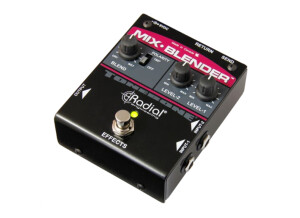
    Radial Engineering is one of those companies that has revolutionized the pedal world with their innovative and useful electronics. They have build some of the world's best foot pedals and controllers. This is an acoustic pre amp and direct box that helps bring the weak sounding pickups in an acoustic guitar up to a level that is cutting through the house pa system. * Piezo acoustic input signal boosters * Designed for studio and live performance * Unique Mix function * 1 -gauge construction * 3-year transferable warranty UTILIZATION * External 15VDC power supply * Input impedance regular: 6.8 kOhm * Input impedance piezo: 10 MOhm * PZB boost level: 10dB * Low cut roll-off pos-1: 75Hz * Low cut roll-off pos-2: 220Hz * Notch frequency range: 56Hz to 330Hz * Notch Q setting-1: 8dB * Notch Q setting-2: 15dB * Low frequency type and spec: Shelving type +/- 12dB @ 75Hz corner freq * Mid frequency range, type and spec: Parametric +/- 12dB 82Hz to 5.6Khz * High frequency type and spec: Shelving type +/- 12dB @ 7.5Khz corner freq * Boost level: 12dB * Effects send & receive : -10dB, Send 1 kOhm, Return 15 kOhm * Polarity Switch: 180 degrees (absolute phase reversal) * Input-1: 1/4" unbalanced * Input-2: 1/4" unbalanced * Insert send & receive: Send 1 kOhm, Return 15 kOhm * Output instrument: Hi-Z, coaxial, 1 kOhm * Output Tuner: Hi-Z, coaxial 6.8 kOhm * Pre-EQ: XLR male balanced mic level 600 ohms * Post-EQ: XLR male balanced mic level 600 ohms * Dimensions: 8" x 4-1/4" x 1-3/8" (203x108x35mm) SOUNDS This thing is a wealth of power in a small little direct box. It has unique mix function that allows you to insert to instruments and mix the both together or even using two different pickups on a single guitar that feature is an option as well. This ting is the brain or multiple functions of getting your sound of a great acoustic to the audience with precision and consistence. It also has the option o boosting your signal as well. Top that off with a built in effects loop for running delays and choruses and such into your acoustic signal. This is great for someone who may be using an acoustic in a small coffee shop and needs to fill the air with multiple leads and throw them in a loop and playing over the effected riff or signal. It is nice for using layers of guitars signals or even using your main signal and adding effects on top of that. OVERALL OPINION At new these units come in right at around $299, which is a fantastic price for a great sounding and resourceful preamp and direct box. I would recommend this to any club or church that needs hook up acoustic guitars on an ongoing basis and needs a very useful and versatile direct box preamp.

  • « Want to switch 2 amps into one cab...this is what you want... »

    The easiest way to describe it as an A/B box after two amps to switch them into the same cab. It's the size of two stomp boxes. You have one speaker out, 2 1/4 inch amplifier inputs off the amps speaker tap, 2 audio inputs to the amp, also 1/4 inch, two inputs for the guitar (one buffered, the other not buffered), and a 1/4 inch jack for remote switching the box. And of course the jack for the power supply. The hook-up for the first time, although explained well in the manual can be a bit overwhelming the first time. It goes something like this.... Guitar plugged into the input of course, send two guitar cables two amp 1 and 2 respectively. Return from the amp's speaker out to the Headbone via speaker cables, and then one more speaker cable to the cab. Now the box has a switch and that is great, the down side is that if you have it on your pedal board you will have to have long cable runs two the 2 amps, as well as long cable runs back from the amps and to the cab. Having it on the backline and using the footswitch jack makes life a lot easier. The downside is that you have no indicato which amp is on. The best set-up I've found for this was when I used it with the programmable relay switches in the TC Electronic G-system. This way the amps were switched via preset and/or one of the assignable switches on the g-system. The other thing I found a bit disconcerting was that when switching between vintage amps you were running "balls out". The transformer of the head that was running in the load did not sound too happy. I'm used to loaded head's transformers "singing" along when you actually can hear the head (for example when the cab is in another room, or using an iso cab, etc) but I've never come across it with no signal going through amps unless there was a ground loop issue. Which reminds me, as always vintage Marshalls are going to want to squeal like a bath room duck when they run on a common ground with a second amp, luckily the Headbone does have a ground lift.