Log in
EN
FR

Crumar

48 products found

Categories
Filter
Sort by
Evaluation
  • Reviewed or not
  • Editor’s award
  • Reviewed by Audiofanzine
Availability
  • Available or not
  • Sold new or used
  • Sold new
  • Sold used
Must-have products
  • All products
  • Flagship products
  • Best rated products
  • Hot products
  • Popular products
Price
  • Freeware
€
Clear
Sort by
  • Popularity
  • User ratings
  • Price - low to high
  • Price - high to low
  • Used price, increasing
  • Used price, decreasing
  • Name (from A to Z)
  • Name (from Z to A)
  • Added on
Sort results
  • Popularity
  • User ratings
  • Price - low to high
  • Price - high to low
  • Used price, increasing
  • Used price, decreasing
  • Name (from A to Z)
  • Name (from Z to A)
  • Added on
Filter results 48 results found
Evaluation
Availability
Must-have products
Price
  • Freeware
Show results

The best Crumar reviews

The reviews Audiofanzine members found the most helpful.
  • « The future of vintage sound is in your hands. »

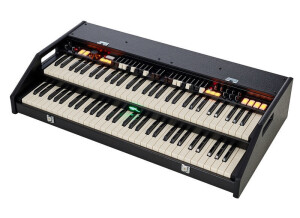
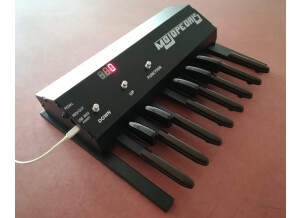
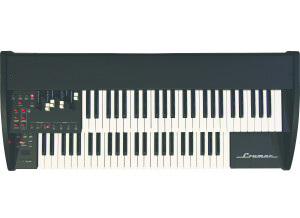
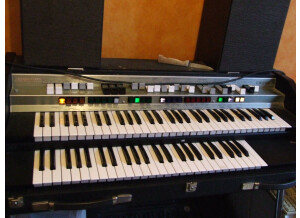
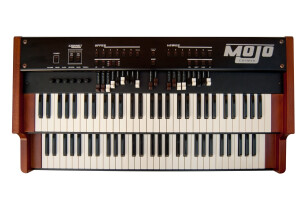
    A rare piece of gear, not an easy one to find. If you chance to see one for sale, don't miss the opportunity to try it - and to try it is to love it instantly. It's a 3-in-1 in the same series as Trilogy, but more of an organ. 2 keaboards of 4 octaves each. First the organs: They're split in 2 parts: - the upper keyboard has 8 presets, ranked from the softest to the brightest. Endowed with auto sustain and a percussion set (nothing to do with drummers, we're talking organ percs here, of course) which decay and volume can be controlled - a real plus that offers nice possibilities. - the lower keyboard has 4 timbre controls (8, 5.1/3, 4, 2.1/3), like a simplified Hammond. Crumar called that part Lower manual Flute. Not much to do with a flute soundwise, rather soft, flutty organ sounds I'd say. Really beautiful. - Both these organs can be routed to a slow-fast rotor effect simulation. Independant. Just superb. And a a bonus, there's an analog reverb which doesn't look like much but always sounds pleasant. Plus, the lower and upper keyboards can be muted separately to leave room for the following... Then the pianos : 3 nuances of electric pianos can be superposed. They remind me of a RMI electra harp, as I can hear on good old Genesis records I love so much. They can be affected to either or both keyboards. The finest is that back then, its conceptors thought of the possibility to route it towards a good old analog phaser. Bliss! Finally, I can get these Tony Banks, Genesis atmospheres. Finally a smaller String machine section: More sober, a little different from that I knew on Trilogy. Just an octave control and a possibility to affect it to both keyboards. But iot can also get through the phaser if you want. Bliss, again... A real enjoyment. Options: The T3 can be comptemented with a 13-note key/pedalboard. A 4th bass part was designed for such. Since I don't own the pedalboard, I can't judge it. I believe it to be impossible to find now. Another option. The faaaaaaaamous -and worthless- sequencer/arranger. I have it... well, too bad! I don't use it, I hate those things. Cons: Ooch ! This is where I feel I made a mistake buying it. - Of course it's cumbersome and heavy. 31Kg, 109x63x26... Ooch! sh..., my back! To be used with a RTX stand, or something sturdy anyway. - its body. While my Trilogy looked in a good state, the T3 one looks like it fell at sea or something. The paint goes away, replaced by rust. It looks like a drowning Russian nuclear submarine. - the electronics, as sh*tty as on all Crumar from this period. Push buttons looking on the verge of breaking, faders and knobs that spit as if out of a nursing home... - wooden flanks in laminated wood that stick out - and impossible to remove. Completely messed up by the thing's weight. -the keyboards are trustworthy, but too light at touch and sensitive. The lightest touch and you're in for a wrong note. In brief. The instrument is too heavy and cumbersome, hence impossible to sell for the price it would deserve. Mine was for sale 30km (20 miles) from my home. It was on sale for a year on a classified ads website for a year, meaning no one wanted to pay more than its value to have it transported professionally (€250). Still, it's not worse than a Hammond or Farfisa. At least, this one can enter your car. A lot of work to restore it. Plenty of work ahead. Not to be put in the hands of a non-handy(wo)man. It sure would stay rotting in the basement. But it's only happiness when its sound aims for your ears alignmed with the speakers. Keep it safe in a dry place and take time to play with it. Let it take you 30 years back. The future of vintage sound is in your hands.

  • « Adendums, corrections and my impressions »

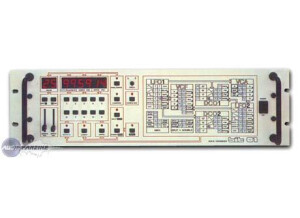
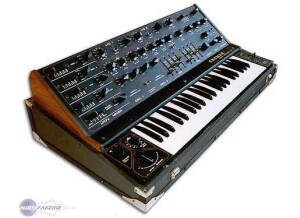
    First of all this is one of the machines I'd delved deeply into. I paid 100 because this one was a rust bucket :-). I paid 400 for another that was an easier repair and sold it for over 1000 as I recall. These are a unique machine. The realistic MG-1 by moog is the most similar in basic architecture. But the ds-2 is better in many ways. (btw my web site has a detailed page on it for troubleshooting tips... and in my virtual studio tour a sound sample of it with my modified glide that extends it to 9 second sweeps or so) The original Digital controlled oscillator (allegedly) synth was the DS-1 also from earlier 1978. It lacked the poly organ section which is totally separate from the rest of the synth until it is mixed into the vcf and vca section. It also uses the same oscillator design though as all three in the DS-2 and two in the DS-1 (of which a tiny number..maybe 150 were produced..whereas a few thousand I believe of DS-2 exist). These oscillators are based around the 74LS221 multivibrator chip. ANALOG CONTROL (not digital) charges the timing capacitor for the chip. Hence it's really an ACDO I suppose we could say. THe output is digital. The control is analog for perfectly smooth bender operation. THe glide however is actually a 12bit number being incremented and decremented through a DAC which then has the glide pot in series with it's output... and this current drives a discrete clock circuit that outputs the stepping clock for the counter....and the value is constantly being compared to the target value by a bit comparator. So that when it reaches target the inc. or dec. process stops. In this way it emulates what a typical portamento circuit does in a fully analog synth. No shortcuts in this beast! Analog circuits only in the signal path once tones are generated. THe waveforms themselves however are not generated using analog converters like in most DCO synths (eg. Roland JX, or Siel DK600 etc.) but rather octave dividers are employed and the outputs are proportioned to created digital approximations of Saw and Triangle waves. Hence the ringy overtones that add a charming chirpy sensation to bass sounds when filter is open :-). So there is no synthesizer quite like it. Real analog delays so S+H of the 2nd LFO for instance can be introduced. Spectacular with the resonance up. The glide time extension switch adds a 1M resistor in series w/ the 100K slider. I recommend replacing it with a 5M pot if you can find one like I did that fits that same hole. Way more useful since the 100K pot is virtually useless once you flip the 1M into series with it. Very simple mod. Well there's my first review on here of one of my favorite monosynths. I'm a big fan of the classics of course as well as octave cat, Yamaha CS units, SH5 if I could afford one and SH3a. The DS2 is the most unique of the entire field really.

  • moosers's review

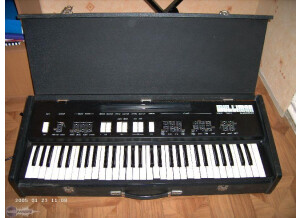
    The Crumar Orchestrator is a vintage analog synthesizer, designed to emulate the sound of strings and other orchestral instruments. This is a really simple synthesizer, but it’s got some really cool and interesting sounds and is very good at what it is able to do. The aim of the synth I guess was to give you the sound of a full orchestra right at your fingertips, as the five octave keyboard is split into two, making it possible to sound two different tones at once. It’s got ¼” outputs in the back, as well as a MIDI input and output. It’s also got a jack for a swell pedal, and is cased in a suitcase like casing, making it easy to hold, even though it’s pretty heavy… UTILIZATION The make up of the Crumar Orchestrator in terms of it’s parameters is somewhat limited compared to other synths, but it’s still possible to get a healthy amount of differing sounds here. The Orchestrator has sections for both the right and left hand, each with settings for piano, cello, violin, brass, and clavichord. It also has a filter with parameters for attack, decay, emphasis, and contour. It also has a vibrato and sustain section in addition to the master volume section. The manual would probably be hard to locate and isn’t really necessary anyway. SOUNDS While the Crumar Orchestrator doesn’t sound like a real orchestra, where it does end up is somewhere in between an analog synthesizer and orchestral instruments. This makes for some really cool synth emulations of acoustic instruments. My favorite settings on here would have to be the two different strings (violin and cello) and the brass, as these sound best in synthesizer form here in my opinion. The sounds on here are definitely not suitable as a replacement for these orchestral instruments, but rather could be used to fatten up these instrument or to be their own sort of sound. OVERALL OPINION I don’t know how easy or hard it would be to get a Crumar Orchestrator, but I haven’t seen too many of these around. The only one that I’ve used and seen is the one that we’ve got at the studio where I work. It kind of reminds me of the Moog Opus 3 in that it’s an analog synthesizer trying to mimic orchestral sounds. If you ever get the chance to mess around with the Orchestrator, I think you’ll have a lot of fun doing so…

  • « looking for one »

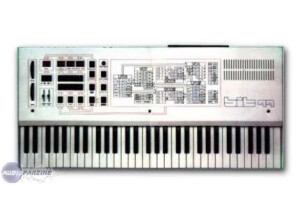
    The Bit99 from Crumar has some really good warm soft sounds. I don’t own this unit because it was too expensive but I know someone that has one and every time I get to use it , it makes me wish that I could afford to have one at my house. I don’t think its possible though because its not cheap and also the unit is a lot bigger than what I thought it was going to be. I just don’t have room for it here, I would have to store it in a closet or something and take it out when I wanted to use it, that is just too much of a hassle. But I will keep my eyes out for one just incase. You can make a very wide range of analog synths with the Bit 99. I have heard all types of sounds come out of it, nice and thick sounds. The keys seem to be semi weighted, which is pretty good, but I expected them to be a little heavier since it’s an expensive board. UTILIZATION Not easy to use, there will be a little learning curve and I hope you like messing with knobs. Because there are plenty of them on the Bit 99. Also the knobs will be worned down, because the unit is so old. Some of the buttons will be very easy to push in because they have been used so much over the years. So if you are looking to get one, keep that in mind and ask the buyer. SOUNDS The sounds and ability to get good sounds that you are trying to create is what makes this keyboard so great in my opinion. I really wasn’t concerned with anything else except the vintage sounding analog sounds. They did not let me down, every time I get to use this keyboard I am amazed on what I can come up with just by messing around. I am not a sound designer or engineer. I just like to mess around until I get something that really catches my ear. OVERALL OPINION I will be keeping my eye out for one of these.

  • « analog vintage »

    The Crumar Multiman S is like a hybrid , it is a analog synth and a sample library. All in one vintage style board, it has been around for a while now and people have been using it for many years. I still get a chance from time to time to get my hands on it and lay down some good melodies with all of the patches, some of the piano sound patches are really good, especially the brass. The brass is probably my favorite sounds that come on the Multiman S. UTILIZATION Its not exactly easy to use, but after you get the hang of the flow of the keyboard and get use to where everything on it is you will have no problems. If you are use to working with vintage gear then you will have no issues learning to use the Crumar Multiman S. I have never seen a manual for it, so im not sure how it is. But if someone still has the manual for it, then my hat goes off to them because most people wouldn’t still have a manual with a board this old. So if you purchase one, don’t expect to get a manual with it. SOUNDS The sounds are pretty good, like I said brass is my favorite. The brass patches sound unlike any other brass that I have heard on any piece of analog gear that I have used. It really is one of a kind brass and I have even sampled it and exported it in .wav format to use some of those patches when im on my computer at home. OVERALL OPINION Very good board, you will be thrilled if you can actually get our hands on one of them. They are hard to find because people just arent really selling them. I get to use a friends, I wish he would sell it to me.

  • FP User's review

    2 DCOs, 2 LFOs, 2 ADSRs, 1 VCF & 1 VCA per voice (6 voices) is quite good, but they don't sound good. It even features a lame unison effect! Price Paid: $150 USD UTILIZATION If you want to control i.e. the filter cutoff you'll have to enter cutoff's address number 18 and then you can use the up and down buttons to set the cutoff frequency. Easy? Nope, it takes too long to program. SOUNDS Soft and thin. IMO, it sounds like sh*te, but since there are casios around I'll give it 3/10 OVERALL OPINION It feels like it would break any time and it has done so for me. The fourth filter chip (Curtis) broke quite early and the sliders are noisy. No quality here! I would NEVER gig this piece without backup. I wouldn't gig it in the first place either. Why did I buy it? Out of cash and needed a new synth, but this is the worst piece of crap I've ever had. I do NOT recommend it. Originally posted on FutureProducers.com Posted by: Krunchie (January 0-, 2005)