Log in
EN
FR

Yamaha Analog Synths

25 products found

Filter
Sort by
Yamaha
Evaluation
  • Reviewed or not
  • Editor’s award
  • Reviewed by Audiofanzine
Availability
  • Available or not
  • Sold new or used
  • Sold new
  • Sold used
Must-have products
  • All products
  • Flagship products
  • Best rated products
  • Hot products
  • Popular products
Price
  • Freeware
€
Clear
Sort by
  • Popularity
  • User ratings
  • Price - low to high
  • Price - high to low
  • Used price, increasing
  • Used price, decreasing
  • Name (from A to Z)
  • Name (from Z to A)
  • Added on
Sort results
  • Popularity
  • User ratings
  • Price - low to high
  • Price - high to low
  • Used price, increasing
  • Used price, decreasing
  • Name (from A to Z)
  • Name (from Z to A)
  • Added on
Filter results 25 results found
Brands
Evaluation
Availability
Must-have products
Price
  • Freeware
Show results

The best Yamaha Analog Synths reviews

The reviews Audiofanzine members found the most helpful.
  • « Yamaha SK-20 Symphonic Ensemble »

    I purchased this keyboard at Coyal Music in Columbus,Ohio "way back" in 1980-81. At that time I needed a portable organ, and the market was small for organs by the very early 80's. I think it was around $1200 new,and I got it for around $950. What I like about it now, and what I LIKED ABOUT IT THEN ARE TWO DIFFERENT THINGS. Back then, I liked the slide switches that worked like foot bars on a Hammond Organ. It also had a pronged Leslie jack on the unit for use with an external Leslie Cabinet,{NOT included} At the time it seemed lightweight at around 30lbs. I liked the Keyboard, the actual keys seemed much sturdier than plastic keys on current Yamaha equiptment. It had a tremelo fast and slow button,as well as ensembe {a leslie simulation.} The slow and fast tremelo "reved",and sounded okay, and still sound different compared to todays sound. It also had seperate organ and polysynth outputs as well as a mixed output. Sustain and volume pedal inputs. 61 Key. A MANUAL POLY SYNTH SECTION AS WELL WITH SLIDERS. The horns and strings where really bad, but then again, this is 1980 equiptment. It only had 3 preset organs, and one manual organ. 2 strings, 3 horns, and a manual Polysynthisizer section. Still, it seemed like alot more back then! The construction is rock solid. The sides and front edge where "Rosewood", and the top was black paintet metal with gold graphics. The plastic keys where much heavier than the keys on CURRENT Yamaha KEYBOARDS. This keyboard by the way is all ANALOG...NOT DIGITAL! Output volume seems much higher than current stuff,and there are no built in speakers. The bottom line is this keyboard is obsoleate. Its built very,very well, but has hardly any sounds compared to todays stuff. It was hard to find portable organs at that time,as organ was not being used much like it was in the 60's and early 70's. Yet,at the same time, Farfisa and Vox organs where becoming hard to find. I keep this relic for sentimental reasons, and it looks great with the other keyboards. Besides, for what its worth, which is not much today,Id rather just keep it for collectability. It still works great, a little crackle in a few sliders, but hey, its 22 years old! I'll rate it by 1980 standards, and how much it cost. Remember, digital was not around yet, and MIDI was still a year or two away if I RECALL. This review was originally published on http://www.musicgearreview.com

  • « some sounds are thin »

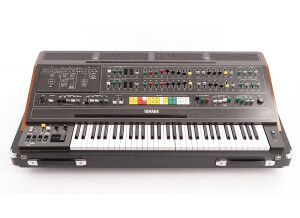
    This analog synth is arguably the best synth I've ever played in my life. More versatile than most synths of its ilk, it's got some of the richest tones that I've ever heard come out of an electronic instrument. It's an eight-voice polyphonic synthesizer with controllers for all effects, including pitch, modulation, sustain, vibrato, tremolo, and others. It originally didn't come with midi but some have been retrofitted to use MIDI. Since these are not made anymore, they're really expensive, and you're just as likely to find one with MIDI as without. The original synth was able to connect to other OB synths through the digital buss system that they developed. This technology also allows the synth to connect to drum machines and sequencers, though only with particular models which I have not come across. UTILIZATION The setup isn't too difficult, and the manual is clear enough on how to operate it. Since it's an older piece of gear, the technology isn't too complex, and most people should be able to figure it out. The editing and effects can take some time to be able to manipulate with ease, but with practice it becomes a more natural process. SOUNDS The sounds of the CS-15 are some of the most useful synth sounds I've ever used or seen used on recordings. They are known for replicating actual instrument sounds as much as creating their own warm, powerful, unique textures. They are particularly effective for adding huge low end to recordings, as well as providing other subtle textures. OVERALL OPINION I can honestly say it's the real deal. It's definitely way out of the price range of most people, but it's definitely up there with any Yamaha synthesizer in my opinion. I can't speak for all of them, but the few that I've heard are pretty comparable to this one. I've tried other synths but none compare in my opinion (except for the OB-4 and some of the other Yamaha's). I can't tell anybody to pay the ridiculous price that they are inevitably going to end up paying, but I will say that if you want one analog synth, save up and get this one. You'll be glad you did.